
Why Your BMI Lies If You Are Indian
If your Body Mass Index reads 24.5 and your fitness app says "normal", you might still be at high risk of diabetes, hypertension, and heart disease. The reason: the BMI chart you are using was developed for Caucasian Europeans in the 1830s by Belgian mathematician Adolphe Quetelet, and adopted globally by the WHO in the 1990s. It does not match the body composition of South Asians.
Indians, Pakistanis, Bangladeshis, and Sri Lankans share what researchers call the South Asian Phenotype: at any given BMI, we carry significantly more body fat (especially abdominal fat) and less muscle mass than Europeans of the same height and weight. A 2009 ICMR study published in the Journal of the Association of Physicians of India showed that Indian adults have 3-5% higher body fat than Caucasians at identical BMI values.
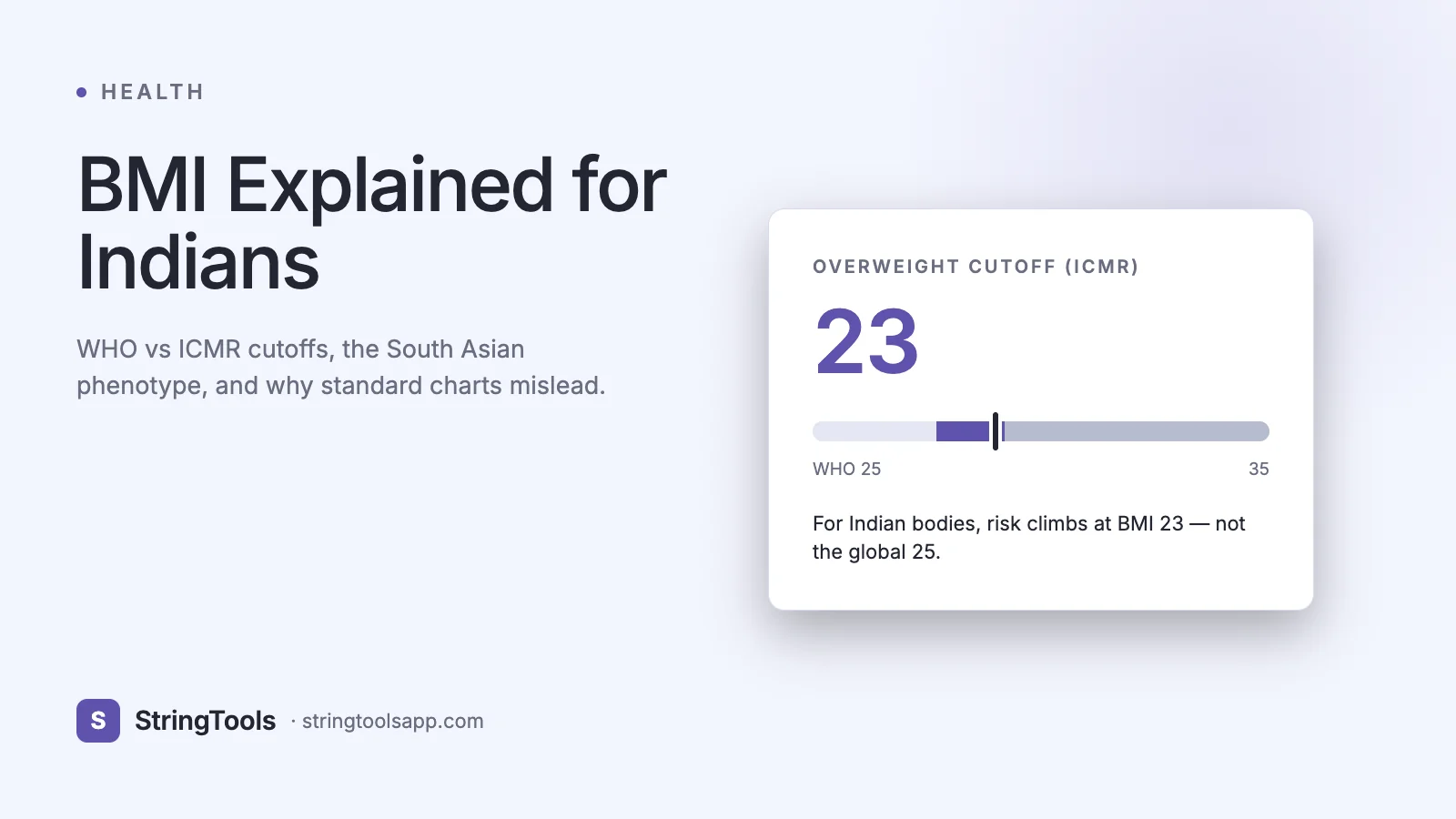
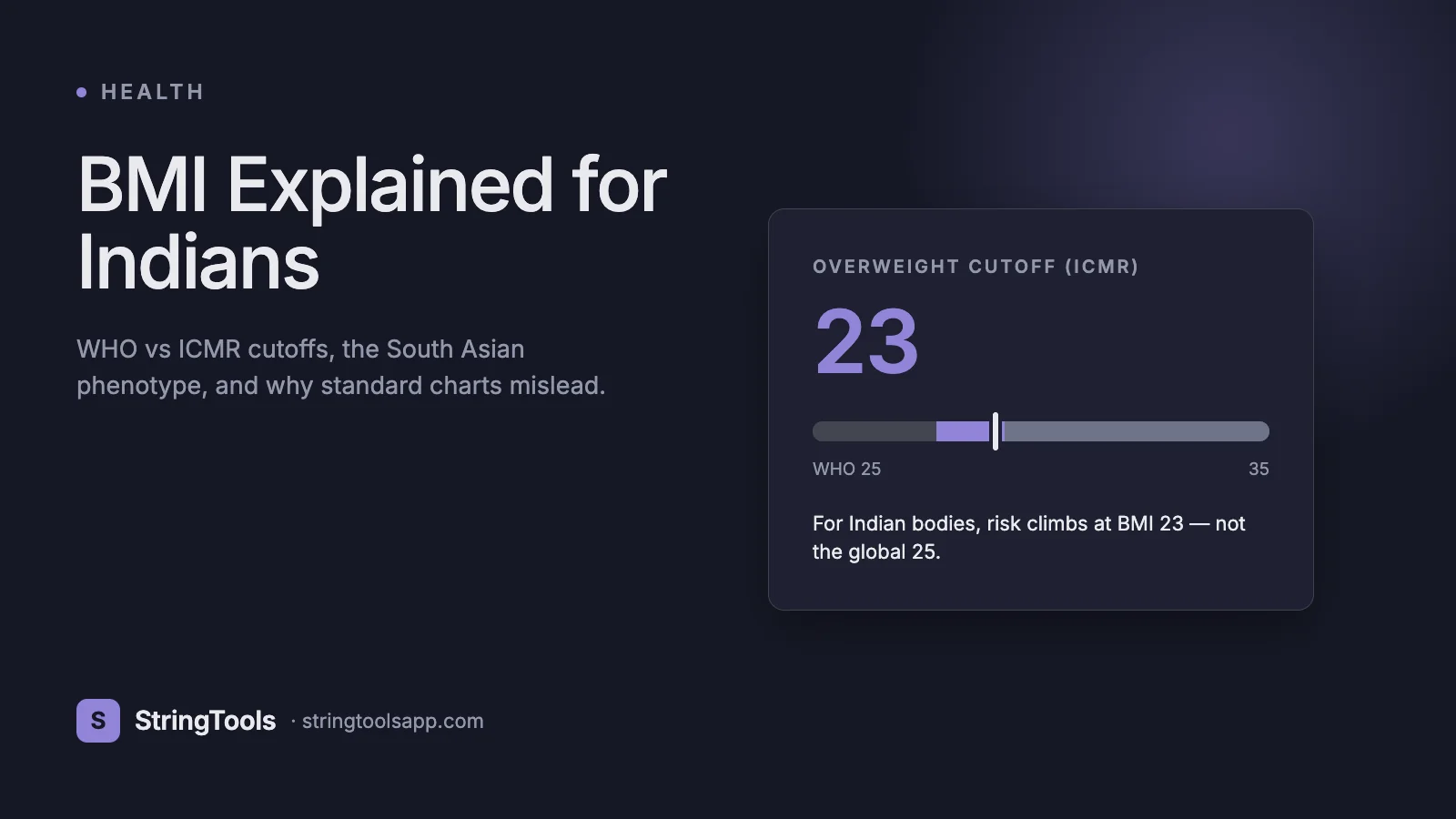
This is why the Indian Council of Medical Research and the Diabetes Foundation of India revised obesity cutoffs in 2009: overweight starts at BMI 23 (not 25), and obesity at 25 (not 30). Many Indians who are "normal" on global charts are actually overweight by Indian standards. This guide explains BMI properly, shows where it fails, and gives you the right metrics to track for an Indian body in 2026.
What Is BMI and Where It Came From
Body Mass Index is a number derived from a person's mass and height. The formula is:
BMI = weight (kg) / height (m) squared
For a 70 kg adult who is 1.70 m tall: BMI = 70 / (1.70 x 1.70) = 70 / 2.89 = 24.2.
Quetelet developed this in 1832 not as a health metric but to identify the "average man" for sociological studies. The term "Body Mass Index" was coined in 1972 by physiologist Ancel Keys. The WHO formally adopted BMI categories in 1995 as a screening tool for population-level obesity.
WHO BMI categories (international standard): Underweight: less than 18.5 Normal: 18.5 to 24.9 Overweight: 25 to 29.9 Obese Class I: 30 to 34.9 Obese Class II: 35 to 39.9 Obese Class III (severely obese): 40 and above
BMI is cheap, fast, and reasonably correlated with body fat in large populations. But it has well-known limits, and these limits are sharpest in non-European populations.
The South Asian Phenotype: Why Indians Are Different
Decades of clinical research have established that South Asians differ from Caucasians in three ways relevant to BMI.
More visceral fat. South Asian abdomens carry more deep visceral fat that wraps around internal organs and drives insulin resistance. A 2014 Lancet Diabetes Endocrinology study showed Indian visceral fat at BMI 23 equals Caucasian visceral fat at BMI 27.
Less muscle mass. South Asians have lower lean body mass at every BMI. A 70 kg Caucasian male might be 55 kg lean and 15 kg fat. A 70 kg Indian male of the same height is more typically 50 kg lean and 20 kg fat.
Earlier metabolic problems. Indians develop diabetes at lower BMIs (often 23-25) and at younger ages than Europeans (often 35-45 vs 55-65). India has 101 million diabetics as of the 2023 ICMR-INDIAB study, the world's second largest diabetic population.
This phenotype is partly genetic (FTO and PPARG variants common in South Asians) and partly developmental (low birth weight followed by rapid childhood weight gain — the "thin-fat" Indian baby syndrome described by Yajnik and others).
The practical implication: BMI 23 in an Indian carries roughly the same metabolic risk as BMI 25 in a European. Standard charts under-classify millions of Indians as healthy when they need intervention.
Indian (ICMR) BMI Cutoffs
In 2009, a consensus statement by the Indian Council of Medical Research, Diabetes Foundation of India, and Indian Heart Association proposed revised cutoffs for South Asians:
Underweight: less than 18.5 (same as WHO) Normal: 18.5 to 22.9 Overweight: 23 to 24.9 Obese: 25 and above
Additionally, the consensus recommends abdominal obesity thresholds based on waist circumference: Men: 90 cm or more (WHO threshold: 102 cm) Women: 80 cm or more (WHO threshold: 88 cm)
These numbers are now used by AIIMS, the Indian Diabetes Association, and most Indian medical guidelines including diabetes screening protocols. Insurance companies in India increasingly apply these cutoffs in underwriting health policies.
Comparison table: WHO vs ICMR for adults
Category | WHO BMI | ICMR BMI for Indians Normal | 18.5-24.9 | 18.5-22.9 Overweight | 25-29.9 | 23-24.9 Obese | 30 and above | 25 and above Abdominal obesity (men, waist) | 102 cm | 90 cm Abdominal obesity (women, waist) | 88 cm | 80 cm
The shift of 2 BMI points and 12-8 cm in waist circumference reclassifies roughly 25-30% of Indian adults from "normal" to "overweight" or higher. This is not a clerical change; it reflects real biology.
BMI Limitations: When BMI Is Just Wrong
BMI cannot tell muscle from fat. A bodybuilder weighing 95 kg at 1.80 m has a BMI of 29.3, classified as "overweight" or even "obese" by Indian standards, despite 8% body fat. Cricketers, weightlifters, and CrossFit athletes routinely fail BMI tests.
BMI ignores fat distribution. Two adults can have identical BMI 27. One carries weight evenly across hips and thighs (lower metabolic risk). The other carries it all in the belly (much higher risk for diabetes and heart disease). The waist circumference distinguishes them.
BMI does not adjust for age. Lean mass falls with age. A 70-year-old with BMI 22 may have lower muscle and higher fat than a 25-year-old with the same BMI. Geriatricians often relax cutoffs for elderly patients.
BMI is inaccurate for very tall and very short people. The squared-height denominator under-penalises tall people and over-penalises short ones. A 5-foot-2 person of "normal" weight may carry more fat than the BMI suggests.
BMI does not work for pregnant women. Pregnancy raises weight by 10-15 kg over 40 weeks. Use pre-pregnancy BMI for category, not current weight.
BMI is unreliable for children. Pediatric BMI uses age- and sex-specific percentiles from WHO or IAP (Indian Academy of Pediatrics) growth charts, not adult cutoffs. A child at 90th BMI percentile is overweight; at 97th percentile is obese.
Better Metrics: Waist, WHR, Body Fat
Waist circumference. The simplest upgrade over BMI. Measure at the level midway between the lowest rib and the iliac crest (top of hip bone), at end of normal exhalation. Indian cutoffs: men 90 cm, women 80 cm. Above these, abdominal obesity is diagnosed regardless of BMI.
Waist-to-hip ratio (WHR). Waist measurement divided by hip (broadest part of buttocks). Cutoffs for South Asians: men above 0.90, women above 0.85 indicate cardiovascular risk. WHO research links WHR to heart disease mortality more strongly than BMI.
Waist-to-height ratio. Waist (cm) divided by height (cm). Healthy: less than 0.5. "Keep your waist less than half your height" is a useful one-liner. Works across age, gender, and ethnicity.
Body fat percentage. Direct measurement via DEXA scan, bioimpedance scales, or skinfold calipers. Healthy ranges for Indians: Men: 10-20% (less than 25%) Women: 18-28% (less than 32%) These are 2-3% stricter than typical Caucasian ranges given the Indian phenotype.
Visceral fat rating. Some smart scales report a 1-30 scale. Below 10 is healthy; 10-14 is high; 15+ is very high. Visceral fat above 13 strongly predicts type 2 diabetes within 5 years for Indians.
Resting metabolic rate, HbA1c, fasting glucose, lipid profile, and blood pressure complement these. No single number tells the full story.
Real Use Cases for Indian BMI
Use case 1: Diabetes screening. The ICMR-INDIAB study recommends fasting glucose testing for any Indian above BMI 23 with one risk factor (family history, sedentary, abdominal obesity). At BMI 25 plus waist 90 cm in men or 80 cm in women, screening is mandatory.
Use case 2: Health insurance underwriting. Many Indian insurers (HDFC ERGO, ICICI Lombard, Max Bupa) load premiums by 10-25% above BMI 25 (Indian standard) and may decline at BMI 35. Tata AIA and Aditya Birla Health Insurance now use waist circumference in addition to BMI.
Use case 3: Surgical fitness. Anaesthesiologists use BMI to assess risk before elective surgery. BMI above 35 (severely obese) requires special consideration; airway management is harder and post-op complications more common.
Use case 4: Pregnancy weight gain. Indian gynaecologists use pre-pregnancy BMI to recommend total gestational weight gain: BMI under 18.5 should gain 12-18 kg, BMI 18.5-22.9 should gain 10-15 kg, BMI 23-24.9 should gain 7-11 kg, BMI 25 and above should gain 5-9 kg.
Use case 5: Pediatric obesity tracking. With childhood obesity rising — 14.4 million Indian children are obese as of 2024 — pediatricians track BMI percentiles at every well-child visit. School health programs in Maharashtra and Tamil Nadu have started annual BMI screening.
Use case 6: Athletic baseline. Elite Indian athletes get DEXA scans and skinfold measurements rather than relying on BMI. Cricket Board (BCCI) and SAI both use body fat percentage in selection.
Step-by-Step: Calculate Your BMI Right
Step 1: Measure your weight in kilograms. Use a calibrated scale, in the morning after using the toilet, before breakfast, in light clothing. Record to one decimal.
Step 2: Measure your height in metres. Stand barefoot against a wall, heels and head touching the wall, looking straight ahead. Mark the highest point on your head. Measure to the floor with a tape. A common error is over-reading by 1-2 cm.
Step 3: Compute BMI = weight in kg divided by (height in metres squared). Example: 68 kg, 1.65 m. BMI = 68 / (1.65 x 1.65) = 68 / 2.7225 = 24.98.
Step 4: Apply Indian (ICMR) cutoffs, not WHO. The 24.98 above is overweight by Indian standards (Class: 23-24.9 overweight, just under obese threshold of 25).
Step 5: Measure waist circumference. Stand relaxed, breathe out, place tape midway between rib and hip bone. Do not suck in. Read in centimetres.
Step 6: Interpret combined risk. If BMI is in normal Indian range (18.5-22.9) and waist is below the threshold, you are at low risk. If either crosses the threshold, you are at moderate or high risk. If both cross, take action seriously.
Step 7: For deeper assessment, get a body composition analysis. Many gyms and clinics in Mumbai, Delhi, Bengaluru, and Chennai offer InBody or DEXA scans for Rs 500-3,000.
Common Mistakes and Best Practices
Mistake 1: Using foot-and-inch height. Convert correctly. 5 feet 6 inches is not 1.66 m, it is 1.6764 m. Errors compound when squared.
Mistake 2: Weighing in heavy clothes or after meals. Add 1-2 kg of error easily. Always same conditions for tracking.
Mistake 3: Tracking BMI weekly. Weight fluctuates due to water and food in transit. Measure once every 2-4 weeks for trends.
Mistake 4: Comparing yourself to global celebrities or social media bodies. Different ethnicities, different genetics, different professional support. Your own trend matters more than the absolute number.
Mistake 5: Ignoring waist while obsessing over BMI. Waist circumference often catches metabolic risk that BMI misses entirely. Especially true for "thin-fat" Indians with normal BMI but high abdominal fat.
Mistake 6: Crash dieting to drop BMI. Quick weight loss is mostly water and muscle. Body fat percentage may rise even as BMI falls. Aim for 0.5-1 kg per week sustainable loss.
Best practice: Track BMI, waist circumference, and ideally body fat percentage every month. Combine with at least 150 minutes of moderate exercise per week, strength training twice weekly, an Indian diet emphasising whole grains, dal, vegetables, fruits, and limited refined carbs and sugar.
Healthy Weight Tips for Indians
Diet. Replace polished white rice and maida with whole grains: brown rice, jowar, bajra, ragi, oats. The traditional Indian thali is well-balanced when not deep-fried. Include 30-40 g protein per meal — dal, paneer, eggs, chicken, fish. Limit added sugar to less than 25 g per day. Restrict refined oils to 3-4 teaspoons daily. Tea and coffee count, often hidden sugar source.
Exercise. The Indian government's Fit India guidelines recommend 150 minutes of moderate aerobic activity per week (brisk walking, cycling, swimming) plus 2-3 days of strength training. For weight loss, 250-300 minutes per week shows better results.
Sleep. Less than 6 hours of sleep raises ghrelin (hunger hormone) and lowers leptin (satiety hormone). Indians average 6.5 hours per the All India Institute of Medical Sciences sleep study, below the 7-8 hour optimum.
Stress. Cortisol from chronic stress drives abdominal fat. Indian working professionals are particularly affected. Yoga (with documented Indian roots in BKS Iyengar and Patanjali traditions), meditation, and pranayama have measurable cortisol-lowering effects.
Water. Aim for 2.5-3 litres daily, more in summer. Drinking water before meals reduces calorie intake by 100-150 kcal on average.
Medical follow-up. After age 30, screen for diabetes, blood pressure, lipids, and thyroid annually. After 40, add liver function and electrocardiogram. Indians develop these conditions earlier than the global average.
Worked Example: Three Indians at BMI 24
Three friends, all Indian, all BMI 24. Are they equally healthy? No.
Ravi, 28, Bengaluru software engineer, height 1.75 m, weight 73.5 kg. Waist 95 cm. Sedentary 9 hours daily. Body fat estimate: 28%. By Indian cutoffs: BMI 24 is overweight, waist 95 cm crosses 90 cm. Combined high metabolic risk. Action: at least 30 minutes daily exercise, dietary calorie deficit of 300-500 kcal.
Meera, 32, Mumbai marathon runner, height 1.62 m, weight 63 kg. Waist 71 cm. Trains 40 km a week. Body fat estimate: 19%. By Indian cutoffs: BMI 24 is overweight, but waist below threshold and body fat low. Higher muscle mass elevates BMI. Low risk. Action: continue current regime; BMI not a concern given body composition.
Arjun, 45, Delhi business owner, height 1.70 m, weight 69.4 kg. Waist 92 cm. Walks 4,000 steps daily. Body fat estimate: 26%. Family history of diabetes. By Indian cutoffs: BMI 24 is overweight, waist 92 cm crosses 90 cm. With 45-year age and family history, very high risk. Action: HbA1c test, structured exercise, dietary review with a nutritionist, regular cardiology consultation.
Same BMI. Three completely different risk profiles. This is exactly why BMI alone is not enough.
Frequently Asked Questions
Q1. Is BMI 23 really overweight for an Indian? Yes per ICMR guidelines. At BMI 23, an Indian carries metabolic risk equivalent to a Caucasian at BMI 25. The risk is real, even if you feel fine.
Q2. I am muscular and BMI says I am overweight. Should I worry? Probably not. If your body fat percentage is in the healthy range and waist is below the threshold, BMI is misclassifying you. Use body composition measurements instead.
Q3. What BMI is healthy in pregnancy? Use pre-pregnancy BMI to set gain targets. Current BMI during pregnancy is not interpretable. Discuss with your obstetrician.
Q4. Does BMI work for kids in India? No, use IAP or WHO growth charts with age- and sex-specific BMI percentiles. The 5th to 85th percentile is healthy; above 85th is overweight; above 95th is obese.
Q5. How often should I check BMI? Monthly is enough. Daily fluctuates too much. Weight, waist, and ideally body fat once a month gives reliable trends.
Q6. Can I lose 1 BMI point in a month? For a 1.70 m adult, 1 BMI point is about 2.9 kg. A 0.5-1 kg per week loss is sustainable, so 2-4 kg per month is realistic. Faster loss is mostly water and muscle.
Q7. What is the ideal BMI for senior Indians? Geriatric studies suggest BMI 22-26 has lowest mortality in those over 65 (the obesity paradox). Slightly higher BMI may be protective in old age, but with normal waist circumference.
Q8. Should I trust the BMI my smart scale gives? The BMI is fine — it is just a formula. The body fat estimate from bioimpedance scales has 3-5% margin of error. Treat it as a trend indicator, not absolute truth.
Q9. Are Indian BMI cutoffs accepted internationally? The WHO acknowledges that Asian populations need lower cutoffs in its Asia-Pacific guidelines. ICMR cutoffs are the operational standard in Indian medical practice and align with these.
Conclusion: Use BMI, But Use It Right
BMI is a quick and useful screen, not a diagnosis. For an Indian body, the standard WHO chart routinely understates risk. Use ICMR cutoffs (overweight at 23, obese at 25) and pair BMI with waist circumference (men 90 cm, women 80 cm) for a far more accurate picture of metabolic health.
Use our BMI calculator at https://stringtoolsapp.com/bmi-calculator to instantly compute your BMI with both WHO and Indian ICMR interpretations side by side. It also highlights category, ideal weight range, and offers waist circumference logging so you can track all the right numbers in one place.
For a complete personal data dashboard, also try /age-calculator to track health milestones, /emi-calculator to plan medical insurance budgets, and our developer reads at /blog/api-security-best-practices and /blog/jwt-tokens-explained if you build health-tech products. Your body deserves metrics built for it — not a 19th-century European average.