
A Tale of Two API Styles
Every backend engineer has lived this scenario: the mobile team needs a user’s profile, their last five posts, and each post’s comment count on a single screen. Your REST API exposes /users/:id, /users/:id/posts, and /posts/:id/comments. Suddenly one screen fires eleven network requests, the designer is furious, and someone on Slack types the words "let’s just use GraphQL."
REST, formalized by Roy Fielding’s 2000 dissertation, has powered the web for over two decades. GraphQL, built at Facebook in 2012 and open-sourced in 2015, was designed to solve exactly the waterfall problem above. In 2026, both are thriving — Stripe, Twilio, and GitHub v3 stand behind REST, while GitHub v4, Shopify, Netflix Studio, and Airbnb lean heavily on GraphQL.
This guide compares the two approaches across schema design, performance, caching, versioning, tooling, real-time support, and security. By the end you’ll know exactly which style fits your next service — and when a hybrid of both is the correct answer.
What Is REST?
REST (Representational State Transfer) is an architectural style, not a protocol. It treats every piece of data as a resource identified by a URL, uses HTTP verbs (GET, POST, PUT, PATCH, DELETE) as the uniform interface, and relies on status codes (200, 201, 400, 401, 404, 500) to communicate outcome.
A canonical REST call looks like this:
GET /api/v1/users/42 HTTP/1.1 Host: api.example.com Accept: application/json
HTTP/1.1 200 OK Content-Type: application/json
{ "id": 42, "name": "Ada Lovelace", "email": "ada@example.com" }
Most modern REST APIs pair with OpenAPI 3.1 (formerly Swagger) for schema documentation, and they follow conventions like pagination via ?page=2&limit=20, filtering via ?status=active, and hypermedia links (HATEOAS) for discoverability. REST is stateless, cache-friendly over HTTP, and understood by every proxy, CDN, and load balancer on earth.
What Is GraphQL?
GraphQL is a query language and runtime for APIs. Instead of multiple resource URLs, the server exposes a single endpoint — typically POST /graphql — and clients send a query describing exactly the fields they need. The server responds with JSON shaped like the query.
A GraphQL schema is defined in SDL (Schema Definition Language):
type User { id: ID! name: String! email: String! posts(limit: Int = 10): [Post!]! }
type Post { id: ID! title: String! commentCount: Int! }
type Query { user(id: ID!): User }
A client then asks:
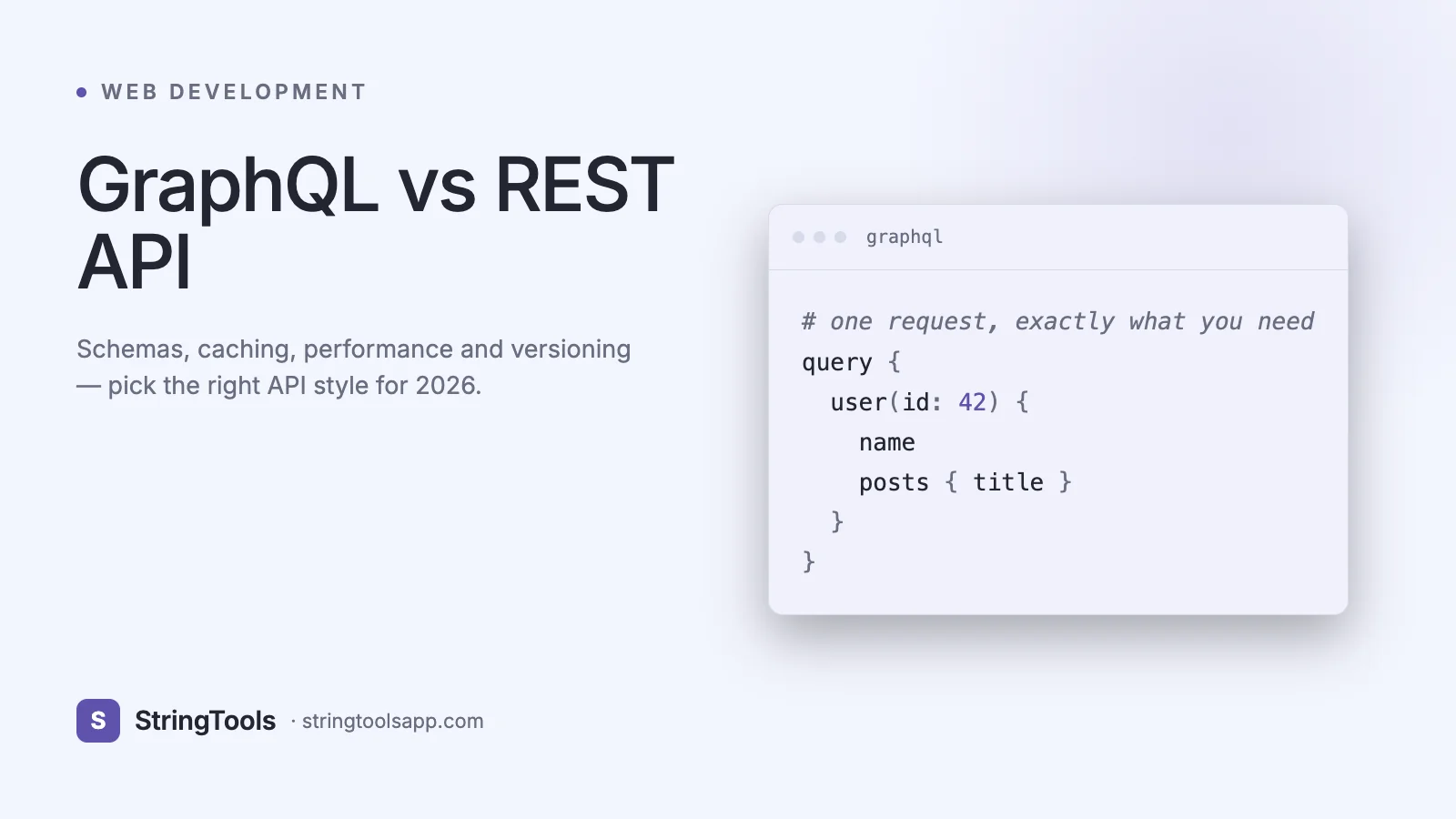
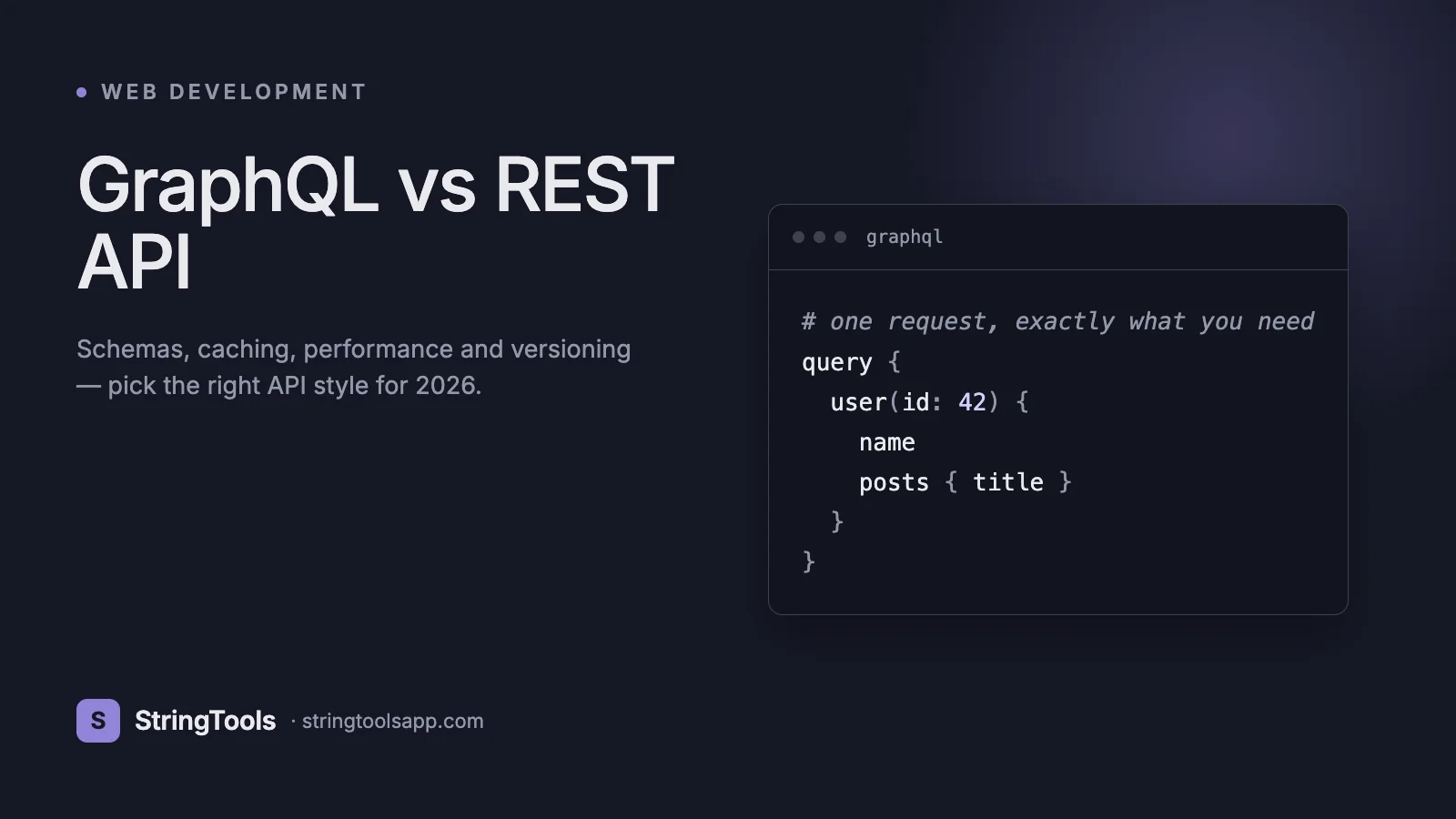
query { user(id: "42") { name posts(limit: 5) { title commentCount } } }
One request, one round-trip, exactly the fields required. Everything else — the email, the post body, the author’s avatar — is simply not fetched. Facebook built GraphQL in 2012 because their iOS app was buckling under REST waterfalls; the spec was open-sourced in 2015 and stewarded by the GraphQL Foundation today.
Side-by-Side: Fetching a User and Their Posts
Consider a profile screen that needs a user’s display name plus the titles of their five most recent posts. Here is the REST flow:
// Round trip 1 GET /users/42
// Round trip 2 (after response arrives) GET /users/42/posts?limit=5
Two sequential requests, two JSON payloads that include fields the client never renders (createdAt, updatedAt, bio, body, tags). On a 4G connection with 200ms latency, that’s 400ms just in round-trip time, plus wasted bandwidth.
The GraphQL equivalent:
POST /graphql { "query": "{ user(id:\"42\"){ name posts(limit:5){ title } } }" }
One request, 200ms, and the payload contains only name and title. This is the over-fetching and under-fetching problem REST commonly creates, and it’s the single biggest reason teams migrate. GraphQL also solves the N+1 waterfall on the client — though it can reintroduce N+1 on the server, which is why DataLoader (batched, cached field resolution) is practically mandatory in any production GraphQL stack.
Schemas, Typing, and Contracts
REST APIs are described — not defined — by OpenAPI 3.1. You write YAML or JSON that documents paths, methods, parameters, and response shapes. Tools like Stoplight, Redocly, and Prism generate docs and mock servers. But the schema is advisory; nothing forces the server to honor it unless you add runtime validators such as Ajv or express-openapi-validator.
GraphQL flips this. The SDL schema is the server. Every query is validated against it at parse time, every field has a type, and introspection (__schema) lets clients discover the whole API at runtime. Tools like GraphQL Code Generator turn the schema into fully typed TypeScript clients, eliminating an entire class of "the API changed and my app broke silently" bugs.
Schema Source — REST: OpenAPI (optional, external) • GraphQL: SDL (mandatory, executable) Type enforcement — REST: runtime validators you add • GraphQL: built into the runtime Client codegen — REST: openapi-typescript, orval • GraphQL: graphql-codegen (richer) Introspection — REST: not standard • GraphQL: built in
Caching: HTTP vs Application Layer
HTTP caching is REST’s unfair advantage. GET requests are idempotent, URLs are stable cache keys, and every CDN on earth understands Cache-Control: max-age=60, ETag, and If-None-Match. Cloudflare, Fastly, and Varnish will cache a REST GET without any code on your part.
GraphQL complicates this. Every request is a POST to /graphql with a different body, so URL-based caches are useless out of the box. Instead, the ecosystem built application-layer caches: Apollo Client’s normalized in-memory cache, Relay’s store, urql’s Graphcache, and server-side solutions like Apollo Server’s response cache plugin. Persisted queries (a hash registered with the server) let you switch to GET with stable cache keys — GitHub, Shopify, and Facebook all use this pattern in production.
Rule of thumb: if your API is mostly public, read-heavy, and cached at the edge (think: content sites, product catalogs), REST’s HTTP cache is extraordinarily hard to beat. If your clients are authenticated SPAs with complex, nested, per-user data, a normalized GraphQL cache is often simpler than orchestrating dozens of REST cache keys.
Errors, Versioning, and Evolution
REST uses status codes: 400 for validation, 401 for auth, 403 for permission, 404 for missing, 409 for conflict, 422 for semantic errors, 500 for server faults. RFC 7807 (Problem Details) standardizes the body format.
GraphQL responds 200 OK almost always. Errors live in an errors array alongside data, and partial success is a first-class concept — a query can return five fields successfully and one as null with an accompanying error. This is powerful but forces you to inspect every response, not just the status code.
Versioning diverges too. REST traditionally versions in the URL (/v1/, /v2/) or in an Accept header (application/vnd.api+json; version=2). GraphQL strongly discourages versioning. Instead you add new fields freely, mark old ones with @deprecated(reason: "..."), and clients simply stop requesting them. GitHub’s GraphQL API has never had a v2 despite five years of evolution — that’s the model working as intended.
Real-Time: Polling, Webhooks, Subscriptions
Real-time is where GraphQL pulls ahead for many teams. REST has no built-in push mechanism; you poll (GET every 5 seconds — wasteful), use Server-Sent Events, open a WebSocket, or ship webhooks (server calls your URL when something changes).
GraphQL has subscriptions as a first-class schema concept:
type Subscription { messageAdded(channelId: ID!): Message! }
Clients subscribe over WebSocket (graphql-ws) or Server-Sent Events, and the server streams typed events using the same schema. This is how Apollo, Hasura, and Shopify power live order feeds and chat UIs.
For a fuller discussion of hardening any API surface, see our guide on /blog/api-security-best-practices, which applies equally to both styles.
Tooling, DX, and the Ecosystem in 2026
REST tooling is mature and ubiquitous: Postman, Insomnia, Bruno, Hoppscotch, Paw, and our own /api-client tool let you hit endpoints in seconds. OpenAPI generators (openapi-generator-cli) scaffold clients in 40+ languages. Rate limiting, observability (OpenTelemetry), and logging are trivially standard.
GraphQL tooling is newer but best-in-class: GraphiQL and Apollo Studio Explorer give you schema-aware autocomplete in the browser, GraphQL Code Generator emits typed hooks for React Query / Apollo / URQL, and Hasura / PostGraphile / Supabase can auto-generate a full GraphQL API from a Postgres schema. On the server, Apollo Server 5, Yoga, Mercurius (Fastify), and Strawberry (Python) are all production-grade.
Editor — REST: Postman / /api-client • GraphQL: Apollo Studio, GraphiQL Codegen — REST: openapi-typescript • GraphQL: graphql-codegen Auto-API from DB — REST: PostgREST • GraphQL: Hasura, PostGraphile Mocking — REST: Prism, MSW • GraphQL: Apollo mocks, MSW
When to Use REST
Choose REST when: you’re building a public, cacheable, read-heavy API (news, product catalogs, public datasets); your consumers are diverse (curl scripts, legacy systems, partners with no GraphQL experience); your resources map naturally to CRUD; file uploads and downloads are central (REST handles multipart and range requests natively); you want rock-solid HTTP-level caching and observability; or you’re shipping a simple microservice with fewer than a dozen endpoints where GraphQL’s overhead isn’t worth it. Stripe, Twilio, and AWS APIs all remain REST for exactly these reasons.
When to Use GraphQL
Choose GraphQL when: you have multiple clients (iOS, Android, web, TV, watch) that each need different slices of the same data; your UI is deeply nested and REST waterfalls are hurting performance; you want a strongly typed contract with automatic client codegen; you’re aggregating data from multiple microservices or databases (GraphQL federation with Apollo Router or GraphQL Mesh shines here); or you need subscriptions for real-time features. GitHub, Shopify, Netflix Studio, Airbnb, and The New York Times all run GraphQL for these reasons. Hybrid is common too — expose REST for public webhooks and GraphQL for your own apps.
Head-to-Head Comparison Table
Year introduced — REST: 2000 (Fielding) • GraphQL: 2015 (Facebook OSS) Endpoints — REST: many resource URLs • GraphQL: single /graphql Transport — REST: HTTP verbs • GraphQL: usually POST Payload control — REST: server-decided • GraphQL: client-decided Over-fetching — REST: common • GraphQL: eliminated Under-fetching — REST: common • GraphQL: eliminated Schema — REST: OpenAPI (optional) • GraphQL: SDL (required) Typing — REST: advisory • GraphQL: enforced Caching — REST: HTTP / CDN • GraphQL: client cache / persisted queries Versioning — REST: URL or header • GraphQL: continuous evolution, @deprecated Errors — REST: HTTP status codes • GraphQL: errors array, 200 OK Real-time — REST: SSE / WebSocket / polling • GraphQL: subscriptions File upload — REST: native multipart • GraphQL: multipart spec (awkward) Learning curve — REST: low • GraphQL: medium Server complexity — REST: low • GraphQL: higher (N+1, DataLoader) Best fit — REST: public, cacheable APIs • GraphQL: rich clients, aggregated data
Common Mistakes on Both Sides
REST pitfalls: inconsistent naming (/getUser vs /users), missing pagination on list endpoints, returning 200 with an error body (breaks every HTTP library), leaking internal IDs as public URLs, and not versioning at all so any breaking change takes down clients.
GraphQL pitfalls: the N+1 resolver problem (always use DataLoader), shipping an unprotected schema where clients can request 1000-level-deep queries (use depth limits and query cost analysis — graphql-depth-limit, graphql-cost-analysis), exposing internal mutations that should have been server-only, forgetting that errors return 200 OK and breaking alerting, and treating GraphQL as a database query language (it is an API — apply authorization per field).
Frequently Asked Questions
Is GraphQL faster than REST? Not inherently. A well-designed REST endpoint that returns exactly the data a screen needs will match any GraphQL query. GraphQL wins when the alternative is multiple REST round-trips or large over-fetched payloads; it loses to a hand-tuned, HTTP-cached REST endpoint on pure throughput.
Can I use both in the same backend? Absolutely, and many teams do. Expose REST for public webhooks, partners, and file I/O; expose GraphQL for your own web and mobile apps. Share the same service layer underneath so business logic isn’t duplicated.
Does GraphQL replace my database? No. GraphQL is an API layer. Behind it you still query Postgres, MongoDB, Redis, or other services. Tools like Hasura and PostGraphile automate the mapping, but they’re still translating to SQL.
How do I secure a GraphQL API? Use query depth limits, query cost analysis, persisted queries in production, per-field authorization (not just per-resolver), rate limiting by operation name and client ID, and disable introspection in production if your schema is not public.
What about gRPC and tRPC? gRPC shines for internal service-to-service calls with Protocol Buffers and HTTP/2 streaming. tRPC is excellent for TypeScript monorepos where the client and server share types directly. Neither replaces a public-facing API; they complement REST and GraphQL.
Is REST dead? Far from it. The vast majority of public APIs in 2026 are still REST. It’s simple, universal, and cache-friendly. GraphQL is a specialist tool, not a replacement.
How large is the GraphQL learning curve? A week to be productive, a month to understand DataLoader and N+1, a quarter to master federation and performance tuning. Most teams underestimate the operational cost.
Can I test GraphQL with curl? Yes: curl -X POST -H 'Content-Type: application/json' -d '{"query":"{ me { name } }"}' https://api.example.com/graphql. But tools like /api-client or GraphiQL give you autocomplete and are far more pleasant.
Conclusion: Pick the Right Tool, Not the Trendy One
REST and GraphQL are not competitors so much as complementary tools for different problems. REST excels at public, cacheable, resource-oriented APIs where HTTP semantics and CDN caching do most of the work. GraphQL excels at rich, multi-client applications where flexible, typed, single-round-trip queries save weeks of frontend work.
The best teams in 2026 aren’t picking one tribe — they’re picking the right tool per service. A Shopify merchant hits REST webhooks and a GraphQL Admin API in the same integration. That pragmatism is the lesson.
Ready to try both? Open our /api-client to hit REST or GraphQL endpoints with syntax highlighting, saved requests, and environment variables — no install required.