
Why GST Still Confuses Smart Business Owners
Eight years after India rolled out the Goods and Services Tax on 1 July 2017, GST remains the single biggest source of compliance headache for SMEs, freelancers, and even seasoned chartered accountants. A 2025 survey by FICCI found that 62% of Indian MSMEs still misclassify at least one invoice every quarter, and the average GST notice cites errors worth Rs 1.4 lakh per business per year.
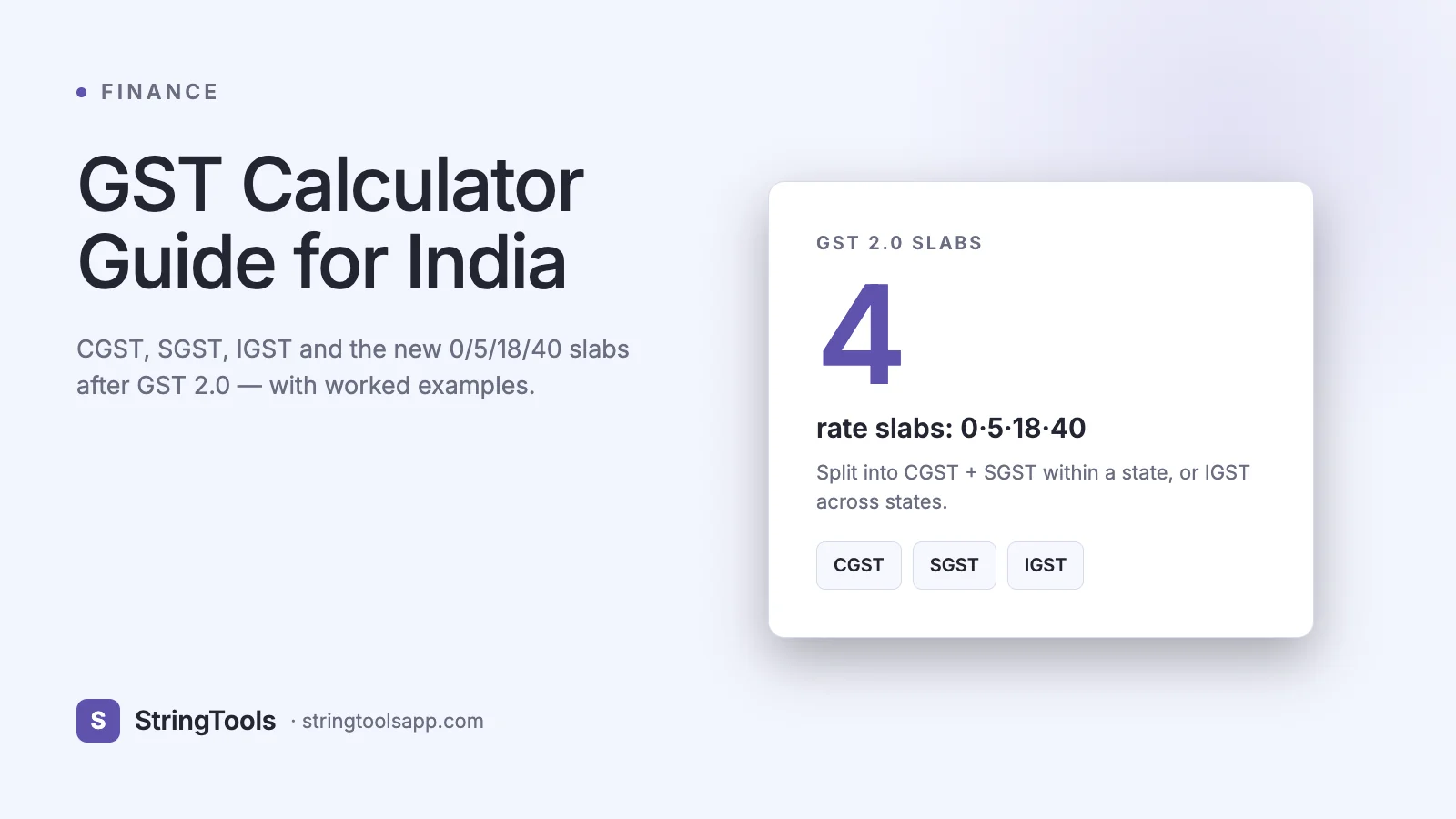
The confusion is not because GST is complicated in theory. It is because GST has many moving parts: four sub-taxes (CGST, SGST, UTGST, IGST), a slab structure simplified by the GST 2.0 reform of 22 September 2025 (nil, 5%, 18%, and 40%, plus special rates of 3% and 0.25%), state-specific rules, evolving e-invoicing thresholds, and a place-of-supply doctrine that treats a Mumbai-to-Delhi sale very differently from a Mumbai-to-Pune sale.
This guide walks you through every concept a business owner, accountant, or freelancer needs in 2025-26. We use real INR examples, the latest CBIC notifications, and clear formulas you can plug into any GST calculator. By the end you will know exactly which tax to charge, when to register, how to claim input tax credit, and which mistakes most commonly trigger department notices.
What Is GST? A One-Tax-Many-Layers Story
GST is a destination-based, value-added consumption tax that replaced 17 indirect taxes including VAT, service tax, central excise, octroi, and luxury tax. The single biggest reform since 1947, it converted 29 states and 7 union territories into one common market.
The key idea: tax is collected at every stage of the supply chain, but each business gets credit for tax already paid on inputs. Only the final consumer bears the full GST burden. If a manufacturer sells goods worth Rs 1,000 plus 18% GST to a wholesaler, the wholesaler pays Rs 1,180 but later claims Rs 180 as Input Tax Credit (ITC) when reselling to the retailer.
GST has four components depending on where supply happens. CGST goes to the central government, SGST to the state government, UTGST to union territories without legislatures (Andaman, Chandigarh, Dadra), and IGST applies to inter-state supplies and imports. The total rate stays the same; only the recipient changes.
The Four Types of GST and How They Split
Every transaction routes tax through exactly one of four channels. Misrouting is the single most common error in GSTR-3B.
CGST plus SGST applies to intra-state supplies (buyer and seller in the same state). An 18% sale becomes 9% CGST plus 9% SGST. A Bangalore Karnataka shop selling to a Mysore Karnataka customer charges Rs 90 CGST plus Rs 90 SGST on a Rs 1,000 base.
CGST plus UTGST applies when supply happens within a Union Territory without legislature. Same split logic: 9% plus 9% for an 18% rate.
IGST applies to inter-state supplies, exports (zero-rated), imports, and supplies to or from SEZs. A Mumbai Maharashtra seller invoicing a Chennai Tamil Nadu buyer charges 18% IGST on Rs 1,000, that is Rs 180. The central government later apportions this to the destination state.
The place-of-supply rules in Section 10-13 of the IGST Act decide which channel applies. For goods, it is usually where the goods are delivered. For services, it depends on the type, with separate rules for transport, telecom, online services, and immovable property.
GST 2.0 Slabs (2025 Reform) With Real Examples
GST in India does not have a single rate. Following the GST 2.0 rationalisation effective 22 September 2025, the Council simplified the structure to two main slabs plus a nil category and a top rate for luxury and sin goods, alongside unchanged special rates for precious metals and stones.
0% (Nil-rated): Fresh fruits, vegetables, milk, eggs, books, educational services, healthcare. A bag of atta from a kirana store has zero GST.
5%: Daily essentials and most mass-consumption goods — packaged staple foods, edible oils, tea, coffee, footwear and textiles below the notified threshold, many household items, and economy class air travel.
18%: The standard rate covering most goods and services — laptops, mobile phones, telecom, banking, IT services, soaps, toothpaste, and most electronics and appliances. The large majority of taxable transactions sit here.
40%: Luxury and sin goods — pan masala and tobacco, aerated and caffeinated drinks, high-end and luxury vehicles, yachts and aircraft, and betting or online gaming.
Special rates: 3% on gold, silver, and jewellery (a Rs 1,00,000 gold purchase attracts Rs 3,000 GST); 0.25% on rough or unworked diamonds and precious stones.
The earlier 12% and 28% slabs were withdrawn in GST 2.0. Most of their items were reassigned to 5% or 18% (for example, cement moved from 28% to 18%), while sin and luxury goods moved to the new 40% rate.
Worked example: A Pune cafe (intra-state) bills Rs 800 for food at 5% and Rs 200 for a packaged snack at 18%. Food at 5% adds Rs 40 (Rs 20 CGST plus Rs 20 SGST). The snack at 18% adds Rs 36 (Rs 18 plus Rs 18). The customer pays Rs 1,076 total.
Registration Thresholds: When You Must Get a GSTIN
You do not register for GST simply because you started a business. Threshold limits decide who must register.
For goods (most states): aggregate turnover of Rs 40 lakh in a financial year. Special category states (Manipur, Mizoram, Nagaland, Tripura) keep the lower Rs 10 lakh limit. Some states like Telangana, Puducherry retain Rs 20 lakh.
For services: Rs 20 lakh nationwide, Rs 10 lakh for special category states. This is critical for freelancers, consultants, content creators, and online sellers. A YouTuber earning Rs 22 lakh from AdSense must register, even if living in a small town.
Mandatory registration regardless of turnover applies to: inter-state suppliers of goods, e-commerce sellers (Amazon, Flipkart vendors), casual taxable persons, agents of suppliers, anyone liable under Reverse Charge Mechanism, and input service distributors.
Composition Scheme is an alternative for small businesses with turnover under Rs 1.5 crore (Rs 75 lakh in special states): pay a flat 1% (traders), 5% (restaurants), or 6% (other services) without claiming ITC. Simpler but cannot make inter-state supplies or sell on Amazon.
Input Tax Credit: The Heart of GST
ITC is what makes GST a value-added tax rather than a cascading sales tax. Every registered business can subtract the GST it paid on purchases from the GST it collects on sales, and remit only the difference.
Formula: Net GST payable = Output GST (on sales) minus Input GST (on purchases).
Example: A Surat textile trader buys fabric for Rs 5,00,000 plus 5% GST (Rs 25,000). He sells finished saris for Rs 8,00,000 plus 5% GST (Rs 40,000). His net cash outflow to the government is Rs 40,000 minus Rs 25,000 = Rs 15,000.
ITC conditions under Section 16 of the CGST Act: you must possess a valid tax invoice, have actually received the goods or services, the supplier must have filed his GSTR-1 (visible in your GSTR-2B), and you must have paid the supplier within 180 days. Missing any condition reverses your credit with 18% interest.
ITC is blocked under Section 17(5) for: motor vehicles (with carve-outs), food and beverages, club memberships, life and health insurance, works contract for buildings, and goods used for personal consumption. Many businesses lose lakhs claiming blocked credit then reversing during audit.
Reverse Charge Mechanism (RCM)
Normally the supplier collects GST from the buyer and deposits it. Under RCM, the buyer (recipient) pays GST directly to the government on behalf of the supplier. This protects revenue when the supplier is unregistered or in a sector prone to leakage.
RCM applies to specific notified supplies: legal services from advocates, GTA (Goods Transport Agency) at 5%, services from director to company, sponsorship, import of services, security services from non-corporate suppliers, and certain agricultural produce.
Worked example: A Mumbai company hires a freelance lawyer (unregistered) for Rs 1,00,000. Under RCM, the company itself self-invoices Rs 18,000 IGST or CGST plus SGST, pays it to the government, and then claims the same Rs 18,000 as ITC (subject to eligibility). Net effect is zero, but compliance is mandatory and missing it triggers penalties up to 100% of tax.
From October 2023 onwards, RCM also applies to commercial property rentals where landlord is unregistered. Many startups discovered this only during audit.
GST Returns: GSTR-1, GSTR-3B, and the Annual Return
Every registered taxpayer must file periodic returns. The big three are GSTR-1, GSTR-3B, and GSTR-9.
GSTR-1 is an outward supplies return. Due by the 11th of the next month for monthly filers, or quarterly under QRMP scheme for businesses with turnover under Rs 5 crore. It captures every invoice issued to B2B customers and aggregate B2C sales by rate.
GSTR-3B is the summary return where you actually pay tax. Due by the 20th of the next month (or 22nd/24th staggered for QRMP). It self-declares output tax, claims ITC, and pays the net cash liability through the electronic cash ledger.
GSTR-9 is the annual return summarising the year, due 31 December of the following financial year. Businesses above Rs 5 crore turnover also file GSTR-9C, a reconciliation statement audited by a CA.
Late fees: Rs 50 per day (Rs 20 for nil returns), capped at Rs 5,000 per return. Plus 18% interest on tax paid late. A two-month delay on a Rs 10 lakh liability costs roughly Rs 30,000 in interest alone.
E-Invoicing and HSN Code Rules
From 1 August 2023, e-invoicing is mandatory for businesses with aggregate annual turnover above Rs 5 crore in any year since 2017-18. The threshold has dropped progressively from Rs 500 crore (2020) to Rs 5 crore today and is rumoured to fall to Rs 1 crore by 2026.
E-invoicing means generating each B2B invoice on the Invoice Registration Portal (IRP), receiving a unique Invoice Reference Number (IRN) and a QR code, and only then issuing the invoice to the customer. Without IRN, the invoice is invalid for ITC.
HSN codes (Harmonized System of Nomenclature) classify goods. SAC codes do the same for services. Businesses with turnover under Rs 5 crore must mention 4-digit HSN; above Rs 5 crore must use 6-digit HSN. Wrong HSN can lead to rate mismatch, ITC denial, and 18% interest.
Quick mistakes to avoid: charging CGST plus SGST on inter-state supply (should be IGST), claiming ITC without GSTR-2B reflection, missing RCM on legal fees, applying composition rate while making inter-state sales, and forgetting to reverse ITC for invoices unpaid beyond 180 days.
Common GST Calculation Mistakes
After auditing hundreds of small business GST returns, the same five errors keep appearing.
First, computing GST on the inclusive amount as if it were exclusive. If a customer pays Rs 1,180 inclusive of 18%, the base is Rs 1,000 and tax is Rs 180. Many shopkeepers compute 18% on Rs 1,180 and over-pay Rs 32.40.
Second, splitting CGST/SGST wrong. The total GST rate divides equally; an 18% rate is 9% plus 9%, not 12% plus 6%.
Third, treating the supply location as the seller's location. GST follows destination. A Bengaluru SaaS company billing a Delhi client charges IGST 18%, not CGST plus SGST.
Fourth, applying GST on TCS or TDS components. GST is on the taxable value before any income-tax TDS deduction.
Fifth, missing the rounding rule. GST should be rounded to the nearest rupee at the invoice level under Section 170. Rounding each line item leads to mismatches with department systems.
A reliable GST calculator removes most of these. Always verify the place of supply, choose the correct slab, and confirm whether the entered amount is inclusive or exclusive.
Worked Example: A Freelancer's Quarterly GST
Priya is a Bengaluru UI designer registered under regular GST, turnover Rs 35 lakh per year. In Q2 FY 2025-26 she has the following:
Client A (Karnataka, Rs 4,00,000) intra-state, 18% GST. CGST 9% Rs 36,000 plus SGST 9% Rs 36,000 = Rs 72,000.
Client B (Delhi, Rs 5,00,000) inter-state, IGST 18% Rs 90,000.
Client C (USA, Rs 6,00,000) export of services, zero-rated. She files Letter of Undertaking and charges 0% but can still claim refund of input GST.
Input purchases: Software subscription Rs 60,000 plus 18% IGST Rs 10,800. Co-working rent Rs 90,000 plus 18% CGST plus SGST Rs 16,200. Laptop Rs 1,20,000 plus 18% CGST plus SGST Rs 21,600.
Total output GST: Rs 1,62,000. Total ITC: Rs 48,600. Net payable: Rs 1,13,400.
Split: After cross-utilisation rules (IGST credit can offset IGST first, then CGST, then SGST), Priya pays approximately Rs 19,800 cash for IGST, Rs 27,000 cash for CGST, and Rs 27,000 cash for SGST.
Frequently Asked Questions
Q1. Do I need GST registration for freelance work below Rs 20 lakh? No, unless you make any inter-state supply or sell through e-commerce. A Mumbai freelancer with Rs 8 lakh turnover serving only Maharashtra clients does not need to register.
Q2. Can I claim ITC on my office laptop? Yes, provided the laptop is used for business, the supplier filed GSTR-1, and your GSTR-2B reflects the credit. Personal-use portion must be reversed.
Q3. What is the GST on Google Ads or Facebook Ads from India? 18% under Reverse Charge Mechanism. The Indian buyer self-pays GST and claims it back as ITC.
Q4. Difference between zero-rated and nil-rated? Nil-rated supplies (fresh milk, books) attract 0% GST and you cannot claim ITC on inputs. Zero-rated supplies (exports, SEZ) also attract 0% but you can claim full ITC and seek refund.
Q5. Can I switch from regular to composition scheme? Yes, by filing CMP-02 before the start of a financial year. You lose the right to claim ITC and cannot make inter-state outward supplies.
Q6. How long must I retain GST records? 72 months (six years) from the due date of the annual return for that financial year, under Section 36 of the CGST Act.
Q7. What happens if my supplier does not pay GST to the government? Your ITC may be reversed. The 2024 amendment to Section 16(2)(c) makes this a serious risk. Always verify the supplier's compliance rating before doing repeat business.
Q8. Is there GST on UPI or bank transfers? No. GST applies to the underlying supply, not the payment method. A Rs 10,000 service paid by UPI still attracts the same GST as one paid by cheque.
Conclusion: Calculate With Confidence
GST in India is not going to get simpler in 2026-27. E-invoicing thresholds will keep dropping, AI-driven scrutiny is already flagging mismatches in real time, and the GST Council adds new notifications almost every meeting. The only sustainable strategy is automation plus understanding.
Use our GST calculator at https://stringtoolsapp.com/gst-calculator to instantly compute CGST, SGST, IGST, and total tax for any slab, with toggles for inclusive and exclusive pricing. It supports the current GST 2.0 slabs (0%, 5%, 18%, 40%, plus the 3% and 0.25% special rates), intra-state and inter-state modes, and gives you a clean breakup ready to paste into invoices.
For businesses building automated invoicing systems, also read our guides on /blog/api-security-best-practices to keep your GSTN API integrations safe, and /blog/jwt-tokens-explained to understand how the GST portal authenticates session tokens. Pair the right tools with the right knowledge and GST stops being a quarterly fire drill.