
The Rs 1 Lakh Mistake Most Salaried Indians Make
Every February, after the Union Budget, lakhs of Indian taxpayers spend a week in WhatsApp groups arguing whether the Old Tax Regime or the New Tax Regime saves more money. Most pick the wrong one. A 2025 study by an Indian payroll firm tracking 4.2 lakh employees found that 38% of switchers paid an extra Rs 80,000 to Rs 1.4 lakh in tax compared to the optimal choice for their salary structure.
The reason is not stupidity. It is that the answer genuinely depends on your salary level, your rent, your home loan, your investments, and even your city. Budget 2025 made the new regime extremely attractive by raising the Section 87A rebate ceiling to Rs 12 lakh of taxable income, but the old regime still wins for many high-deduction profiles.
This guide unpacks every slab, every deduction, and every break-even point for FY 2025-26 (AY 2026-27). We will compare both regimes at salary brackets of Rs 5L, Rs 10L, Rs 15L, Rs 20L, Rs 30L, and Rs 50L, then show you a quick rule of thumb you can apply in 30 seconds before filing your ITR-1 or ITR-2.
What Changed in Budget 2025
The Finance Act 2025 made the New Tax Regime the default and significantly more generous. Key changes effective for FY 2025-26:
New slabs: 0% up to Rs 4 lakh, 5% from Rs 4-8 lakh, 10% from Rs 8-12 lakh, 15% from Rs 12-16 lakh, 20% from Rs 16-20 lakh, 25% from Rs 20-24 lakh, and 30% above Rs 24 lakh.
Section 87A rebate raised so that taxable income up to Rs 12 lakh attracts zero net tax in the new regime. With the standard deduction of Rs 75,000, a salaried person earning up to Rs 12.75 lakh gross pays nothing.
Standard deduction in new regime stays at Rs 75,000 (was Rs 50,000 until FY 2023-24). Old regime continues at Rs 50,000.
The surcharge cap in the new regime stays at 25% (down from 37% in old regime for incomes above Rs 5 crore), making the new regime much more attractive for very high earners.
No change to Old Regime slabs: Rs 0-2.5 lakh nil, Rs 2.5-5 lakh at 5%, Rs 5-10 lakh at 20%, above Rs 10 lakh at 30%. Senior citizens (60-79) get Rs 3 lakh basic exemption; super seniors (80+) get Rs 5 lakh.
New Regime Slabs and Tax Calculation
The new regime is a clean, deduction-light structure designed for taxpayers who do not want to track 80C, HRA, and home loan paperwork.
FY 2025-26 slabs: Up to Rs 4,00,000 — 0% Rs 4,00,001 to Rs 8,00,000 — 5% Rs 8,00,001 to Rs 12,00,000 — 10% Rs 12,00,001 to Rs 16,00,000 — 15% Rs 16,00,001 to Rs 20,00,000 — 20% Rs 20,00,001 to Rs 24,00,000 — 25% Above Rs 24,00,000 — 30%
Worked example for taxable income of Rs 18 lakh in new regime: First Rs 4L: 0 Next Rs 4L (4-8): 5% = Rs 20,000 Next Rs 4L (8-12): 10% = Rs 40,000 Next Rs 4L (12-16): 15% = Rs 60,000 Next Rs 2L (16-18): 20% = Rs 40,000 Total income tax = Rs 1,60,000 Add 4% Health and Education Cess = Rs 6,400 Net tax = Rs 1,66,400
Under Section 87A, if taxable income is up to Rs 12 lakh, the rebate equals the tax liability, making net tax zero. So a salaried person with Rs 12.75 lakh gross (after Rs 75,000 standard deduction = Rs 12 lakh taxable) pays zero income tax. Above Rs 12 lakh there is a marginal relief mechanism so that someone earning slightly more does not face a cliff.
Old Regime Slabs and the Deductions Universe
Old regime keeps the same slabs since FY 2014-15: Rs 0-2.5L nil, Rs 2.5-5L at 5% (with Section 87A rebate making tax zero up to Rs 5L taxable), Rs 5-10L at 20%, above Rs 10L at 30%. Same 4% cess and surcharge structure.
But the old regime is built around deductions, and these can be substantial.
Section 80C: Rs 1.5 lakh combined cap covering EPF, PPF, ELSS mutual funds, life insurance premium, principal home loan repayment, kids' tuition fees, NSC, 5-year tax-saver FD, Sukanya Samriddhi.
Section 80CCD(1B): Additional Rs 50,000 for NPS Tier-1 contributions, over and above 80C.
Section 80D: Health insurance premiums. Rs 25,000 for self/spouse/kids, plus Rs 25,000 for parents (Rs 50,000 if parents are senior citizens). Maximum Rs 1 lakh.
HRA exemption: Least of (a) actual HRA received, (b) 50% of basic for metro / 40% for non-metro, (c) rent paid minus 10% of basic. Mumbai, Delhi, Kolkata, Chennai, Bengaluru, Hyderabad treated as metros.
Section 24(b): Home loan interest up to Rs 2 lakh on self-occupied property, unlimited on let-out (capped against house property income).
Section 80E: Education loan interest, full amount, for 8 years.
Standard deduction Rs 50,000, Section 80TTA Rs 10,000 on savings bank interest, Section 80G donations, LTA exemption, leave encashment exemption, gratuity exemption.
A fully optimised salaried employee can stack Rs 4-5 lakh of deductions easily.
Break-Even Analysis: Which Regime Wins at Each Salary
Below is a comparison at common salary brackets, assuming a salaried individual under 60 with a typical deduction profile in old regime: Rs 50K standard deduction, Rs 1.5L Section 80C, Rs 25K Section 80D, Rs 50K NPS, and HRA exemption of roughly Rs 1.5L for metro renters.
Gross Salary Rs 5,00,000: New regime tax: Rs 0 (after standard deduction Rs 75K and rebate) Old regime tax: Rs 0 (after deductions and 87A) Verdict: Tie.
Gross Salary Rs 10,00,000: New regime: Rs 0 (taxable Rs 9.25L, but rebate caps at Rs 12L taxable so zero tax) Old regime: Approx Rs 23,400 after deductions (taxable around Rs 4L after Rs 6L deductions) New regime wins by Rs 23K.
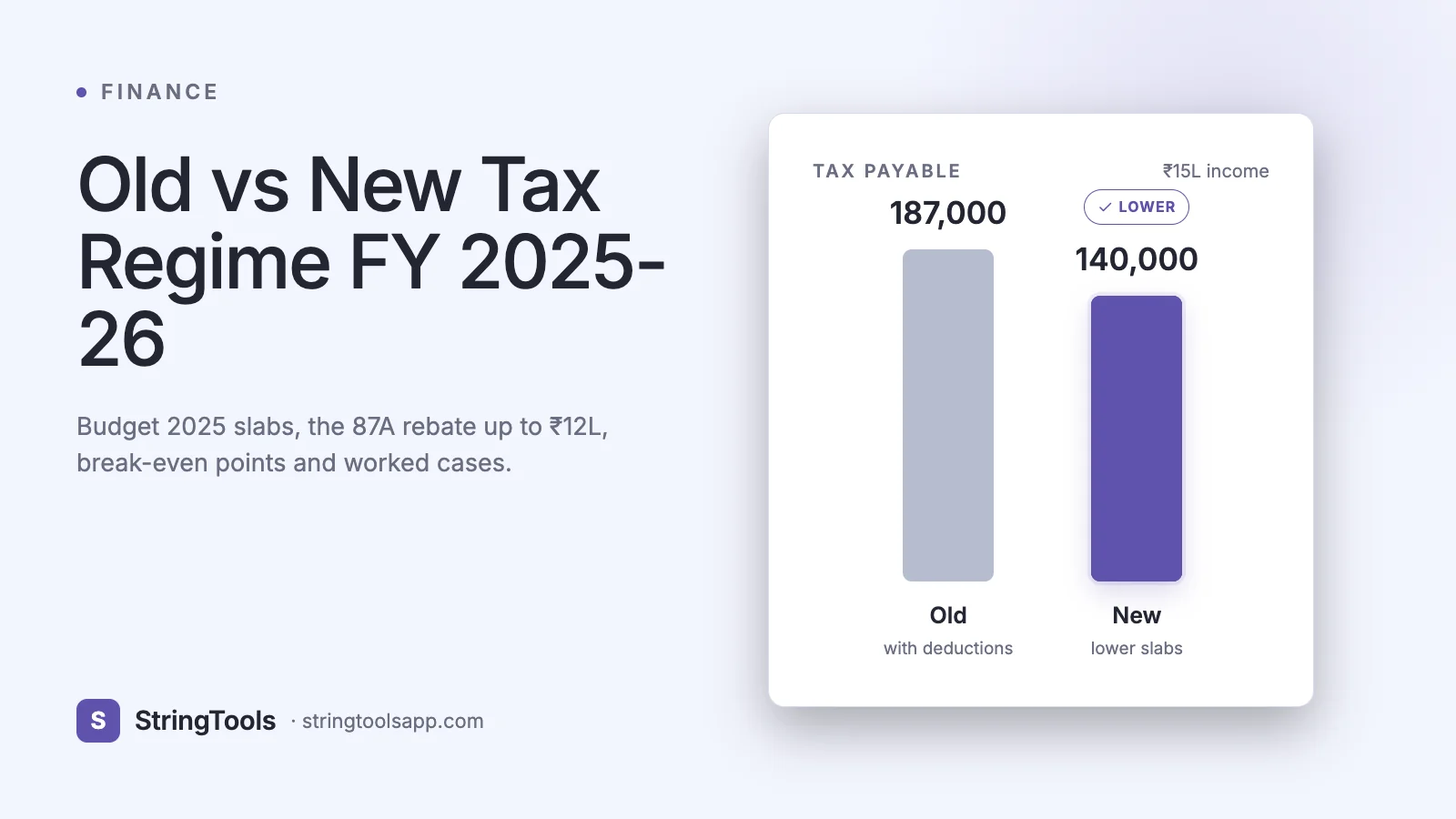
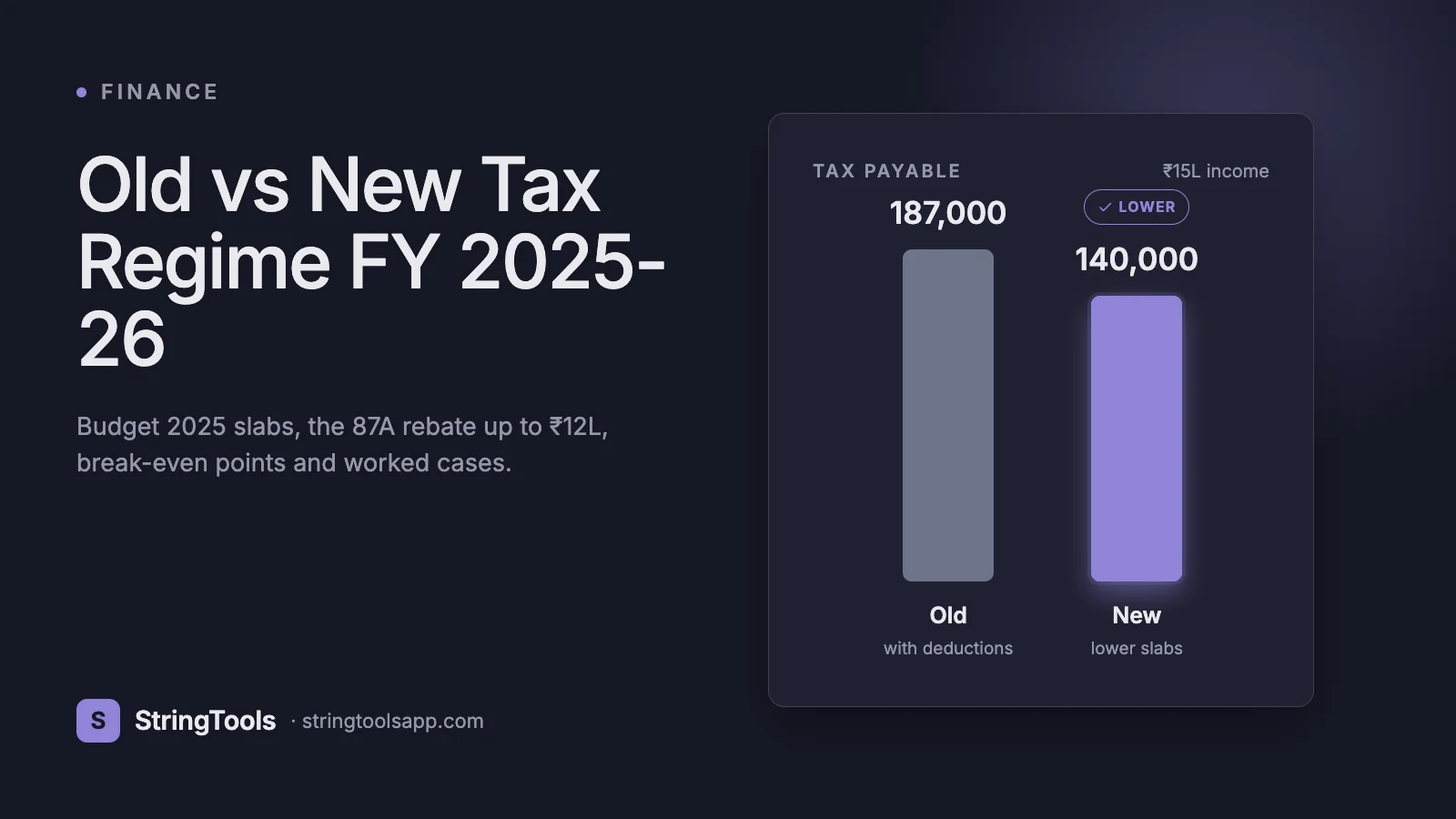
Gross Salary Rs 15,00,000: New regime: Rs 1,09,200 (taxable Rs 14.25L) Old regime: Approx Rs 1,17,000 (taxable around Rs 9L after deductions) New regime wins by Rs 8K.
Gross Salary Rs 20,00,000: New regime: Rs 2,08,000 Old regime: Approx Rs 2,15,000 Close tie; new regime narrowly wins for typical deductions, old regime wins if you have home loan plus full deductions.
Gross Salary Rs 30,00,000: New regime: Rs 4,99,200 Old regime with full Rs 6.5L deductions: Approx Rs 5,40,000 New regime wins by Rs 40K.
Gross Salary Rs 50,00,000: New regime: Rs 11,03,440 (with surcharge) Old regime: Approx Rs 12,50,000 New regime wins clearly.
The break-even rule: if your total deductions exceed Rs 8 lakh and you have a substantial home loan, old regime may still win. Otherwise new regime wins almost always at FY 2025-26 rates.
Real Use Cases by Profile
Profile 1: Software engineer, Rs 18 lakh CTC, lives with parents, no rent, no home loan. Almost no deductions beyond Rs 1.5L 80C and Rs 25K 80D. New regime saves around Rs 1.2 lakh per year vs old.
Profile 2: Mumbai marketing manager, Rs 25 lakh CTC, pays Rs 45,000 rent, has Rs 50L home loan with Rs 1.8L interest, full 80C, NPS, 80D. Total deductions Rs 7.5L. Old regime saves around Rs 50,000.
Profile 3: Bengaluru freelancer, Rs 22 lakh receipts, claims 50% presumptive under 44ADA, no home loan, modest investments. New regime is simpler and saves slightly more.
Profile 4: Senior citizen retiree, Rs 8 lakh interest income, no salary. Old regime gives basic exemption Rs 3 lakh and Section 80TTB Rs 50K bank interest deduction. Old regime wins.
Profile 5: Doctor, Rs 60 lakh income, two home loans, Rs 8 lakh deductions. Old regime wins by around Rs 80K despite higher slab rates, because deductions are capped 30% bracket savings.
Profile 6: Founder drawing Rs 5 crore salary. New regime surcharge cap of 25% versus old regime 37% saves around Rs 35 lakh at this level.
Step-by-Step Guide: How to Choose in 5 Minutes
Step 1: Add up your gross salary, perks, bonus, and any other income (interest, dividends, capital gains, rent received).
Step 2: List every deduction you actually claim. Be honest. Many people list theoretical 80C contributions they never make.
Step 3: Compute taxable income under new regime: Gross income minus Rs 75,000 standard deduction (only for salary income). No other deductions.
Step 4: Compute taxable income under old regime: Gross income minus Rs 50,000 standard deduction minus all Chapter VI-A deductions minus HRA exemption minus home loan interest under Section 24.
Step 5: Apply the respective slabs and add 4% cess. Apply Section 87A rebate if applicable (Rs 12L taxable threshold for new regime, Rs 5L for old).
Step 6: Pick the lower number. Keep in mind that salaried employees can switch between regimes every year. Business or professional income filers can switch only once back to old regime after opting out.
Step 7: Inform your employer through Form 12BB at the start of FY so TDS aligns with your chosen regime.
Common Mistakes That Cost Real Money
Mistake 1: Forgetting that the new regime denies almost all deductions, including HRA, LTA, home loan interest on self-occupied, and 80C. Some assume only 80C is denied and miscalculate.
Mistake 2: Not claiming Section 87A rebate. If your taxable income is Rs 11.95 lakh in new regime, your tax is zero, not Rs 90K. Many employers' TDS systems still default to deducting tax.
Mistake 3: Choosing old regime to claim Rs 1.5 lakh 80C when you have no other deductions. The Rs 30,000 saved at 20% slab is dwarfed by the Rs 60-80K loss from new regime's lower rates.
Mistake 4: Investing Rs 1.5 lakh in 5-year tax saver FD purely for 80C while in new regime — the deduction is lost and the FD is locked.
Mistake 5: Ignoring surcharge. Above Rs 50 lakh, surcharge starts at 10% and rises to 25% (new) or 37% (old). This swings the comparison significantly.
Mistake 6: Not factoring marginal relief. Just above Rs 12 lakh in new regime, marginal relief kicks in to limit tax to the excess over Rs 12 lakh, so don't panic about a cliff.
Mistake 7: Forgetting that NPS employer contribution under Section 80CCD(2) up to 14% of basic is allowed in new regime too. Salaried employees with strong corporate NPS get this benefit in both regimes.
Comparison Table: Old vs New at a Glance
Slabs: Old: 0-2.5L nil, 2.5-5L 5%, 5-10L 20%, 10L+ 30% New: 0-4L nil, 4-8L 5%, 8-12L 10%, 12-16L 15%, 16-20L 20%, 20-24L 25%, 24L+ 30%
Standard deduction: Old: Rs 50,000 New: Rs 75,000
Section 87A rebate: Old: up to Rs 5L taxable, max Rs 12,500 New: up to Rs 12L taxable, max Rs 60,000
80C investments: Old: Up to Rs 1.5L New: Not allowed
HRA exemption: Old: Allowed New: Not allowed
Home loan interest (self-occupied): Old: Up to Rs 2L New: Not allowed
80D health insurance: Old: Allowed New: Not allowed
NPS 80CCD(1B) Rs 50K: Old: Allowed New: Not allowed
NPS 80CCD(2) employer: Old: Allowed New: Allowed
Surcharge cap: Old: 37% above Rs 5 cr New: 25% above Rs 2 cr
Default for FY 2025-26: New regime (must opt out for old)
Worked Example: Rohan vs Sneha
Rohan, 32, Bengaluru, software engineer. Gross salary: Rs 22 lakh. Lives with parents, no rent, no home loan. Investments: Rs 1.5L PPF, Rs 25K health insurance, Rs 50K NPS.
Old regime: Gross 22L, less standard deduction 50K, less 80C 1.5L, less 80D 25K, less 80CCD(1B) 50K = Taxable Rs 19.25L. Tax: 0 + 12,500 + 1,00,000 + (19.25L - 10L) x 30% = 1,12,500 + 2,77,500 = Rs 3,90,000. Plus 4% cess Rs 15,600. Total Rs 4,05,600.
New regime: Gross 22L, less standard deduction 75K = Taxable Rs 21.25L. Tax: 0 + 20,000 (4-8) + 40,000 (8-12) + 60,000 (12-16) + 80,000 (16-20) + 31,250 (20-21.25) = Rs 2,31,250. Plus 4% cess Rs 9,250. Total Rs 2,40,500.
New regime saves Rohan Rs 1,65,100 per year. Clear winner.
Sneha, 38, Mumbai, banker. Gross salary: Rs 28 lakh. Pays Rs 60K rent, has Rs 80L home loan with Rs 2L interest deduction, Rs 1.5L 80C, Rs 1L 80D (parents senior), Rs 50K NPS, HRA exemption Rs 2.4L.
Old regime taxable: 28L - 50K - 2L (HRA) - 2.4L wait, simplified: 28L - 50K - 1.5L - 1L - 50K - 2L (home loan) - 2.4L HRA = approx Rs 18.1L. Tax approx Rs 3.55L plus cess = Rs 3,69,200.
New regime taxable: 28L - 75K = Rs 27.25L. Tax: 20K + 40K + 60K + 80K + 1L + 97,500 = Rs 3,97,500 plus cess = Rs 4,13,400.
Old regime saves Sneha Rs 44,200. The home loan plus HRA combination tips the balance.
Frequently Asked Questions
Q1. Can I switch regimes every year? Salaried individuals: yes, every year. Business and professional income filers: only once back to old regime after opting out.
Q2. Does NPS Tier-1 employer contribution count in new regime? Yes, Section 80CCD(2) up to 14% of basic salary is allowed in both regimes. This is a powerful lever for salaried employees.
Q3. What about capital gains? Long-term equity gains above Rs 1.25L taxed at 12.5%. Short-term equity at 20%. These rates apply identically in both regimes.
Q4. Are HRA and LTA blocked in new regime? Yes, both are blocked. So is Section 80TTA savings interest exemption.
Q5. I am a senior citizen with FD interest of Rs 7 lakh. Which regime? Old regime usually wins because Section 80TTB Rs 50,000 bank interest deduction plus higher Rs 3 lakh basic exemption work in your favour.
Q6. Can my employer deduct TDS based on the new regime by default? Yes, FY 2025-26 onwards new regime is the default. You must explicitly inform via Form 12BB if you want old regime.
Q7. Does Section 87A rebate apply to special-rate incomes? No. Long-term capital gains, lottery winnings, and other special-rate incomes do not qualify for 87A rebate, even if total income is below Rs 12 lakh.
Q8. What is marginal relief in new regime? If taxable income just exceeds Rs 12 lakh, the tax cannot exceed the income above Rs 12 lakh. So at Rs 12.10 lakh, tax is approximately Rs 10,000 instead of Rs 61,000.
Q9. Should I stop SIPs in ELSS if I switch to new regime? Not necessarily. ELSS still offers good equity returns with shorter 3-year lock-in than other tax savers. But you should evaluate purely on returns, not tax.
Conclusion: Run the Numbers in 60 Seconds
The right regime is not a matter of opinion. It is arithmetic. With FY 2025-26 changes, the new regime will be optimal for over 70% of salaried Indians, but a meaningful minority — those with home loans, full deductions, or senior citizen profiles — still save with old regime.
Do not guess. Use our income tax calculator at https://stringtoolsapp.com/income-tax-calculator to compare both regimes side by side for FY 2025-26 with your exact salary and deduction profile. It handles standard deduction, all Section 80 deductions, HRA, home loan interest, NPS, surcharge, cess, and Section 87A rebate including marginal relief — giving you a final number for each regime in seconds.
Also explore /gst-calculator if you have any business income, /emi-calculator if you are evaluating that home loan, and our deeper technical reads at /blog/api-security-best-practices and /blog/jwt-tokens-explained for developers building tax automation systems. Plan early in April, not in March, and keep more of your salary in your pocket.