
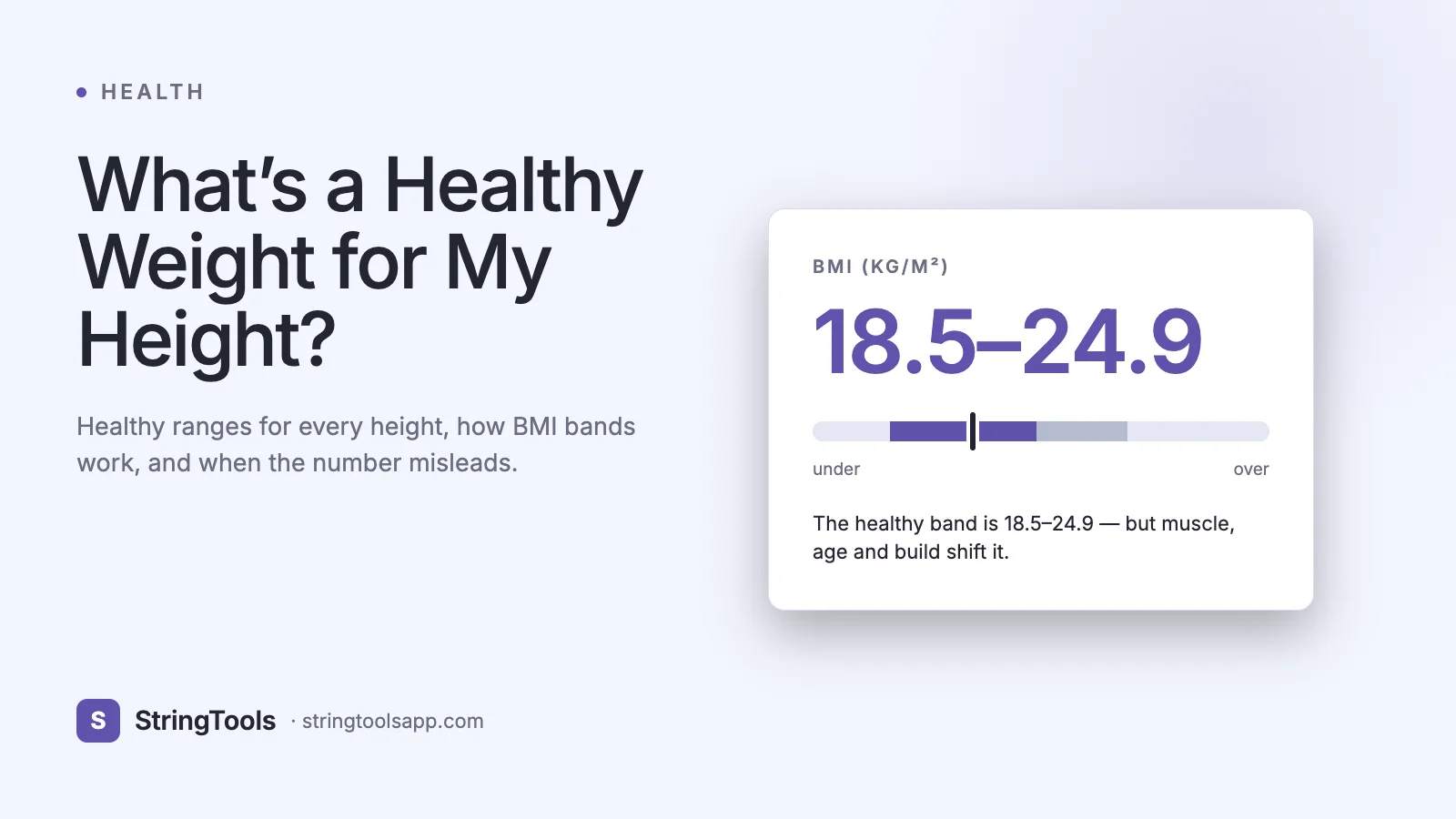
Quick answer: For adults, a "healthy weight" is conventionally the range that puts your BMI between 18.5 and 24.9 — for example, roughly 108–145 lb at 5'4" or 136–184 lb at 6'0" (full chart below). But that range is a screening guide, not a verdict: muscle mass, age, ethnicity, and — above all — where you carry fat change what's actually healthy for you. The most useful quick check pairs BMI with one tape measurement: keep your waist under half your height.
One Question, Two Honest Answers
"What should I weigh for my height?" is one of the most-searched health questions in the world, and it deserves two answers at once. The short answer is a number — the chart below gives it to you in pounds and kilograms for every height. The longer answer is that the number is only the beginning: two people at the same height and weight can have completely different health profiles, and some of the healthiest bodies technically sit "outside" the chart.
This guide gives you both answers properly. You'll get the standard healthy-weight ranges and the BMI math behind them, the cases where BMI genuinely misleads (athletes, older adults, and entire ethnic groups), the simple measurements that fill BMI's blind spots, and the evidence-backed reframe that matters more than any chart: how little weight change it takes to meaningfully improve health. You can check your own number as you read with our free BMI calculator.
The Healthy Weight Chart, by Height
These ranges correspond to the World Health Organization's healthy-BMI band of 18.5–24.9 for adults of all sexes. Find your height; the range is your conventional "healthy weight." (If you've been searching for an ideal weight calculator or a healthy weight calculator, this table is the exact math those tools run — our BMI calculator computes it for any height, not just the rows shown.)
| Height | Healthy range (lb) | Healthy range (kg) |
|---|---|---|
| 5'0" (152 cm) | 95–128 lb | 43–58 kg |
| 5'2" (157 cm) | 101–136 lb | 46–61 kg |
| 5'4" (163 cm) | 108–145 lb | 49–66 kg |
| 5'6" (168 cm) | 115–154 lb | 52–70 kg |
| 5'8" (173 cm) | 122–164 lb | 55–75 kg |
| 5'10" (178 cm) | 129–174 lb | 59–79 kg |
| 6'0" (183 cm) | 136–184 lb | 62–83 kg |
| 6'2" (188 cm) | 144–194 lb | 65–88 kg |
Ranges computed from BMI 18.5–24.9 and rounded to the nearest pound/kilogram. For heights in between, our BMI calculator interpolates exactly.
Before you anchor on your row: this chart is where the conversation starts. The next sections explain who should read their range higher, lower, or with a grain of salt — and which single measurement adds the most missing information.
The Math Behind the Chart: BMI in 60 Seconds
Every range above comes from one formula. Body Mass Index is your weight divided by the square of your height:
BMI = weight (kg) ÷ height (m)² — or in US units — BMI = 703 × weight (lb) ÷ height (in)². Example: 5'6" and 150 lb → 703 × 150 ÷ 66² = BMI 24.2 (inside the healthy range).
The standard categories, used by the WHO and CDC:
| BMI | Category (WHO standard) | WHO Asian cutoffs* |
|---|---|---|
| Below 18.5 | Underweight | Below 18.5 |
| 18.5–24.9 | Healthy weight | 18.5–22.9 |
| 25.0–29.9 | Overweight | 23.0–27.4 |
| 30.0 and above | Obese | 27.5 and above |
*WHO expert consultation cutoffs for Asian and South Asian populations, who face elevated metabolic risk at lower BMI values.
One age note before the caveats: these adult categories apply uniformly from age 20 up — there is no separate adult BMI chart by age. For children and teens, though, the cutoffs change with every birthday, which we cover below.
Notice that second column: the "one-size" scale isn't actually one-size. WHO analysis found that people of Asian descent tend to carry more visceral fat at the same BMI, so risk rises earlier — a person of South Asian background at BMI 24 sits in "healthy" on the standard scale and "overweight" on the adjusted one. It's the first clue that the formula, invented by a Belgian statistician in the 1830s for describing populations, gets blurry when applied to one individual. (We cover the South Asian context in depth in our BMI for Indians guide.)
Why the Same Height Gets a 40-Pound Range
Look back at the chart: at 5'8", both 122 lb and 164 lb are "healthy." That 40-pound spread isn't imprecision — it's the formula making room for how differently humans are built.
Muscle changes everything. Muscle is about a third denser than fat: a pound of each weighs the same, but the muscle takes far less space. A person who lifts weights carries more pounds per inch of height — invisible to BMI, which only sees mass.
Frame size is real. Shoulder width, hip structure, and bone density vary meaningfully between people of identical height, easily shifting resting weight by 10–15 pounds.
Age shifts the target. Adults naturally lose muscle with age (sarcopenia); some research suggests slightly higher BMI in older adults is associated with better outcomes, partly because a weight reserve protects against illness-driven loss.
Sex matters too. At the same BMI, women typically carry more body fat than men — and need to, for basic physiology. The chart treats everyone identically; biology doesn't.
Practical translation: your personal healthy weight is a band inside the band — the weight where your energy is good, your waist measurement is in range, and your lab work is clean. For many people that's the lower half of their row; for the strength-trained, it may be the top of it or above.
When BMI Misleads — Four Cases That Matter
1. Athletes and lifters. A muscular 5'10" person at 195 lb computes to BMI 28 — "overweight" — while carrying less body fat than a sedentary neighbor at 160 lb. If you strength-train seriously, expect BMI to over-read your risk; use waist and body-fat measures instead.
2. Older adults. BMI can under-read risk here: someone who has lost muscle can hold a "healthy" BMI while carrying excess fat (sometimes called sarcopenic obesity). Grip strength, gait speed, and body composition tell the truer story after ~65.
3. Ethnicity. As the cutoff table showed, identical BMIs carry different metabolic risk across populations — higher at a given BMI for many Asian and South Asian people, which is why the WHO published separate action points. One number, different meanings.
4. Pregnancy and children. Adult BMI simply doesn't apply: pregnancy has its own clinical weight guidance, and children and teens are assessed with a BMI chart by age — age- and sex-specific percentile charts where a "healthy" BMI at 8 years old differs from one at 15 — never the adult categories.
The common thread: BMI is a population-level screening statistic. It flags who might benefit from a closer look — it was never designed to be the closer look itself.
Better Signals to Pair With the Scale
You don't need a lab to see past BMI's blind spots. A tape measure covers most of them:
| Measure | How | Watch-out threshold | What it adds |
|---|---|---|---|
| Waist circumference | Tape at navel level, relaxed exhale | >40 in / 102 cm (men), >35 in / 88 cm (women); lower for South Asians (~90/80 cm) | Visceral fat — the kind that drives metabolic risk |
| Waist-to-height ratio | Waist ÷ height, same units | Keep below 0.5 | One rule that self-adjusts for height |
| Body-fat estimate | Smart scale, calipers, or DEXA | Very roughly: men ~10–20%, women ~18–28% (varies with age) | Separates muscle from fat directly |
| Lab markers | Annual physical | BP, fasting glucose/HbA1c, lipids | The outcomes all the proxies try to predict |
If you remember one thing from this table, make it the ratio: waist under half your height. It's height-adjusted, it tracks the fat that matters most, it needs no chart, and research increasingly supports it as a better single screen than BMI. A 5'8" (68 in) person aims to keep their waist under 34 inches; a 6'0" (72 in) person under 36.
The 5% Rule: What Actually Improves Health
Here's the finding that should take the pressure off the chart: according to research cited by the CDC and NIH, losing just 5–10% of body weight measurably improves blood pressure, blood sugar, and cholesterol — even if the final number never reaches the "healthy" column. For someone at 220 lb, that's 11–22 pounds, not the 60 the chart seems to demand.
Health, in other words, responds to direction long before it responds to destination. The habits that move the direction are unglamorous and extremely well-evidenced: strength training to protect muscle (which keeps BMI honest as you age), adequate protein and mostly-unprocessed food, 7+ hours of sleep, activity you'll actually repeat, and not smoking. A person practicing those at BMI 27 is, by most outcomes that matter, in far better shape than a sedentary person at BMI 23.
So use the chart the way clinicians do: as one input. Weigh in under consistent conditions, watch the trend rather than any single morning's number, add the waist measurement monthly, and let annual lab work referee the argument.
Frequently Asked Questions
What is a healthy weight for 5'4"?
Roughly 108–145 lb (49–66 kg), corresponding to BMI 18.5–24.9. Where you personally sit best inside that range depends on muscle, frame, age, and ethnicity — treat it as a guide band, not a target line.
What is a healthy weight for 6'0"?
Roughly 136–184 lb (62–83 kg) at BMI 18.5–24.9. Muscular builds can sit above 184 and still be lean; pair the scale with a waist measurement before drawing conclusions.
Is BMI an accurate way to measure health?
It's a decent population screen and a blunt individual tool: it can't distinguish muscle from fat, ignores fat location, and applies one scale across ethnicities with different risk profiles. Use it as a starting point alongside waist circumference and lab markers — not as a diagnosis.
What BMI should I aim for?
Most adults: 18.5–24.9. People of South Asian and some other Asian backgrounds: risk rises from about 23, so a lower ceiling is prudent. Older adults and the strength-trained may be healthiest slightly above the band — personalize with a clinician.
Does muscle really weigh more than fat?
Pound for pound they're equal — but muscle is about a third denser, occupying less space. Same height, same weight, completely different bodies: that's the single biggest reason BMI misreads fit people.
How much weight do I need to lose to improve my health?
Often just 5–10% of current weight. At 180 lb, that's 9–18 pounds — enough for measurable improvements in blood pressure, blood sugar, and cholesterol, per CDC- and NIH-cited research, even without reaching the "normal" column.
What is a healthy waist size?
Common thresholds: under 40 in (102 cm) for men, under 35 in (88 cm) for women — lower for South Asian populations (about 90/80 cm). Simpler still: keep your waist under half your height.
Check Your Own Numbers
Two minutes covers everything in this guide. Open our free BMI calculator — it works in both metric and imperial and doubles as a healthy weight calculator, showing your exact position in the categories and the ideal weight range for your specific height (the same output an ideal weight calculator gives), with the Asian-cutoff context flagged where relevant. Then grab a tape measure, check your waist against half your height, and you'll have a more honest picture of where you stand than any single chart can give. If the trend needs to move, remember the 5% rule — and that direction beats destination.
This article is for general educational purposes only and is not medical advice, diagnosis, or treatment. BMI and the other measures discussed are screening tools with known limitations; healthy targets vary by individual. Always consult a qualified healthcare professional about your weight, diet, or health concerns.