
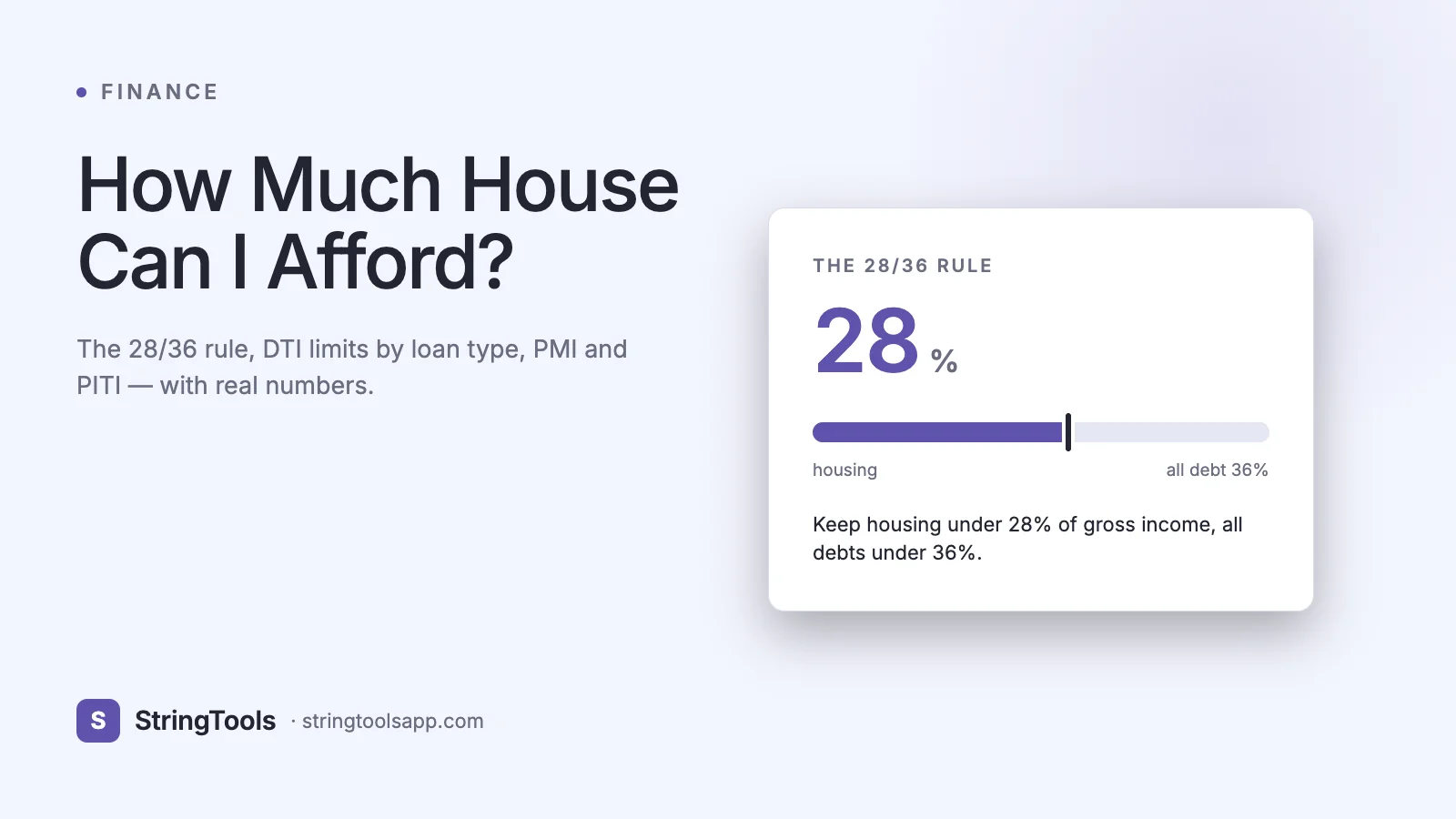
Quick answer: Most lenders size your mortgage using the 28/36 rule: your total monthly housing payment (principal, interest, taxes, insurance — "PITI") should stay under 28% of your gross monthly income, and all your debt payments combined should stay under 36%. On a $72,000 salary with typical taxes and insurance and 20% down at a 6.5% rate, that works out to a home price of roughly $260,000–$275,000. Your exact number depends on your interest rate, down payment, and existing debt — the full math is below.
The Question Behind the Question
When people ask "how much house can I afford," they're usually really asking two different questions at once. The first is how much will a bank lend me? The second, far more important, is how much can I borrow without lying awake at night? Those two numbers are rarely the same, and the gap between them is where a lot of financial stress is born.
A lender will happily approve you for the largest loan their formulas allow, because a bigger loan means more interest for them. But the maximum you qualify for assumes nothing ever goes wrong — no job change, no medical bill, no new baby, no roof that needs replacing. This guide shows you exactly how lenders decide your number using the time-tested 28/36 rule, walks a complete example from salary to home price, compares the debt-to-income limits across loan programs (conventional, FHA, VA), and then shows you why the smart move — especially for a first-time home buyer — is usually to buy well below your ceiling. When you're done, you can put your own numbers into a mortgage affordability calculator and get a personal answer in minutes.
The 28/36 Rule: The Two Percentages Lenders Live By
Almost every home affordability decision traces back to two simple percentages applied to your gross monthly income (your income before taxes). Together they form the backbone of mortgage qualification at nearly every lender in the United States, and consumer agencies like the Consumer Financial Protection Bureau (CFPB) use the same framework when explaining affordability to borrowers.
The 28% rule (the front-end ratio). Your total monthly mortgage payment — the full housing cost, not just the loan — should not exceed 28% of your gross monthly income.
The 36% rule (the back-end ratio). Your total monthly debt payments — housing plus car loans, student loans, minimum credit-card payments, personal loans, and any other recurring debt — should not exceed 36% of your gross monthly income. This second number is your debt-to-income ratio (DTI), and in practice it's the one underwriters scrutinize hardest.
What is the 28/36 rule? It's a lending guideline that says you should spend no more than 28% of gross monthly income on housing costs and no more than 36% on total debt payments. A household earning $6,000 a month should therefore keep housing under $1,680 and all debt payments under $2,160.
The stricter of the two wins. If you carry meaningful other debt, the 36% back-end ratio will cap you before the 28% front-end ratio does. If you're debt-free, the 28% housing limit is your binding constraint. And 28/36 is deliberately conservative: it's the benchmark for buying comfortably, not the legal maximum a lender can approve.
How DTI Limits Differ by Loan Type
Different mortgage programs allow different debt-to-income ratios, which is why two lenders can quote you very different maximum loans. Here's how the major programs compare in practice:
| Loan type | Typical front-end / back-end DTI | Notes |
|---|---|---|
| Conventional (28/36 guideline) | 28% / 36% | The classic comfort benchmark this article uses |
| Conventional (with strong compensating factors) | up to ~45–50% back-end | Fannie Mae's automated underwriting can approve higher DTIs for borrowers with excellent credit and reserves |
| FHA | ~31% / 43% | Government-insured; friendlier to first-time home buyers, allows 3.5% down |
| VA | ~41% back-end | For eligible veterans/service members; also weighs "residual income" |
Program limits change and lenders overlay their own rules — treat these as orientation, not gospel.
Notice what this table really says: the system will let you go far beyond 28/36 if you push. Fannie Mae and Freddie Mac — the two government-sponsored enterprises that buy most US mortgages — will accept back-end ratios approaching 50% for strong files. That's precisely why "the bank approved me" is not the same as "I can afford it." The approval machinery measures default risk for the lender, not financial breathing room for you.
What Really Counts as Your "Housing Payment" (PITI)
This is where most first-time buyers underestimate their number. Your monthly mortgage payment for affordability purposes is not just the loan — it's the full PITI stack, plus a couple of add-ons:
Principal and interest — the actual loan repayment, fixed for the life of a fixed-rate mortgage. (For a deeper walkthrough of exactly how this figure is computed, see our guide on how mortgage payments are calculated.)
Property taxes — set by your county or city, usually collected monthly into an escrow account. These vary enormously by location: the same $300,000 house can carry $150 a month in taxes in one state and $600 in another, which is why housing affordability is so local.
Homeowners insurance — also escrowed monthly, and rising fast in storm- and wildfire-prone regions.
PMI (private mortgage insurance) — added when your down payment is under 20%, typically 0.3%–1.5% of the loan per year. Under the federal Homeowners Protection Act, PMI must be cancelled automatically once your balance reaches 78% of the original home value, and you can request cancellation at 80%.
HOA dues — if your home or condo belongs to a homeowners association.
When lenders apply the 28% rule, they measure it against this entire stack. A buyer who budgets only for principal and interest is often shocked when the true monthly mortgage payment lands 25–40% higher than the loan payment alone.
A Full Worked Example: From Salary to Home Price
Let's turn the rule into an actual home-buying budget. Say you earn $72,000 a year, which is $6,000 a month gross.
Step 1 — Find your housing ceiling. 28% of $6,000 is $1,680. That's the most you should spend on total monthly housing (PITI).
Step 2 — Carve out taxes and insurance. Suppose property taxes and homeowners insurance together run about $300 a month for the homes you're looking at. Subtract that, and roughly $1,380 is left for principal and interest.
Step 3 — Convert the payment into a loan amount. At a 6.5% interest rate on a 30-year fixed loan, every $1,000 borrowed costs about $6.32 a month in principal and interest. So $1,380 a month supports a loan of about $218,000 ($1,380 ÷ $6.32 × $1,000).
Step 4 — Add your down payment to get the home price. With a 20% down payment, a $218,000 loan means a home price of about $273,000 ($218,000 ÷ 0.80). Put less down and you can technically buy a bit more house, but you'll add PMI, which eats into that $1,380 and lowers the loan you qualify for.
So on a $72,000 salary with modest other debt, a comfortable target is a home priced around $260,000–$275,000. This four-step method is exactly what a good house affordability calculator automates — it runs the same arithmetic instantly for any combination of income, rate, and down payment.
How your interest rate moves the same budget
Change the interest rate and this number moves a lot. Here's what that same $1,380 monthly principal-and-interest budget buys across rates on a 30-year fixed loan:
| Rate | P&I per $1,000 borrowed | Loan a $1,380/mo budget supports |
|---|---|---|
| 6.0% | $6.00 | ≈ $230,000 |
| 6.5% | $6.32 | ≈ $218,000 |
| 7.0% | $6.65 | ≈ $207,000 |
| 7.5% | $6.99 | ≈ $197,000 |
A one-point rate difference swings your buying power by roughly $25,000–$33,000 on this budget — for the exact same monthly payment. Rate matters as much as price, which is why shopping multiple lenders is one of the highest-paid hours of the entire home-buying process.
Salary vs. Home Price: A Quick Reference Table
The table below runs the same 28% method across common salaries so you can find your rough starting point. Assumptions: 30-year fixed at 6.5%, 20% down payment, about $300/month for taxes and insurance, and minimal other debt. Your market's actual property taxes will shift these numbers.
| Annual salary | Gross monthly | 28% housing budget | Approx. loan | Approx. home price |
|---|---|---|---|---|
| $50,000 | $4,167 | $1,167 | ≈ $137,000 | ≈ $170,000 |
| $60,000 | $5,000 | $1,400 | ≈ $174,000 | ≈ $215,000 |
| $72,000 | $6,000 | $1,680 | ≈ $218,000 | ≈ $273,000 |
| $80,000 | $6,667 | $1,867 | ≈ $248,000 | ≈ $310,000 |
| $100,000 | $8,333 | $2,333 | ≈ $322,000 | ≈ $400,000 |
| $120,000 | $10,000 | $2,800 | ≈ $396,000 | ≈ $495,000 |
| $150,000 | $12,500 | $3,500 | ≈ $506,000 | ≈ $630,000 |
Estimates for orientation only — carry other debt, put down less than 20%, or live in a high-tax area and your number drops. Run your own inputs in a mortgage affordability calculator for a personal figure.
The Four Other Levers That Move Your Number
The 28/36 rule sets the payment, but four factors decide how much house that payment buys.
Down payment. A larger down payment shrinks the loan and can eliminate PMI once you cross 20% down, freeing up more of your budget for actual principal and interest. It also improves your loan-to-value ratio, which can earn you a better rate.
Interest rate. As the table above showed, a one-point rate change swings your buying power by tens of thousands of dollars. Even a quarter-point improvement is worth negotiating for.
Credit score. Your score doesn't change the 28/36 math directly, but it heavily influences the rate you're offered — and the rate determines how far your payment stretches. Moving from "fair" to "very good" credit routinely saves half a point or more.
Debt-to-income (DTI). This is the 36% back-end ratio in action. Paying down a car loan or credit-card balance before you apply can raise your housing ceiling more effectively than earning a raise, because it frees up room under the DTI cap. If you're carrying a personal or auto loan, our loan calculator shows exactly how an extra payment accelerates the payoff — and our guide to how loan amortization works explains why early extra payments punch above their weight.
Pre-Qualification vs. Pre-Approval: Know the Difference
Before you shop, get clear on two terms that sound alike but carry very different weight.
Pre-qualification is an informal estimate based on numbers you self-report. It takes minutes, involves no document checks, and sellers give it little weight.
Mortgage pre-approval is the real thing: the lender verifies your income, assets, credit report, and debt, then issues a conditional commitment for a specific loan amount. In a competitive market, a pre-approval letter is effectively your ticket to make offers — many listing agents won't take an offer seriously without one.
One caution: your pre-approval amount is the lender's maximum, computed at the aggressive end of the DTI limits we covered earlier. Treat it as the ceiling of what's possible, not the target of what's sensible. The number you should actually shop with is the one you calculated from your own 28% budget.
First-Time Home Buyer? Your Down Payment Options Are Wider Than You Think
The "you need 20% down" belief stops many renters from even checking their home loan affordability — and it hasn't been true for decades. Realistic minimums today: conventional programs backed by Fannie Mae and Freddie Mac start at 3% down for qualifying first-time buyers, FHA loans require as little as 3.5% down with a 580+ credit score, and VA loans (veterans and active service members) and USDA loans (eligible rural areas) can go to 0% down.
The trade-off is that smaller down payments mean bigger loans, higher monthly payments, and mortgage insurance — PMI on conventional loans, or FHA's own mortgage insurance premiums, which are harder to remove. There's no universally right answer: putting 5% down and buying four years sooner can beat waiting to save 20% in a rising market, or it can strain your budget in a flat one. The point is to run both scenarios with real numbers instead of assuming you're locked out.
Why "Approved For" Is Not "Should Spend"
Here's the uncomfortable truth lenders won't emphasize: qualifying for a number and being able to live on it are different things. The 28/36 rule is calculated on gross income, but you pay your mortgage out of take-home pay, after taxes, health insurance, and retirement contributions. A payment that's 28% of gross can easily be 38%–40% of what actually lands in your bank account.
Buying below your maximum leaves room for the things affordability formulas ignore: maintenance, an emergency fund, retirement savings, and simply having money left over to enjoy life. Many financially secure buyers deliberately target the low-to-mid 20s as a percentage of gross income rather than the full 28%. The house you can barely afford has a way of becoming the reason you can't afford anything else.
The Costs Beyond the Mortgage
A complete home buying budget accounts for three costs that never show up in a monthly payment quote:
Closing costs. Typically 2%–5% of the loan amount, per the CFPB — covering appraisal, title insurance, origination, and prepaid escrow. On our $218,000 example loan, that's roughly $4,400–$11,000 due at closing, on top of the down payment.
Maintenance and repairs. The common planning figure is about 1% of the home's value per year — around $2,700 annually on a $273,000 home. Some years it's a $150 faucet; some years it's a $9,000 roof. The average is what matters for planning.
Moving, furniture, and immediate fixes. The first six months of ownership are reliably more expensive than expected. Keeping a cash cushion after closing — most advisors suggest at least 3–6 months of expenses — is what separates a comfortable first year from a stressful one. If you're building that cushion, our compound interest calculator shows how quickly consistent monthly savings grow, and our guide to how compound interest works explains why starting early matters more than starting big.
Frequently Asked Questions
How much house can I afford on a $60,000 salary?
$60,000 a year is $5,000 a month gross, so the 28% rule gives a housing ceiling of about $1,400 a month. After typical taxes and insurance, that supports a home around $215,000 at a 6.5% rate with 20% down — less if you carry other debt or put down under 20%.
How much house can I afford on a $100,000 salary?
At $100,000 a year ($8,333 a month gross), the 28% rule allows about $2,333 for monthly housing. With typical taxes and insurance, that supports roughly a $320,000 loan — a home price around $400,000 with 20% down at a 6.5% rate.
What is a good debt-to-income ratio to buy a house?
Under 36% total DTI is the classic comfort benchmark, and under 28% for housing alone. Many programs approve up to 43%–50% DTI, but payments at that level consume a large share of take-home pay and leave little margin for savings or surprises.
Is the 28/36 rule strict, or just a guideline?
It's a guideline, not a law. FHA commonly allows around 31/43, VA focuses on residual income at roughly 41% back-end, and conventional loans with strong credit can reach back-end ratios near 50%. But 28/36 remains the benchmark for buying comfortably rather than at the edge of approval.
How much do I need for a down payment?
Less than most people think: 3% for some conventional first-time-buyer programs, 3.5% for FHA, and 0% for VA and USDA loans. However, putting down less than 20% adds mortgage insurance (PMI or FHA premiums), which raises your monthly payment and lowers the loan the 28% rule supports.
Does getting pre-approved hurt my credit score?
A pre-approval involves a hard credit inquiry, which typically dings your score a few points temporarily. Credit models treat multiple mortgage inquiries within a short shopping window (generally 14–45 days) as a single inquiry, so comparing several lenders doesn't multiply the impact.
Should I buy the most expensive house I qualify for?
Usually not. Qualification is based on gross income, but you live on take-home pay, and the formulas ignore maintenance, emergencies, and retirement. Buying below your ceiling is what keeps a home an asset instead of a source of stress.
How does PMI affect how much house I can afford?
PMI adds roughly 0.3%–1.5% of the loan amount per year to your payment — about $56–$281 a month on a $225,000 loan. Because that comes out of your 28% housing budget, PMI directly reduces the loan size you qualify for. It ends at 20% equity (you can request cancellation at 80% loan-to-value; it terminates automatically at 78% under the Homeowners Protection Act).
Run Your Own Numbers
The fastest way to pin down your own figure is to work backward from a payment you're comfortable with. If you've been searching for a "how much house can I afford calculator," our free mortgage calculator does exactly that job: enter a home price, down payment, rate, and your local taxes and insurance, and watch the full PITI payment update instantly — then check that it lands comfortably inside your 28% ceiling. Test a few scenarios (smaller down payment with PMI, a half-point better rate, a 15-year term) and you'll learn more about your real home buying budget in ten minutes than any rule of thumb can teach.
This article is for general educational purposes and is not financial advice. Loan programs, DTI limits, tax rates, and insurance costs vary by lender, location, and over time — confirm your specific numbers with a licensed mortgage lender or financial advisor before making a decision.