
Fifty Separate Systems, Not One With Fifty Settings
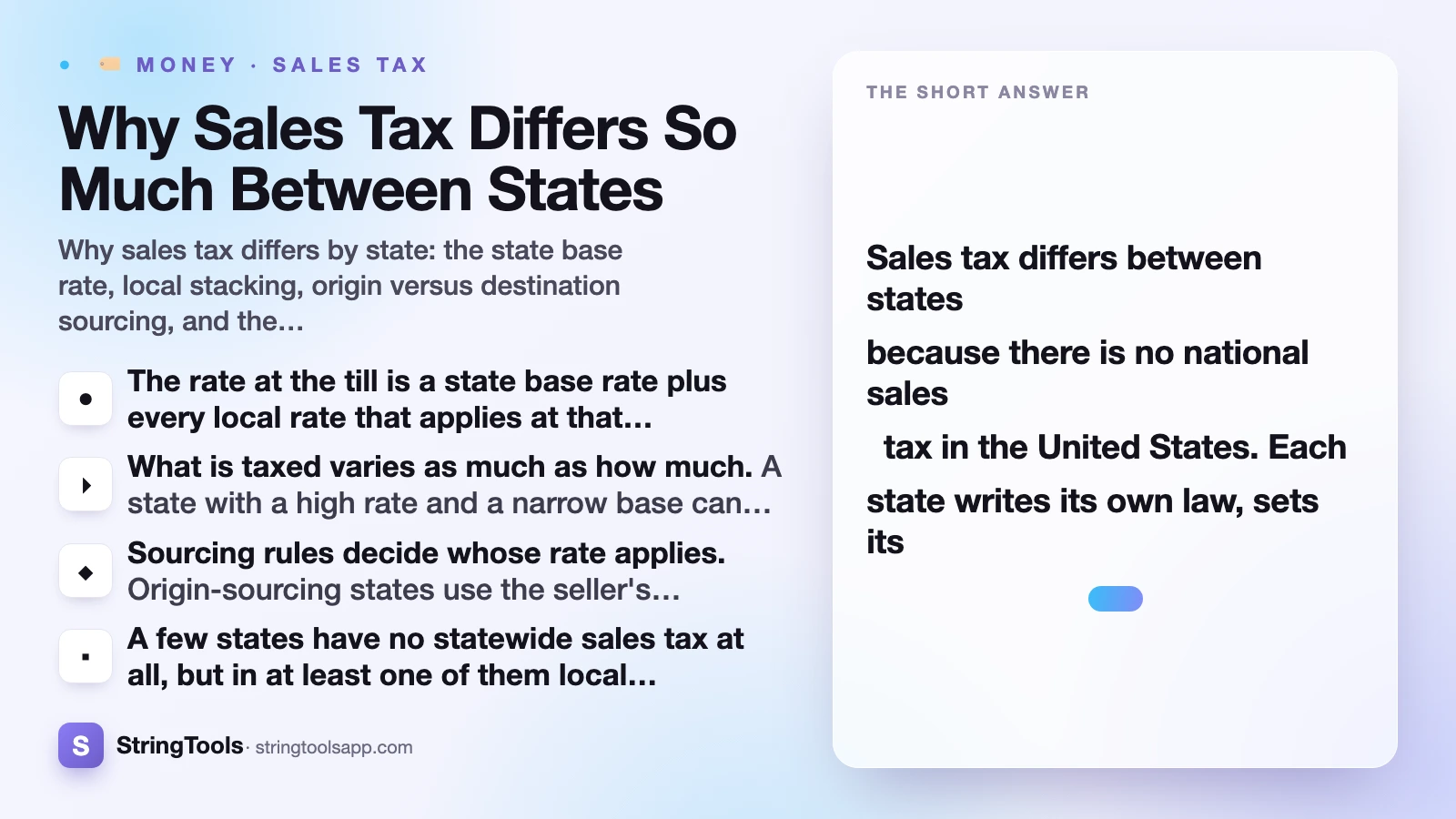
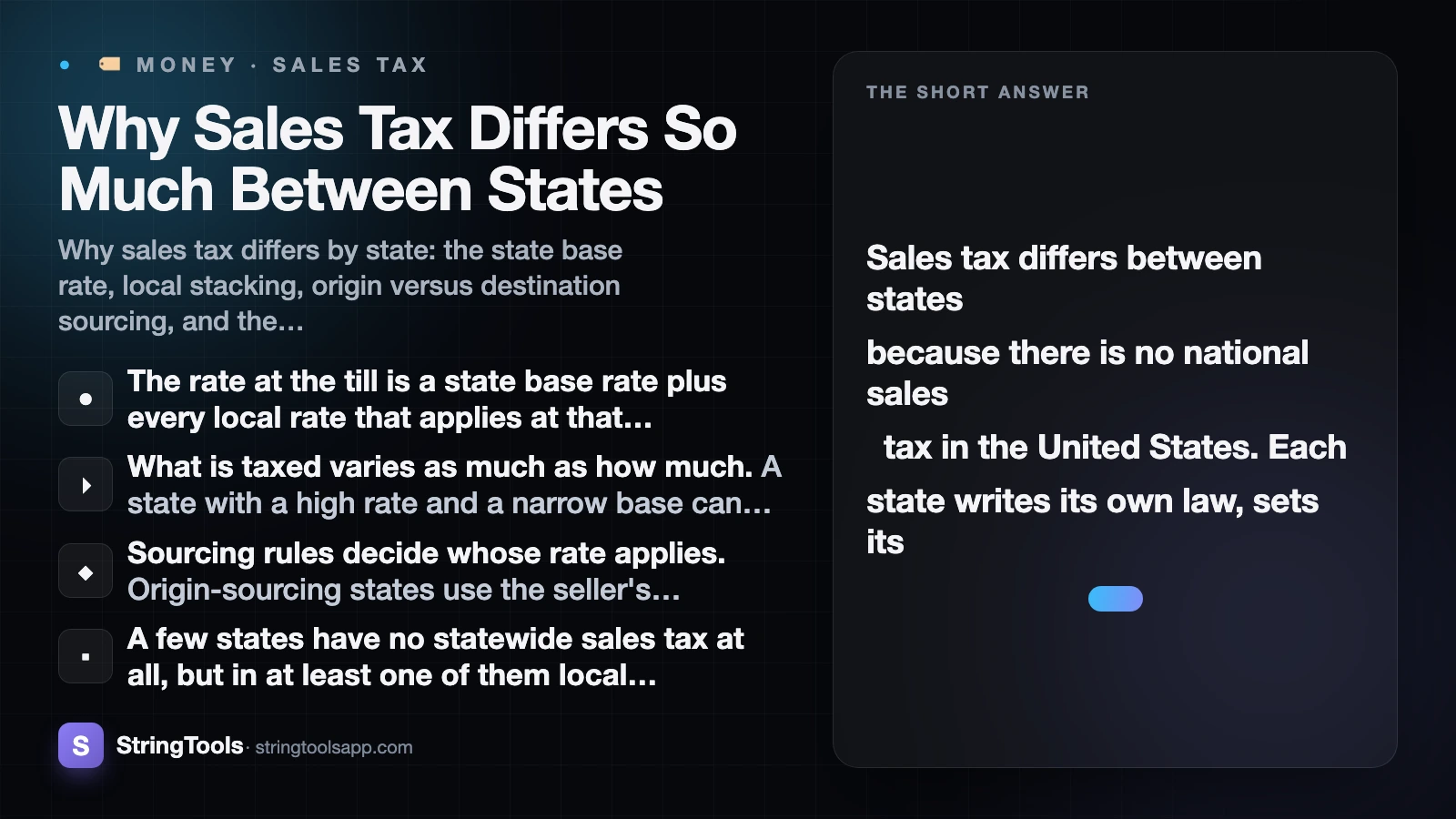
Sales tax differs between states because there is no national sales tax in the United States. Each state writes its own law, sets its own base rate, decides what is taxable, and then lets counties, cities and special districts add their own rates on top. What you pay is the sum of those layers at one address.
Key Takeaways
- The rate at the till is a state base rate plus every local rate that applies at that location. The local portion is often the larger share of the difference between two places.
- What is taxed varies as much as how much. A state with a high rate and a narrow base can collect less on a shopping trip than one with a low rate on everything.
- Sourcing rules decide whose rate applies. Origin-sourcing states use the seller's location; destination-sourcing states use where the buyer takes delivery.
- A few states have no statewide sales tax at all, but in at least one of them local governments levy their own, so a zero assumption is wrong across much of it.
- States that raise little income tax generally lean harder on sales tax, and tourism-heavy states shift part of the burden onto visitors.
- Rates change on legislative schedules, sometimes mid-year. Any number in an article is a snapshot; use a dated source and check the address.
This is general information, not tax advice. For anything you will file, the state revenue department is the authority.
The Layers That Make Up a Combined Rate
The single most common mistake is treating a state's published rate as the rate. It is the floor.
| Layer | Who sets it | What it does to the total |
|---|---|---|
| State base rate | The state legislature | The floor. In some states it is the whole story; in others it is under half of what you pay. |
| County rate | County government, often by referendum | Usually a fraction of a percent to a few percent, applied across the county. |
| City or municipal rate | The municipality | The most variable layer. Two towns on either side of a boundary can differ noticeably. |
| Special district | Transit authorities, stadium districts, hospital or library districts | Often small individually, but several can overlap on one address. |
| Mandatory local share | The state, collected statewide | Bundled into the published state figure in some states, which is why a couple of state rates look oddly high. |
Some states have no local sales taxes at all, which makes life simple: one rate covers the whole state. Others have local rates that on average exceed the state rate itself, so quoting the state figure alone can understate the bill by half. A handful of states use home-rule cities that administer their own sales tax separately from the state, with their own definitions and their own filing, which is the hardest version of this problem for a business to deal with.
This is precisely why the sales tax calculator has two fields rather than one: a state base-rate dropdown, carrying its own as-of date so you can see how fresh the figure is, and a separate box for the local portion you look up at the actual address. There is no honest way to collapse those into a single national lookup.
The Base Matters as Much as the Rate
A rate is a multiplier. What it multiplies is the tax base, and the base varies more between states than the rate does.
Consider the categories where states genuinely disagree:
- Groceries. Some states exempt unprepared food entirely, some tax it at a reduced rate, and some tax it normally. Several have changed position in recent years, sometimes with local governments replacing a repealed state tax with their own.
- Clothing. A few states exempt clothing outright; a few exempt it up to a per-item price threshold, so the same shirt is taxed or not depending on what it cost.
- Prescription medicine. Almost universally exempt. Over-the-counter medicine is where states diverge.
- Services. Historically most states taxed goods and not services. As economies shifted toward services, some states extended the base; others did not. This is one of the biggest structural differences between state systems.
- Digital goods. Downloads, streaming and software-as-a-service are treated inconsistently, because the statutes were written before any of it existed.
The consequence is that comparing states by headline rate alone is close to meaningless for a household. A state with a higher rate that exempts food and clothing may take less from a typical weekly shop than a state with a lower rate that taxes everything. The kinds of rules involved, and the awkward boundaries they create, are covered in what is tax exempt.
Origin Versus Destination: Whose Rate Applies
Once goods move, a second question appears that has nothing to do with the rate itself: which jurisdiction's rate governs the sale.
Destination sourcing applies the rate where the buyer takes delivery. This is the dominant approach, and it is why a seller shipping across a state needs a rate for each delivery address rather than one rate for the business.
Origin sourcing applies the rate where the seller is located, at least for sales within the state. A shop in an origin state charges its own local rate to every in-state customer regardless of where the goods go.
A number of states use origin rules for intrastate sales and destination rules for sales arriving from outside, which is a sensible compromise and an administrative headache.
| Situation | Whose rate usually applies | Practical consequence |
|---|---|---|
| In-store purchase, taken away | The shop's location | The simplest case; the rate is on the shelf edge, not the receipt |
| Shipped within a destination-sourcing state | The delivery address | The rate can change street by street |
| Shipped within an origin-sourcing state | The seller's address | One rate for all in-state orders |
| Shipped from out of state | The delivery address | The seller must know the buyer's local rate |
| Digital delivery | Usually the buyer's billing or primary-use address | Frequently the least clearly drafted rule in the statute |
The reason remote sellers have to care at all is a 2018 Supreme Court decision, South Dakota v. Wayfair, which overturned the earlier physical-presence requirement from Quill v. North Dakota. States may now require out-of-state sellers to collect once they cross an economic nexus threshold — typically a level of sales or transactions into that state — without any office, warehouse or staff there.
Why States Choose Such Different Rates
The rate is a political choice about where a state's revenue comes from, and the differences are not random.
The revenue mix. A state funds itself from some combination of income tax, sales tax, property tax and business taxes. States that levy little or no individual income tax generally lean harder on sales tax, and in some cases on property tax too. A low sales tax rate does not mean a low tax burden; it often means the burden sits somewhere else.
Exporting the burden. States with heavy tourism, or with large retail corridors drawing shoppers from neighbouring states, can raise a meaningful share of revenue from people who do not vote there. That makes a higher sales tax politically cheaper.
Local government funding. Where cities and counties are given sales tax as their primary own-source revenue, the local layer grows, which is why some states with modest base rates end up with high combined rates.
Border competition. A state whose neighbour has no sales tax faces real pressure on retailers near the line, which shows up as pressure to keep rates or bases lower on big-ticket and easily transported items.
Regressivity politics. Sales tax takes a larger share of a lower income, because lower-income households spend a larger share of what they earn. Grocery and clothing exemptions, and periodic sales tax holidays, are the usual legislative response.
None of this is stable. Rates and bases change through legislation, referendum and scheduled sunsets, sometimes with a mid-year effective date. The Tax Foundation's state and local sales tax data publishes dated tables and is the usual starting point for comparison, and the state's own revenue department is the authority for anything binding — the Texas Comptroller's sales tax pages are a representative example of what that looks like.
What This Means If You Are Selling
For a business, the difference between states is not an interesting fact. It is a compliance workload with a specific shape.
- Registration comes before collection. You register in a state once you have nexus there, whether from physical presence or from crossing an economic threshold. Collecting tax without registering is not a safe middle ground.
- You need address-level rates, not state averages. An average local rate is fine for a quote and wrong for a return.
- Filing frequency and due dates differ by state, and they can change based on your volume.
- Exemption certificates must be collected and kept. In an audit, a missing certificate is treated as a taxable sale you failed to tax.
- Product taxability is per state. The same item can be taxable in one state, exempt in another, and taxable at a reduced rate in a third.
- Marketplace facilitator laws may shift the obligation. Where a marketplace collects on your behalf, your own liability for those sales usually changes, but your registration obligations may not disappear.
The Streamlined Sales Tax Governing Board exists specifically to reduce this workload, with member states agreeing common definitions, a shared rate database and simplified registration. Not every state participates, but where they do the rules are considerably more predictable.
How to Get a Rate You Can Actually Rely On
A practical sequence, in order of reliability:
- Ask the state. Every state revenue department publishes a rate lookup, most of them by address rather than by ZIP code. This is the only answer that is defensible in an audit.
- Avoid ZIP-code-only lookups for filing. ZIP boundaries and tax jurisdiction boundaries were drawn for different reasons and do not align. A ZIP can straddle two rates.
- Check the effective date, not just the rate. A correct rate for last quarter is a wrong rate for this one. Any table worth using prints the date its data is from.
- Separate the state and local portions. If you only have one blended number and no idea what is in it, you cannot tell whether it is out of date in the state layer or the local one.
- Re-check periodically. Local rates change more often than state rates, and usually with less publicity.
For the arithmetic once you have the rate, both directions are set out in how to calculate sales tax — and remember that reversing a tax-inclusive total means dividing by one plus the rate, never subtracting a percentage. If you are comparing what happens here with how consumption tax works elsewhere, sales tax vs VAT vs GST covers why a single national rate makes the rest of the world's prices tax-inclusive and America's not.
The sales tax calculator keeps the state base rate and the local add-on separate, shows the as-of date for the state figure it carries, and lets you override either one, on the assumption that you will have looked the local portion up at the address rather than trusted an average.
Frequently Asked Questions
Why is sales tax different in every state?
Because there is no national sales tax. Each state writes its own law, sets its own base rate and decides its own taxable base, and then counties, cities and special districts add their own rates on top. The figure at the till is the sum of those layers at that specific address.
Is the state rate the rate I actually pay?
Usually not. It is the floor. Some states have no local sales taxes, so the state rate is the whole story, but in others the local layers together average more than the state rate itself. Always look up the combined rate for the address rather than relying on the state figure.
Which state's sales tax applies when I buy online?
Almost always the delivery address, because most states use destination sourcing for goods arriving from outside. Since the 2018 South Dakota v. Wayfair decision, states may require out-of-state sellers to collect once they cross an economic nexus threshold, with no physical presence required.
Do any states have no sales tax at all?
A small number levy no statewide sales tax. Even then the picture is not always zero: in at least one of them, boroughs and cities levy their own local sales taxes, so a zero assumption is wrong across much of the state. Check the specific locality rather than the state.
Why do two shops a few miles apart charge different rates?
Because they sit in different local jurisdictions. A city, county or special district boundary can run between them, and each side carries its own stack of local rates on top of the same state base. In destination-sourcing states, the same effect applies to two delivery addresses on the same street.
How often do sales tax rates change?
State rates change through legislation, sometimes with a scheduled future effective date or a sunset built into the original bill. Local rates change more often and with less publicity, frequently at quarter boundaries. Anything you rely on should carry a date, and should be re-checked before a filing.
Sources and references
Tax Foundation's state and local sales tax data (taxfoundation.org) · Texas Comptroller's sales tax pages (comptroller.texas.gov) · Streamlined Sales Tax Governing Board (streamlinedsalestax.org). Content was reviewed against these sources as of the last-updated date above; external figures and rules may change after publication.