
Three Names, Two Genuinely Different Systems
Sales tax is collected once, from the final consumer, at the last sale in the chain. VAT and GST are collected at every stage, with each business reclaiming the tax it paid on its inputs, so only the value it added is taxed. GST is largely a regional name for VAT. The real divide is single-stage versus multi-stage.
Key Takeaways
- US retail sales tax is a single-stage tax. Businesses buying for resale present an exemption certificate, so tax lands only on the final consumer sale.
- VAT and GST are multi-stage. Every seller charges tax on its sales and deducts the tax it paid on purchases, remitting only the difference.
- Under either system, with an equal rate and a clean chain, the consumer pays the same amount. The difference is who holds the money on the way and what happens when the chain breaks.
- US prices are displayed excluding tax because the rate depends on the buyer's address. Most VAT and GST countries display tax-inclusive prices, because one national rate applies to the whole market. Canada is the notable exception: it runs a GST but shows prices before tax, because the combined rate varies by province.
- VAT and GST have registration thresholds; a small enough business does not charge the tax at all. US sales tax uses economic nexus thresholds, which work differently.
- Canada, Australia, India, New Zealand and Singapore all say GST and all mean a VAT. India splits its GST between the centre and the states.
This is general information about how the systems work, not tax advice. Rates and thresholds change, and they differ by country, so check the relevant tax authority.
How a Single-Stage Sales Tax Works
In the United States there is no national consumption tax. States, and then counties, cities and special districts within them, levy their own retail sales tax on the final sale of taxable goods and certain services.
The word that does the work is retail. Tax is meant to be charged once, when the item reaches the person who will actually use it. A wholesaler selling to a shop does not charge tax, because the shop is not the end user. To make that work, the buyer hands the seller a resale or exemption certificate, and the seller keeps it on file as evidence of why no tax was collected.
That certificate system is the load-bearing part of the design, and it is also its weak point. If it fails — a certificate not collected, a buyer who was not really reselling — the tax either never gets paid or gets paid twice on the same value. There is no self-correcting mechanism, because nobody downstream reclaims anything.
The rate is the other complication. It is not one number. It is the state base rate plus whatever local jurisdictions stack on top, and for shipped goods it usually follows the delivery address. That is why a US price tag cannot include the tax: the shop genuinely does not know what the buyer will pay until it knows where the buyer is. The mechanics of that stacking are in why sales tax differs so much between states, and the arithmetic for both directions is in how to calculate sales tax.
How Multi-Stage VAT and GST Work
VAT reverses the logic. Instead of exempting everyone except the final seller, it taxes everyone and lets businesses take credit for what they were charged.
Each registered business does two things. It charges tax on what it sells (output tax) and it reclaims the tax it was charged on what it bought (input tax). What it sends to the tax authority is the difference. The tax it collects from its customer is not its money; it is holding it.
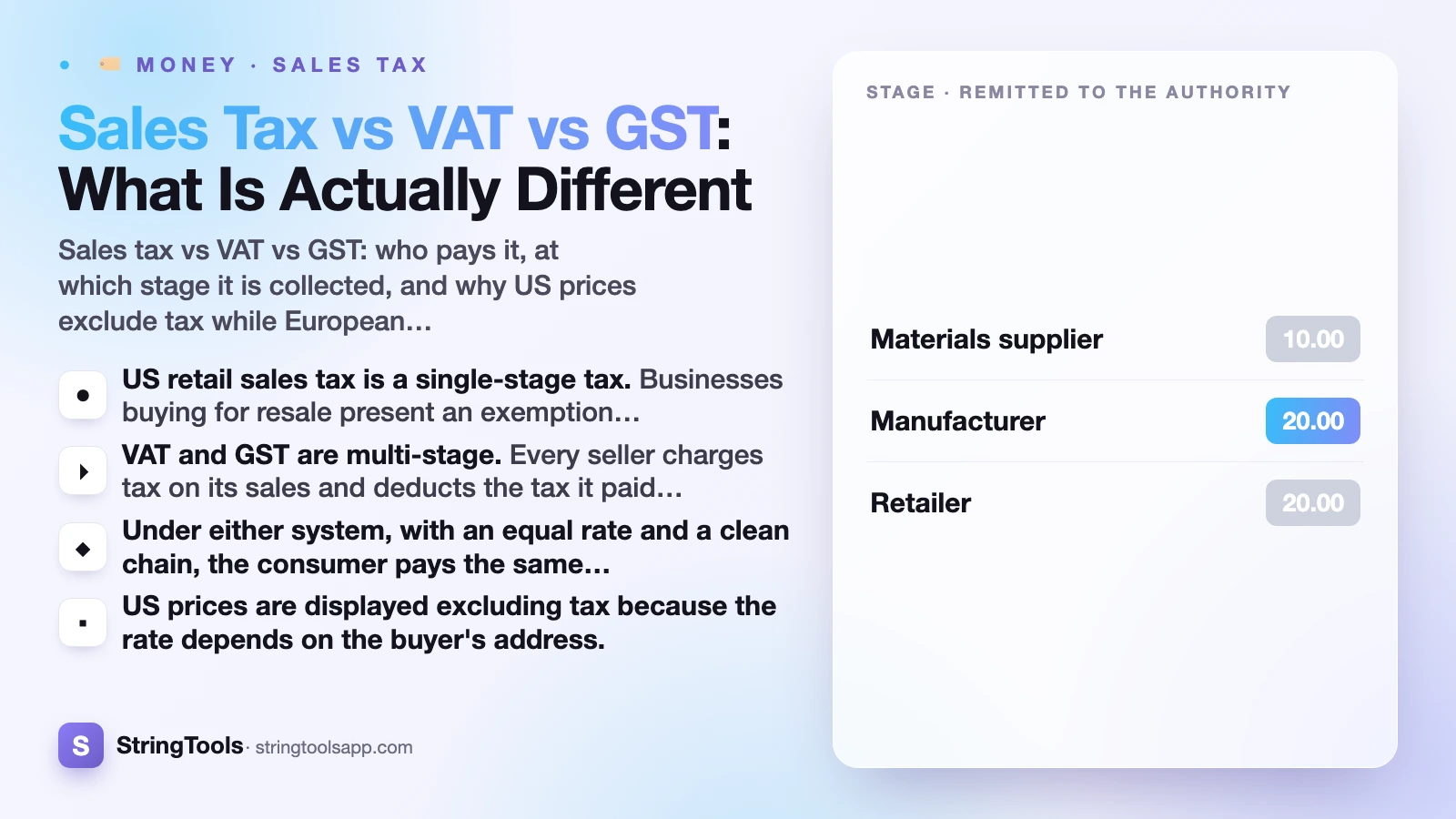
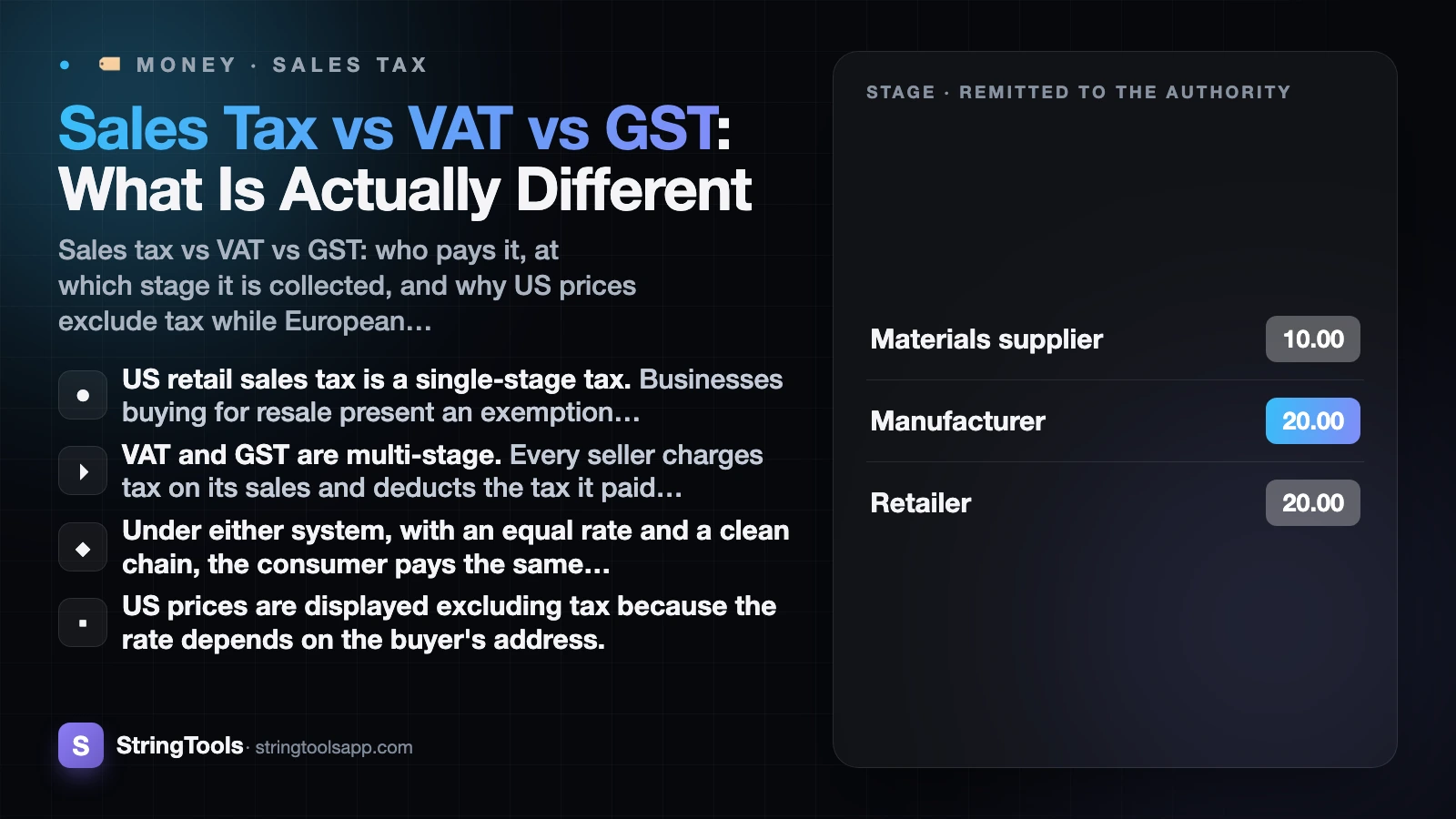
Follow one chain at an illustrative 10% rate, with a net price rising from 100 to 300 to 500:
| Stage | Net sale price | Tax charged | Input tax reclaimed | Remitted to the authority |
|---|---|---|---|---|
| Materials supplier | 100.00 | 10.00 | 0.00 | 10.00 |
| Manufacturer | 300.00 | 30.00 | 10.00 | 20.00 |
| Retailer | 500.00 | 50.00 | 30.00 | 20.00 |
| Consumer pays | 500.00 | 50.00 | — | — |
Total remitted across the chain is 10.00 + 20.00 + 20.00 = 50.00, which is exactly 10% of the 500.00 final price. The consumer pays 550.00.
Now run the same chain as a single-stage sales tax at an illustrative 10%. The first two sales are exempt on resale certificates, the retailer charges 50.00 on the 500.00 sale, and the consumer pays 550.00. Same consumer, same 550.00, same 50.00 to the authority.
That is the point worth holding on to. The two systems are not designed to collect different amounts. They collect the same amount by different routes, and the routes have very different properties.
The tax that neither system is, but that both replaced, is a cascading turnover tax: a tax at every stage with no input credit, so the tax charged at stage two applies to a price that already includes stage one's tax. That compounds, punishes long supply chains, and quietly rewards businesses for merging with their suppliers. Avoiding that cascade is the whole reason the input-credit mechanism exists.
The Comparison That Actually Matters
| Question | US retail sales tax | VAT / GST |
|---|---|---|
| Collected at | The final retail sale only | Every stage of the chain |
| Who bears it | The final consumer | The final consumer |
| Who remits it | The retailer alone | Every registered business, in part |
| Business purchases | Exempt via a resale certificate | Taxed, then reclaimed as input tax |
| Rate setting | State, plus county, city and district | National, sometimes with regional components |
| Shown in the shelf price | No, added at the till | Usually yes, but not in Canada |
| Typical scope | Goods, plus selected services | Goods and services broadly |
| If the chain breaks | Tax is lost or doubled, with no correction | Largely self-correcting through the credit trail |
| Small sellers | Registration driven by nexus rules | Below a registration threshold, no tax charged |
| Refund for visitors | Rare | Common for exported goods, with conditions |
Two rows deserve a note. "Who remits it" explains why VAT systems generate so much more paperwork for small businesses and so much better data for the authority: every credit claimed by one business implies tax charged by another, which makes under-reporting harder to hide.
"Shown in the shelf price" is the difference travellers actually feel. A European or Australian price is the price. A US price is not, and the gap between the sticker and the till is the local rate that could not be printed. Canada keeps the US habit despite running a GST, for the same reason: the combined rate depends on which province you are standing in. Working back from a tax-inclusive price to the net figure is the routine job that follows, covered in how to remove sales tax from a total.
Why GST Is Mostly Just VAT With Another Name
Canada, Australia, New Zealand, Singapore, India and others use the term GST. Structurally, all of them are value-added taxes: charge on outputs, credit on inputs, remit the difference. The naming is political and historical rather than technical.
Where they genuinely differ is in how the tax is divided between levels of government.
Canada runs a federal GST, which some provinces have harmonised with their provincial tax into a single HST, while other provinces levy a separate provincial sales tax alongside it. So a Canadian business may face GST, HST or GST-plus-PST depending on the province. The Canada Revenue Agency's GST/HST pages set out which applies where.
Australia and New Zealand run a single national GST with a broad base and relatively few exemptions, which is unusually clean by international standards.
India splits every transaction. A sale within a state carries central GST and state GST together; a sale across state lines carries a single integrated GST that is later apportioned. It is one rate structure administered by two levels of government at once. The practical mechanics for Indian readers are in the GST calculation guide for India.
The European Union runs VAT under a common framework, with each member state setting its own rates within agreed limits. The European Commission's taxation and customs pages are the reference for how the common rules fit together.
The United Kingdom runs VAT with a standard rate, reduced rates and zero rates, plus a registration threshold below which a business does not charge it. Current figures are published on GOV.UK's VAT rates page.
Exemptions, Zero-Rating and the Difference Between Them
Both systems carve out categories, and in VAT there is a distinction that costs businesses real money and that most people never hear about.
A zero-rated supply is taxable, at a rate of zero. The seller charges nothing to the customer but is still a taxable business, so it can reclaim the input tax on everything it bought to make the sale.
An exempt supply is outside the tax entirely. The seller charges nothing and can reclaim nothing, so the tax on its inputs becomes a cost it must absorb or build into the price.
To a shopper the two look identical, because both produce a price with no tax line. To the seller they are opposite outcomes. This is why the specific wording in a country's legislation matters more than the headline rate.
US sales tax has a rough parallel in exemptions by category and by use — resale, manufacturing inputs, non-profit purchases — and in thresholds where the same item is taxed or not depending on its price. The categories that come up most often, including the prepared-versus-unprepared food line, are set out in what is tax exempt.
Either way, the practical consequence for anyone doing the arithmetic is the same: a receipt that mixes rated and unrated lines cannot be reversed with one divisor. Split it by rate first. The sales tax calculator handles that directly with per-line exempt flags, in both the add and the reverse direction.
What This Means in Practice
If you are a consumer, the difference is mostly about what the sticker means. Outside the US, the number on the shelf is what you pay. Inside it, the number on the shelf is the start of a sum, and you need the combined local rate to finish it.
If you are selling across borders, the difference is much larger than a naming convention:
- Registration is not optional once a threshold is crossed. VAT and GST regimes set turnover thresholds; US states set economic nexus thresholds based on sales into the state. Both can be triggered without any physical presence.
- Digital services usually follow the customer. Most VAT and GST regimes tax digital supplies where the consumer is, which means a foreign seller can owe tax in a country it has never visited.
- Your prices must say which basis they are on. Quoting a tax-inclusive price into a market that expects tax-exclusive quotes, or the reverse, produces a predictable argument at invoice time.
- Input tax is only reclaimable with a valid invoice. In VAT systems the paperwork is the entitlement. A receipt missing the seller's registration number is often not reclaimable at all.
- Exemption certificates are the US equivalent of that paperwork, and the same rule applies: no certificate on file, no defence in an audit.
For multi-state US sellers, the Streamlined Sales Tax Governing Board publishes the simplification framework many states have adopted, which is the closest thing the US has to a common rulebook. For anything you will actually file, in any country, the tax authority is the source and an accountant who works in that jurisdiction is the person to ask. Nothing here is a substitute for either.
Frequently Asked Questions
What is the main difference between sales tax and VAT?
Sales tax is collected once, at the final retail sale, with business-to-business purchases exempted by resale certificate. VAT is collected at every stage, with each business reclaiming the tax on its inputs and remitting only the difference. With the same rate and a clean chain, the consumer pays the same either way.
Is GST the same as VAT?
Structurally, yes. Canada, Australia, New Zealand, Singapore and India all call their value-added tax a GST. The mechanism is identical — output tax charged, input tax credited. What differs is how the revenue is split between national and regional government, which is why India runs central and state GST together on the same sale.
Why do US prices not include sales tax?
Because the applicable rate depends on the buyer's location, not the seller's shelf. A state base rate plus county, city and district rates can differ between two shops a few miles apart, and for shipped goods the rate usually follows the delivery address, so a single printed price could not be correct for every buyer.
Do businesses pay VAT?
They charge it and they remit it, but a registered business making taxable supplies does not ultimately bear it, because it reclaims the VAT on its purchases as input tax. The exception is a business making exempt supplies, which cannot reclaim its input tax and therefore absorbs it as a genuine cost.
What is the difference between zero-rated and exempt?
A zero-rated supply is taxable at a rate of zero, so the seller can still reclaim input tax on its costs. An exempt supply is outside the tax, so the seller reclaims nothing and absorbs the tax on its inputs. To the customer both look the same; to the seller they are opposite outcomes.
Which system raises more revenue?
Neither is inherently higher-yielding at the same rate, because both are designed to tax the same final consumption. VAT tends to collect more of what it is owed, because every input credit claimed implies output tax charged by another business, leaving an audit trail that single-stage collection does not produce.
Sources and references
Canada Revenue Agency's GST/HST pages (canada.ca) · taxation and customs pages (taxation-customs.ec.europa.eu) · GOV.UK's VAT rates page (gov.uk) · Streamlined Sales Tax Governing Board (streamlinedsalestax.org). Content was reviewed against these sources as of the last-updated date above; external figures and rules may change after publication.