
Why Profitable Businesses Still Get Rejected
Key Takeaways
- Lenders approve the paper trail, not the pitch — cash sales that never touch a bank account and GST returns that do not match the ITR sink otherwise strong businesses.
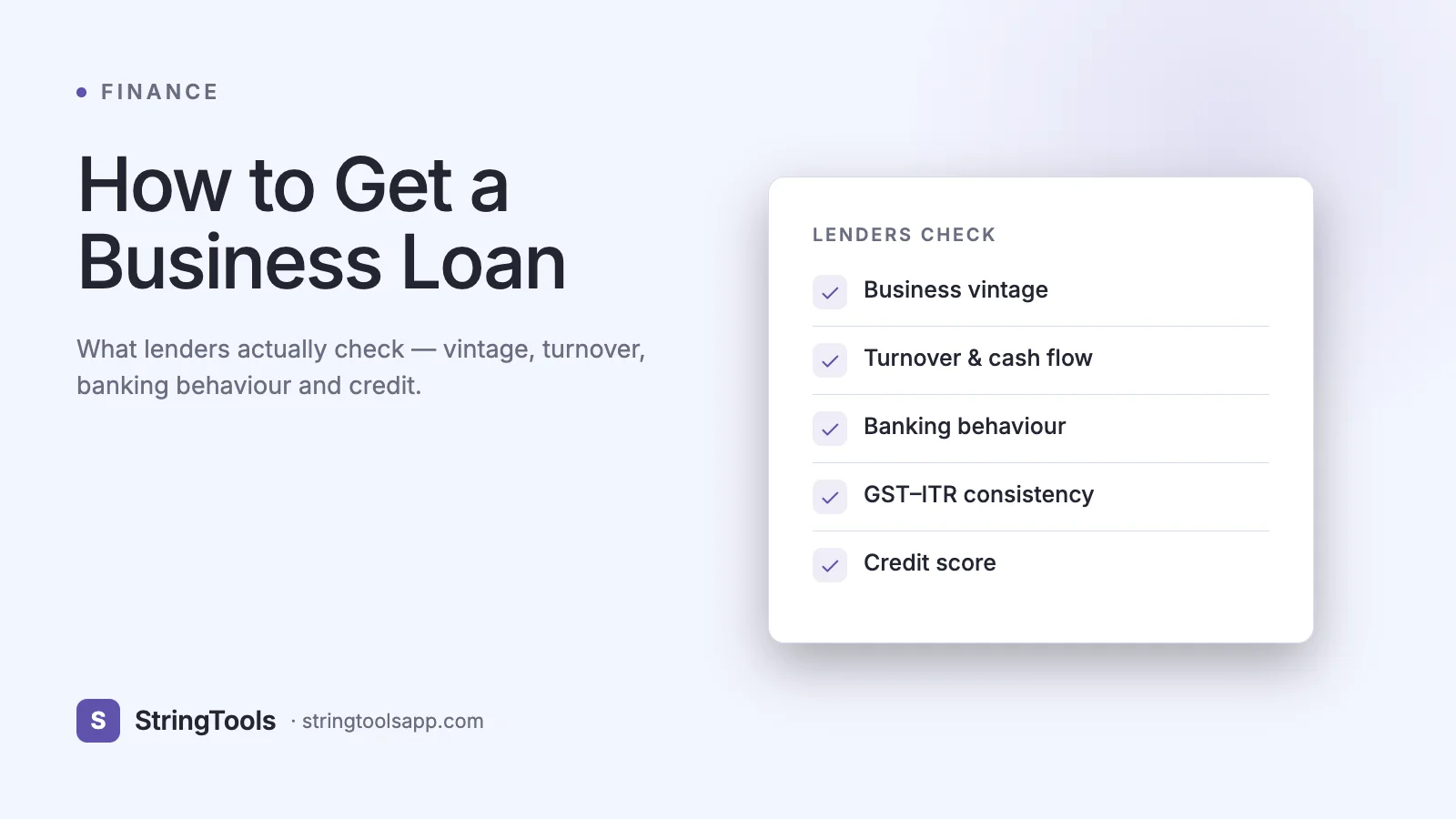
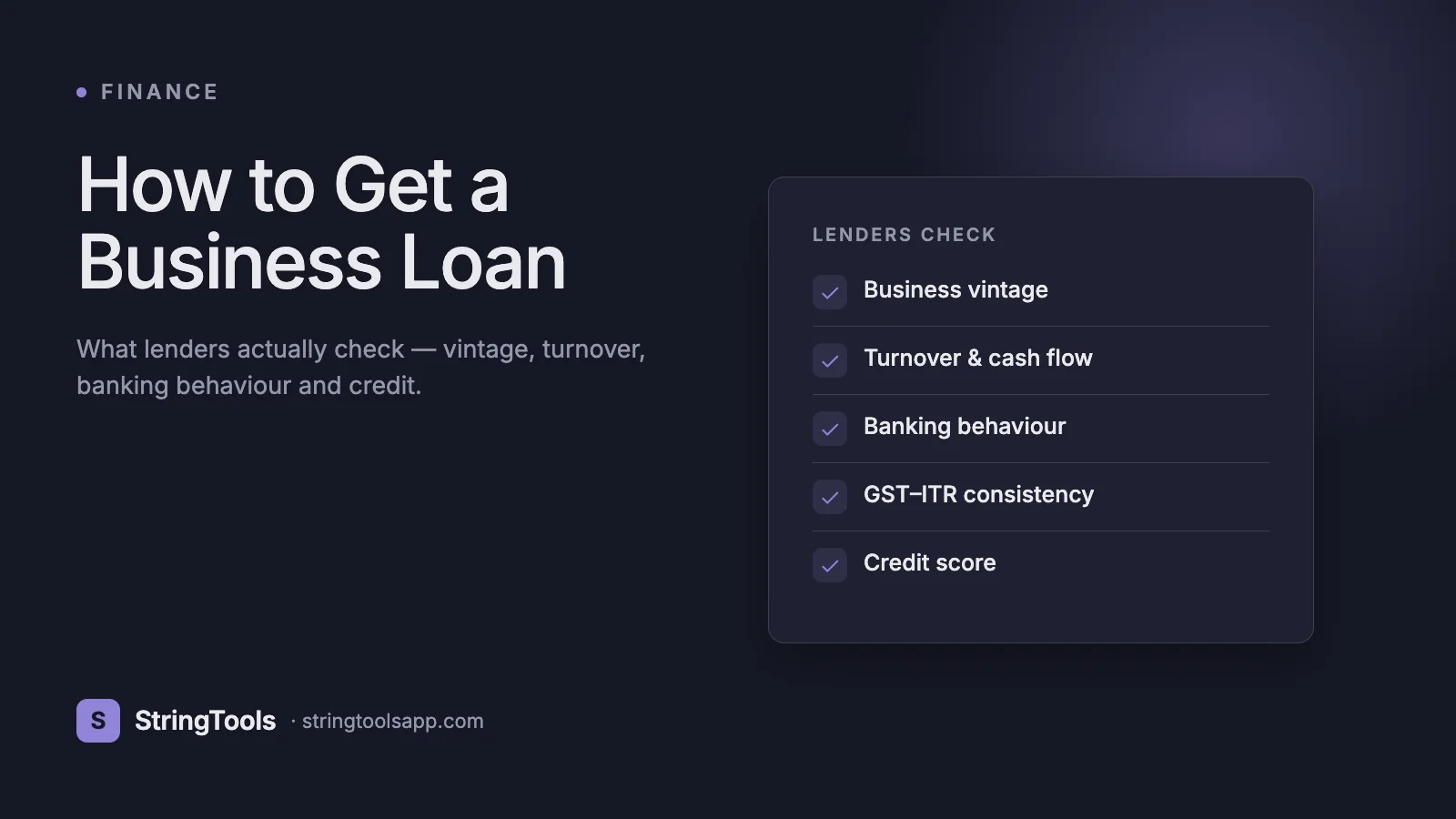
- Six checks decide the outcome: business vintage (two to three years for unsecured loans), turnover and margins, banking behaviour, existing obligations, GST-ITR consistency, and both the promoter's personal and the business's commercial credit scores.
- Match the product to the need: term loan for one-time investments, overdraft for working-capital gaps, invoice financing for slow-paying buyers, equipment finance and loan against property when you can pledge security.
- Collateral-free loans exist but cost more; government schemes like Mudra, CGTMSE and the US SBA guarantee part of the loan so banks can lend without security.
- Rate matters more than it looks: on a ₹10,00,000 loan over 36 months, moving from 14 percent to 16 percent costs roughly ₹35,258 extra in interest.
- Route your real revenue through the current account and file consistent returns for six to twelve months before you apply.
Profitable businesses get rejected for loans because lenders approve the paper trail, not the pitch. Cash sales that never reach a bank account, GST returns that do not match the income tax filing, and cheque bounces in recent statements make even a genuinely strong business unreadable to an underwriter — so the application is declined on documentation, not performance.
Here is a pattern every loan officer has seen a hundred times. A business owner walks in with a genuinely good business — steady customers, decent margins, maybe even a growth story worth telling. The application gets declined anyway. Not because the business is bad, but because the paperwork tells a different story than the owner does: cash sales that never touched a bank account, a GST return that does not match the income tax filing, three cheque bounces from a month when a big client paid late.
Business lending is fundamentally different from salaried lending. A salaried borrower has one clean, verifiable income stream. A business has revenue that fluctuates, expenses that blur into personal spending, and documentation spread across bank statements, tax returns and, in India, GST filings. Lenders cannot sit in your shop and watch customers come in. They can only read the paper trail — so the paper trail is what gets approved or rejected, not the business itself.
The good news is that this is fixable, and mostly fixable by you. Underwriting criteria at banks and NBFCs are surprisingly consistent, and once you know the five or six things every credit team checks, you can prepare for them months in advance. This guide walks through exactly what those checks are, which loan type fits which need, what a realistic offer looks like in numbers, and the mistakes that quietly sink otherwise strong applications.
The Six Things Underwriters Actually Check
Business lenders check six things before approving: how long your business has operated, your turnover and margins, your banking behaviour, your existing loan obligations, whether your GST and income-tax returns agree, and both the promoter's personal credit score and the business's commercial credit report.
Business vintage. Most lenders want to see that your business has survived long enough to prove it is not a hobby or a launch that might fizzle. Two to three years of operations is the commonly preferred threshold for unsecured business loans, though some lenders accept less for secured products or existing customers. Vintage is usually verified through your registration documents, GST registration date, or the age of your current account — so a business that operated informally for five years but registered last year may be treated as a one-year-old business.
Turnover and margins. Lenders look at your declared annual turnover and, more importantly, whether the loan amount you are asking for is proportionate to it. A request for a loan several times your annual revenue raises immediate questions. They also look at margins: two businesses with identical turnover can get very different offers if one runs at 3 percent net margin and the other at 15 percent, because margin is what actually repays the EMI.
Banking behaviour. This is the check most applicants underestimate. Underwriters study six to twelve months of bank statements looking at average monthly balances, the regularity of credits, how much of your declared turnover actually flows through the account, and — critically — cheque or mandate bounces. Repeated bounces, even small ones, signal cash-flow stress and can sink an application on their own. A business that routes most sales through its current account looks far stronger than one with the same real revenue collected in cash.
Existing obligations. Every EMI you already pay — business loans, personal loans, vehicle loans, credit card dues — reduces the surplus available for a new EMI. Lenders compute a coverage ratio between your cash flows and your total obligations including the proposed loan. If existing debt already consumes most of your monthly surplus, the new loan gets declined or downsized regardless of how good the business looks.
GST and ITR consistency. In India, this has become one of the fastest checks lenders run. Your GST returns, income tax returns and bank statements should broadly tell the same story. If your GST filings show one turnover, your ITR shows another, and your bank credits support neither, the underwriter does not know which number to believe — and lenders price uncertainty as risk or simply decline. Filed, consistent returns matter more to an approval than any pitch deck ever will.
Credit scores — both of them. For proprietorships and small companies, lenders check the promoter's personal credit score alongside the business's commercial credit report (in India, a CIBIL score for the individual and a commercial rank for the entity; in the US, personal FICO plus business credit files). A promoter with late personal EMIs will drag down the application even if the business itself has never borrowed. Keep both records clean, because in small-business lending the owner and the business are effectively underwritten together.
Which Type of Business Loan Fits Which Need
Match the loan product to the need: a term loan for one-time, defined investments; a working capital overdraft for day-to-day cash-flow gaps; invoice financing when buyers pay on 30 to 90 day terms; equipment finance for machinery with a resale market; and a loan against property for larger amounts, longer tenures and lower rates.
Business borrowers often apply for the wrong product — asking for a term loan when they need a credit line, or funding machinery with expensive unsecured money. Matching the product to the need lowers your cost and raises your approval odds, because lenders approve more readily when the purpose and the product line up.
| Product | Best for | Secured? | Notes |
|---|---|---|---|
| Term loan | One-time, defined investments like renovation, a new location or a marketing push | No (unsecured unless large) | Interest on the full amount from day one; one to five year tenure |
| Working capital / overdraft | The day-to-day gap between paying suppliers and collecting from customers | Often against stock or receivables | Pay interest only on the amount drawn; typically renewed annually |
| Invoice financing / bill discounting | Selling to larger companies on 30 to 90 day credit terms | Backed by the unpaid invoice | Your customer's creditworthiness matters as much as yours |
| Equipment / machinery finance | Buying vehicles, machinery or equipment with a resale market | Yes — the equipment is security | Lower rates and easier eligibility than unsecured loans |
| Loan against property | Larger amounts, longer tenures and lower rates | Yes — your property | The property is at risk if the business fails |
Term loan. A lump sum repaid in fixed EMIs over one to five years (longer if secured). Best for one-time, defined investments: renovating premises, opening a new location, a large marketing push. You pay interest on the full amount from day one, so it is the wrong tool for fluctuating needs.
Working capital loan or overdraft. A sanctioned limit you can draw from and repay as needed, paying interest only on the amount actually used. Best for the day-to-day gap between paying suppliers and collecting from customers — inventory purchases, seasonal stocking, payroll during slow months. Typically renewed annually and often requires stock or receivables statements.
Invoice financing or bill discounting. The lender advances you a large share of an unpaid invoice's value and recovers it when your customer pays. Best when you sell to larger companies on 30 to 90 day credit terms and the waiting is what starves your cash flow. Your customer's creditworthiness matters as much as yours, which can help newer businesses with strong buyers.
Equipment or machinery finance. A loan specifically to buy equipment, where the equipment itself serves as security. Because the lender holds collateral, rates are usually lower than unsecured loans and eligibility is easier. Best for vehicles, machinery, medical or restaurant equipment — anything with a resale market.
Loan against property. If you own commercial or residential property, pledging it typically unlocks larger amounts, longer tenures and lower rates than any unsecured option. The trade-off is obvious: the property is at risk if the business fails. Because these behave like secured home lending, a mortgage calculator is the right tool to model the long-tenure EMIs before you commit.
Business Loans Without Collateral, and Government-Backed Schemes
Collateral-free business loans absolutely exist — unsecured business loans are a core product at most banks and NBFCs — but understand the trade you are making. Because the lender has no asset to fall back on, unsecured loans carry higher interest rates, shorter tenures and stricter eligibility: this is where the two-to-three-year vintage preference, clean banking and consistent returns are enforced most rigidly. Amounts are also smaller relative to turnover than secured options.
Governments run schemes specifically to soften this problem for small businesses. In India, the MSME ecosystem includes the Mudra scheme for micro and small enterprises and the CGTMSE credit-guarantee framework, under which the government guarantees a portion of the loan so that banks can lend to small businesses without demanding collateral. Loan limits, guarantee coverage and eligibility rules under these schemes are revised periodically, so treat any specific number you read online as potentially outdated and confirm current limits on the official scheme portals or with the lending bank directly. In the US, SBA-guaranteed loans work on a similar principle — a government guarantee that reduces the bank's risk — and the UK, Canada and Australia each run comparable small-business guarantee or start-up loan programs.
Two practical notes on these schemes. First, the government is usually the guarantor, not the lender — you still apply through a bank or NBFC, and that bank still runs the same underwriting checks on your banking and returns, so scheme eligibility does not replace financial hygiene. Second, guaranteed loans often take longer to process than plain-vanilla commercial loans because of the additional documentation, so they suit planned expansion better than urgent cash needs.
A Worked Example: What Two Percentage Points Really Cost
On a ₹10,00,000 business loan repaid over 36 months, moving from 14 percent to 16 percent raises the EMI by only about ₹979 a month but adds roughly ₹35,258 in total interest over the tenure. Two percentage points look trivial on a sanction letter; across the full repayment schedule they are not.
Business loan rates vary widely — by lender type, by whether the loan is secured, and by how strong your file is. Unsecured business loans commonly price several percentage points above home-loan rates, and NBFCs typically price above banks (worth weighing when you read bank vs NBFC) in exchange for faster, more flexible approval. Rather than quote rates that will be stale in six months, here is the arithmetic that stays true forever: what a two-point rate difference does to the same loan.
Take a loan of ₹10,00,000 repaid over 36 months. Using the standard EMI formula — EMI equals P times r times (1+r)^n divided by ((1+r)^n minus 1), where r is the annual rate divided by 12 and divided by 100, and n is the number of months — at 14 percent per annum the EMI works out to about ₹34,178. Over 36 months you repay roughly ₹12,30,395 in total, of which about ₹2,30,395 is interest.
Now the same loan at 16 percent: the EMI rises to about ₹35,157 — only ₹979 more per month, which is easy to shrug off. But total interest climbs to about ₹2,65,653. That casual-looking two-point difference costs you roughly ₹35,258 over three years, on a single mid-sized loan. Scale that to a ₹50 lakh loan or a five-year tenure and the gap runs into lakhs.
This is why comparing offers is not a formality. Two lenders looking at the same file routinely quote rates two or three points apart, because each prices your risk against its own portfolio. Before accepting any sanction letter, run the numbers yourself with an EMI calculator, and use a loan calculator to see the full amortization schedule — how much of each payment goes to interest versus principal, and what prepaying in year one actually saves. And if you are borrowing to fund an investment in the business, sanity-check the other side too: a compound interest calculator will show you what the money needs to earn to beat the cost of the debt.
The Documents Lenders Will Ask For
For a business loan in India, lenders typically ask for KYC and PAN of both the business and the promoter, business registration proof, the last six to twelve months of current account bank statements, two to three years of income tax returns with financials, recent GST returns, and details of existing loans.
Document lists vary slightly by lender and by loan type, but almost every business loan application in India draws from the same core set. Having these ready before you apply is the single easiest way to cut approval time from weeks to days.
KYC of the business and the promoter. Business registration proof (GST certificate, Udyam registration, shop and establishment licence, or incorporation documents for companies), PAN of both the entity and the promoter, and address proof for both.
Bank statements. Typically the last six to twelve months of your primary current account. This is where banking behaviour gets judged, so the account you submit should be the one your real revenue flows through.
Income tax returns. Usually the last two to three years of ITRs with computation of income, and audited financials (balance sheet and profit-and-loss) where applicable. Newer or smaller businesses may be asked for provisional financials instead.
GST returns. Commonly the last six to twelve months of filings, which the lender cross-checks against your bank credits and ITR turnover.
Proof of existing obligations. Sanction letters or statements for current loans, so the lender can compute your total obligations accurately rather than guessing from bureau data.
Purpose documents, where relevant. A quotation for the machinery in equipment finance, property papers for a loan against property, or the invoices themselves for invoice financing.
For lenders in the US, UK, Canada and Australia the shape is the same even if the names differ: business registration, business and personal tax returns, bank statements, financial statements and details of existing debt. Everywhere in the world, the file that gets approved fastest is the one where all these documents tell one consistent story.
Common Mistakes and Myths That Sink Applications
The mistakes that most often sink business loan applications are: believing turnover matters more than banking behaviour, applying to many lenders at once, ignoring small cheque bounces, under-reporting income to save tax, assuming a good pitch offsets weak paperwork, taking the first fast offer, and confusing flat rates with reducing-balance rates.
Believing turnover matters more than banking. Owners love quoting their annual sales figure, but underwriters believe bank statements over claims. If you do ₹1 crore in sales but only ₹30 lakh moves through your account, you will be assessed — and offered a loan — as a ₹30 lakh business. Routing revenue through your current account for at least six to twelve months before applying is the highest-return preparation you can do.
Applying to many lenders at once. Every formal application triggers a hard credit inquiry, and a burst of inquiries in a short window makes you look credit-hungry, which itself lowers your score and spooks subsequent lenders. Shortlist first, compare on paper, then apply to one or two.
Ignoring small bounces. A ₹5,000 mandate bounce feels trivial when a client paid late, but bounces are among the loudest red flags in a bank statement. Keep a buffer in the account your EMIs and mandates hit, especially in the months before you apply.
Under-reporting income to save tax, then asking for a big loan. This is the classic small-business trap: minimise declared profit for years, then discover no lender will believe you can service the EMI. The ITR you file this year is the eligibility you will have two years from now. Filed, honest returns are a financing asset.
Assuming a great pitch compensates for weak paperwork. Business-loan underwriting at banks and NBFCs is document-driven and increasingly automated. Nobody scores your vision statement. A boring business with clean banking, consistent GST and ITR filings, and no bounces beats an exciting business with messy accounts every single time.
Taking the first offer because it came fast. As the worked example above showed, a two-point rate difference on a mid-sized loan costs tens of thousands. Speed is worth something when cash flow is burning, but it is rarely worth two percentage points for three years.
Confusing flat rates with reducing-balance rates. Some lenders quote a flat rate that is applied to the original principal for the whole tenure, which makes the effective reducing-balance rate dramatically higher than the headline number. Always ask for the effective annualised rate and verify the quoted EMI yourself before signing.
Finding the Right Lender Without Applying Everywhere
The way to find the right lender without applying everywhere is to prepare one clean, consistent file, then compare multiple offers from a single submission — getting soft quotes from several RBI-regulated banks and NBFCs at once lets lenders compete on rate, tenure and fees without a burst of hard credit inquiries.
By now the strategy should be clear: prepare the file lenders want to see — clean banking, consistent returns, both credit scores in shape — pick the product that matches the need, and then compare seriously, because pricing on the same file genuinely varies from lender to lender. The hard part is the last step. Approaching banks and NBFCs one by one is slow, and each formal application adds a hard inquiry to your credit report.
That is exactly why comparison is the highest-value step. Instead of visiting ten branches, get quotes from several RBI-regulated banks and NBFCs — or a reputable, regulated comparison marketplace. Compare the offers side by side — rate, tenure, processing fee, prepayment terms — and proceed only with the lender you choose.
Whatever offers you receive, verify them independently before signing. Put the sanctioned amount, rate and tenure into an EMI calculator and confirm the quoted EMI matches; if a lender's number differs from the formula, ask why — the answer is usually a fee or a flat-rate quote hiding in the fine print. For secured, longer-tenure borrowing against property, a mortgage calculator will show you the full interest cost across 10 or 15 years, which is where long tenures quietly get expensive.
A good business loan is not the one with the friendliest relationship manager or the fastest phone call. It is the one whose numbers you have checked, from a lender you chose after seeing alternatives. Get your documents consistent, give your bank statements a few clean months, and let lenders compete for your file instead of pleading with one.
This article is general education, not financial advice — eligibility criteria, interest rates, scheme limits and terms vary by lender and change over time, so confirm current details with the lender or official scheme sources before making decisions.
Frequently Asked Questions
What credit score is needed for a business loan?
Most Indian lenders prefer a personal credit score of roughly 700 or above for the promoter on unsecured business loans, though exact cutoffs vary by lender and are stricter for collateral-free products. For proprietorships and small companies, lenders check both the promoter's personal score and the business's commercial credit report, so both need to be clean. A lower score does not always mean rejection — secured loans, government-guaranteed schemes and NBFCs offer more flexibility — but it usually means a higher rate.
Can I get a business loan without collateral?
Yes. Unsecured business loans are a standard product at banks and NBFCs, but they come with higher interest rates, shorter tenures and stricter eligibility — typically two to three years of business vintage, healthy bank statements and consistent tax filings. In India, government-backed frameworks like Mudra and CGTMSE let banks lend to micro and small enterprises without collateral because the government guarantees part of the loan; current limits and eligibility should be confirmed on official scheme portals since they are revised periodically.
How many years of business vintage do lenders require?
Two to three years of operations is the commonly preferred minimum for unsecured business loans, verified through registration documents, GST registration date or the age of your current account. Some lenders accept around one year for secured products, equipment finance or existing account holders. Note that vintage is counted from formal registration, not from when you informally started — a business that ran in cash for years but registered recently is treated as a new business.
What documents are required for a business loan in India?
The core set is: KYC and PAN of both the business and the promoter, business registration proof (GST certificate, Udyam registration or incorporation documents), the last six to twelve months of current account bank statements, two to three years of income tax returns with financials, recent GST returns, and details of existing loans. Purpose-specific documents like machinery quotations or property papers apply to equipment finance and loans against property. Files where the GST, ITR and bank statement figures match get approved fastest.
What is the difference between a term loan and a working capital loan?
A term loan is a lump sum repaid in fixed EMIs over a set tenure — right for one-time investments like renovation or expansion, but you pay interest on the full amount from day one. A working capital loan or overdraft is a sanctioned limit you draw from and repay as needed, paying interest only on the amount used — right for inventory, payroll and the gap between paying suppliers and collecting from customers. Using a term loan for fluctuating needs means paying interest on money sitting idle.
Why do banks reject business loans even when the business is profitable?
The most common reasons are documentation, not profitability: revenue collected in cash that never appears in bank statements, mismatches between GST returns, ITR and banking, cheque or EMI bounces in recent statements, high existing obligations, or under-reported income filed to save tax. Lenders underwrite the paper trail, not the shop floor. Routing sales through your current account, filing consistent returns and keeping six clean months of banking before applying fixes most of these rejections.
Sources and references
Mudra scheme (mudra.org.in) · SBA-guaranteed loans (sba.gov) · RBI-regulated (rbi.org.in). Content was reviewed against these sources as of the last-updated date above; external figures and rules may change after publication.