
The Question Every Borrower Faces Sooner or Later
Key Takeaways
- Registered NBFCs are supervised by the Reserve Bank of India, so as a borrower your protections are broadly the same as at a bank; the real danger is unregistered lending apps, not NBFCs.
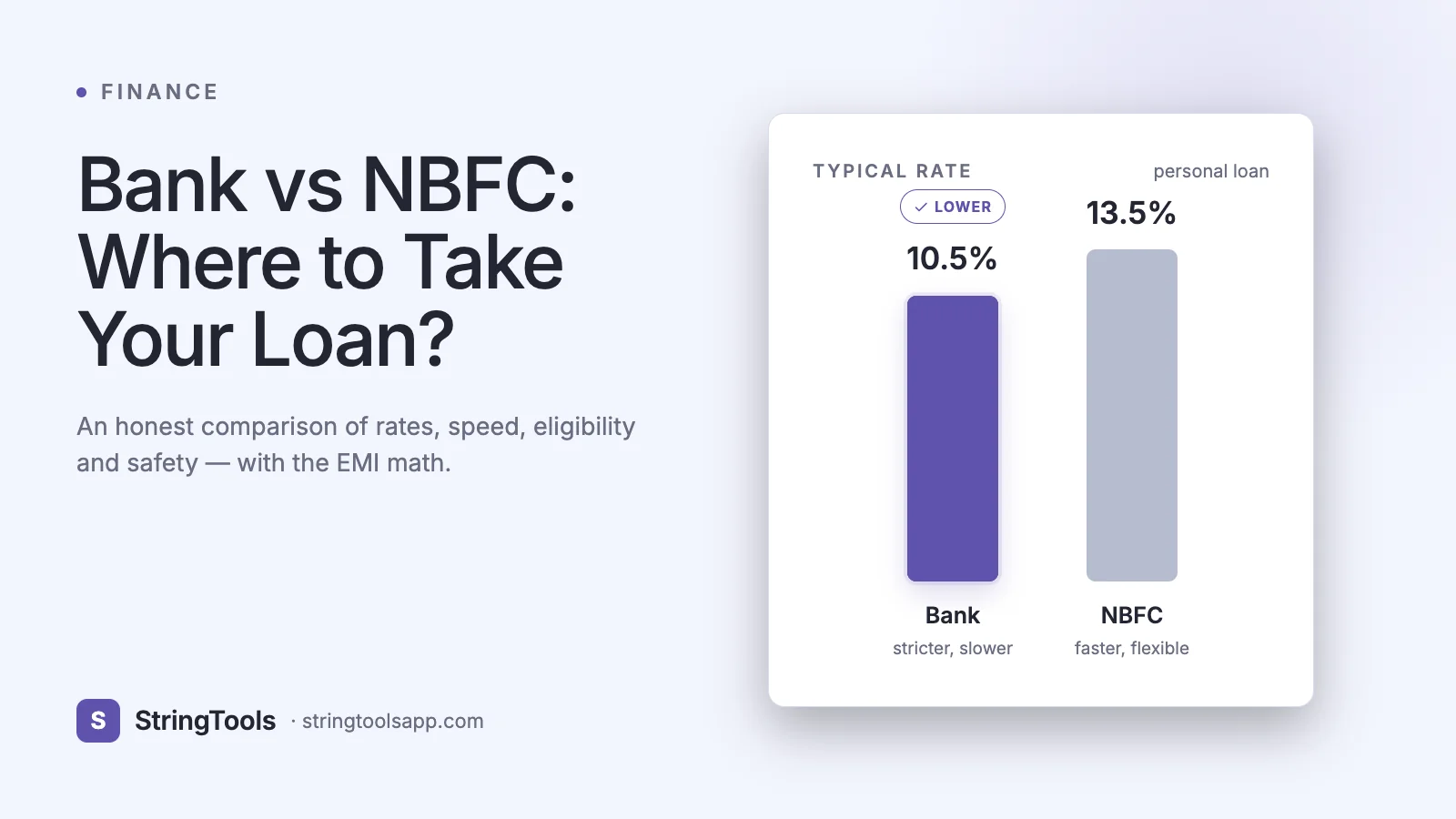
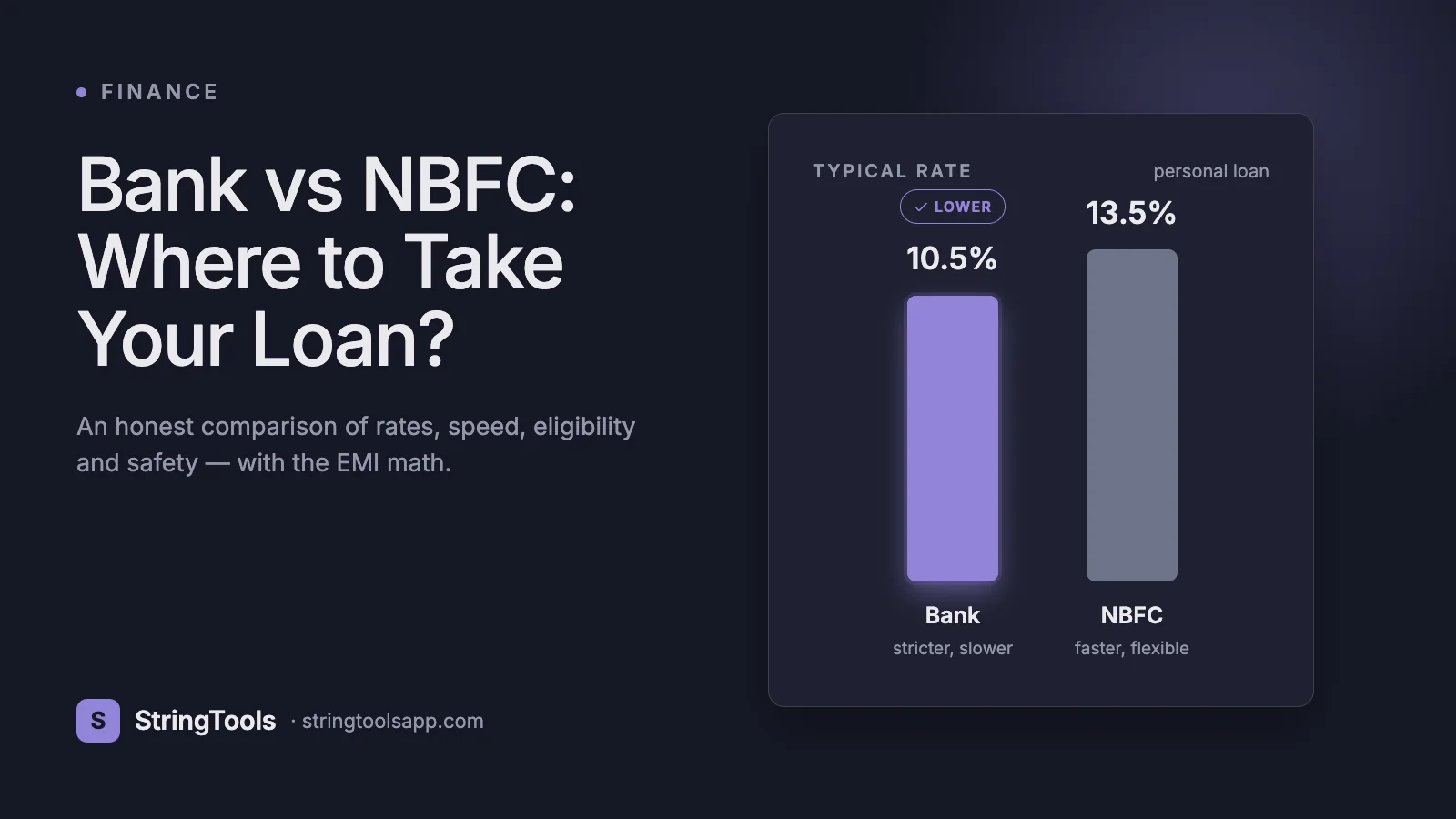
- Banks are usually cheaper by roughly half a percentage point to two percentage points, because they fund loans from low-cost deposits that NBFCs cannot take.
- On a Rs 30 lakh, 20-year home loan, a one-point gap (8.5 vs 9.5 percent) costs about Rs 1,929 more every month and roughly Rs 4.6 lakh more in interest over the tenure.
- NBFCs win on speed and flexibility: personal loans can be sanctioned in hours, and thin-file or self-employed borrowers get a fairer hearing.
- A smart middle path is to take an NBFC loan now, repay cleanly for 12 to 24 months, then move the balance to a bank via balance transfer.
- Whatever you choose, judge the loan on the Key Fact Statement's all-in rate, not the headline number or the sales pitch.
Every borrower eventually faces the same choice: take the loan from a bank or from an NBFC. Banks are usually cheaper by roughly half a point to two percentage points, while NBFCs approve faster and read imperfect profiles more fairly. The right answer depends on your credit profile, income documentation, and urgency.
You need a loan. Maybe it is a home loan for a flat you have already booked, a personal loan for a medical bill, or working capital for your business. You walk into a bank first, because that is what everyone does. The bank quotes a decent rate, then asks for three years of income tax returns, six months of bank statements, and two weeks of patience. Meanwhile, an NBFC has already called you twice with a pre-approved offer that could be disbursed by Friday. The catch: the NBFC's rate looks about one percentage point higher.
So which do you choose? Ask around and you will get two confident, opposite answers. One camp says banks are always cheaper and safer, so anything else is a mistake. The other says banks reject anyone whose income does not arrive as a neat monthly salary credit, so NBFCs are the only realistic option for millions of self-employed people.
The honest answer is that both camps are right about different borrowers. Banks and NBFCs are built differently, funded differently, and regulated under different rulebooks, and those structural differences show up as real trade-offs in rate, speed, and flexibility. This guide walks through exactly what separates them, works out what a typical rate gap costs in actual rupees, and gives you a simple framework for deciding which side of the fence you belong on. The same logic applies if you are reading this in the US, UK, Canada, or Australia, where the equivalent choice is between traditional banks and non-bank lenders such as fintech and specialist mortgage companies.
Banks and NBFCs: What Actually Separates Them
What separates a bank from an NBFC is legal structure and funding, not legitimacy. Banks are licensed under the Banking Regulation Act and fund loans from low-cost, DICGC-insured deposits; registered NBFCs operate under the RBI Act, cannot take such deposits, and borrow at higher cost, which is why their loan rates run higher.
Start with the fear question, because it blocks everything else: is an NBFC even legitimate? In India, yes. Registered NBFCs (non-banking financial companies) are regulated by the Reserve Bank of India, just as banks are. The difference is not regulated versus unregulated; it is two different regulatory frameworks. Banks are licensed under the Banking Regulation Act and can accept demand deposits, which means your savings and current accounts, and those deposits carry DICGC insurance up to a limit. NBFCs are registered with the RBI under the RBI Act, cannot offer savings or current accounts, and most cannot accept public deposits at all. Since 2022, larger NBFCs face progressively stricter RBI supervision under what is called scale-based regulation, so the big housing finance and consumer lending NBFCs operate under meaningful oversight.
Here is the part most comparison articles miss: the deposit difference matters enormously if you are a depositor, but you are a borrower. As a borrower, your protection comes from the loan agreement, RBI's fair practices rules, and your right to escalate complaints against both banks and NBFCs through the RBI's Integrated Ombudsman Scheme. On that front, a registered NBFC borrower is not meaningfully worse off than a bank borrower.
Where the deposit difference does hit you is pricing. Banks fund loans largely from low-cost deposits sitting in savings accounts. NBFCs cannot do that; they borrow from banks and bond markets at higher cost and lend that money onward. That is the structural reason NBFC rates tend to run higher, and it is not going away. There is also a transparency difference: floating-rate retail loans from banks are typically linked to an external benchmark such as the repo rate, so policy rate cuts flow through to your EMI relatively quickly. NBFCs generally price off their own internal benchmark rates, where transmission is slower and less predictable.
Side by Side: How They Compare on the Factors That Matter
Take your loan from a bank if you have a strong credit score and clean, documented salaried income, because banks usually price roughly half a point to two percentage points cheaper. Choose an NBFC when you are self-employed, have a thin or blemished credit file, or need funding within days.
| Factor | Bank | NBFC |
|---|---|---|
| Interest rate | Usually lower for comparable borrowers | Roughly 0.5 to 2 points higher (costlier funds) |
| Approval speed | Slower; more credit-approval layers | Hours to a day or two; home loans in days |
| Eligibility flexibility | Wants 750-plus score and stable salaried income | Reads bank-statement cash flow; thin-file OK |
| Regulation | Banking Regulation Act; takes DICGC-insured deposits | RBI Act; scale-based supervision, no deposits |
| Prepayment | No penalty on floating individual loans | Same rule; foreclosure charges common on fixed-rate |
Interest rates. Banks are usually cheaper, often by roughly half a percentage point to two percentage points for comparable borrowers, though the exact gap varies by product, lender, and your profile. For top-tier salaried applicants the gap is widest; for riskier profiles an NBFC quote may actually beat the rate a hesitant bank would offer, if the bank offers anything at all.
Processing speed. NBFCs win clearly. Personal loans from digital NBFCs can be sanctioned in hours and disbursed in a day or two; home loans often move in days rather than weeks. Banks typically take longer, especially public sector banks, because credit approval passes through more layers.
Eligibility and credit score. Banks generally want a strong bureau score (750 plus is the commonly cited comfort zone), stable salaried income, and a clean repayment history. NBFCs are built to look deeper: many will assess bank statement cash flows, business receipts, or alternative data, and will lend to thin-file or lower-score borrowers at a price.
Documentation. Banks tend to want the full formal stack, including income tax returns and audited financials for the self-employed. NBFCs frequently offer surrogate or low-documentation programs that infer income from banking behaviour instead.
Flexibility on the asset and amount. NBFCs are often more accommodating on property types, older buildings, or loan structures that banks decline, and may stretch loan-to-value or tenure further within regulatory limits. If you are still working out how much you can borrow, that flexibility can be the difference between a sanction and a rejection.
Prepayment and foreclosure. For floating-rate loans taken by individuals for non-business purposes, RBI rules bar prepayment penalties, and that protection covers banks and NBFCs alike. On fixed-rate loans, foreclosure charges are common and NBFCs typically charge them, often in the range of a few percent, so read this clause before signing.
Recourse if things go wrong. Both are covered by RBI grievance mechanisms and the ombudsman. The genuine safety gap is not bank versus NBFC; it is regulated lender versus unregistered app, which we cover below.
The Rate Gap in Real Money: A Worked Example
On a Rs 30 lakh, 20-year home loan, a one-percentage-point rate gap (8.5 versus 9.5 percent) raises the EMI from about Rs 26,035 to about Rs 27,964, which is Rs 1,929 more every month, and adds roughly Rs 4.6 lakh in interest over the full tenure.
Percentages hide the pain, so let us convert a typical gap into rupees. Suppose you need a home loan of Rs 30 lakh over 20 years. A bank offers 8.5 percent per year and an NBFC offers 9.5 percent. These are illustrative figures for the calculation, not current quotes; actual rates change over time and vary widely by lender and borrower profile.
The EMI follows the standard amortization formula: EMI equals P times r times (1+r) to the power n, divided by ((1+r) to the power n minus 1), where P is the principal, r is the monthly rate (annual rate divided by 12 and by 100), and n is the number of monthly instalments.
At 8.5 percent, the monthly rate is 0.7083 percent and n is 240 months. The EMI works out to about Rs 26,035. Over the full tenure you would pay roughly Rs 62.48 lakh in total, of which about Rs 32.48 lakh is interest.
At 9.5 percent, the monthly rate is 0.7917 percent. The EMI comes to about Rs 27,964. Total payments run to roughly Rs 67.11 lakh, with about Rs 37.11 lakh of interest.
So one percentage point costs you about Rs 1,929 more every month and roughly Rs 4.6 lakh more over 20 years on this loan. That is a serious number, and it is why a borrower who qualifies comfortably at a bank should rarely pay the NBFC premium on a long-tenure loan. You can rerun this comparison for your own numbers in seconds with our mortgage calculator or EMI calculator.
But notice what the example assumes: that both lenders actually approve you. If the bank declines and the NBFC approves, the comparison is not 8.5 versus 9.5; it is 9.5 versus no loan. And there is a middle path many borrowers overlook: take the NBFC loan now, repay flawlessly for 12 to 24 months, then move the outstanding balance to a bank through a balance transfer once your credit profile has strengthened. You pay the premium temporarily, not for two decades.
When an NBFC Is Genuinely the Right Call, and When a Bank Wins
An NBFC is genuinely the right call if you have a thin or new credit file, self-employed or irregular income, past credit blemishes, an unusual property, or a deadline where speed is worth money. A bank wins for strong, documented salaried profiles, long tenures, and transparent floating-rate pricing.
Choose an NBFC, without guilt, in these situations.
Thin or new credit file. If you have never had a loan or credit card, many banks simply have nothing to score you on. NBFCs routinely lend to first-time borrowers and, by reporting your repayments to the credit bureaus, help you build the very history banks want to see.
Self-employed with irregular income. If your income is real but lumpy, seasonal, or partly outside formal tax filings, an NBFC that underwrites from bank statements and business cash flow will read your file far more sympathetically than a bank checklist will.
Speed is worth money. A property deal with a payment deadline, a medical emergency, a business opportunity that expires: when a two-week delay costs more than a one-point rate premium, the faster lender is the cheaper lender.
Past credit blemishes or an unusual asset. A settled default from years ago, or a property type banks avoid, often gets a fair hearing at an NBFC and an automatic rejection at a bank.
Choose a bank in these situations.
Strong, documented, salaried profile. If your score is high and your income is clean, banks will compete for you. Take the lowest rate; you have earned it.
Long tenures where small differences compound. On a 20 or 30 year home loan, even half a percentage point compounds into lakhs, as the worked example shows; a compound interest calculator makes the long-run effect uncomfortably vivid.
Floating-rate transparency. If you want policy rate cuts passed to you quickly and predictably, a bank loan linked to an external benchmark is the cleaner instrument.
Existing relationship pricing. Banks often shave rates or fees for customers with salary accounts, deposits, or prior loans. Ask; it is free.
How to Stay Safe: Checks Before You Sign Anything
Before signing with any lender, run four checks: verify the company on the RBI's published list of registered NBFCs at rbi.org.in, insist on a Key Fact Statement showing the all-in annual percentage rate, read the foreclosure and penal-charge clauses, and reject any app showing loan-shark red flags such as upfront fees.
The real safety question is not bank versus NBFC. It is regulated versus unregistered, and this is where borrowers actually get hurt.
Verify the registration. Every legitimate NBFC holds a certificate of registration from the RBI, and the RBI publishes the list of registered NBFCs on its website, rbi.org.in. Before you share documents with any lender you have not heard of, find them on that list. If a lending app is involved, RBI's digital lending rules require the app to clearly disclose which regulated bank or NBFC is actually providing the money, and the funds must flow directly from that lender's account to yours, not through some intermediary's wallet.
Demand the Key Fact Statement. RBI requires lenders to give retail borrowers a Key Fact Statement showing the all-in annual percentage rate, including processing fees and other charges, before you sign. This single document defeats most pricing tricks. If a lender will not produce one, walk away.
Read the agreement, specifically these clauses. Whether the rate is fixed or floating and what benchmark it resets against; foreclosure and part-prepayment charges; penal charges for late payment (RBI rules now require these to be reasonable, disclosed charges rather than compounding penal interest); and any mandatory insurance bundled into the loan, which you can often decline or buy cheaper separately.
Know the red flags of loan sharks in app form. No named RBI-regulated lender behind the app. Demands for an upfront fee into a personal account before sanction. Requests for full access to your phone contacts and photos. Disbursal of a smaller amount than sanctioned with the difference taken as hidden fees. Any of these means uninstall and report; unregistered digital lenders are behind most loan harassment horror stories, and they are neither banks nor NBFCs.
If a regulated lender does treat you unfairly, complain in writing first, and escalate to the RBI Integrated Ombudsman if unresolved. That route covers banks and NBFCs alike, and it is free.
Myths and Mistakes That Cost Borrowers Real Money
The costliest borrower errors are believing registered NBFCs are unregulated, trusting a headline rate instead of the Key Fact Statement, comparing a flat rate with a reducing-balance rate, choosing the lowest EMI by stretching the tenure, and applying to several lenders in quick succession. Every one of them is avoidable.
Myth: NBFCs are unregulated and therefore unsafe. Registered NBFCs answer to the RBI, follow its fair practices code, and fall under the ombudsman scheme. The unsafe players are unregistered apps and offline moneylenders masquerading as NBFCs, which is exactly why the registration check above matters.
Myth: the bank is always cheaper once you actually add everything up. Usually, but not automatically. Compare the total cost, including processing fees, legal and valuation charges, bundled insurance, and the cost of delay. A headline rate is not an offer; a Key Fact Statement is.
Mistake: comparing a flat rate with a reducing-balance rate. Some lenders quote flat rates that look low but are charged on the full original principal for the whole tenure. A flat 10 percent can cost about as much as a reducing-balance rate in the high teens. Always convert both quotes to the same basis; a loan calculator does this for you instantly.
Mistake: choosing whichever loan has the lowest EMI. A lower EMI achieved by stretching the tenure means you pay far more interest overall. Compare total interest across offers, not just the monthly outgo.
Mistake: applying to five lenders one after another. Each formal application can trigger a hard inquiry on your credit report, and a burst of inquiries makes you look desperate to the next underwriter. Shortlist first, then apply narrowly, or use a channel where lenders evaluate your requirement before you formally apply.
Myth: whichever lender you pick, you are stuck for the full tenure. Balance transfer is a standard, widely used product. Starting with an NBFC and refinancing to a bank later is a legitimate strategy, not a failure; just factor in transfer costs and any foreclosure charges on fixed-rate loans.
The Smart Way to Decide: Make Lenders Compete for You
By now the framework should be clear. Strong salaried profile and no urgency: start with banks and negotiate hard. Self-employed, thin file, credit blemishes, or a deadline: give NBFCs a serious look, price the premium honestly, and plan a balance transfer once your profile improves. In every case, judge lenders on the Key Fact Statement, not the sales pitch.
The practical problem is that doing this properly means approaching several banks and several NBFCs, repeating your story each time, and risking a trail of hard inquiries. That is exactly why the comparison step is worth it. Rather than repeating your story at each branch, get quotes from several RBI-regulated banks and NBFCs — or a reputable, regulated comparison marketplace — and compare what each can actually offer someone with your profile. Take the best one, or none at all.
When the offers arrive, verify every number yourself before signing. Put each quote through the EMI calculator to check the instalment, and use the loan calculator or mortgage calculator to see the total interest each offer costs over its full tenure. If an offer's EMI does not match what the formula says it should be, ask the lender why; the answer is usually a fee or an insurance premium quietly folded into the principal.
A bank is not automatically the right answer, and an NBFC is not automatically the expensive one. The right lender is the regulated one that approves your real profile at the lowest total cost, fast enough for your situation, on terms you have actually read. This article is general education, not financial advice; interest rates, charges, and eligibility rules vary by lender and change over time, so confirm current terms directly with any lender before you commit.
Frequently Asked Questions
Is it safe to take a loan from an NBFC?
Yes, if the NBFC is registered with the RBI. Registered NBFCs are supervised by the Reserve Bank of India, must follow its fair practices code, and are covered by the RBI Integrated Ombudsman Scheme, so borrowers have the same complaint route as bank customers. The real risk is unregistered digital lending apps posing as legitimate lenders. Before borrowing, verify the company on the RBI's published list of registered NBFCs at rbi.org.in and insist on a Key Fact Statement showing the all-in cost.
Why are NBFC interest rates higher than bank rates?
It is structural. Banks fund loans largely from low-cost savings and current account deposits, while NBFCs cannot take such deposits and must borrow from banks and bond markets at higher cost, then lend that money onward. NBFCs also serve riskier borrower segments that banks avoid, and risk is priced into the rate. The typical gap for comparable borrowers is roughly half a point to two percentage points, though it varies by product, lender, and profile, and a strong applicant can sometimes negotiate an NBFC rate close to bank levels.
Which is better for a home loan: a bank or an NBFC?
For a salaried borrower with a strong credit score and clean documents, a bank usually wins because even a small rate difference compounds heavily over 20 or 30 years; on a Rs 30 lakh, 20-year loan, one percentage point costs roughly Rs 4.6 lakh extra in interest. An NBFC or housing finance company makes sense if you are self-employed with irregular income, have a thin credit file, need faster processing for a deal deadline, or the property type does not fit bank norms. Many borrowers start with an NBFC and later transfer the balance to a bank.
Can I transfer my NBFC loan to a bank later?
Yes. Balance transfer is a standard product: after you build a clean repayment record, typically 12 to 24 months, a bank can take over your outstanding loan at its lower rate. Before switching, compare the savings against the costs, including the new lender's processing fees and, on fixed-rate loans, any foreclosure charges from your current lender. Note that RBI rules bar prepayment penalties on floating-rate loans taken by individuals for non-business purposes, which makes transfers of such loans cheaper.
Do NBFC loans affect my credit score the same way as bank loans?
Yes. Registered NBFCs report your loan and repayment behaviour to the same credit bureaus as banks, including CIBIL, so timely EMIs build your score and missed payments damage it identically. This cuts both ways: an NBFC loan repaid well is a legitimate way for first-time borrowers to build the credit history that banks want to see before offering their best rates.
How do I check if an NBFC is registered with RBI?
The RBI publishes a list of all registered NBFCs on its official website, rbi.org.in, which you can search by company name. Legitimate NBFCs display their RBI certificate of registration number, and lending apps are required under RBI's digital lending rules to disclose which regulated bank or NBFC is actually funding the loan. If a lender does not appear on the RBI list, will not name its regulated partner, or asks for upfront fees into a personal account, do not proceed.
Sources and references
Reserve Bank of India (rbi.org.in) · CIBIL (cibil.com). Content was reviewed against these sources as of the last-updated date above; external figures and rules may change after publication.