
The question every borrower asks — and why your guess is usually wrong
Key Takeaways
- Lenders do not multiply your salary by a magic number — they cap your total EMIs at a 40–55% FOIR (Fixed Obligations to Income Ratio) and work backwards to a loan amount using the rate and tenure.
- FOIR runs on net, in-hand income — not gross — and always includes the EMI of the new loan you are applying for.
- On a ₹50,000 net salary with no existing EMIs, expect a home loan of roughly ₹27.8 lakh at an illustrative 9% for 20 years under a 50% cap.
- Every ₹1,000 of monthly EMI you already pay costs you about ₹1.1 lakh of home loan eligibility.
- Closing an existing EMI raises eligibility far more than stretching the tenure — killing Priya's ₹15,000 car EMI doubles her eligibility to about ₹33.3 lakh.
- The single biggest jump is usually adding an earning co-applicant, because both incomes then count in the FOIR calculation.
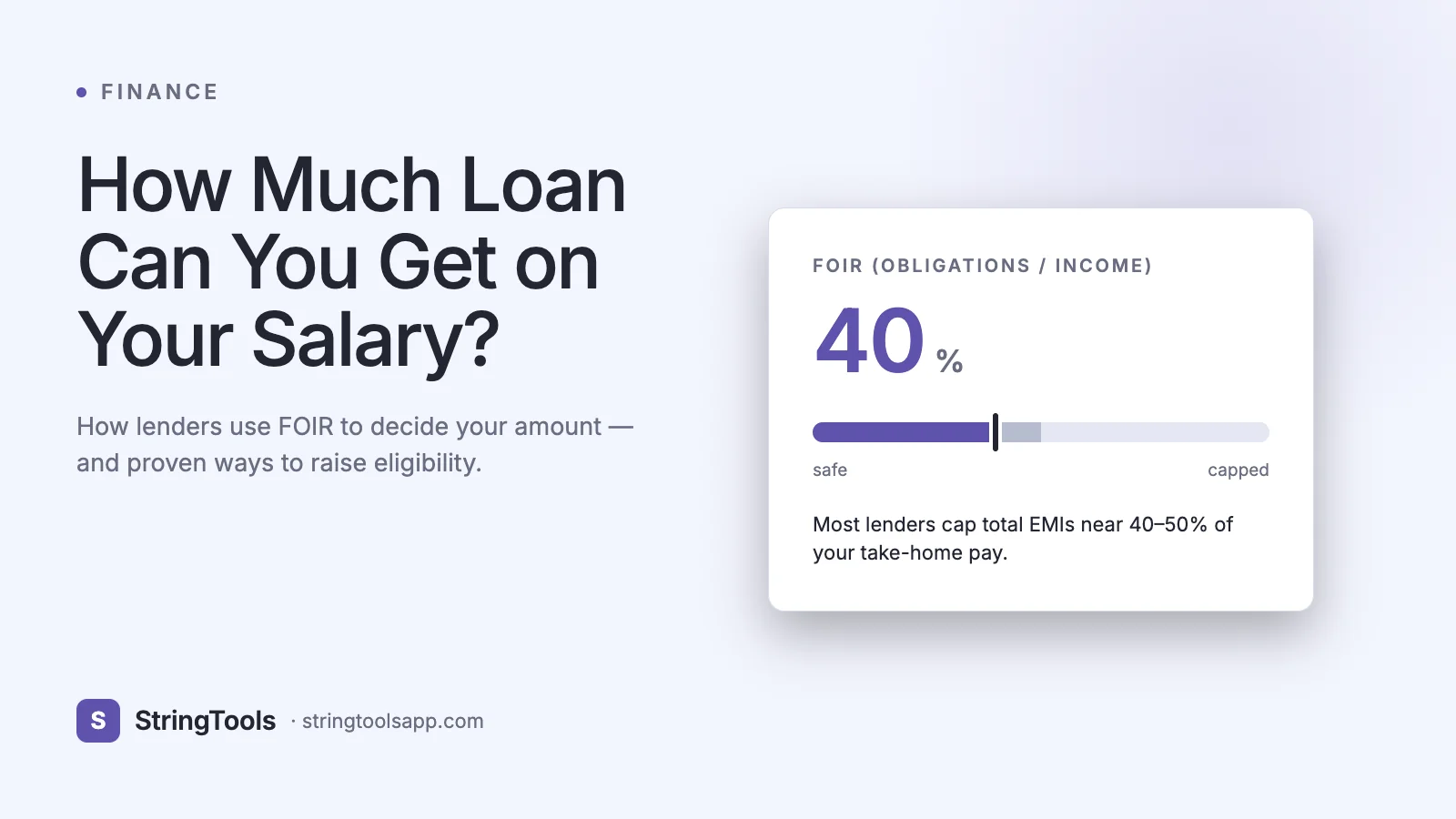
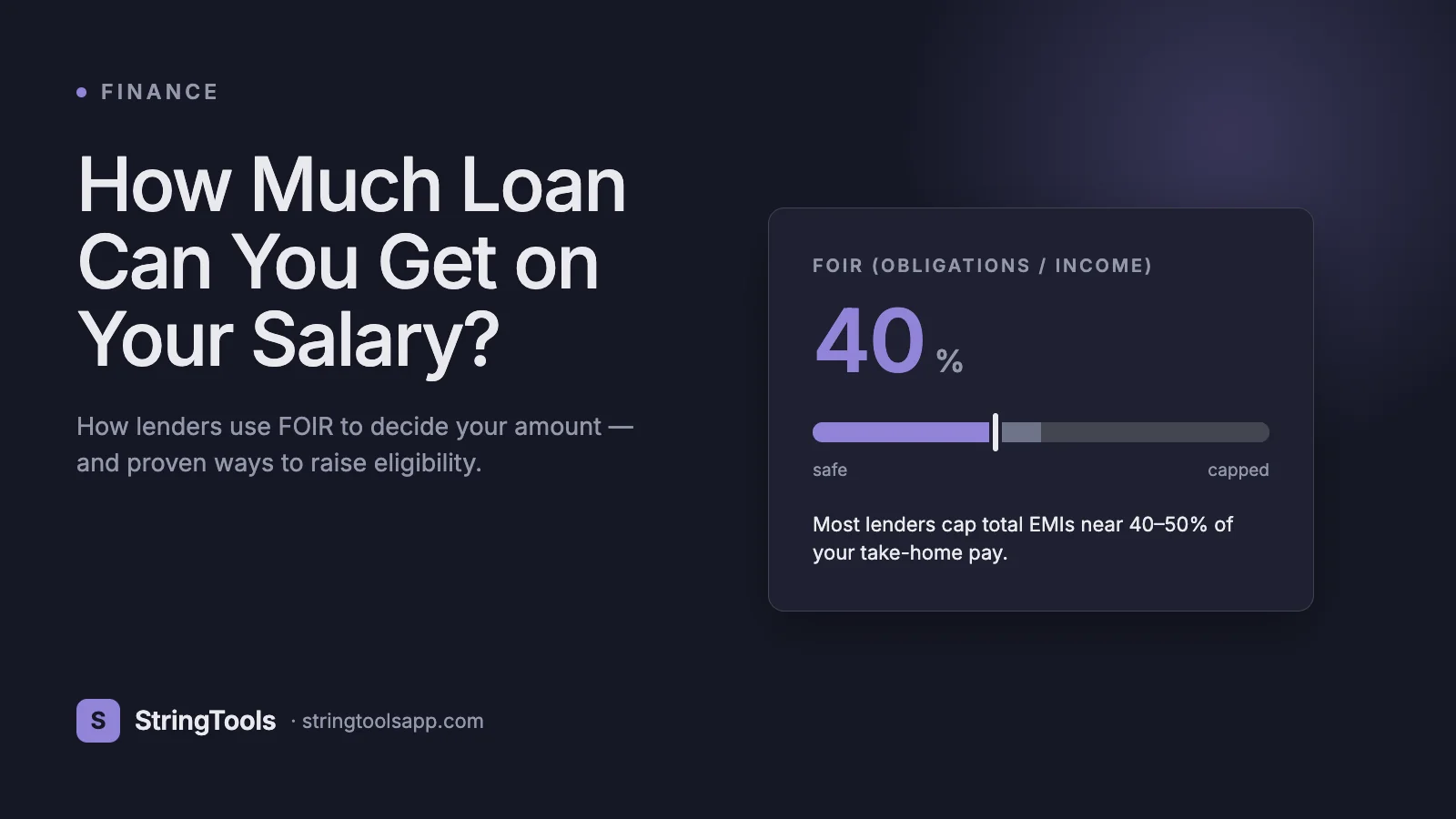
Your guess is usually wrong because loan eligibility is not a multiple of salary. Lenders cap your total EMIs — existing ones plus the new loan's — at 40–55% of your net monthly income, a ratio called FOIR, and then convert the remaining EMI headroom into a loan amount using the interest rate and tenure.
Type your salary into any search engine with the words "how much loan can I get" and you will find a hundred confident answers, most of them contradicting each other. One site says 60 times your monthly salary, another says five times your annual income, a third gives you a number that seems pulled out of thin air. Meanwhile, the bank quotes you a figure that matches none of them.
Here is the truth: lenders do not start with your salary and multiply it by a magic number. They start with your monthly repayment capacity — how much EMI you can safely pay every month after your existing obligations — and then work backwards to a loan amount using the interest rate and tenure. The ratio they use to measure that capacity is called FOIR, short for Fixed Obligations to Income Ratio. In the US, UK, Canada and Australia the same concept goes by DTI, or debt-to-income ratio. Different name, identical logic.
Once you understand FOIR, you can estimate your own eligibility to within a few percent of what the bank will offer, spot exactly which lever to pull if the number is too low, and walk into a negotiation knowing the arithmetic as well as the loan officer does. This article walks through the method with fully worked numbers, a salary-to-loan reference table, and the honest list of what actually increases eligibility.
What FOIR means and how lenders calculate it
FOIR is the percentage of your net monthly income that goes toward fixed obligations. The formula is simple: add up all your monthly EMIs — including the EMI of the new loan you are applying for — plus any other committed payments like existing credit card EMIs, and divide by your net (in-hand) monthly income.
FOIR = (all existing EMIs + proposed new EMI) ÷ net monthly income × 100.
Most lenders cap this ratio somewhere between 40% and 55%. The exact cap varies by lender, by loan type, and by how much you earn — these are typical ranges, not fixed rules, and each bank sets its own policy. Broadly, the pattern looks like this.
Lower incomes, tighter caps. If your net salary is modest — say under roughly ₹35,000 to ₹40,000 a month in India — lenders often cap FOIR around 40% to 45%, because a larger share of a smaller income is needed just for living expenses.
Mid incomes. In the middle band, roughly 50% is the most common ceiling for salaried applicants with stable jobs.
High incomes. For high earners, some lenders stretch to 55% or occasionally more, reasoning that a person taking home several lakh a month can devote a larger fraction to EMIs and still live comfortably.
Note two details that trip people up. First, it is net income, not gross — the amount that actually hits your bank account after tax, provident fund and other deductions. Second, the proposed EMI counts. Many borrowers compute their FOIR using only existing loans, get a comfortable-looking 20%, and are then confused when the bank says no. The bank is testing what your FOIR will be after the new loan, not before it.
For Tier-1 readers: US mortgage lenders typically look for a total DTI around 36% to 43% of gross income (note: gross, not net, which is why the percentage looks lower), UK lenders run affordability stress tests on income and outgoings, and Canadian lenders use GDS and TDS ratios with similar ceilings. The US Consumer Financial Protection Bureau explains the same debt-to-income logic in plain terms for American borrowers. The mechanics below work identically — just swap the currency and the local cap.
From affordable EMI to loan amount: a fully worked example
On a typical salary, your loan amount equals the EMI you can afford — your net income times a 40–55% FOIR cap, minus existing EMIs — converted to a principal at the going rate and tenure. A ₹60,000 net salary carrying a ₹15,000 car EMI, for instance, supports roughly ₹16.7 lakh of home loan under a 50% cap.
Let us walk through the exact calculation a bank does, with real arithmetic. Meet Priya, a salaried professional in India with a net monthly income of ₹60,000. She already pays a car loan EMI of ₹15,000 and wants a home loan.
Step 1: find the FOIR cap. Her lender allows 50% FOIR at her income level. So her total obligations can be at most 50% of ₹60,000 = ₹30,000 per month.
Step 2: subtract existing obligations. ₹30,000 minus the existing ₹15,000 car EMI leaves ₹15,000 per month available for the new home loan EMI.
Step 3: convert that EMI into a loan amount. This uses the standard amortization formula that every EMI calculator runs: EMI = P × r × (1+r)^n ÷ ((1+r)^n − 1), where P is the principal, r is the monthly rate (annual rate ÷ 12 ÷ 100) and n is the number of months. Rearranged to solve for the principal: P = EMI × ((1+r)^n − 1) ÷ (r × (1+r)^n).
At an illustrative 9% per annum for 20 years, r = 0.0075 and n = 240. Plugging in ₹15,000: (1.0075)^240 is about 6.009, so P = 15,000 × (6.009 − 1) ÷ (0.0075 × 6.009) ≈ ₹16.7 lakh. That is Priya's home loan eligibility: roughly ₹16.7 lakh, despite a ₹60,000 salary.
Now see how sensitive this is. If Priya closes the car loan first, the full ₹30,000 becomes available for the home loan EMI, and the same formula gives 2 × 16.7 = about ₹33.3 lakh — her eligibility doubles. If instead she keeps the car loan but stretches the home loan to 25 years, the ₹15,000 EMI supports about ₹17.9 lakh — a gain of just ₹1.2 lakh. Killing the existing EMI is worth far more than adding five years of interest.
The same three steps work for a personal loan; only the rate and tenure change. That same ₹15,000 monthly headroom at an illustrative 14% for 5 years supports only about ₹6.4 lakh, because shorter tenures and higher rates shrink the principal an EMI can carry. You can verify every one of these numbers yourself in a couple of minutes with a loan calculator or, for home loans specifically, a mortgage calculator.
Salary-to-eligible-loan reference table (home loan, illustrative)
At an illustrative 9% for 20 years with no existing EMIs, a ₹30,000 net salary supports roughly ₹15 lakh of home loan, ₹50,000 supports about ₹27.8 lakh, and ₹1,00,000 about ₹55.6 lakh. As a rule of thumb, every ₹1,000 of monthly EMI capacity carries roughly ₹1.1 lakh of home loan.
The figures below show approximate home loan eligibility at different net monthly salaries, assuming no existing EMIs, an illustrative rate of 9% per annum, a 20-year tenure, and a FOIR cap of 45% for salaries up to ₹40,000 and 50% above that. Every number is computed with the amortization formula above. Your actual offer will differ with your lender's FOIR policy, the prevailing rate and your credit profile — treat this as a consistent illustration, not a quote.
| Net monthly salary | FOIR cap | Affordable EMI | Approx. eligible home loan |
|---|---|---|---|
| ₹30,000 | 45% | ₹13,500 | ₹15.0 lakh |
| ₹40,000 | 45% | ₹18,000 | ₹20.0 lakh |
| ₹50,000 | 50% | ₹25,000 | ₹27.8 lakh |
| ₹60,000 | 50% | ₹30,000 | ₹33.3 lakh |
| ₹75,000 | 50% | ₹37,500 | ₹41.7 lakh |
| ₹1,00,000 | 50% | ₹50,000 | ₹55.6 lakh |
| ₹1,50,000 | 50% | ₹75,000 | ₹83.4 lakh |
The ₹50,000 row is the direct answer to the most-searched version of this question: on a ₹50,000 net salary with no other EMIs, expect a home loan offer in the ₹25–28 lakh region under these assumptions.
A useful rule of thumb falls out of this table: at around 9% for 20 years, every ₹1,000 of monthly EMI capacity supports roughly ₹1.1 lakh of home loan. Every existing ₹1,000 EMI you carry costs you that same ₹1.1 lakh of eligibility. Subtract your existing EMIs from your FOIR-capped budget, multiply the remainder, and you have a serviceable estimate before you ever talk to a bank.
FOIR is the ceiling, not the whole story
FOIR sets the maximum EMI a lender will allow, but several other filters decide whether you actually get that maximum, and at what rate.
Credit score. Your score mostly decides approval and pricing rather than the FOIR cap itself, but the two interact: a strong score (roughly 750+ in India, "good" to "excellent" bands abroad) often earns a lower interest rate, and a lower rate means the same EMI supports a larger principal. A weak score can also make a lender apply a more conservative FOIR. You can check your own score free with CIBIL, and our guide on the credit score you need for loan approval breaks down the bands lenders actually use.
Income stability and employer category. Salaried applicants at large, stable employers typically get the friendliest FOIR treatment. Self-employed applicants are assessed on average declared income across two to three years of tax returns, which often lands lower than their real cash flow.
Age and tenure. Lenders usually want the loan to finish before retirement age. A 45-year-old may be offered a maximum 15-year tenure where a 30-year-old gets 25 or 30 years — and shorter tenure directly shrinks the loan the same EMI can support.
Property value, for home loans. Home loans face a second, independent cap: the loan-to-value ratio. The Reserve Bank of India and lenders typically cap home loans at roughly 75% to 90% of the property's value depending on loan size, so even if your salary supports ₹50 lakh, a ₹40 lakh property will not get you a ₹40 lakh loan. Your eligibility is the lower of the FOIR-based number and the LTV-based number.
Personal loan multiplier caps. For unsecured personal loans, many lenders also apply a crude cap of roughly 10 to 20 times net monthly salary regardless of FOIR headroom, since there is no collateral behind the loan.
Five levers that genuinely increase your eligibility
Five levers genuinely raise loan eligibility: closing or consolidating small existing EMIs, adding an earning co-applicant, extending the tenure, documenting every source of income, and shopping across lenders. The first two move the number most — each ₹1,000 of monthly EMI you free up restores roughly ₹1.1 lakh of home loan eligibility.
If the number the bank quotes is short of what you need, these are the levers that actually move it, ranked roughly by impact.
Close or consolidate small loans first. As Priya's example showed, an existing ₹15,000 EMI can halve your home loan eligibility. Even trimming it helps: if she refinanced or partly prepaid the car loan so the EMI dropped from ₹15,000 to ₹8,000, her home loan EMI headroom would rise from ₹15,000 to ₹22,000, lifting eligibility from about ₹16.7 lakh to about ₹24.5 lakh. Small consumer-durable and credit card EMIs are the cheapest eligibility you can buy back.
Add a co-applicant. A working spouse or parent as co-applicant lets the lender combine both incomes in the FOIR calculation. Two ₹50,000 salaries assessed together can support roughly the eligibility of one ₹1,00,000 salary — often the single biggest jump available.
Extend the tenure — with eyes open. Moving a 9% loan from 10 to 20 years raises what a ₹15,000 EMI supports from about ₹11.8 lakh to about ₹16.7 lakh; stretching to 30 years adds only about ₹1.9 lakh more, to roughly ₹18.6 lakh. The gains flatten sharply while total interest keeps climbing, so treat tenure extension as a last-mile tool, not the first move. An EMI calculator makes this trade-off visible in seconds.
Document every rupee of income. Variable pay, verifiable bonuses, rental income and consistent incentives often count partially — many lenders include a percentage of documented variable income. Undocumented cash income counts for nothing. Salary slips, Form 16 or tax returns, and bank statements showing regular credits are what convert real income into eligible income.
Shop across lenders. FOIR caps, rate offers and income-assessment policies genuinely differ between banks and NBFCs. The same profile can be offered meaningfully different amounts by two lenders in the same week, which is why it pays to compare loan offers from several institutions rather than accepting the first quote.
Common mistakes and myths that cost borrowers money
The costliest borrower errors are believing eligibility is a fixed multiple of salary, calculating FOIR on gross instead of net income, forgetting the new loan's EMI in the ratio, applying to many lenders in quick succession, treating maximum eligibility as sensible borrowing, and ignoring the interest rate because the EMI seems to fit.
The FOIR arithmetic is simple, but a few recurring misunderstandings lead people to overestimate what they can get or over-borrow relative to what they should.
Myth: eligibility is a fixed multiple of salary. "60 times monthly salary" style rules are marketing shorthand, not underwriting. As the table above shows, the real number depends on your existing EMIs, the rate, the tenure and the FOIR cap — a person with a ₹1 lakh salary and ₹40,000 of existing EMIs can be eligible for less than a debt-free person earning ₹60,000.
Mistake: calculating on gross salary. FOIR runs on net, in-hand income. If your CTC is ₹12 lakh but your monthly credit is ₹72,000, the bank sees ₹72,000. Using gross figures inflates your self-estimate by 20–30% and sets you up for disappointment.
Mistake: forgetting the new EMI in the ratio. FOIR includes the loan you are applying for. Your post-loan ratio is what gets tested.
Mistake: applying to many lenders in quick succession. Each formal application can trigger a hard credit enquiry, and a burst of enquiries in a short window can dent your score right when you need it highest. Estimate first, shortlist, then apply deliberately.
Myth: maximum eligibility equals sensible borrowing. A 50% FOIR is the lender protecting itself, not you budgeting. If your income is variable or your city is expensive, a self-imposed 35–40% ceiling leaves room for rate rises on floating loans and for life to happen. Understanding fixed vs floating interest rates helps here, because a floating loan can push your EMI up mid-tenure. It is also worth remembering the flip side of amortization: money not committed to EMIs can compound in your favour instead — a compound interest calculator will show you what the gap between maximum and sensible borrowing could grow into over the same 20 years.
Mistake: ignoring the rate because the EMI "fits". At ₹15,000 a month for 20 years, the difference between 9% and 9.5% is roughly ₹58,000 of eligibility — and on a fixed loan amount, that same half-percent adds lakhs of interest over the tenure. Negotiate the rate, not just the amount.
Estimate, verify, then let lenders compete for you
Here is the practical sequence. First, estimate: take your net monthly income, apply a 45–50% FOIR, subtract your existing EMIs, and convert the remaining EMI headroom into a loan amount at a realistic rate and tenure — the loan calculator on this site does the conversion instantly, and the mortgage calculator adds the home-loan-specific view with amortization schedules. Second, strengthen: close small EMIs, line up a co-applicant if needed, and gather income documents. Third, make lenders compete.
That third step is where most borrowers leave money on the table, because approaching five banks individually is tedious. The way to do this without walking into each branch is to compare several lenders at once: get written quotes from two or three banks and NBFCs, or use a reputable, regulated loan-comparison marketplace, and put the offers side by side. Proceed only if one genuinely beats what you have. When the offers arrive, run each one through the EMI calculator to verify the quoted EMI, total interest and the eligibility math from this article before you sign anything.
The borrowers who get the best terms are not the ones with secret contacts — they are the ones who know their own FOIR, arrive with clean documentation, and make two or more lenders bid for the same loan. You now know the exact arithmetic; the rest is execution.
This article is general financial education, not personalised financial advice — FOIR caps, interest rates and eligibility policies vary by lender and change over time, so always confirm current terms with the lender before making decisions.
Frequently Asked Questions
How much home loan can I get on a ₹50,000 salary?
With no existing EMIs, a 50% FOIR cap allows a ₹25,000 monthly EMI, which supports roughly ₹27.8 lakh at an illustrative 9% for 20 years. If your lender caps FOIR at 45%, that drops to about ₹25 lakh. Every existing EMI reduces this: a ₹10,000 car loan EMI, for example, would cut eligibility to roughly ₹16.7 lakh. Exact figures depend on the lender's rate, your tenure and your credit profile.
What is FOIR in banking?
FOIR stands for Fixed Obligations to Income Ratio — the share of your net monthly income committed to fixed payments. It is calculated as (all existing EMIs + the proposed new EMI) divided by net monthly income. Most lenders cap it between 40% and 55%, with lower caps for lower incomes. In the US, UK, Canada and Australia the equivalent concept is the debt-to-income (DTI) ratio.
How much personal loan can I get on my salary?
Apply the same FOIR logic, but with personal-loan rates and tenures: ₹15,000 of monthly EMI headroom at an illustrative 14% for 5 years supports only about ₹6.4 lakh, far less than the same EMI supports as a 20-year home loan. Many lenders additionally cap unsecured personal loans at roughly 10 to 20 times net monthly salary, whichever limit is lower. A strong credit score and stable salaried employment push you toward the higher end.
Does my credit score change how much loan I can get, or only whether I'm approved?
Both, indirectly. The score primarily decides approval and your interest rate — and the rate feeds straight into eligibility, because a lower rate lets the same EMI carry a larger principal. A weak score can also make lenders apply a more conservative FOIR cap or shorter tenure. Above roughly 750 in India (or the 'good'/'excellent' bands abroad) you typically get the best combination of rate and amount.
How can I increase my loan eligibility quickly?
In rough order of impact: close or prepay small existing EMIs (each ₹1,000 of monthly EMI freed adds roughly ₹1.1 lakh of 20-year home loan eligibility at around 9%), add an earning co-applicant so both incomes count in the FOIR calculation, document variable pay and other income with bank statements and tax returns, and consider a longer tenure — though gains flatten beyond about 20–25 years while total interest keeps rising.
Do banks calculate loan eligibility on gross or net salary?
In India, FOIR is applied to net (in-hand) monthly income — what actually lands in your bank account after tax and deductions, not your CTC. This is the most common reason self-estimates run 20–30% too high. US lenders, by contrast, quote DTI limits (typically 36–43% for mortgages) against gross income, which is why their percentage caps look lower than Indian FOIR caps for a similar real-world burden.
Sources and references
Consumer Financial Protection Bureau (consumerfinance.gov) · CIBIL (cibil.com) · Reserve Bank of India (rbi.org.in). Content was reviewed against these sources as of the last-updated date above; external figures and rules may change after publication.