
The one decision that outlasts the interest rate itself
Key Takeaways
- Floating rates track a benchmark (the RBI repo rate in India) and reset at least once every three months; fixed rates stay locked — but often only for an initial 2 to 5 year window outside the US.
- On a ₹60 lakh, 20-year loan, a 1% rate rise lifts the EMI from about ₹52,069 to about ₹55,928 — roughly ₹9.26 lakh of extra interest if it persists over the full tenure.
- If your lender extends the tenure instead of raising the EMI, that same 1% hike can stretch a 20-year loan to nearly 26 years while your monthly outgo "feels" unchanged.
- In India, floating-rate loans to individuals carry no foreclosure or prepayment penalty; fixed loans often do, commonly a 2 to 4% charge on the outstanding balance.
- Decide on what you actually know — your budget headroom, tenure, and prepayment plans — never on someone's rate forecast.
When you sign a home loan, the headline interest rate gets all your attention. But there is a quieter decision on the same page that will shape your finances for the next 15 to 30 years: whether that rate is fixed or floating. Pick floating, and your EMI can drift up or down for decades based on decisions made in a central bank boardroom. Pick fixed, and you pay a premium today for the promise that nothing changes tomorrow — a promise that, depending on the fine print, may not even last the full tenure.
This choice matters more than most borrowers realise because home loans are large and long. On a ₹60 lakh loan over 20 years, a single percentage point of interest is worth roughly ₹9 lakh in total interest — we will compute that precisely below. Yet many borrowers pick fixed or floating based on a one-line suggestion from a bank officer whose incentives may not match theirs.
This guide explains how each structure actually works in India and in markets like the US and UK, what the honest trade-offs are, what a 1% rate rise really does to your EMI, and a practical framework for choosing. It deliberately avoids predicting where rates will go — nobody reliably knows, and any advice built on a rate forecast is a coin flip dressed up as analysis.
What fixed and floating actually mean
A fixed interest rate stays locked at the value you signed, so your EMI never changes; a floating rate moves with a benchmark — in India, typically the RBI repo rate — and resets at least once every three months. Floating usually starts cheaper because you, not the lender, absorb the risk of future rate changes.
A fixed interest rate is locked at the value you sign at. Your EMI is identical in month 1 and month 180, regardless of what the economy does. In the United States this is the dominant structure: the classic 30-year fixed-rate mortgage keeps one rate for the entire life of the loan. In India, the UK, and Australia, true full-tenure fixed loans are rarer and pricier; what is usually sold as "fixed" is fixed for an initial period — commonly 2 to 5 years in the UK, 1 to 5 years in Australia, and in India sometimes fixed only for a few years or subject to a reset clause buried in the agreement. Always check whether your "fixed" rate is fixed forever or just for a while, and what happens at the end of that window.
A floating (or variable, or adjustable) rate moves with a benchmark. In India, the Reserve Bank of India required banks to link new floating-rate retail loans to an external benchmark from October 2019, and most banks chose the repo rate. So a typical new floating home loan is priced as repo rate plus a spread — for example, repo plus a margin that reflects your credit profile. When the RBI changes the repo rate, your loan rate follows, and RBI rules require external-benchmark-linked rates to reset at least once every three months. This is what "repo rate linked home loan" means: your cost of borrowing is transparently tied to monetary policy, for better and worse.
In the US, the floating equivalent is the adjustable-rate mortgage (ARM), usually structured as a hybrid — a 5/1 or 7/6 ARM is fixed for the first 5 or 7 years, then adjusts periodically, with caps limiting how much the rate can move per adjustment and over the loan's life. In Canada, variable-rate mortgages move with the lender's prime rate. The mechanics differ, but the core deal is the same everywhere: floating shifts interest-rate risk from the lender to you, and lenders pay you for taking that risk with a lower starting rate.
One more Indian detail worth knowing: when floating rates rise, many lenders do not raise your EMI by default. Instead they quietly extend your tenure and keep the EMI constant. That feels painless but can add years of interest, which is why regulators have pushed lenders to give borrowers clear choices at reset — including the option to increase the EMI, part-prepay, or switch to a fixed rate, subject to the lender's terms.
The real trade-off: certainty is a product, and it has a price
Strip away the jargon and the choice is simple: fixed rates sell you certainty, floating rates sell you a discount for living with uncertainty.
| Factor | Fixed rate | Floating rate |
|---|---|---|
| Rate certainty | EMI locked and predictable (often only for an initial 2–5 year window outside the US) | Moves with the benchmark; resets at least once every three months |
| Prepayment / foreclosure penalty | Often charged — commonly a 2 to 4% fee on the outstanding balance | None for individual borrowers in India, by RBI rule |
| Typical starting rate | Higher — often 1 to 2.5 percentage points above the same lender's floating rate | Lower; also falls automatically when the benchmark is cut |
| Who it suits | Tight budgets, short tenures, borrowers who value certainty | Budget headroom, long tenure, or plans to prepay early |
Floating loans typically start cheaper. Because the borrower absorbs rate risk, lenders usually price floating home loans somewhere below comparable fixed offers — in India the gap between a floating rate and a genuinely fixed rate from the same lender has often been in the range of one to two-and-a-half percentage points, though this varies by lender and rate environment, so treat that as a typical range rather than a rule. Floating borrowers also benefit automatically when the central bank cuts rates: a repo cut flows into a repo-linked loan within the reset cycle without you lifting a finger.
Fixed loans buy peace of mind at a premium. You pay more from day one in exchange for immunity from rate hikes. If rates rise sharply, a fixed borrower wins. If rates fall, the fixed borrower keeps paying the old, higher rate while floating borrowers ride the cuts down. And in India there is a second, less obvious cost: RBI rules prohibit foreclosure charges and prepayment penalties on floating-rate loans to individual borrowers, but fixed-rate loans enjoy no such protection — lenders can and often do charge a prepayment or foreclosure fee on fixed loans, commonly a percentage of the outstanding amount. If you plan to prepay aggressively or foreclose early, that single clause can outweigh the rate difference entirely.
Neither structure is "better." They are different insurance positions. The right question is not "which rate is lower today" but "which risk can my household budget actually survive."
What a 1% rate rise does to a ₹60 lakh loan: the worked numbers
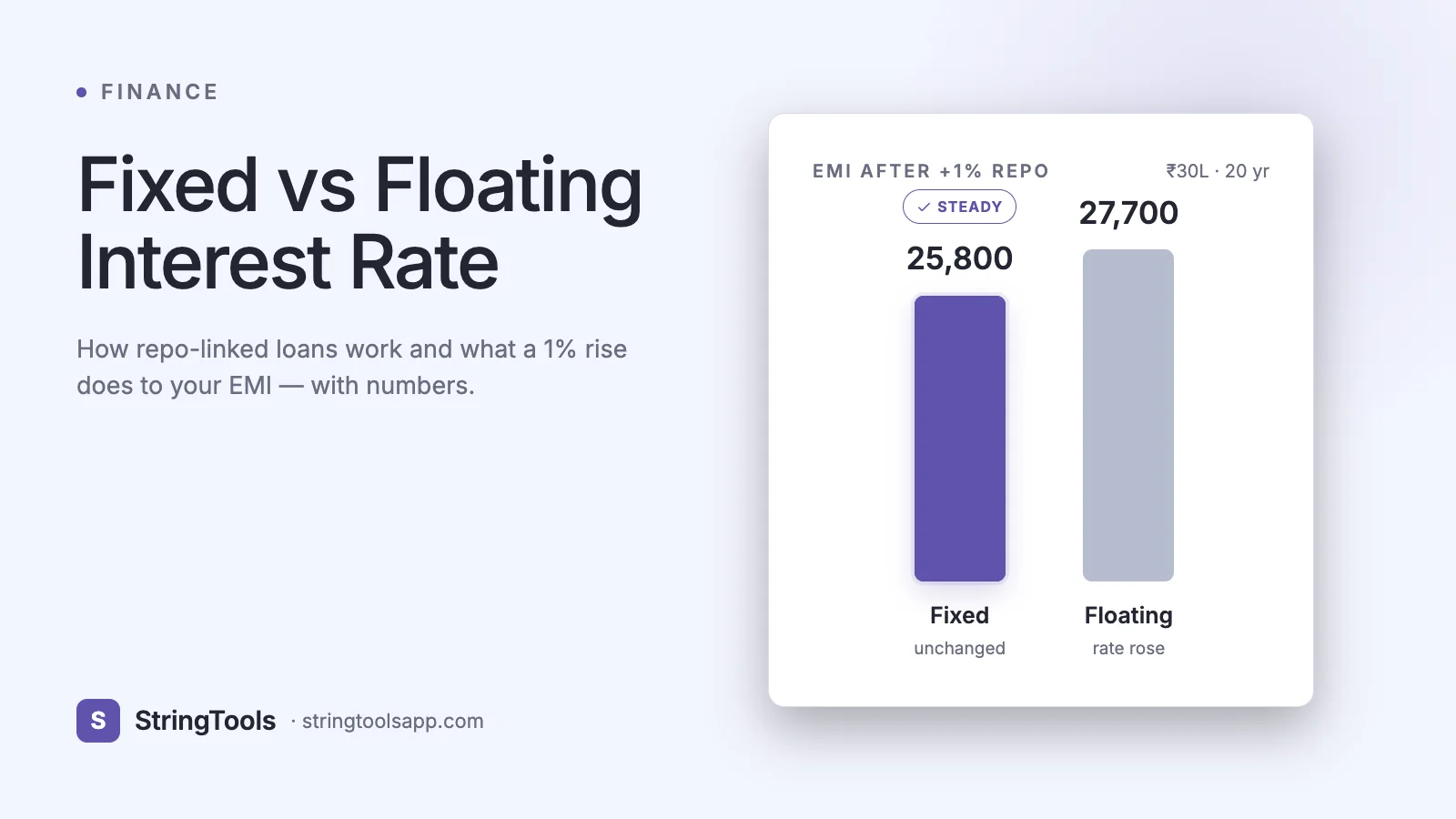
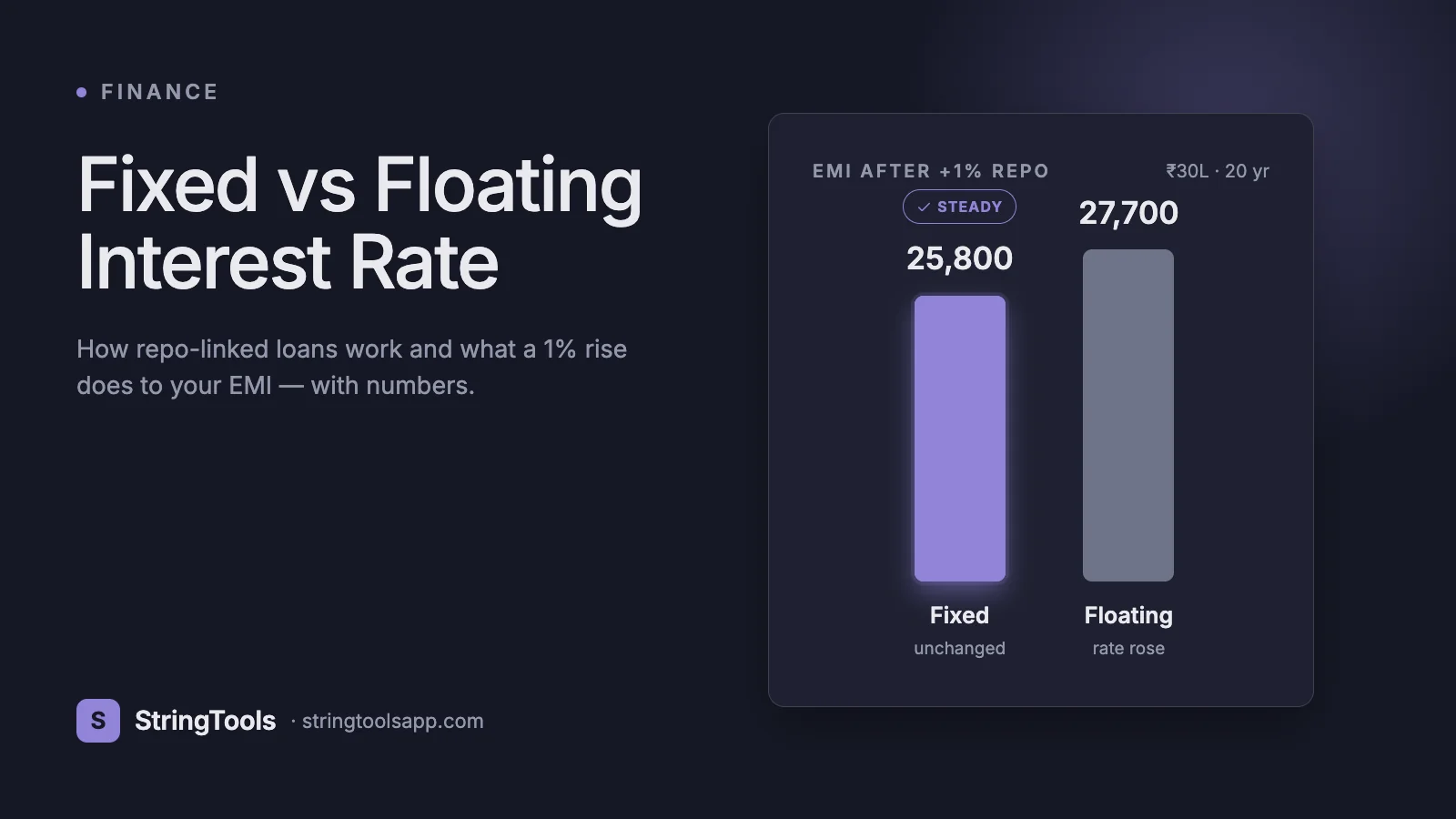
A 1% rate rise on a ₹60 lakh, 20-year home loan lifts the EMI from about ₹52,069 (at 8.5%) to about ₹55,928 (at 9.5%) — ₹3,859 more every month, and roughly ₹9.26 lakh of extra interest if the higher rate persists for the full tenure.
Abstract percentages hide the real stakes, so let us compute an example properly using the standard amortization formula: EMI = P × r × (1 + r)^n ÷ ((1 + r)^n − 1), where P is the principal, r is the monthly rate (annual rate ÷ 12 ÷ 100), and n is the number of months. The rates below are purely illustrative, not current market quotes.
Take a ₹60,00,000 home loan over 20 years (240 months) at a floating rate of 8.5% per year. The monthly rate is 8.5 ÷ 12 ÷ 100 = 0.7083%. Plugging in, the EMI works out to about ₹52,069. Over the full tenure that is roughly ₹1.25 crore paid in total, of which about ₹64.97 lakh is interest — more than the amount you borrowed.
Now suppose the benchmark rises by one percentage point early in the loan and your rate resets to 9.5%. The same formula gives an EMI of about ₹55,928. That is ₹3,859 more every single month. If the higher rate persisted for the whole tenure, total interest would climb to about ₹74.23 lakh — roughly ₹9.26 lakh of extra interest from a single 1% move.
It gets worse if your lender extends tenure instead of raising the EMI. Keeping the EMI at ₹52,069 while the rate sits at 9.5% stretches the payoff from 240 months to roughly 309 months — from 20 years to nearly 26. Your monthly outgo "feels" unchanged while almost six extra years of interest accrue silently.
The same mathematics applies in dollars. A $300,000 mortgage over 30 years costs about $1,896 per month at 6.5%, and about $2,098 at 7.5% — an extra $201 per month and roughly $72,500 of additional interest over the life of the loan. This is exactly why American borrowers overwhelmingly choose fixed when long-term fixed pricing is reasonable: on a 30-year horizon, rate risk compounds into enormous sums. You can reproduce every figure here in seconds with an EMI calculator or, for US-style loans with taxes and insurance, a mortgage calculator — and you should, before trusting any lender's brochure.
How to actually decide: five factors that matter more than predictions
Choose floating if your budget has 15 to 20% headroom, your tenure is long, or you plan to prepay — it starts cheaper and carries no prepayment penalty in India. Choose fixed if a rate rise would strain your budget or your loan is short. Never decide on a rate forecast. Since nobody can reliably forecast rates, base the decision on things you actually know about your own situation.
Where rates sit in the cycle — descriptively, not predictively. You cannot know the future, but you can observe the present. If policy rates are near multi-year highs, a floating loan at least has room to benefit if cuts eventually come, while locking a fixed rate at the peak can mean overpaying for years. If rates are near historic lows, the logic reverses: fixing locks in cheap money, and floating mostly has one direction to go. This is about acknowledging asymmetry, not predicting timing.
Your tenure. The longer the loan, the more likely you will live through multiple rate cycles, and the more valuable floating's ability to fall becomes — but also the more painful a sustained rise. Short-tenure borrowers (say 5 to 10 years) can more sensibly lock a fixed rate, since one bad cycle can dominate a short loan.
Your budget headroom. This is the most honest test. Take your proposed EMI, add 15 to 20% to it, and ask whether your monthly budget survives. If a ₹52,000 EMI becoming ₹60,000 would force genuine hardship, you have no business holding rate risk — pay the fixed premium and sleep. If you have comfortable slack, floating's lower starting cost and downside participation usually justify the volatility. A loan calculator makes this stress test trivial: run your numbers at the offered rate, then again at 1% and 2% higher.
Your prepayment plans. In India this factor is decisive more often than people realise. Floating-rate loans to individuals carry no foreclosure or prepayment penalty by regulation, so if you expect bonuses, ESOP sales, an inheritance, or business income that you intend to throw at the loan, floating preserves that freedom. Fixed loans frequently charge a penalty on early repayment — read the schedule of charges before signing, because a 2 to 4% foreclosure charge on a large outstanding balance can erase years of rate savings.
The size of the loan relative to your income. A small loan against a large income is a rounding error either way; take the cheaper floating rate. A loan whose EMI already consumes 40 to 50% of your take-home pay leaves no room for surprises, which argues for fixing — or, better, for borrowing less. Before you fixate on the rate type, it is worth checking how much you can borrow on your income in the first place. If you want to see why lenders care so much about this ratio, a compound interest calculator will show you how quickly unpaid balances grow when payments slip.
Myths and mistakes that cost borrowers real money
The most expensive home-loan myths are believing that "fixed" means fixed for the entire tenure, that floating is always cheaper in the long run, and that an unchanged EMI means a rate hike has not cost you — when the lender may simply have added years to your tenure instead. Here is what actually holds up.
Fixed means fixed forever. Often false outside the US. Many Indian "fixed" home loans are fixed only for an initial period or contain a reset clause allowing the lender to revise the rate after a few years. UK fixes typically last 2 to 5 years before reverting to the lender's standard variable rate. Read the sanction letter, not the advertisement, and ask directly: is this rate contractually fixed for the entire tenure?
Floating is always cheaper in the long run. Not guaranteed. Floating starts cheaper and has historically often ended cheaper, but a borrower who took a floating loan just before a sustained hiking cycle paid dearly. The correct claim is narrower: floating is cheaper on average, riskier in any given case.
My EMI stays the same, so rate hikes have not hurt me. This is perhaps the most expensive illusion in Indian home lending. As shown above, a lender that holds your EMI constant after a 1% hike may have added nearly six years to your loan. Check your outstanding balance and remaining tenure after every reset cycle, and ask the lender to raise the EMI instead of the tenure if you can afford it — the interest savings are enormous.
I can always switch later, so the initial choice does not matter. Switching is possible — India's regulator has pushed lenders to offer floating-to-fixed switches at reset, and refinancing to another lender is common everywhere — but it is not free. Conversion fees, processing charges, and (for fixed loans) prepayment penalties all apply, and you will be switching at whatever rates prevail then, not now. Choose deliberately the first time.
The lowest advertised rate is the best offer. Advertised rates are typically for the best credit profiles and specific loan sizes. Your actual offer depends on your credit score, income stability, property type, and the lender's current appetite. Two banks can quote the same borrower rates half a percentage point apart in the same week — which is exactly why you should compare loan offers from multiple lenders rather than accepting the first sanction letter.
Comparing a fixed rate from one lender with a floating rate from another. This mixes up two decisions. First decide fixed versus floating using the factors above; then compare like with like across lenders, including processing fees, insurance bundling, and prepayment terms — not just the headline rate.
Get real offers on the table before you decide
Everything above becomes concrete only when you have actual sanctioned offers in hand, because the fixed-versus-floating premium, the spread over the benchmark, and the prepayment terms all vary meaningfully from lender to lender. Comparing three or four real offers routinely surfaces a difference of 0.25 to 0.75 percentage points for the same borrower — which, as the worked example showed, is worth lakhs over a long tenure.
That is why comparison is worth the effort. Instead of filling out separate applications at half a dozen banks, get quotes from several regulated banks and NBFCs — or a reputable, regulated comparison marketplace — so you see a real market picture. Ask for soft quotes where possible — you stay in control, and you get a real market picture instead of one branch manager's quote. Once the offers arrive, verify every number yourself: put each offer's rate, amount, and tenure into the EMI calculator to confirm the quoted EMI, and rerun it at 1% higher to stress-test the floating options before you sign anything.
Whichever way you choose, choose it consciously: floating if your budget has headroom and you value prepayment freedom, fixed if certainty is worth a known premium to you, and never on the basis of someone's rate prediction. This article is general education, not financial advice — actual rates, reset rules, charges, and eligibility vary by lender and over time, so confirm the terms of any specific loan with the lender before committing.
Frequently Asked Questions
What is the meaning of a floating interest rate on a home loan?
A floating (or variable) rate moves with a benchmark instead of staying constant. In India, most new floating home loans are linked to the RBI repo rate — your rate is the repo rate plus a fixed spread, and it resets at least once every three months when the benchmark changes. When the RBI cuts rates your EMI (or tenure) falls; when it hikes, your cost rises. In the US the equivalent is an adjustable-rate mortgage (ARM), which is typically fixed for an initial period and then adjusts periodically within caps.
Is a fixed or floating interest rate better for a home loan?
Neither is universally better — they are different risk positions. Floating usually starts cheaper, falls automatically when benchmark rates fall, and in India carries no prepayment penalty for individual borrowers. Fixed costs more upfront but protects you if rates rise. Choose fixed if a 15–20% EMI increase would strain your budget or your tenure is short; choose floating if you have budget headroom, a long tenure, or plans to prepay. Avoid deciding based on anyone's rate forecast.
How much does a 1% interest rate increase affect my EMI?
On a ₹60 lakh loan over 20 years, moving from 8.5% to 9.5% raises the EMI from about ₹52,069 to about ₹55,928 — roughly ₹3,859 more per month and about ₹9.26 lakh in extra interest if sustained over the full tenure. If the lender keeps your EMI constant and extends tenure instead, the same hike stretches a 20-year loan to nearly 26 years. On a $300,000, 30-year loan, a rise from 6.5% to 7.5% adds about $201 per month and roughly $72,500 in lifetime interest.
Do floating rate home loans have prepayment penalties in India?
No. RBI rules prohibit banks and NBFCs from charging foreclosure charges or prepayment penalties on floating-rate loans to individual borrowers, so you can part-prepay or close a floating home loan early at no penalty. Fixed-rate loans are not covered by this protection — lenders often charge a foreclosure or prepayment fee, commonly a percentage of the outstanding balance, so check the schedule of charges before choosing fixed if you plan to prepay.
What is a repo rate linked home loan?
It is a floating-rate loan whose interest rate is directly tied to the RBI's repo rate. Since October 2019, banks must link new floating-rate retail loans to an external benchmark, and most chose the repo rate. Your rate is quoted as repo plus a spread based on your credit profile, and it must reset at least once every three months. The structure is transparent — policy rate changes pass through to your loan quickly, in both directions — unlike older MCLR or base-rate loans where transmission was slow.
Can I switch from a floating to a fixed interest rate later?
Usually yes, but not for free. Indian regulators have directed lenders to offer floating-rate borrowers the option to switch to a fixed rate at reset, and you can also refinance with another lender. Expect conversion or processing fees, and remember you will switch at the rates prevailing then, not today's. Because switching costs money and prepayment penalties can apply to fixed loans, it is better to choose deliberately upfront and to compare offers from several lenders before signing.
Sources and references
Reserve Bank of India (rbi.org.in) · adjustable-rate mortgage (ARM) (investopedia.com). Content was reviewed against these sources as of the last-updated date above; external figures and rules may change after publication.