
Quick answer: Paying extra on your mortgage is a guaranteed, risk-free return equal to your interest rate — on a $300,000 loan at 6.5%, an extra $200/month saves about $103,000 and 7 years; a single extra payment each year saves about $87,000 and 6 years. Whether that beats investing the same money depends almost entirely on your rate vs. expected returns (the break-even is roughly your mortgage rate), your discipline, and how much you value liquidity. Prepay after your employer match, high-interest debt, and emergency fund are handled — never before.
The Debate That Splits Every Dinner Table
Few money questions divide people like this one. One camp says a mortgage is the cheapest debt you'll ever hold, so pay the minimum forever and invest the rest. The other says there's no feeling on earth like a paid-off house, and no market return worth lying awake for. Both camps quote math; both camps are mostly quoting feelings.
This guide does the arithmetic honestly. You'll see exactly what an extra $200 a month does to a real loan — dollar for dollar, month by month — what the famous "one extra payment a year" trick actually saves, where the invest-instead argument genuinely wins, the five prepayment methods compared (including the two most people confuse: recasting and refinancing), and the checklist of things that should always come before extra mortgage payments. Every figure is verifiable in our mortgage calculator, which doubles as a mortgage payoff calculator with its extra-payment field.
Why Extra Payments Punch Above Their Weight
To see why prepaying is so potent, you need one fact about how mortgages charge interest: every month, interest is computed on your remaining balance. Your regular payment barely dents that balance early on — on a $300,000 loan at 6.5%, the first $1,896 payment sends $1,625 to interest and only $271 to principal.
An extra payment skips that split entirely. Every extra dollar goes 100% to principal. And a dollar removed from the balance today stops generating 6.5% interest for the entire remaining life of the loan — that's the compounding-in-reverse effect that makes early extra payments so much more valuable than late ones. A $200 prepayment in year one quietly cancels hundreds of dollars of future interest; the same $200 in year 28 cancels only a few. (The full mechanics are in our guide to how loan amortization works.)
This is also why the payoff accelerates: each extra payment shrinks the balance, which shrinks next month's interest charge, which means more of your regular payment hits principal too. You're not just adding $200 — you're improving the efficiency of every payment that follows.
The Real Numbers: $200/Month and the 13th Payment
Here's what prepayment actually does to a $300,000, 30-year fixed loan at 6.5% (payment $1,896/month, baseline total interest about $382,600):
| Strategy | Payoff time | Time saved | Total interest | Interest saved |
|---|---|---|---|---|
| Minimum payments only | 30 yrs | — | ≈ $382,600 | — |
| One extra payment/year (13th payment or biweekly) | ≈ 24.2 yrs | ≈ 5.8 yrs | ≈ $295,400 | ≈ $87,300 |
| Extra $200 every month | ≈ 23.1 yrs | ≈ 6.9 yrs | ≈ $279,200 | ≈ $103,400 |
| Extra $500 every month | ≈ 17.5 yrs | ≈ 12.5 yrs | ≈ $202,900 | ≈ $179,800 |
Computed month-by-month with the standard amortization formula; verify any row with the extra-payment field in our mortgage calculator.
Read the second row twice, because it's the most famous trick in home finance and it's real: one extra payment a year — about $158 a month — removes almost six years and $87,000 from this loan. That's the entire mechanism behind "biweekly payments": paying half your mortgage every two weeks produces 26 half-payments, which is 13 full payments a year instead of 12. The two-week rhythm isn't magic; the 13th payment is.
And notice the diminishing-but-still-huge returns as you scale up: $200/month saves about $103k, $500/month about $180k. The first extra dollars are the most powerful — which means even a modest, sustainable extra payment is very much worth making if prepaying is right for you at all. That's the next question.
Prepay or Invest? The Honest Break-Even
Every extra dollar you send to the mortgage earns you exactly one thing: the interest it would have accrued. Prepaying a 6.5% mortgage is therefore a guaranteed 6.5% annual return, tax-free and risk-free. There is no other guaranteed 6.5% available to retail investors — that's the strongest argument for prepaying.
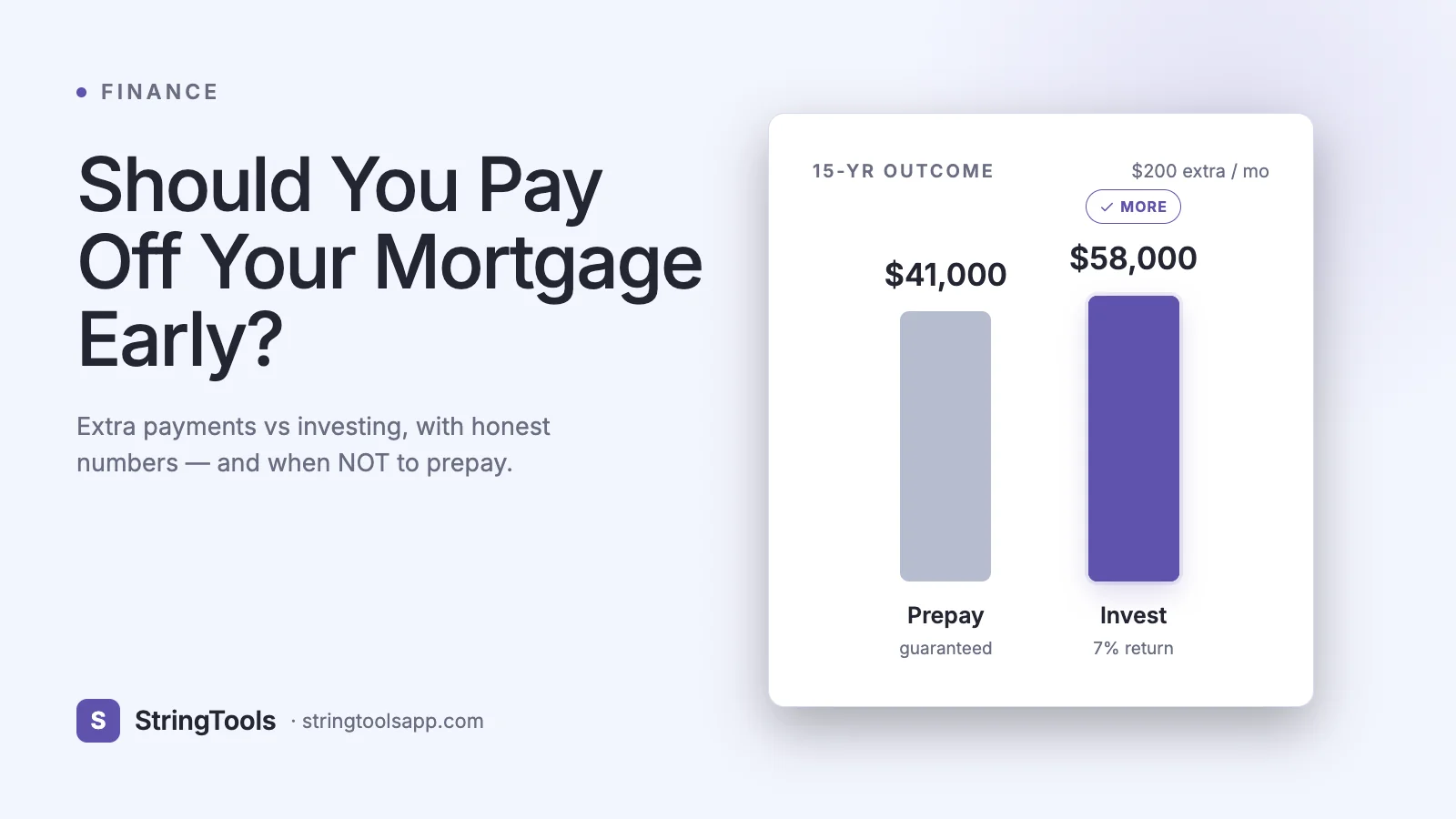
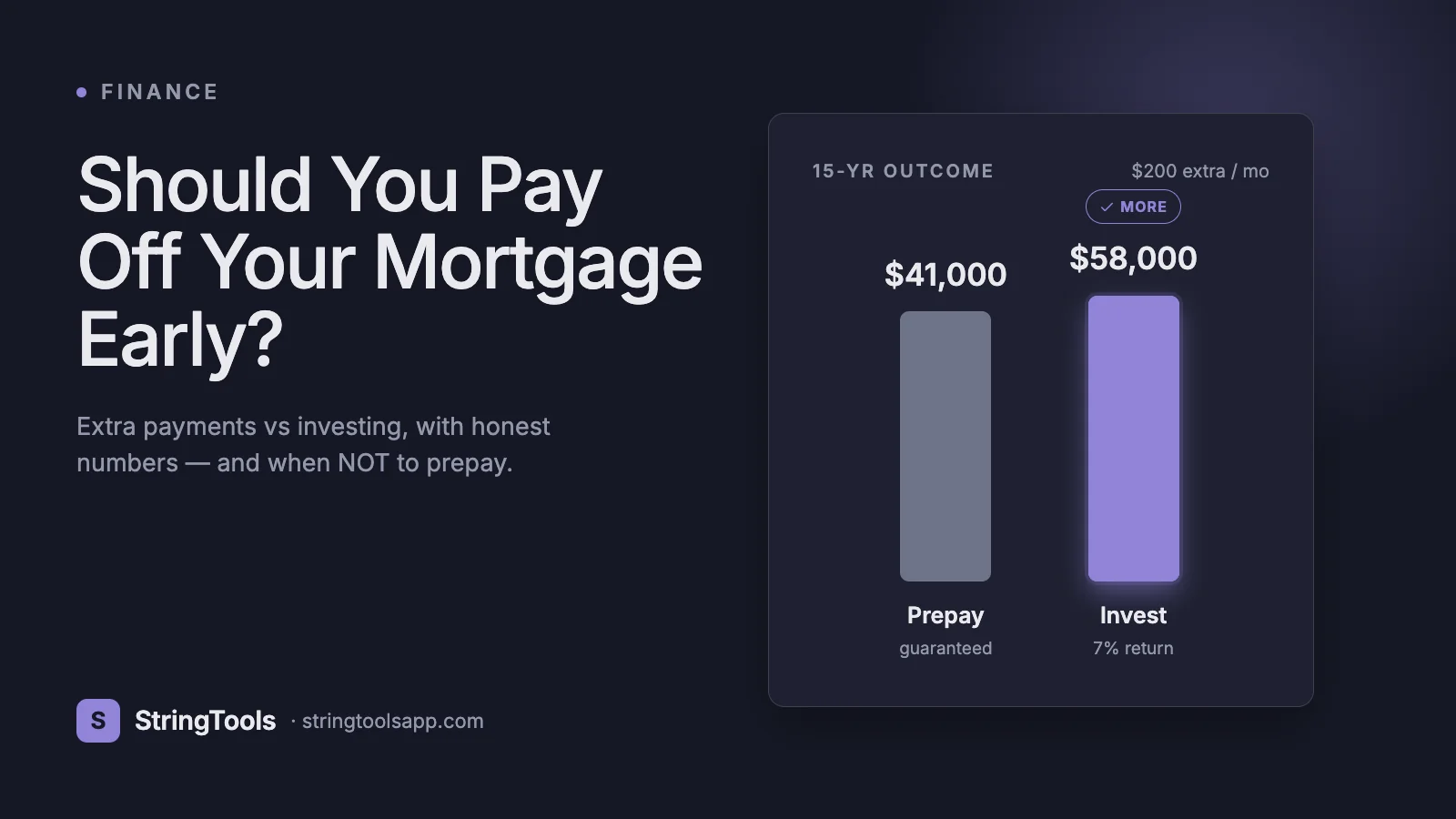
The counter-argument: over long horizons, diversified stock investing has averaged more. Run our $200/month example the other way — invested at a 7% average return for the same 23 years, it grows to roughly $136,000, versus the ~$103,000 of interest prepaying saves. Invest wins on paper. Drop the return to 5% and investing yields about $103,000 — a near-exact tie. That's not a coincidence: the break-even return on invest-vs-prepay is approximately your mortgage rate. Above it, investing wins mathematically; below it, prepaying wins.
So the spreadsheet says: at today's typical rates, it's close. Which means the decision actually turns on the things the spreadsheet can't hold:
Guarantee vs. expectation. The mortgage return is certain; the market's is not, especially over any specific decade. If a 30% drawdown would break your resolve, the guaranteed option has extra value the math doesn't show.
Discipline. Prepaying is automatic once set up. "Investing the difference" only works if the difference actually gets invested every month for decades — in practice, unallocated money leaks. (The same honesty applies to the 15-year-vs-30-year decision, which is really this same question wearing different clothes — see our 15 vs 30-year mortgage guide.)
Liquidity. Money invested in a brokerage account can be retrieved in days. Money in home equity is locked behind a sale or a loan application — and banks are least eager to lend exactly when you're least employed. Prepaying aggressively while cash-poor is how people end up house-rich and stressed.
Taxes. Investment gains may be taxed; mortgage interest saved is an untaxed "return." But if the investing happens inside a matched 401(k) or other tax-advantaged account, the advantage flips hard toward investing — see the checklist below.
Five Things That Come Before Extra Payments
Financial planners broadly agree on the order of operations. Before a single extra dollar goes to a 6.5% mortgage:
1. Employer retirement match. A 50–100% instant return beats any mortgage rate, always. Max the match first, every year.
2. High-interest debt. Credit cards at ~24% APR (an effective ~27% with daily compounding — see our APR vs APY guide) and most personal loans outrank the mortgage by a mile.
3. Emergency fund. Three to six months of essentials in a high-yield account. Prepaid principal cannot fix a transmission — our emergency fund guide covers how much and where.
4. Core retirement contributions. Tax-advantaged space (401(k), IRA or your country's equivalent) is use-it-or-lose-it each year; home equity has no contribution deadline.
5. Known near-term needs. Tuition, a car replacement, a planned move — cash you'll need within a few years doesn't belong in the walls of your house.
Clear all five and still have surplus? Now prepaying is a genuinely excellent use of money — especially in the early loan years when each dollar works hardest.
Five Ways to Prepay, Compared
| Method | How it works | Effect | Watch out for |
|---|---|---|---|
| Extra monthly amount | Add a fixed sum to every payment, marked "apply to principal" | Shortens the loan; most flexible — pause anytime | Confirm the servicer applies it to principal, not next month |
| Biweekly / 13th payment | Half-payment every 2 weeks = 13 full payments/yr | ≈ 6 yrs and ~$87k saved on our example | Do it yourself free (add 1/12 monthly); skip paid services |
| Lump sum | Windfall (bonus, inheritance) straight to principal | Big one-time balance cut; earlier = better | Payment stays the same; loan just ends sooner |
| Recast | Lump sum + servicer re-amortizes remaining term | Lowers the required payment, keeps rate & term | Small fee (~$150–$500); not all loans qualify |
| Refinance to 15-year | New, shorter loan at (usually) a lower rate | Largest interest savings; forces the discipline | Closing costs 2–5%; payment obligation rises — see the 15 vs 30 guide |
The recast row deserves a highlight because almost nobody knows it exists: if you want a lower monthly payment rather than a shorter loan — say, after a windfall, heading into a single-income season — a recast gets you there for a small fee without refinancing, requalifying, or touching your rate. Extra payments and recasting solve opposite problems; knowing both exist means you can pick deliberately.
Whichever method you choose, two hygiene checks: confirm your loan has no prepayment penalty (rare on post-2014 US mortgages, but check the note), and verify in your servicer's portal that extra money posts as "principal only" — the default handling at some servicers is to hold it as an early next payment, which saves you nothing.
The Tax-Deduction Myth
"Don't pay it off — you'll lose the tax deduction" is the most repeated and least examined line in this debate. Here's the reality: mortgage interest is only deductible if you itemize, and since the standard deduction was roughly doubled in 2018, the large majority of US households — roughly nine in ten — take the standard deduction instead. For them, the mortgage-interest deduction is worth exactly $0, and keeping a loan to preserve it is paying the bank a dollar to avoid nothing.
Even for itemizers, the deduction only refunds your marginal tax rate on the interest — spending $10,000 of interest to save perhaps $2,400 of tax is still $7,600 out the door. The deduction can tilt a close decision at high incomes; it should never be the reason to carry a mortgage you'd otherwise retire.
Frequently Asked Questions
What happens if I pay an extra $200 a month on my mortgage?
On a $300,000, 30-year loan at 6.5%: payoff arrives about 7 years early and total interest drops by roughly $103,000. The earlier in the loan you start, the larger the effect — extra dollars in year one work nearly 30 years of interest-cancelling duty.
Does one extra mortgage payment a year really knock off years?
Yes — about 6 years and $87,000 on our example loan. It's the same math behind biweekly payment plans: 26 half-payments equal 13 full payments a year.
Is it better to pay off the mortgage early or invest?
The break-even is roughly your mortgage rate. Expected market returns above it favor investing; below it, prepaying wins — and prepaying is guaranteed while markets aren't. Handle the employer match, high-interest debt, and emergency fund first regardless; after that it's a values call between certainty, liquidity, and expected growth.
What is mortgage recasting?
A lump-sum principal payment followed by re-amortizing the existing loan over its remaining term — the payment drops, the rate and payoff date stay. Typically a $150–$500 fee, no requalification. Choose recasting when you want breathing room; choose extra payments when you want the loan gone sooner.
Do biweekly mortgage payments save money?
Yes, purely because they smuggle in a 13th annual payment. Replicate it free by adding one-twelfth of your payment to each month — and skip services that charge fees to manage the schedule for you.
Are there penalties for paying off a mortgage early?
Rare in the US: post-2014 conventional loans face tight restrictions on prepayment penalties, and FHA/VA/USDA loans don't carry them. Verify on your loan estimate or note, then make sure every extra dollar posts as principal-only.
Should I pay off my mortgage before retirement?
A strong goal for many: no payment means far lower required income, smaller taxable withdrawals, and resilience in down markets. Just don't starve peak-year retirement contributions to get there — run both paths with real numbers before choosing.
Run Your Own Numbers
This entire debate reduces to about ten minutes of honest input. Open our free mortgage calculator and use it as a mortgage payoff calculator: enter your actual balance, rate, and remaining term, then put your realistic extra amount into the extra-payment field and watch the payoff date and interest-saved figures move. Then run the same monthly amount through the compound interest calculator at the return you honestly expect. Whichever number wins — with full credit given to the one that's guaranteed — you'll have your answer, and it'll be yours rather than a dinner-table slogan.
This article is for general educational purposes and is not financial or tax advice. Rates are illustrative; prepayment terms, recast availability, and tax treatment vary by lender, loan, and jurisdiction — confirm specifics with a licensed lender, financial advisor, or tax professional before making a decision.