
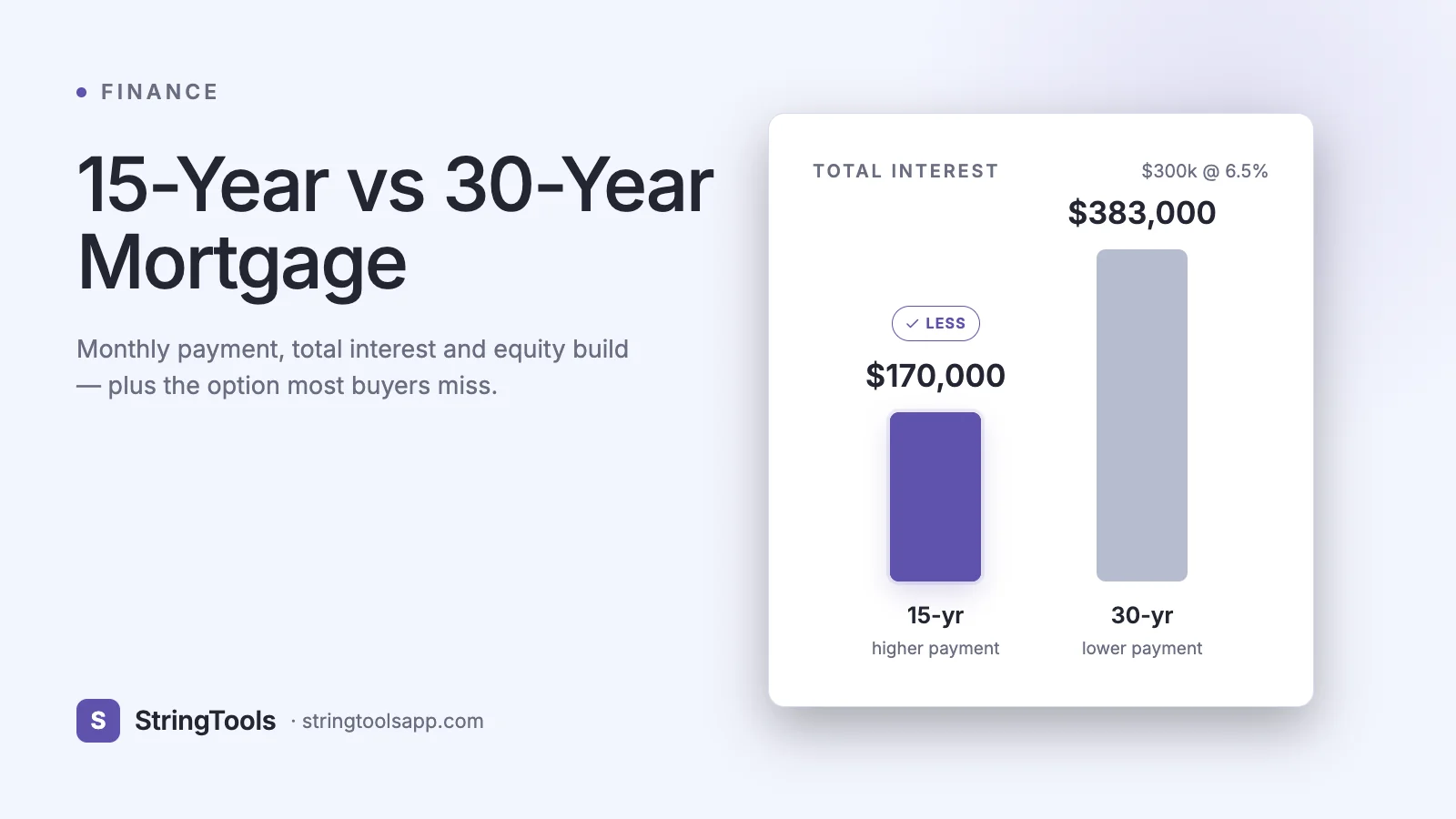
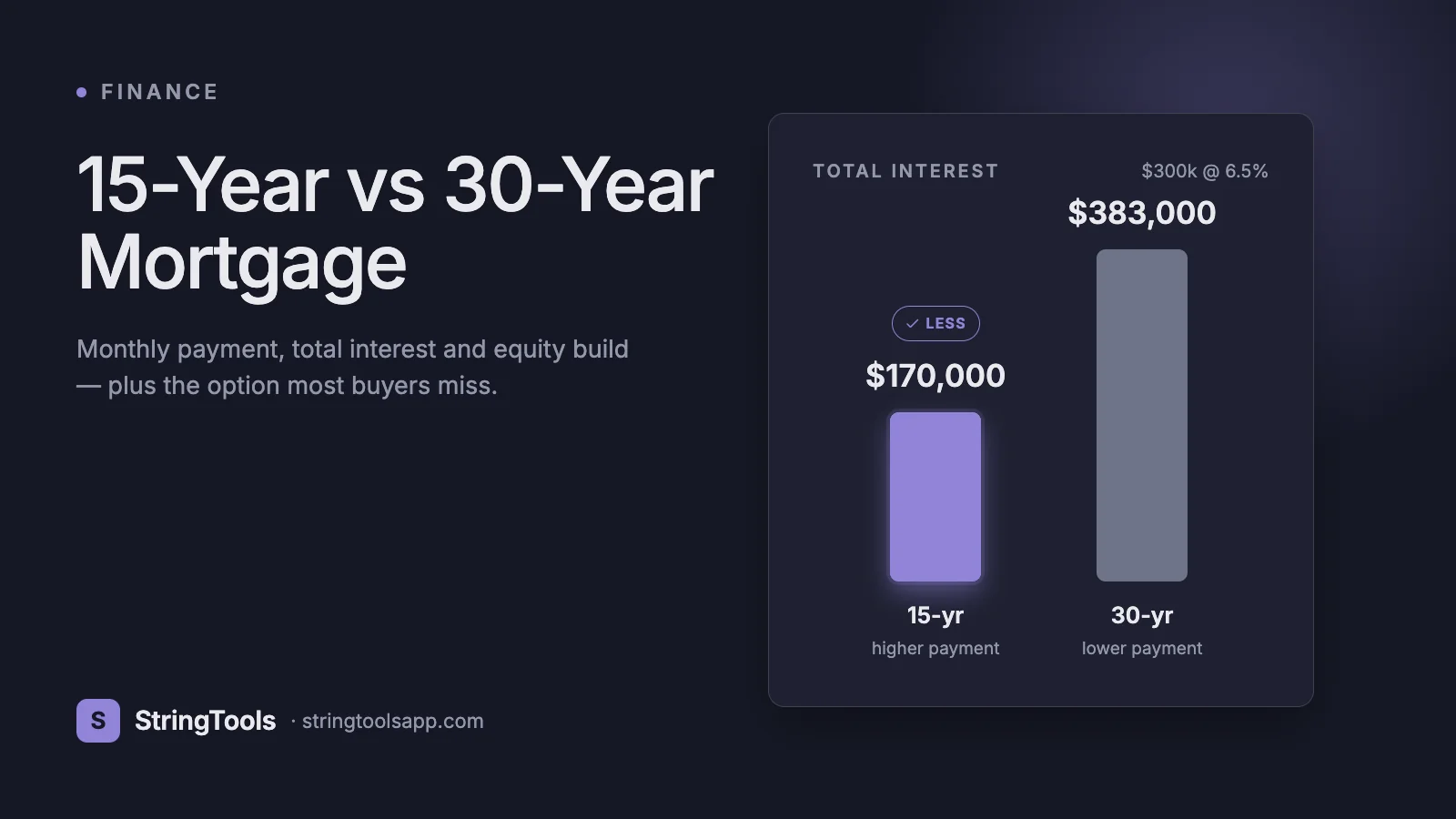
Quick answer: On a $300,000 loan at typical rates, a 15-year mortgage costs about $2,532/month and $155,700 in lifetime interest, while a 30-year mortgage costs about $1,896/month and $382,600 in interest. The 15-year saves roughly $227,000 — but demands an extra $635 every month for 15 years. Which one "saves more" depends on whether that higher payment crowds out retirement savings and your emergency fund. There's also a third option most buyers overlook, covered below.
The Most Expensive Checkbox on the Application
When you apply for a home loan, the term field looks like a small choice — a dropdown with "30" selected by default. It is, in dollar terms, one of the biggest financial decisions you'll ever make with a single click. On a typical loan, the difference between a 15-year and a 30-year mortgage is more than the price of a luxury car — sometimes more than the price of a small house in a cheaper market.
Yet the answer isn't automatically "pick the shorter term." The 15-year mortgage saves a fortune in interest but demands a much larger payment every single month, whether or not the roof leaked or your car died that month. The 30-year costs more over its life but leaves room to breathe — and what you do with that room decides whether the 30-year was a smart choice or an expensive one.
This guide is a complete mortgage term comparison with real numbers on both paths: the true monthly payment difference, where the interest savings actually come from, how much faster you build home equity, the "pay a 30 like a 15" strategy that captures most of the benefit with none of the lock-in, and an honest look at the invest-the-difference argument. There is no universal "best mortgage term" — only the best one for your budget and stage of life — and by the end you'll know exactly which one that is. You can verify every figure yourself in our mortgage calculator.
The Real Difference: It's the Rate AND the Term
First, what we're comparing: both options here are fixed-rate mortgages — the interest rate, and therefore the principal-and-interest payment, never changes for the life of the loan. The only variable is the term. Most comparisons only mention the obvious factor — a 15-year home loan is paid back in half the time, so less interest accrues. But there's a second, quieter advantage: 15-year mortgage rates are consistently lower than 30-year rates, typically by around 0.5 to 0.75 percentage points.
The reason is risk. A lender committing money for 30 years is exposed to three decades of inflation, rate moves, and borrower life events. Cut that window in half and the risk shrinks, so the price of the money — your interest rate — drops with it. You're not just borrowing for less time; you're borrowing at a discount.
That double effect (shorter term × lower rate) is why the savings numbers get so large. Let's see them properly.
Side by Side: A $300,000 Loan, Both Ways
Here's the full mortgage term comparison for a $300,000 loan at realistic 2026-style rates — 6.5% for the 30-year home loan, 6.0% for the 15-year (reflecting the usual rate discount). Figures are principal and interest only; property taxes and insurance ride on top of both equally.
| 30-Year @ 6.5% | 15-Year @ 6.0% | |
|---|---|---|
| Monthly payment (P&I) | $1,896 | $2,532 |
| Extra per month vs 30-year | — | +$635 |
| Total of all payments | ≈ $682,600 | ≈ $455,700 |
| Total interest paid | ≈ $382,600 | ≈ $155,700 |
| Interest saved | — | ≈ $227,000 |
| Years of payments | 30 | 15 |
Computed with the standard amortization formula. Rates are illustrative — plug today's quotes into a mortgage payment calculator for your own numbers.
Read that interest line again: on the 30-year loan, you pay back more in interest than you borrowed. The 15-year cuts the total interest bill by well over half. And notice the asymmetry that makes this decision genuinely hard: the 15-year saves $227,000 eventually, but costs $635 more every month, starting now. Big future reward, constant present-day pressure — that's the whole debate in one sentence.
Where the Savings Actually Come From
It's tempting to credit the lower 15-year rate for the savings, but the term itself does most of the work. To prove it, hold the rate constant: take the same $300,000 at 6.5% for both terms. The 15-year payment becomes $2,613, and total interest comes to about $170,400 — versus $382,600 on the 30-year. That's $212,000 saved by the shorter term alone, before any rate discount. The discount then adds roughly another $15,000 on top.
Why does the term matter so much? Amortization. Every month, interest is charged on your remaining balance. A 15-year schedule forces much bigger principal payments from month one, so the balance — and therefore next month's interest — shrinks dramatically faster. On the 30-year loan, the first payment of $1,896 includes $1,625 of interest and just $271 of principal. The 15-year's first payment includes the same $1,500-ish interest charge (at 6.0%) but slams over $1,000 into principal immediately. Each early principal dollar is a dollar that stops generating interest for decades. (Our guide to how loan amortization works walks this mechanism step by step.)
Equity: The 15-Year's Quiet Superpower
Interest savings get the headlines, but the equity difference changes lives sooner. Home equity — the part of the house you actually own — is what you walk away with when you sell, what you can borrow against in an emergency, and what turns a house from a payment into wealth.
Here's the remaining loan balance on our $300,000 example after five years of on-time payments:
| After 5 years | 30-Year @ 6.5% | 15-Year @ 6.0% |
|---|---|---|
| Remaining balance | ≈ $280,800 | ≈ $228,000 |
| Principal paid off | ≈ $19,200 | ≈ $72,000 |
| Share of loan repaid | ≈ 6% | ≈ 24% |
Five years in, the 15-year home loan has built almost four times the equity. The gap keeps widening: after 15 years, the 15-year borrower owns the home outright, while the 30-year home loan still carries a balance of about $217,700 — nearly 73% of the original loan. Halfway through a 30-year term, you've retired barely a quarter of the principal. That's not a flaw in your loan; it's just how front-loaded amortization is — and it's the single most misunderstood fact in home financing.
The Monthly Payment Reality Check
Now the honest part. That extra $635 a month has to come from somewhere, every month, for 180 consecutive months. Before choosing the 15-year term, check it against the 28% housing guideline: your full housing payment (principal, interest, taxes, insurance — PITI) should stay under about 28% of gross monthly income. On our example, the 15-year's $2,532 P&I plus, say, $300 of taxes and insurance is $2,832 a month — which needs a gross income of roughly $121,000 a year to sit comfortably at 28%. The 30-year version needs about $94,000.
Same house. Nearly $27,000 a year of extra income required, just to make the faster payoff comfortable rather than stressful. That's why the right term is inseparable from the affordability question — if you haven't sized your overall budget yet, start with our guide on how much house you can afford, then come back to the term decision.
A 15-year payment that's technically payable but leaves nothing for retirement contributions, an emergency fund, or a failed water heater isn't savings — it's fragility with a good interest rate.
The Third Option: Pay a 30 Like a 15
Here's the strategy that deserves far more attention: take the 30-year loan, then voluntarily pay the 15-year amount. Extra payments go entirely to principal, so the loan pays down almost as fast as a real 15-year.
On our example: take the 30-year at 6.5% ($1,896 required) and pay $2,532 every month anyway. The loan pays off in roughly 15.8 years with about $181,000 in total interest — within about $25,000 of the true 15-year result (the gap is the rate discount you didn't get).
What does that $25,000 buy you? An escape hatch. If you lose a job, have a baby, or face a medical year, you can instantly drop back to the $1,896 required payment — no refinancing, no lender permission, no fees. A true 15-year borrower owes $2,532 every month regardless. In effect, you're paying about $130 a month in extra interest for the right to change your mind, which for a single-income household or anyone with variable earnings is often the best insurance policy money can buy.
Two practical notes: confirm your loan has no prepayment penalty (most US fixed-rate mortgages don't), and make sure extra payments are applied to principal, not "next month's payment" — a checkbox or a phone call fixes this with most servicers. Our mortgage calculator has an extra-payment field that shows exactly how many years and dollars any additional amount removes.
"Just Invest the Difference" — The Honest Math
The standard counterargument to the 15-year says: take the 30-year, invest the $635 monthly difference in the market, and come out ahead. It deserves an honest treatment, not cheerleading in either direction.
Run the numbers: $635 a month invested for 15 years at a 7% average annual return grows to roughly $201,000. Compare that to the ~$227,000 of interest the 15-year saves — remarkably close. Push the assumed return to 9% and investing wins on paper; drop it to 5% and the mortgage payoff wins clearly. (You can test any assumption in our compound interest calculator.)
But paper math hides three real-world differences. First, guarantee: paying down a 6.5% mortgage is a risk-free 6.5% return; markets offer no such promise over any specific 15-year window. Second, discipline: the strategy only works if the $635 is actually invested every single month — in practice, unallocated budget room tends to get spent. Third, taxes and behavior: investment gains may be taxed, and staying invested through a 40% drawdown is easier in a spreadsheet than in real life. If you're a disciplined, automatic investor already maxing tax-advantaged accounts, the invest-the-difference case is genuinely strong. If the money would realistically leak into lifestyle, the forced saving of a bigger mortgage payment quietly wins.
Who Should Pick Which: A Decision Framework
The best mortgage term is the one that fits your cash flow, not the one that wins a spreadsheet. Use these profiles as a starting point:
The 15-year mortgage fits you if: the payment sits comfortably under 28% of your gross income; you're already contributing well to retirement; you hold a 3–6 month emergency fund; your income is stable; and being debt-free sooner has real value to you — for instance, you want the house paid off before retirement or before kids hit college.
The 30-year mortgage fits you if: you're a first-time buyer stretching to get into the market; your income is variable or single-source; the 15-year payment would squeeze retirement contributions (tax-advantaged compounding you can never get back); or you value flexibility over optimization.
The 30-paid-like-a-15 fits you if: you want most of the interest savings but refuse to give up the safety valve — arguably the sweet spot for a majority of households.
One more scenario worth naming: already own a home on a 30-year? You don't have to refinance to capture most of these benefits — extra principal payments replicate the effect without closing costs. Refinancing into a 15-year makes sense mainly when today's 15-year rate is meaningfully below your existing rate, and you plan to stay in the home long enough for the savings to outrun the 2–5% closing costs.
Frequently Asked Questions
How much do you save with a 15-year vs a 30-year mortgage?
On a $300,000 loan at typical rates (6.0% vs 6.5%), the 15-year costs about $155,700 in total interest against the 30-year's $382,600 — saving roughly $227,000. The saving scales with loan size: on a $500,000 loan the gap is well over $375,000.
Why are 15-year mortgage rates lower than 30-year rates?
Less risk for the lender. The money is repaid twice as fast, with half the exposure to inflation, rate moves, and default risk — and that lower risk is priced into the rate, typically 0.5–0.75 points below the 30-year.
Can I pay off a 30-year mortgage in 15 years?
Yes — make the equivalent 15-year payment voluntarily and the loan retires in roughly 15–16 years. You forgo the 15-year rate discount (costing modestly more interest), but you keep the option to drop back to the lower required payment whenever needed.
What's the monthly payment difference on a $300,000 mortgage?
About $635 a month at typical rates: roughly $1,896 for the 30-year at 6.5% versus $2,532 for the 15-year at 6.0%, principal and interest only.
Is a 15-year mortgage worth it?
It's worth it when the payment fits comfortably — under the 28% housing guideline — after retirement savings and an emergency fund are already funded. It's the wrong tool if it crowds out those priorities; a mortgage can be refinanced or extended, but lost retirement compounding can't be bought back.
Should I refinance from a 30-year to a 15-year?
Consider it when the new 15-year rate is meaningfully below your current rate, the payment fits your budget, and you'll stay long enough for savings to beat the 2–5% closing costs. Otherwise, extra principal payments on your existing loan achieve most of the same result for free.
Is it better to invest the difference or pay off the mortgage faster?
At long-run returns above your mortgage rate, investing wins on paper ($635/month at 7% for 15 years ≈ $201,000, versus ≈ $227,000 interest saved in our example — close). But the mortgage payoff is guaranteed and automatic, while investing requires discipline and tolerance for market swings. Honest answer: the best plan is the one you'll actually execute every month.
Run Your Own Numbers
Rates, loan sizes, and budgets differ — the right answer is personal arithmetic, not a slogan. Open our free mortgage calculator and run your actual loan amount both ways: set the term to 30 and then 15, and compare the payment and total interest lines. The same tool doubles as an extra mortgage payment calculator — use the extra-payment field to model the pay-a-30-like-a-15 strategy and watch the payoff date move. And if you're still deciding on price range, pair it with our home affordability guide to set the budget first. Ten minutes of testing scenarios against your real numbers will settle a debate that generic advice never can.
This article is for general educational purposes and is not financial advice. Rates shown are illustrative and change daily; loan terms, closing costs, and tax treatment vary by lender and location — confirm your specific numbers with a licensed mortgage lender or financial advisor before making a decision.