
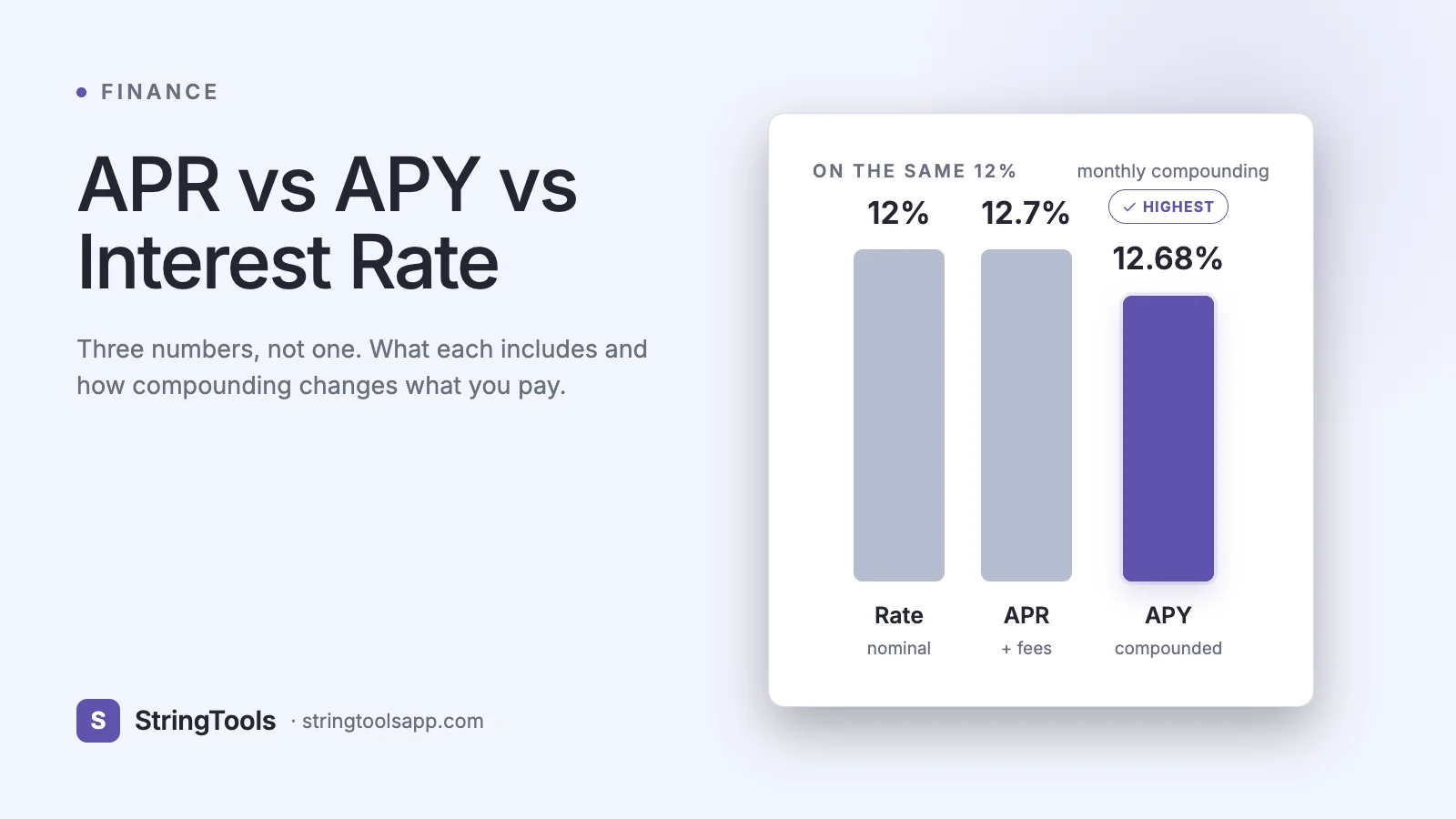
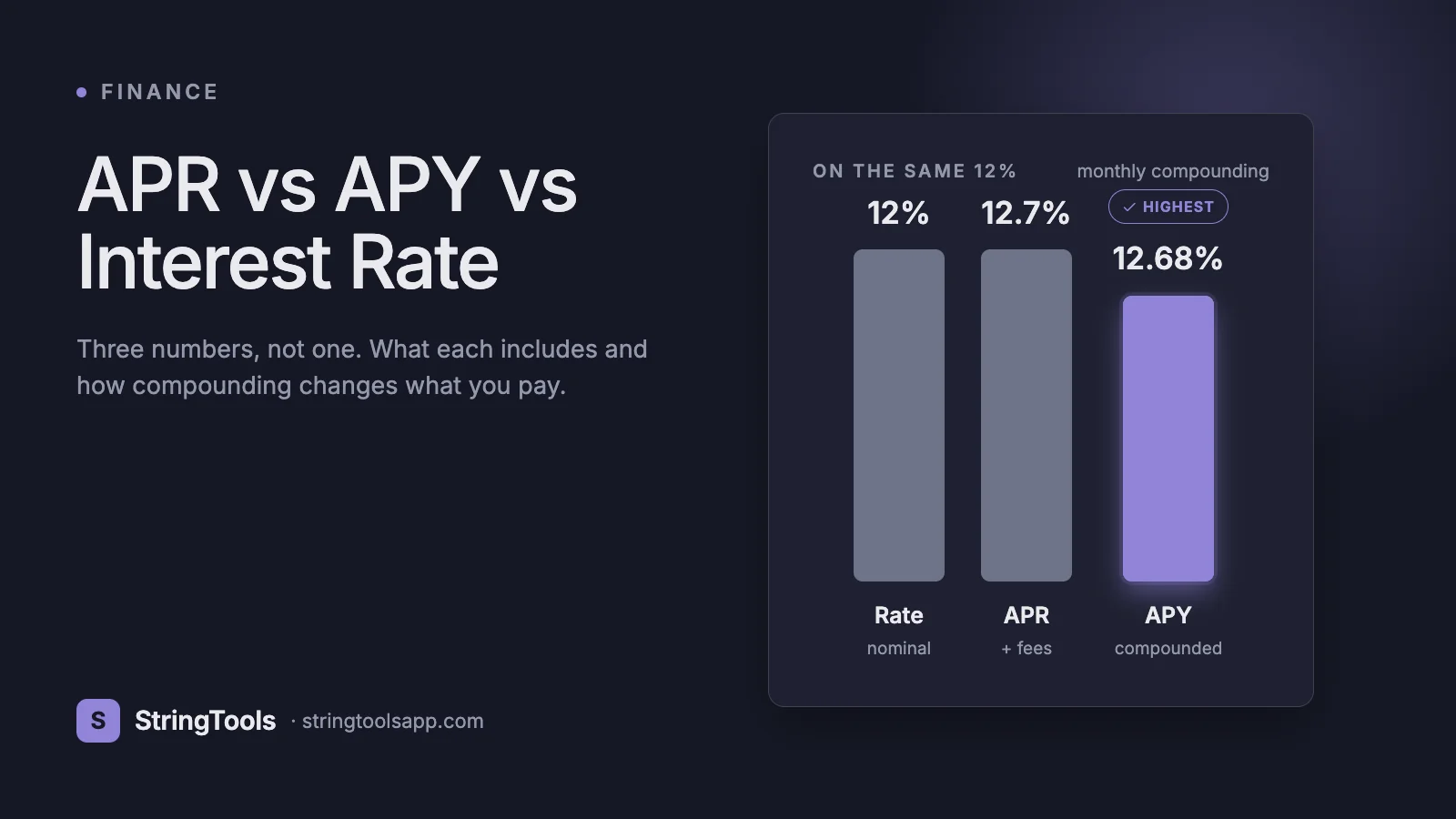
Quick answer: The interest rate is the raw price of money. APR (annual percentage rate) is that rate plus most required lender fees — it's how loans are compared. APY (annual percentage yield) is the rate including compounding — it's how savings are compared. The same 5% produces three different numbers: a 5% rate, roughly a 5% APR (before fees), and a 5.12% APY with monthly compounding. Banks lead with whichever number flatters the product — knowing which is which is worth real money on every loan and savings account you'll ever open.
Three Numbers That Look Alike — and Aren't
Walk past any bank window and you'll see percentages everywhere: a mortgage "from 6.5%," a savings account "earning 5.12% APY," a credit card at "24.99% APR." They all look like the same kind of number. They aren't. Each one is calculated differently, regulated differently, and — this is the part that costs people money — chosen strategically to make the product look as attractive as possible.
The result is a quiet asymmetry: banks advertise the smallest honest number on things you pay for, and the largest honest number on things they pay you. None of it is lying; all of it is framing. Once you can translate between interest rate, APR, and APY, the framing stops working on you.
This guide defines each term precisely, shows the formulas with worked examples you can verify, walks through comparing two real mortgage offers, exposes how credit-card interest quietly compounds daily, and ends with the three-line cheat sheet worth keeping. Every calculation here can be reproduced in our compound interest calculator or loan calculator.
Interest Rate: The Raw Price of Money
The interest rate (formally the nominal interest rate, or on mortgages the note rate) is the base percentage a lender charges you to borrow, or pays you to save, per year. It's the number the actual interest math runs on: a $300,000 mortgage at a 6.5% rate accrues interest at 6.5% ÷ 12 on the remaining balance each month.
What the interest rate doesn't tell you is just as important: it ignores fees, and it says nothing about how often interest compounds. Two loans with identical rates can cost very different amounts once fees enter the picture, and two savings accounts with identical rates can pay different amounts depending on compounding frequency. That's exactly the gap APR and APY were invented to close.
APR: What Borrowing Actually Costs
APR — annual percentage rate — is the interest rate plus most of the required cost of getting the loan, expressed as one yearly percentage. In the US, lenders must disclose it under the Truth in Lending Act (Regulation Z), precisely so borrowers can compare offers on one standardized number instead of untangling fee sheets.
What typically gets baked into a mortgage APR: origination fees, discount points, most lender charges, and certain closing costs. What usually doesn't: appraisal, title, and other third-party costs (rules vary by fee type and loan).
Here's the effect in numbers. Take a $300,000, 30-year mortgage at a 6.5% note rate with $6,000 in lender fees. Your payment is calculated on the full $300,000 at 6.5% — about $1,896 a month. But because you effectively received only $294,000 of value after fees, the true yearly cost of the money you got is higher than 6.5%. Solve for the rate that equates the two and you get an APR of roughly 6.7%. Same payment, same loan — but the second number tells you what you're really paying.
One honest caveat about APR: it spreads those one-time fees across the entire 30-year term. If you sell or refinance in year five — which is common — the fees were actually spread over five years, not thirty, and your true annual cost was higher than the disclosed APR. This is why a low-fee loan with a slightly higher rate can genuinely beat a low-rate loan with heavy fees for anyone who might move. (Our guide on how mortgage payments are calculated covers where the payment itself comes from.)
APY: What Your Savings Actually Earn
APY — annual percentage yield — answers the saver's version of the question: after compounding, what did my money actually earn in a year? Economists call the same concept the effective annual rate (EAR) — APY is simply the effective annual rate applied to savings products. US banks must disclose it on deposit accounts under the Truth in Savings Act (Regulation DD).
The formula is compact:
APY = (1 + r/n)n − 1, where r is the annual interest rate as a decimal and n is how many times per year interest compounds. Example: 5% compounded monthly → (1 + 0.05/12)12 − 1 ≈ 5.12% APY.
Compounding is the whole story here — interest starts earning interest. The same 5% rate produces a different APY at each compounding frequency:
| Compounding | Periods/year | APY on a 5% rate | On $10,000, 1 year |
|---|---|---|---|
| Annually | 1 | 5.000% | $500 |
| Quarterly | 4 | 5.095% | $509 |
| Monthly | 12 | 5.116% | $512 |
| Daily | 365 | 5.127% | $513 |
Computed with APY = (1 + r/n)^n − 1. Verify any row in our compound interest calculator — it doubles as an APY calculator for any rate and frequency.
Two things jump out. First, more frequent compounding always helps the saver — daily beats monthly beats annual. Second, the differences on one year of one deposit are modest ($13 between annual and daily on $10,000). Compounding's real power isn't the frequency — it's time. Over 20–30 years the interest-on-interest effect dominates everything, which is why we wrote a whole guide on how compound interest works.
Practical takeaway: when comparing savings accounts or CDs, compare APY to APY — never a rate to an APY. The APY already includes compounding, so it's the apples-to-apples number, and it's the bigger of the two — which is exactly why banks put it on the poster.
APR vs APY Head to Head
Same family, opposite jobs. Here's the whole picture in one table:
| Interest rate | APR | APY | |
|---|---|---|---|
| What it measures | Raw price of money | Borrowing cost incl. most fees | Savings return incl. compounding |
| Includes lender fees? | No | Yes (most) | No |
| Includes compounding? | No | Generally no | Yes |
| Where you see it | Quotes for both | Mortgages, auto loans, cards | Savings, CDs, money market |
| US disclosure rule | — | Truth in Lending (Reg Z) | Truth in Savings (Reg DD) |
| Bigger or smaller than the rate? | — | Higher (fees added) | Higher (compounding added) |
And now the marketing asymmetry makes sense. On a loan, the smallest honest number is the note rate — so the rate goes on the billboard and the (higher) APR lives in the fine print. On savings, the biggest honest number is the APY — so the APY goes on the poster. Same bank, same math, opposite emphasis. The rule of thumb: whichever number the ad leads with, ask for the other one.
Credit Cards: Where APR Quietly Compounds Daily
Credit cards deserve their own section because their APR behaves differently from a mortgage APR — and worse for you.
Card issuers take the stated APR, divide it by 365 to get a daily periodic rate, and charge that on your balance every day. Yesterday's interest joins today's balance, so interest compounds daily. A card at 24% APR therefore costs an effective annual rate of about (1 + 0.24/365)365 − 1 ≈ 27.1% if you carry a balance for a year. On a $5,000 revolving balance, that's roughly $1,356 of interest — not the $1,200 the "24%" suggests.
Two defenses. First, the grace period: pay the statement balance in full each month and no interest is charged at all — the APR becomes irrelevant. Second, if you do carry a balance, remember the effective rate is a fifth higher than the sticker, which changes the math on consolidation: a personal loan at 12–15% simple interest often beats minimum payments on a 24%-APR card by a wide margin. Run both against each other in our loan calculator before deciding.
Comparing Two Loan Offers the Right Way
Here's the classic trap, with numbers. Two lenders quote the same $300,000, 30-year fixed mortgage:
| Offer A: "low rate" | Offer B: "low fees" | |
|---|---|---|
| Note rate | 6.25% | 6.50% |
| Lender fees & points | $9,000 | $1,500 |
| Monthly payment (P&I) | $1,847 | $1,896 |
| Payment difference | Offer A saves $49/month | |
| Extra fees for A | $7,500 more upfront | |
| Break-even | $7,500 ÷ $49 ≈ 153 months ≈ 12.8 years | |
Offer A only wins if you keep this loan almost thirteen years. Sell or refinance before then — which most people do — and the "worse" rate was the better deal. This is what APR tries to summarize in one number — it's the calculation every lender's APR calculator runs behind the Loan Estimate — and why the smarter move for anyone unsure of their timeline is to compute the break-even explicitly: extra fees ÷ monthly savings = months to break even. Everything before that month, the low-fee offer is winning.
Three rules for clean comparisons: get quotes for the same loan type and term on the same day (rates move daily); compare APR to APR, never one lender's rate to another's APR; and if your timeline is short, weight fees heavily — they're sunk the day you close. If you're still sizing the loan itself, start from our home affordability guide and the mortgage calculator.
The Four Most Expensive Mistakes
Comparing a rate against an APR. One lender's advertised nominal interest rate will almost always look better than another's disclosed APR, because they're different quantities — the first excludes fees, the second includes them. Line up the same number from both.
Assuming APY applies to loans. A "5% APY" savings account and a "5% APR" loan are not mirror images — the first includes compounding in your favor; the second hides fees you'll pay and, on cards, compounding against you.
Trusting APR with a short timeline. APR amortizes fees across the full term. If there's a real chance you'll move or refinance within ~5–7 years, do the break-even math above instead of leaning on APR alone.
Ignoring compounding frequency on big balances. On $1,000, daily-vs-annual compounding is pocket change. On a $500,000 retirement portfolio or a long-carried card balance, the same percentage gaps are real money. The bigger the balance and the longer the time, the more the fine print matters.
Frequently Asked Questions
What is the difference between APR and interest rate?
The interest rate is the raw price of borrowing; APR is the rate plus most required lender fees, expressed as one yearly number. A 6.5% mortgage with $6,000 in fees carries an APR of about 6.7%. APR exists so you can compare loan offers apples-to-apples.
What is the difference between APR and APY?
APR measures borrowing cost and generally ignores intra-year compounding; APY measures savings returns and includes compounding. Loans disclose APR; deposit accounts disclose APY. The same 5% rate is a 5.00% APR but a 5.12% APY with monthly compounding.
Why is APY higher than the interest rate?
Compounding. Each period's interest joins the balance and earns its own interest. At 5% compounded monthly, (1 + 0.05/12)^12 − 1 ≈ 5.12% — the extra 0.12% is interest on interest, and it grows with compounding frequency and time.
Is a lower APR always the better loan?
Not always. APR assumes you hold the loan to full term. Exit early — sell or refinance — and heavy upfront fees never finish paying for themselves. Compute the break-even (extra fees ÷ monthly savings) and compare it to how long you realistically expect to keep the loan.
What does 24% APR mean on a credit card?
The card charges 24% ÷ 365 per day on your balance, compounding daily — an effective rate of about 27.1% a year if you revolve a balance. Pay the statement balance in full each month and the grace period makes the APR irrelevant.
How do I convert an interest rate to APY?
APY = (1 + r/n)^n − 1, with r as the decimal rate and n the compounding periods per year. So 4% compounded daily → (1 + 0.04/365)^365 − 1 ≈ 4.08% APY. A compound interest calculator does the conversion instantly.
Do savings accounts use APR or APY?
APY. US banks must disclose APY on savings products under the Truth in Savings Act, just as lenders must disclose APR on loans under the Truth in Lending Act. Each disclosure standardizes the number that matters most for that product.
Run Your Own Numbers
The fastest way to make these three numbers intuitive is to play with them. Use our free compound interest calculator as an APY calculator: enter any rate, switch the compounding frequency between annual, monthly, and daily, and watch the effective annual rate move — it does the same conversion an APY calculator or APR calculator performs, with the working shown year by year. Then flip to the borrowing side — model any loan's true cost and payoff in the loan calculator, or compare mortgage offers with fees in the mortgage calculator. Ten minutes of experimenting beats memorizing definitions — and the next bank poster you walk past will read very differently.
This article is for general educational purposes and is not financial advice. Rates shown are illustrative; APR rules, fee inclusions, and disclosure requirements vary by product, lender, and jurisdiction — confirm specifics with a licensed lender or financial advisor before making a decision.