
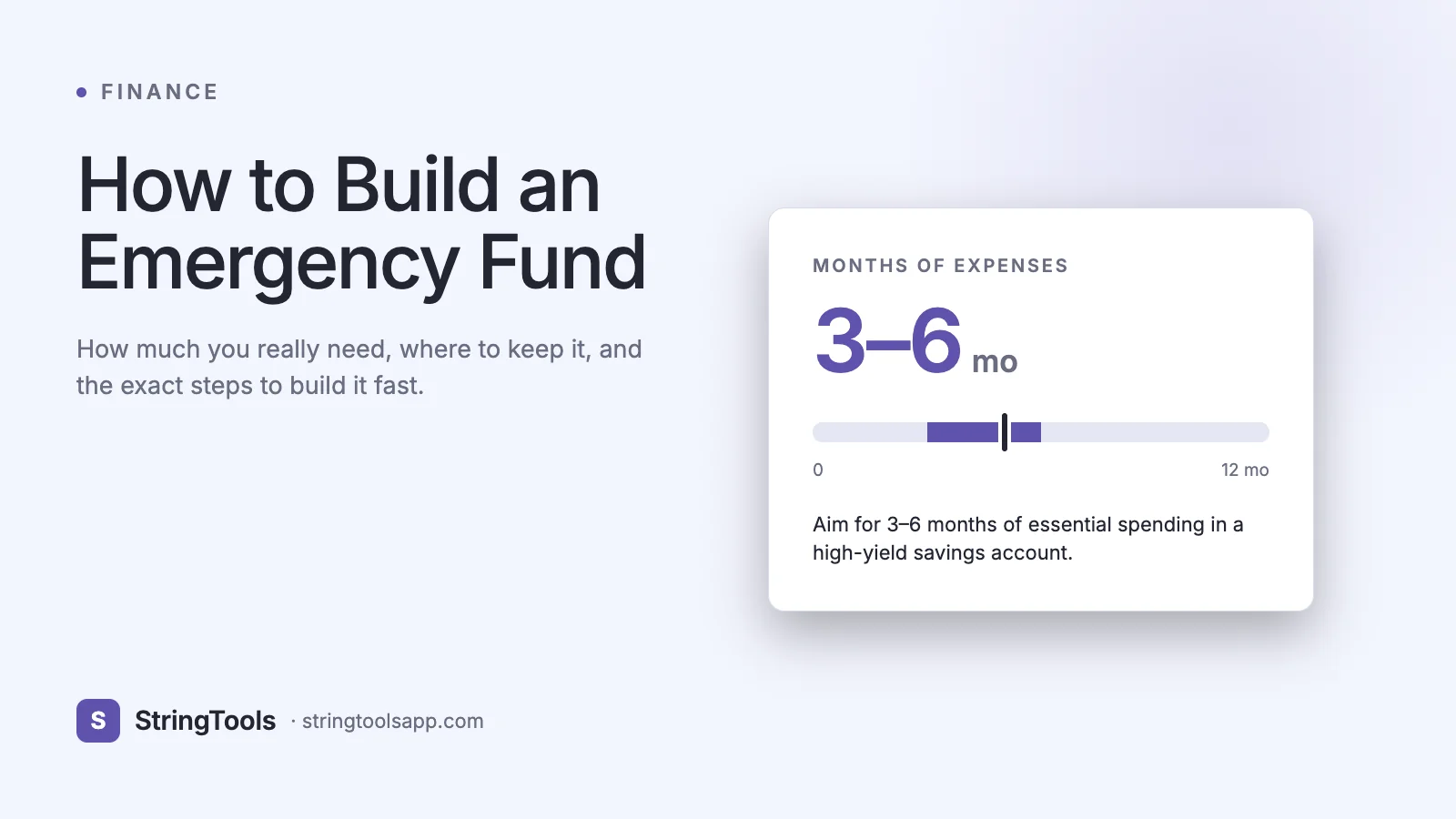
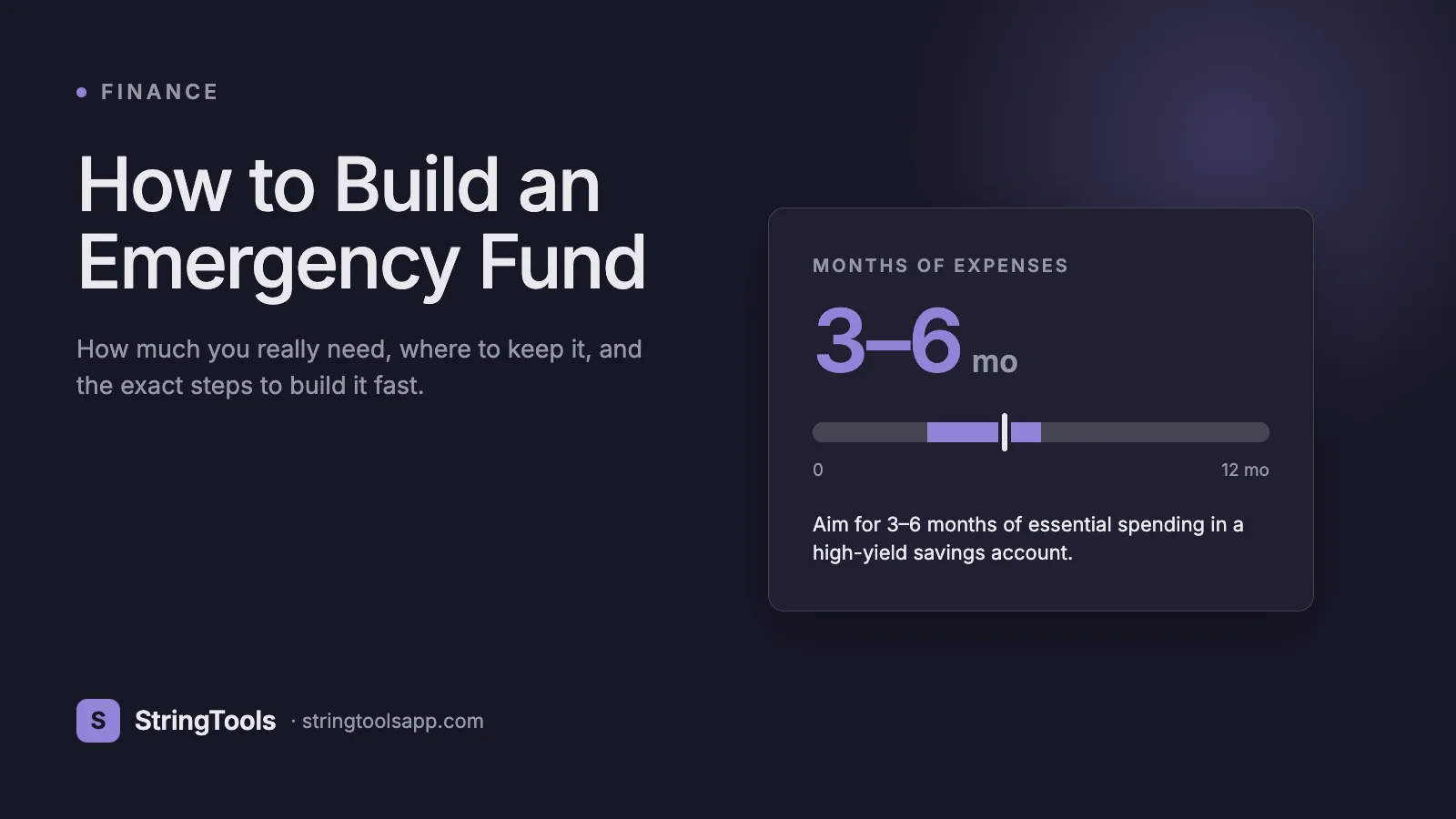
Quick answer: Build your emergency fund in three stages: a $1,000 starter fund as fast as possible, then 3–6 months of essential expenses (for most households, $12,000–$24,000), kept in a high-yield savings account earning around 4% APY — liquid, insured, and separate from your checking. Saving $500 a month gets a typical $12,000 fund done in about 23 months. Automate the transfer on payday and the plan runs itself.
The $400 Problem
Every year, the Federal Reserve asks American adults a deceptively simple question: could you cover a $400 surprise expense with cash or its equivalent? Year after year, more than a third say no — they'd have to borrow, sell something, or simply couldn't pay. Not $4,000. Four hundred dollars.
That's not a character flaw; it's what happens when every dollar has a job before it arrives and no structure exists to catch the surplus. And it's expensive: without a cash buffer, a dead alternator becomes credit-card debt at an effective rate near 27%, a layoff becomes a panicked fire-sale of investments, and every small crisis compounds into a financial one.
An emergency fund is the structure that breaks that chain. It isn't glamorous — it's a pile of boring cash whose entire job is to sit still — but it's the foundation every other money goal stands on. This guide covers exactly how much you need (personalized, not just the slogan), where to keep it so it earns real interest without risk, how fast you can realistically build it, and what happens after it's full — which is where the story gets genuinely exciting. Every number here can be verified in our compound interest calculator, which doubles as an emergency savings calculator the moment you point it at a target.
What an Emergency Fund Is (and Isn't)
What is an emergency fund? A dedicated pool of liquid cash — separate from checking and investments — reserved exclusively for unexpected, necessary, urgent expenses: job loss, medical bills, major car or home repairs. Standard size: 3–6 months of essential living expenses.
Three words in that definition carry all the weight. Dedicated: it has its own account, because money mixed into checking gets spent — not through weakness, but because mental accounting only works when the accounting is real. Liquid: you can get it within a day or two without penalties or selling at a loss. Unexpected: it is not for holidays, annual insurance premiums, or the tires you know wear out — those are predictable irregular expenses that belong in planned savings (often called sinking funds). The emergency fund is strictly the insurance layer for what you genuinely couldn't see coming.
It's also worth naming what the fund buys beyond money: options. With six months of expenses banked, a layoff is a runway instead of a freefall, and you can leave a bad job, negotiate, or relocate on your terms. Financial advisors call it self-insurance; behaviorally, it's the difference between deciding under pressure and deciding with a clear head.
How Much Do You Actually Need?
The classic rule — 3 to 6 months of expenses — is right, but only after two clarifications that most articles skip.
First: it's essential expenses, not income. Count what you must pay to keep life running: rent or mortgage, groceries, utilities, insurance, minimum debt payments, transport, childcare. Don't count what you'd cut in a crisis — streaming, restaurants, travel. For most households, essentials run 60–75% of take-home pay, which makes the target meaningfully smaller than "six months of salary."
Second: the right multiple depends on how replaceable your income is.
| Your situation | Suggested target | Why |
|---|---|---|
| Dual income, both stable jobs | 3 months | Two incomes rarely vanish at once |
| Single income, stable job | 4–6 months | One point of failure covers everything |
| Self-employed / freelance / commission | 6–12 months | Income is the emergency sometimes |
| Single income + dependents or a specialized field | 6+ months | Longer, narrower job searches |
Put together, the arithmetic is simple. Monthly essentials of $3,000 mean a target of $9,000–$18,000; $4,000 means $12,000–$24,000; $5,000 means $15,000–$30,000.
If those numbers feel impossibly large, good news: you don't build them in one leap, and the first milestone is much closer than you think.
Start With $1,000 — Here's Why
Nearly every credible money framework — from Dave Ramsey's baby steps to the CFPB's savings guidance — starts with a small, fast, fixed first goal, usually $1,000 (or one month of essentials if you can stretch). The logic is part math, part psychology.
The math: roughly speaking, most emergencies are small. Car repairs, urgent dental work, a last-minute flight, a broken refrigerator — the bulk of real-world surprise expenses land under $1,000. A starter fund converts the most frequent emergencies from debt events into inconveniences immediately, even while the full fund is under construction.
The psychology: $18,000 is a horizon; $1,000 is a sprint. Hitting a goal in six to ten weeks proves the system works, and momentum — not spreadsheets — is what actually keeps people saving. Once the starter fund exists, graduating to the full 3–6 month target is the same habit on a longer timer.
One sequencing question comes up constantly: should I save while carrying credit-card debt? The consensus answer: build the $1,000 starter first, then throw everything at high-interest debt, then build the full fund. A card at 24% APR compounds daily to an effective rate around 27% — no savings account competes with paying that off (we break down that math in our APR vs APY guide). The starter fund's job during payoff is simple: make sure the next surprise doesn't refill the card you just emptied.
Where to Keep It (and Where Not To)
The emergency fund has exactly two requirements — available fast and never down when you need it — plus a nice-to-have: earn something meanwhile. That points to one clear answer and several tempting mistakes.
| Location | Liquidity | Risk to principal | Typical yield | Verdict |
|---|---|---|---|---|
| High-yield savings (HYSA) | 1–2 days | None (FDIC/NCUA insured) | ~4% APY | Ideal |
| Money market account | 1–2 days | None (insured) | ~3–4% APY | Also good |
| Checking account | Instant | None | ~0% | Too spendable, earns nothing |
| Stocks / index funds | 2–3 days | Can be −30% at the worst moment | Higher long-run | Wrong tool for this job |
| Long-term CDs | Locked | None, but withdrawal penalties | ~4% | Penalties defeat the purpose |
The gap between a big-bank savings account and a high-yield savings account is not cosmetic. On a $15,000 fund, 0.40% pays about $60 a year; a 4% APY pays roughly $611 (thanks to monthly compounding — that's the APY doing its work, as covered in our APR vs APY guide). Same money, same safety, ten times the interest — switching accounts is a one-hour task with a permanent payoff.
And resist the itch to "put it to work" in the market. In 2008 the S&P 500 fell roughly 37% — precisely when layoffs spiked. An emergency fund invested in stocks is a fund that shrinks exactly when it's most likely to be called on. The modest APY is not the return; availability is the return.
How Long Will It Take? The Honest Math
Take a $12,000 target (three months at $4,000 of essentials) in a 4% APY account with monthly compounding. Any savings goal calculator will confirm these timelines — ours shows the month-by-month path — but here's the shape of it at different contributions:
| Monthly saving | Time to $12,000 | Of which interest |
|---|---|---|
| $250 | ≈ 45 months (3.7 yrs) | ≈ $850 |
| $500 | ≈ 23 months (1.9 yrs) | ≈ $450 |
| $750 | ≈ 16 months (1.3 yrs) | ≈ $300 |
| $1,000 | ≈ 12 months | ≈ $230 |
Computed with the future-value-of-contributions formula at 4% APY, monthly compounding. Test your own numbers in the compound interest calculator — used this way it's an emergency savings calculator for any target, rate, and monthly amount.
Two honest observations. First, the contribution is the engine; interest is a tailwind. At this size and timespan, compounding contributes hundreds, not thousands — its heroics come later, in decades-long investing. Second, the difference between $250 and $500 a month is the difference between nearly four years and under two. If the timeline looks discouraging, the answer usually isn't a cleverer account — it's temporarily widening the gap between income and essentials, which is exactly what the next section is about.
Seven Ways to Fill It Faster
1. Automate on payday. A standing transfer to the HYSA the morning your paycheck lands — before discretionary spending sees it. Pay-yourself-first isn't a slogan; it's removing the monthly decision entirely.
2. Route windfalls by rule. Decide now that tax refunds, bonuses, gift money, and side-gig income go 100% (or a fixed 50%) to the fund until it's full. The average US tax refund alone is roughly $3,000 — a quarter of a typical fund in one deposit.
3. Bank every "found" reduction. Paid off a car? Renegotiated insurance? Cancelled subscriptions? Redirect the exact freed-up amount to savings before it dissolves into the budget.
4. Sell the clutter. Most homes hold a few hundred to a few thousand dollars of unused electronics, furniture, and gear. It's a one-time boost that often funds the entire $1,000 starter.
5. Add a temporary income sprint. Overtime, freelancing, seasonal work — ugly-but-effective when framed as "six months to finish the fund," not a lifestyle.
6. Trim the big three, briefly. Housing, transport, food dominate every budget. A roommate for a year, one fewer car, meal planning — temporary discomfort, permanent safety net.
7. Make progress visible. Name the account ("6 Months of Freedom"), track the percentage, celebrate quartiles. Visible progress is the cheapest motivation technology ever invented.
When to Use It — the Three-Question Test
A fund that's too easy to raid isn't a fund; it's a slush account. Before withdrawing, ask three questions:
Is it unexpected? A transmission failure, yes. Christmas — which arrives every December 25th — no.
Is it necessary? Emergency dental work, yes. A once-a-decade sale on a watch, no.
Is it urgent? The water heater flooding the basement, yes. A dishwasher that can limp along another month while you cash-flow the replacement, maybe not.
Three yeses: spend without guilt — this is literally what the money is for, and using it is the system working, not failing. Any no: it comes from regular budget or planned savings instead.
After a withdrawal, refill before resuming other goals. Pause the extra investing or accelerated debt payments, restore the fund, then continue. And revisit the target once a year or after life changes — a new child, a mortgage, one income becoming two — since "three months of essentials" is a moving number. (If a mortgage is on your horizon, our home affordability guide shows why lenders also love seeing cash reserves.)
After It's Full: Where the Money Goes Next
Here's the part that makes the whole grind worthwhile. The day the fund hits its target, the $500 a month that built it doesn't stop — it redirects. And pointed at long-term investing, that same habit changes scale entirely.
$500 a month invested at a 7% average annual return grows to roughly $260,000 in 20 years — about $120,000 of contributions and $140,000 of compounding. The emergency fund phase, in hindsight, turns out to be training: same transfer, same discipline, different destination. The fund also protects those investments — with cash on hand, you'll never be forced to sell holdings in a down market to fix a roof. (The mechanics of why this snowballs are in our compound interest guide.)
Think of it as a sequence, not a choice: starter fund → high-interest debt → full fund → invest the difference. Each stage makes the next one safer.
Frequently Asked Questions
How much should I have in an emergency fund?
Three to six months of essential expenses — not income. At $4,000 a month of essentials, that's $12,000–$24,000. Use 3 months if you're a stable dual-income household; push toward 6 or more if you're self-employed, single-income, or supporting dependents.
Is $1,000 enough for an emergency fund?
It's the right first milestone, not the destination. $1,000 handles the most frequent emergencies and keeps them off credit cards while you build the full fund. Stopping there leaves job loss — the expensive emergency — uncovered.
Where should I keep my emergency fund?
A high-yield savings account or money market account at an insured institution: liquid in a day or two, zero principal risk, and around 4% APY at current rates. Keep it at a different bank than your checking if you need friction against impulse withdrawals.
Should I invest my emergency fund?
No. Markets can be down sharply exactly when emergencies cluster (layoffs and recessions travel together). The fund's return is availability; growth is the job of money you won't need on short notice.
Should I build an emergency fund or pay off debt first?
Staged: $1,000 starter → high-interest debt → full 3–6 month fund. Card debt at an effective ~27% outranks any APY, but without the starter buffer, one surprise re-borrows everything you just repaid. If you're weighing a consolidation loan, run it in our loan calculator first.
How long does it take to build an emergency fund?
At 4% APY: about 23 months to $12,000 saving $500 a month; 45 months at $250; 12 months at $1,000. The monthly amount dominates — automate it and adjust annually.
What counts as a real emergency?
Unexpected AND necessary AND urgent. Car repairs, medical bills, job loss: yes. Predictable annual costs, gifts, sales, vacations: no — those belong in planned savings ("sinking funds"), which keep the emergency fund pure.
Run Your Own Numbers
Every table above is one formula away from being personal. Open our free compound interest calculator and use it as a savings goal calculator: enter your starting balance, your monthly contribution, and a 4% rate with monthly compounding, then read the year-by-year table to see exactly when you cross your target. Then run the fun scenario — the same contribution at 7% for 20 years — to see what the post-fund investing phase looks like. If debt payoff is competing for the same dollars, model it honestly in the loan calculator and let the numbers pick the order.
This article is for general educational purposes and is not financial advice. APY rates change with the market, insurance limits and account rules vary by institution and country, and the right savings target depends on your circumstances — confirm specifics with a licensed financial advisor.