
Why Your Credit Score Decides More Than Just Approval
Key Takeaways
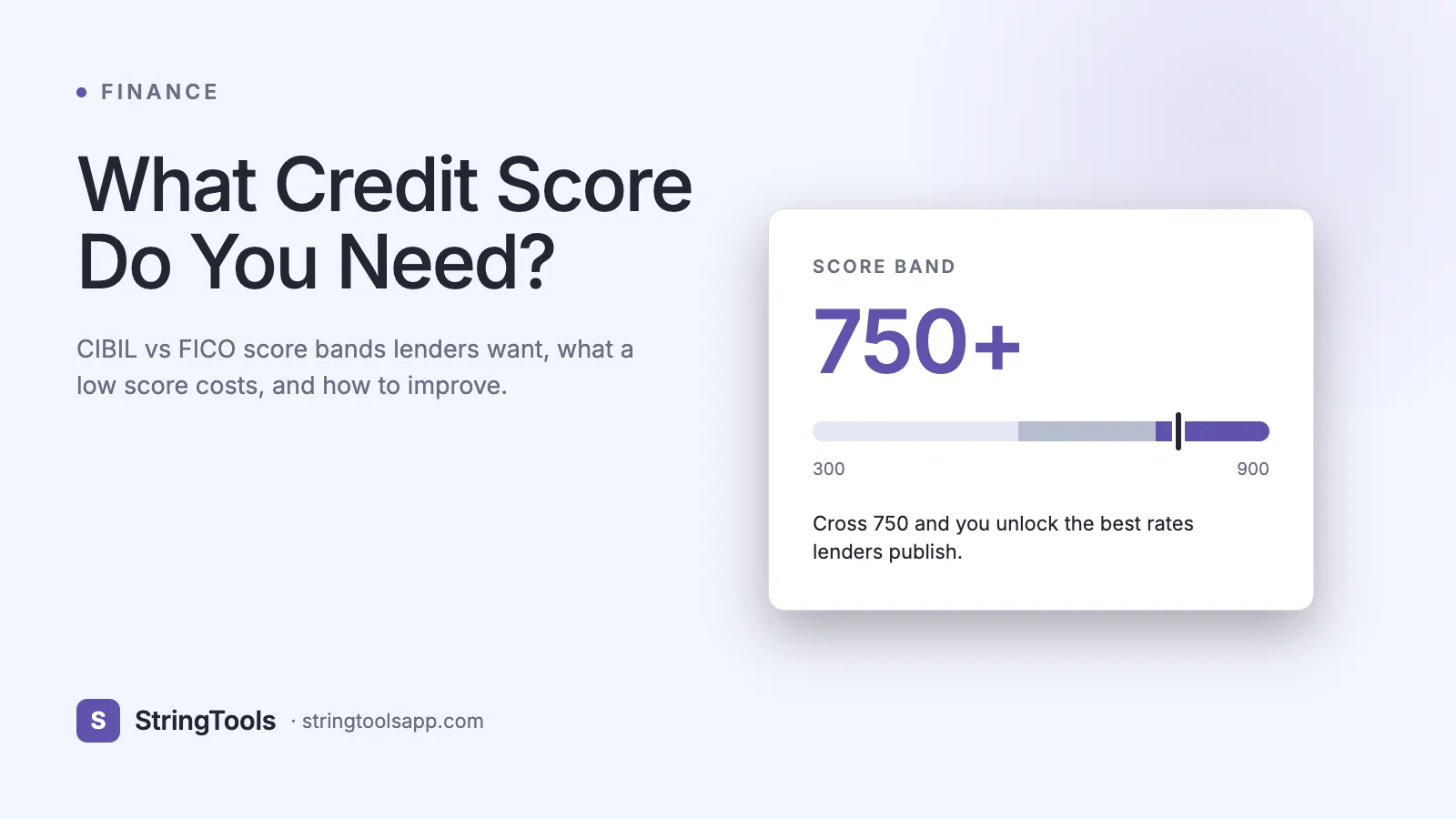
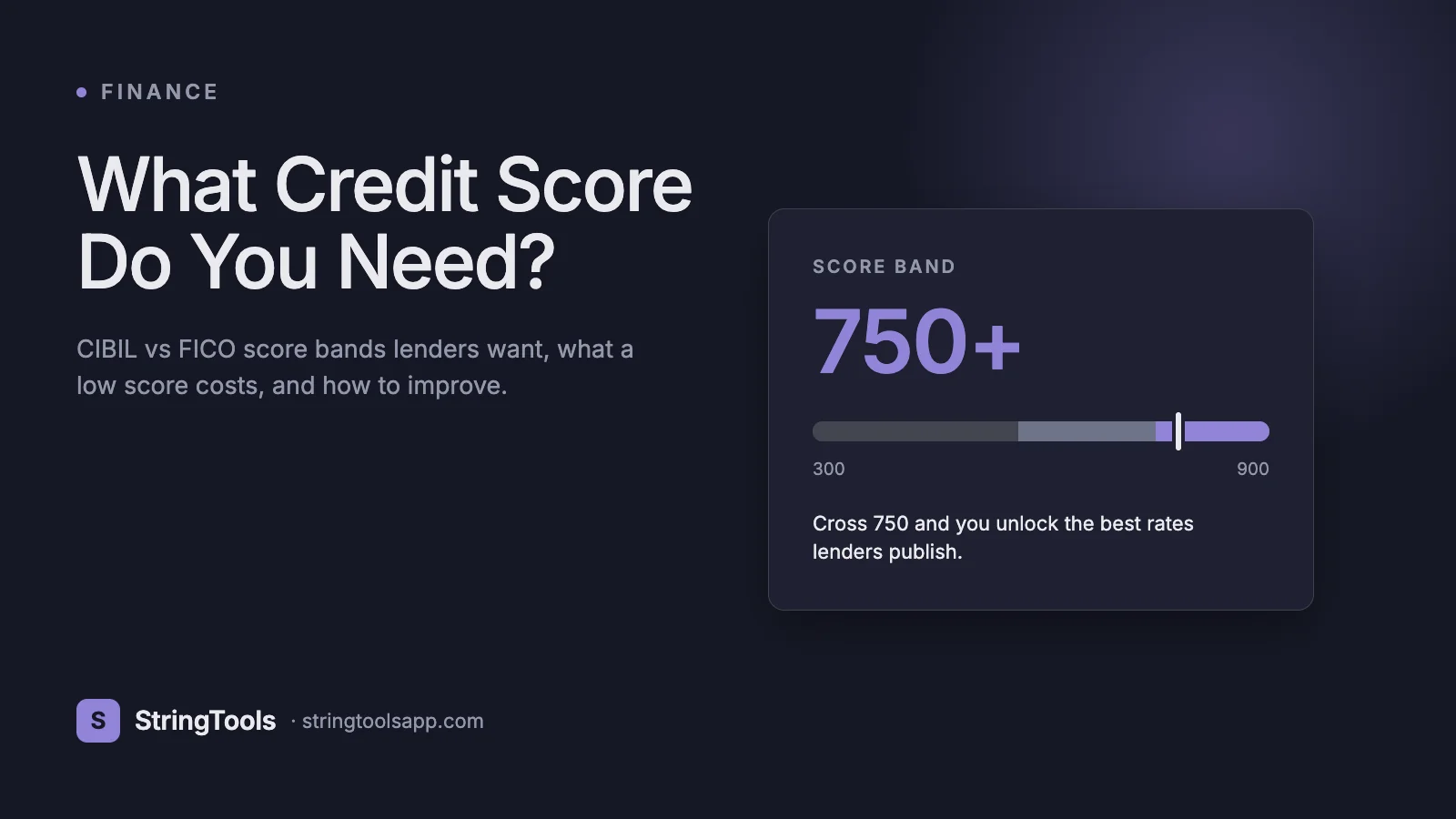
- In India a CIBIL score of 750 and above unlocks the smoothest approvals and a lender's best advertised rates; in the US that top tier starts around a FICO of 740.
- Your score does three separate jobs: it decides whether you are approved, sets your interest rate through risk-based pricing, and can cap how much you are allowed to borrow.
- On a Rs 30 lakh, 20-year home loan, paying 9.5 percent instead of 8.5 percent costs roughly Rs 4.63 lakh in extra interest; on a 300,000 dollar US mortgage, a one-point gap costs about 72,500 dollars.
- Payment history (roughly 35 percent of a FICO score) and credit utilization (roughly 30 percent) are the two biggest levers, so pay on time and keep utilization under about 30 percent.
- Checking your own score is a soft inquiry and never lowers it; only formal loan and card applications create score-denting hard inquiries.
- Utilization fixes and bureau-error corrections can lift a score in about 30 to 60 days, while recovering from missed payments takes several months.
Your credit score decides more than approval: lenders also use it to set your interest rate through risk-based pricing and to cap how much you are allowed to borrow. In India that score is usually your CIBIL score, on a 300 to 900 scale; in the US it is your FICO score, on a 300 to 850 scale.
Two people walk into the same bank with the same salary, the same job stability, and the same loan request. One walks out with an approval at the bank's best advertised rate. The other gets approved too, but at a rate one full percentage point higher, and on a 20-year home loan that single point can quietly cost several lakh rupees, or tens of thousands of dollars, in extra interest. The difference between them was a three-digit number neither of them had looked at in years.
Your credit score is the first thing most lenders check, often before a human being ever reads your application. In India that usually means your CIBIL score. In the United States it means your FICO score (or the similar VantageScore). The UK, Canada, and Australia have their own bureaus and scales, but the logic is identical everywhere: the score is a statistical estimate of how likely you are to miss payments, based entirely on how you have handled credit in the past.
What many borrowers do not realize is that the score does three separate jobs. It influences whether you get approved at all. It influences the interest rate you are offered, because most lenders practice risk-based pricing. And it can influence how much you are allowed to borrow. This guide explains both the CIBIL and FICO systems, what the score bands typically mean in practice, exactly how much money a weaker score costs you, and how to improve yours on a realistic timeline.
The CIBIL Score: How India's 300 to 900 Scale Works
CIBIL, run by TransUnion CIBIL, is the oldest and most widely used of India's four RBI-licensed credit bureaus; the others are Experian, Equifax, and CRIF High Mark. Banks and NBFCs report your loan and credit card behaviour to these bureaus every month, and the bureau compresses that history into a score between 300 and 900. Higher is better. If you have never taken a loan or card, you may see no score at all, or markers like NA or NH, which simply mean there is not enough history to score you.
While every lender sets its own internal cutoffs, and those policies are not published, Indian lending practice has settled into fairly consistent bands.
750 and above. Widely treated as a strong score. Applicants in this range typically face the least friction, qualify with the most lenders, and are the ones most likely to be offered a lender's better advertised rates on home loans and personal loans.
700 to 749. Generally considered good. Most banks and NBFCs will still lend, though you may not get the very best pricing, and some premium offers may be out of reach.
650 to 699. A grey zone. Approvals are possible, especially with NBFCs or with a strong income profile, but expect higher rates, lower sanctioned amounts, or requests for a co-applicant or collateral.
Below 650. Many mainstream lenders become cautious here. Secured loans, loans against deposits or gold, or a guarantor often become the practical route.
Two important caveats. First, these are typical patterns, not rules; each lender weighs score alongside income, existing EMIs, employer category, and banking relationship. Second, you are entitled under RBI rules to one free full credit report from each bureau every year, so checking your own score costs nothing and, because it is a soft inquiry, does not reduce it.
The FICO Score: How the US 300 to 850 Scale Works
In the United States, the dominant score is FICO, which runs from 300 to 850 and is built from data held by the three big bureaus: Experian, Equifax, and TransUnion. FICO itself publishes the bands most lenders reference.
Below 580. Classified as poor, often called subprime. Mainstream unsecured credit is difficult; loans that are available tend to carry the highest rates.
580 to 669. Fair. Borrowing is possible but pricing is noticeably worse than average, and some lenders decline this range for unsecured personal loans.
670 to 739. Good. This is roughly the range where most lenders regard a borrower as acceptable risk, and where approval odds improve sharply.
740 to 799. Very good. Borrowers here typically qualify for better-than-average rates across mortgages, auto loans, and cards.
800 and above. Exceptional. Rate offers at or near the best a lender advertises.
For mortgages specifically, conventional loans backed by Fannie Mae or Freddie Mac generally require a minimum FICO of around 620, while FHA program rules allow scores as low as 580 with a 3.5 percent down payment, and 500 to 579 with 10 percent down, though individual lenders often add their own stricter overlays on top of program minimums. Crucially, even after you clear the minimum, mortgage pricing improves in steps as your score rises, which is why the jump from the mid-600s to 740 plus can be worth real money every single month.
If you are in the UK, Canada, or Australia, the branding differs, Experian and Equifax scores in the UK, scores up to 900 in Canada, and even higher scales with Australian bureaus, but the same principle holds: the top band gets the best pricing, the middle band gets approved at a premium, and the bottom band gets declined or heavily surcharged.
What Score Bands Actually Mean for Approval Odds and Pricing
For most loans, lenders want a CIBIL score of 750 or above in India or a FICO of roughly 670 or higher in the US to approve you cleanly at a good rate. Below that, approval is still possible through NBFCs, secured loans, or FHA-type programs, but you pay higher interest and may be asked for a co-applicant or collateral.
It helps to think of your score as controlling two separate doors. The first door is approval. Most lenders run an automated screen, and applications below the lender's internal floor are declined or routed to manual review before a person ever evaluates your income. This is why a borrower with excellent salary but a 640 score can be rejected while a modest earner at 780 sails through.
The second door is pricing, and this is the one borrowers underestimate. Lenders do not offer one interest rate; they offer a grid. A home loan advertised from 8.5 percent per annum in India, for instance, usually means 8.5 percent for the highest score band, with progressively higher rates for lower bands. Several large Indian banks have explicitly linked home loan pricing to bureau score bands for years, and risk-based pricing is standard practice in the US mortgage and personal loan markets too. The advertised headline rate is effectively reserved for roughly the 750-plus CIBIL crowd or the 740-plus FICO crowd.
Roughly, the bands line up like this:
| Score band | CIBIL / FICO range | Approval odds | Typical rate impact |
|---|---|---|---|
| Top tier | CIBIL 750+ / FICO 740+ | Very high, least friction | Best advertised rate |
| Good | CIBIL 700-749 / FICO 670-739 | Most lenders will still lend | Slightly above the best |
| Grey zone | CIBIL 650-699 / FICO 580-669 | Possible, often via NBFCs | Noticeably higher rates |
| Weak | CIBIL below 650 / FICO below 580 | Many mainstream lenders decline | Highest, or secured route only |
There is a third, less visible effect: loan amount and terms. A weaker score can shrink the amount a lender will sanction, shorten the maximum tenure, trigger requirements for a co-applicant or additional collateral, or add processing conditions. It also interacts with the kind of rate you are offered, which is why it pays to understand fixed vs floating pricing before you sign. On credit cards it shows up as lower limits, which then feeds back into your utilization ratio and can suppress your score further.
The practical takeaway is that your score matters even when approval is not in doubt. Moving from the good band to the very good band rarely changes whether you get the loan, but it very often changes what the loan costs, and on long-tenure borrowing that difference compounds into serious money, as the next section shows with exact numbers.
The Real Cost of a Lower Score: Two Worked Examples
A lower credit score typically costs you about one interest-rate band, and that gap is expensive. On a Rs 30 lakh, 20-year home loan, paying 9.5 percent instead of 8.5 percent adds roughly Rs 4.63 lakh in extra interest; on a 300,000 dollar, 30-year US mortgage, a one-point spread costs about 72,500 dollars.
Let us put actual numbers on the gap between score bands, using the standard amortization formula every bank uses. The rates below are illustrative, chosen only to show what a one percentage point spread does; actual rates change over time and vary by lender.
The India example. Suppose you borrow Rs 30 lakh for a home over 20 years, which is 240 monthly payments. A borrower in the strong score band is offered 8.5 percent per annum, while a borrower in a weaker band is offered 9.5 percent for the identical loan.
At 8.5 percent, the EMI works out to about Rs 26,035 per month. Over 240 months you pay roughly Rs 62.48 lakh in total, of which about Rs 32.48 lakh is interest.
At 9.5 percent, the EMI is about Rs 27,964 per month. Total payments come to roughly Rs 67.11 lakh, of which about Rs 37.11 lakh is interest.
The weaker score costs roughly Rs 1,929 extra every month, which adds up to approximately Rs 4.63 lakh of additional interest over the life of the loan. That is the price of a few hundred score points, on a single loan. You can verify these figures yourself in seconds with an EMI calculator, and test your own loan amount and tenure with a loan calculator before you ever speak to a bank.
The US example. Take a 300,000 dollar mortgage over 30 years, which is 360 payments. At 6.5 percent the monthly payment is about 1,896 dollars; at 7.5 percent it is about 2,098 dollars. That one point spread costs roughly 201 dollars per month, or about 72,500 dollars across the full term. A mortgage calculator will confirm the math instantly. And if you want to appreciate why long loans amplify small rate differences so dramatically, run the same numbers through a compound interest calculator: interest charged on a balance that shrinks slowly behaves much like compounding working against you.
The Five Factors That Build or Break Your Score
Five factors determine your credit score: payment history (roughly 35 percent of a FICO score), amounts owed and utilization (roughly 30 percent), length of credit history (roughly 15 percent), new credit and hard inquiries (roughly 10 percent), and credit mix (roughly 10 percent). Paying on time and keeping utilization low are the two biggest levers.
Both CIBIL and FICO are built from broadly the same ingredients. FICO publishes its approximate weightings, and CIBIL's model, while not public in the same detail, rewards and punishes the same behaviours.
Payment history, roughly 35 percent of a FICO score. Whether you pay EMIs and card bills on time is the single biggest input. Even one payment reported 30-plus days late can dent a good score noticeably, and late payments can stay on your report for years, up to seven in the US. Settlements and write-offs, where a lender closes a loan for less than what was owed, are especially damaging in India because the account is flagged as settled rather than closed.
Amounts owed and utilization, roughly 30 percent. This is your card balances relative to your limits. Keeping total utilization under about 30 percent is the common guideline, and lower is better. Maxed-out cards signal stress even if you pay on time.
Length of credit history, roughly 15 percent. Older accounts help. This is why closing your oldest credit card, a very common tidy-up instinct, can actually reduce your score by shortening your average account age and cutting your total limit.
New credit and hard inquiries, roughly 10 percent. Every formal loan or card application triggers a hard inquiry, and several inquiries in a short window make you look credit-hungry. Checking your own score, by contrast, is a soft inquiry and has no effect.
Credit mix, roughly 10 percent. A blend of secured lending, like a home or auto loan, and unsecured lending, like cards, scores slightly better than unsecured borrowing alone. This is the smallest factor, so never take a loan you do not need just to improve mix.
Credit Score Myths That Quietly Cost Borrowers Money
Six common credit score myths cost borrowers money: that checking your own score lowers it, that income affects the score, that carrying a card balance builds credit, that closing old cards helps, that one score number rules everything, and that a bad score is permanent. All six are false, and each is corrected below.
The myth that checking your score lowers it. False, and expensively so, because it stops people from monitoring their own reports. Self-checks are soft inquiries. Only applications you submit to lenders generate hard inquiries. Check your score freely and regularly.
The myth that income affects your credit score. Your salary appears nowhere in the CIBIL or FICO calculation. A high earner with missed payments will score worse than a modest earner who pays on time. Income matters to the lender's separate affordability check, not to the score itself.
The myth that carrying a card balance builds credit. Paying interest does nothing for your score. What builds credit is on-time payment and low utilization; paying your statement in full every month achieves both and costs you nothing.
The myth that closing old cards cleans up your profile. As covered above, closing your oldest card usually hurts, by raising utilization and shortening history. Keep old no-fee cards open with occasional small use.
The myth that one score number rules everything. You actually have multiple scores, one per bureau, and they differ because lenders do not all report to every bureau. A lender may also use its own internal scorecard on top. If one bureau shows an error, a wrongly reported late payment or a loan that was closed but still shows active, dispute it with that bureau directly; corrections are free and errors are among the fastest fixable score problems.
The myth that a bad score is permanent. Scores are recalculated as new data arrives every month. Negative marks fade in impact over time, and positive behaviour starts registering within a few reporting cycles. Nobody is locked out forever.
How Fast Can You Improve, and What to Do Next
Improvement timelines depend on what is dragging your score down. The fastest lever is utilization: pay card balances down before the statement date and the lower figure reflects in your score within one or two reporting cycles, often 30 to 60 days. Correcting a bureau error can produce a jump in a similar window once the dispute is resolved. Recovering from actual missed payments is slower, typically several months of clean, on-time history before meaningful recovery, and a year or more for serious delinquencies or settled accounts. Building a score from scratch, with no history at all, usually takes about six months of activity on a starter card or a secured card against a fixed deposit.
A realistic 90-day plan looks like this: pull your reports from the bureaus, dispute any errors, drop utilization below 30 percent, set every EMI and card bill on auto-pay, and stop submitting new applications so hard inquiries stop accumulating.
When you are ready to borrow, do not walk into a single branch and accept whatever rate you are quoted, because as the worked example showed, the spread between offers can be worth lakhs. It also helps to know in advance how much loan you can get on your salary so you can sanity-check what lenders come back with. The smarter sequence is to compare loan offers from multiple lenders at once and let them compete for you: get written quotes from two or three regulated banks and NBFCs, or a reputable, regulated loan-comparison marketplace, rather than accepting the first rate you are offered. Each lender independently decides whether to make you an offer and on what terms. Nothing here is a guarantee of approval or of any particular rate. Before accepting anything, run the quoted rate and tenure through the EMI calculator or mortgage calculator to verify the repayment figures match what the lender promised, down to the rupee or dollar.
This article is general education, not financial advice; score cutoffs, rates, and terms vary by lender and change over time, so always confirm current terms directly with the lender before signing.
Frequently Asked Questions
What CIBIL score is needed for a personal loan in India?
There is no single official cutoff because every lender sets its own policy, but in practice a CIBIL score of 750 or above is widely treated as strong and gets the smoothest approvals and better rates on personal loans. Scores between 700 and 749 are usually approvable at slightly higher pricing, 650 to 699 is a grey zone where NBFCs are more flexible than banks, and below 650 many mainstream lenders decline unsecured loans or ask for a co-applicant or collateral.
Is a 750 CIBIL score good enough for a home loan?
Yes. 750 is the threshold most Indian lenders informally treat as the start of the best score band, and several large banks explicitly link their lowest home loan rates to high bureau scores. At 750 plus you typically qualify with the widest range of lenders and are eligible for their better advertised rates. Approval still depends on income, existing EMIs, and property checks, but the score itself will rarely be the obstacle.
What FICO score do I need for a mortgage in the US?
Conventional loans backed by Fannie Mae or Freddie Mac generally require a minimum FICO of about 620. FHA program rules go lower: 580 with a 3.5 percent down payment, or 500 to 579 with 10 percent down, though individual lenders often impose stricter overlays. The bigger point is pricing: rates improve in steps as your score rises, and borrowers at 740 plus typically get meaningfully cheaper mortgages than borrowers who barely clear the minimum.
How fast can I improve my CIBIL or FICO score?
It depends on the cause. Lowering credit card utilization shows up within one or two monthly reporting cycles, roughly 30 to 60 days, and fixing a bureau error can produce a similar quick jump. Recovering from missed payments takes several months of clean on-time history, and serious delinquencies or settled accounts can weigh on the score for a year or more. Building a score from zero usually takes about six months of responsible activity on a starter or secured card.
Does checking my own credit score lower it?
No. Checking your own score is a soft inquiry and has zero effect on it, no matter how often you do it. Only hard inquiries, which happen when you formally apply for a loan or credit card, can reduce your score, and even then the impact is small unless you make many applications in a short period. In India, RBI rules entitle you to one free full credit report from each bureau every year.
Can I get a loan with a low credit score?
Often yes, but on worse terms. Options include secured loans such as gold loans or loans against fixed deposits, adding a co-applicant or guarantor with a strong score, applying with NBFCs that accept higher risk at higher rates, or FHA-type programs in the US that permit lower scores with larger down payments. Because low-score offers vary enormously between lenders, it is especially worth comparing multiple offers, and always verify the quoted EMI with a calculator before accepting.
Sources and references
CIBIL (cibil.com) · RBI (rbi.org.in) · FICO itself (myfico.com). Content was reviewed against these sources as of the last-updated date above; external figures and rules may change after publication.