
Rejected With a Good Credit Score? Here Is What Actually Happened
Key Takeaways
- A healthy credit score above 750 does not guarantee approval — it clears just one of five or six independent gates.
- The most common silent killer is a high FOIR or DTI: Indian lenders want total EMIs under roughly 40 to 55 percent of net income, and US mortgage lenders around 36 to 43 percent.
- Applying to several lenders at once backfires — each triggers a hard inquiry, and a cluster reads as credit-hunger to the next lender.
- Many rejections come from non-financial gates: document mismatches, employer or pin-code policy lists, or legal issues on the property.
- After a rejection, diagnose the exact cause first, then wait roughly three to six months for inquiries to age before reapplying.
- Run your numbers through an EMI calculator before applying so you know your ratio before the bank does.
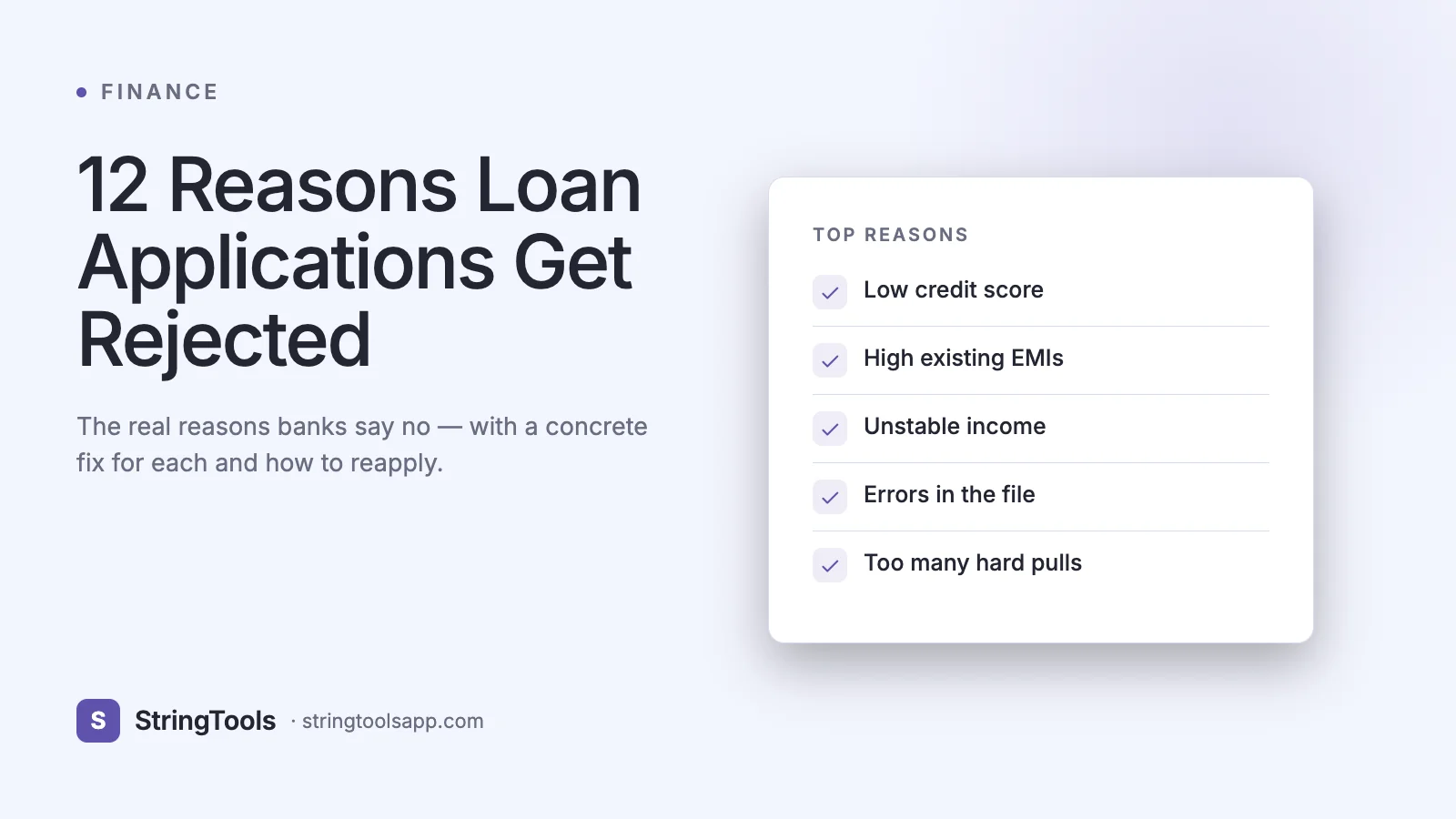
Loan applications get rejected because approval depends on far more than your credit score. A modern application must clear several independent gates — the credit bureau, an income-and-obligations (FOIR/DTI) assessment, document verification, internal lender policy, and, for secured loans, a legal check on the asset — and failing any single one kills the file. That is why the rejection stings most when your score is healthy: you checked your CIBIL or FICO score, saw it comfortably above 750, submitted the application, and the bank still said no.
The confusing part is that most lenders will not tell you exactly why. In India, banks and NBFCs typically send a one-line rejection with a vague reason code. In the US, lenders are required to give an adverse action notice stating a principal reason, and in the UK, Canada, and Australia you are generally entitled to be told if a credit reference agency was used and to see your file — but even these disclosures are often generic phrases like "debt obligations too high" or "insufficient credit history."
Here is the truth that lenders rarely spell out: your credit score is only one gate out of many. A modern loan application passes through a credit bureau check, an income and obligations assessment, a document verification stage, an internal policy filter (employer lists, pin codes, business categories), and — for secured loans — a legal and technical evaluation of the asset. A failure at any single gate kills the application, and most of those gates have nothing to do with your score.
This matters because the wrong response to rejection makes things worse. The most common mistake borrowers make is immediately applying to three or four other lenders. Each application triggers a hard inquiry on your credit report, and a burst of inquiries is itself a rejection trigger at the next lender. So before you apply anywhere else, diagnose the real cause. This guide walks through the 12 reasons that account for the overwhelming majority of rejections, with a specific fix for each, a fully worked numeric example of the most common silent killer, and a sensible reapplication plan.
Reasons 1–4: The Credit and Income Filters
The first four rejection reasons are the core credit and income filters: a credit score below the lender's cutoff (roughly 700–750 for unsecured personal loans in India), a high existing EMI burden that breaches the FOIR or DTI ceiling, unstable income or a recent job change, and a thin credit file with no borrowing history to score.
Low credit score. This is the obvious one, but the thresholds surprise people. Many Indian lenders want roughly 700–750 or higher for unsecured personal loans, and Tier-1 lenders have similar internal cutoffs that vary by product. The fix is unglamorous but reliable: pay every EMI and credit card bill on time for six to twelve months, bring credit card utilisation below about 30 percent of your limit, and dispute any errors on your report — bureau errors are more common than most people assume, and correcting one can move your score meaningfully within a couple of months. You can pull and check your own file directly at CIBIL; for the full picture of what score each loan type needs, see our guide on the credit score for loan approval.
High existing EMI burden. This is the single most common reason people with good scores get rejected. Lenders compute your fixed obligation to income ratio, called FOIR in India and debt-to-income (DTI) ratio elsewhere. As a typical range, Indian lenders want total EMIs — including the new loan — under roughly 40 to 55 percent of net monthly income, while US mortgage lenders commonly work around a 36 to 43 percent DTI band. These cutoffs vary by lender and product, but the principle is universal: too many existing obligations means no room for a new one. The fix: close or prepay a small loan before applying, avoid converting card purchases into EMIs in the months before an application, ask for a longer tenure to shrink the proposed EMI, or add an earning co-applicant. Run your numbers through an EMI calculator first so you know your ratio before the bank does. If you are not sure of your ceiling, our guide on how much loan you can get on your salary breaks the maths down.
Unstable income or frequent job changes. Lenders want evidence you can pay for years, not months. Typical expectations are six months to a year in your current job for salaried applicants, and two to three years of income proof (ITRs, audited statements) for the self-employed — again, ranges vary by lender. If you switched jobs recently, waiting until you have cleared probation and can show three to six salary credits in your bank statement dramatically improves your odds.
Thin credit file. If you have never borrowed, there is nothing for the bureau to score, and "no history" reads as risk. The fix is to build a small track record deliberately: a secured credit card against a fixed deposit, or a small consumer loan repaid perfectly for six to twelve months, gives the bureau data to score you on.
Reasons 5–8: The Paperwork and Behaviour Filters
Reasons five through eight are paperwork and behaviour failures: insufficient documentation, information that does not match across your documents, too many recent applications creating a cluster of hard inquiries, and cheque bounces or failed auto-debits in your bank statements. Each can kill a file even when your score and income are otherwise strong.
Insufficient documentation. Missing salary slips, unstamped bank statements, an expired address proof, or an unsigned form can quietly stall a file until it lapses. The fix is a pre-application checklist: identity proof, address proof, PAN (in India), three to six months of bank statements, salary slips or income tax returns, and — for secured loans — the complete property or asset document chain. Ask the lender for their exact list before submitting, not after.
Mismatched information across documents. This one is brutal because it looks like fraud to an automated system even when it is an honest slip. A name spelled "Mohammed" on your PAN and "Mohammad" on your Aadhaar, an old address on your bank KYC, a salary figure on the application that does not match the credited amount in your statement, or a different date of birth across two IDs — any of these can trigger rejection or an indefinite "verification pending" state. The fix: audit your own documents before applying. Update KYC records with your bank, correct spelling mismatches at the source, and make sure the income you declare matches what your statements show to the rupee, dollar, or pound.
Too many recent applications. Every formal application creates a hard inquiry. One inquiry is normal; five inquiries in two months tells every subsequent lender you are credit-hungry and being turned away elsewhere. Scores dip a little with each inquiry, but the pattern is the bigger problem. The fix: stop applying, wait roughly three to six months for the inquiry pile-up to age, and next time compare loan offers through a single soft-inquiry channel before formally applying to one chosen lender.
Cheque bounces and returned payments in your statements. Underwriters read your bank statements line by line. Cheque returns, failed auto-debits (ECS/NACH bounces in India, missed direct debits elsewhere), and overdraft flags in the last six to twelve months signal cash-flow stress even if your credit score has not caught up yet. The fix: keep a buffer in the account your EMIs debit from, set balance alerts, and if a bounce was a one-off technical issue, get a letter or proof from your bank explaining it and attach it proactively.
Reasons 9–12: The Policy Filters Nobody Tells You About
The last four rejection reasons are internal lender-policy filters: legal or title problems on the property backing a secured loan, an employer or business category not on the lender's approved list, an age-versus-tenure conflict that pushes the EMI over the FOIR limit, and a co-applicant or guarantor whose weak credit sinks the joint file.
Property or legal issues on secured loans. For home loans and loans against property, the asset must clear the lender's legal and technical checks: a clean title chain, approved building plan, no pending litigation, and a location the lender services. Unclear titles, unapproved construction, gram panchayat or unregistered properties, and disputed inheritance shares are classic silent killers — your finances can be perfect and the loan still dies. The fix: get the title documents vetted by a lawyer before applying, obtain an encumbrance certificate, and if one lender's panel rejects the property, ask precisely why — some issues are curable (missing completion certificate) and some mean choosing a different property or lender. A mortgage calculator will tell you what you can afford, but only clean paperwork gets you approved.
Employer or business category not on the lender's list. Many banks maintain internal lists of approved employers, and companies that are very small, newly incorporated, or in stressed sectors may be categorised unfavourably. Self-employed applicants in categories a lender considers volatile — commission-only sales, certain cash-heavy trades — face the same wall. The fix: this is a lender-policy issue, not a you issue, so apply where your profile fits. NBFCs and newer digital lenders often have broader employer coverage than conservative banks, usually at a somewhat higher rate.
Age versus tenure conflicts. Lenders want the loan fully repaid before you exit your earning years — commonly by around age 60 to 70 depending on the lender and whether you are salaried or self-employed. A 54-year-old asking for a 20-year home loan will usually be offered a shorter tenure, which raises the EMI, which can then breach the FOIR limit and cause rejection. The fix: model the shorter tenure honestly with a loan calculator before applying, add a younger co-applicant to extend the permissible tenure, or increase the down payment to shrink the loan.
Guarantor or co-applicant problems. Your co-applicant's credit report is scrutinised as hard as yours, and their weak score or high obligations can sink a joint application. Separately, if you have stood guarantor for someone else's loan, that liability counts against your own capacity — and if they default, it hits your report directly. The fix: check every co-applicant's report before applying, choose the co-applicant strategically (income and score, not just relationship), and think twice before guaranteeing loans casually.
Quick Reference: Rejection Reason to Fix
The twelve reasons above condense into a handful of moves. Use this as a diagnostic shortlist once you know which gate failed.
| Rejection reason | How to fix it |
|---|---|
| Low credit score | Pay every EMI on time for six to twelve months, bring card utilisation below about 30 percent, and dispute report errors |
| High existing EMI burden (FOIR/DTI) | Close or prepay a small loan, ask for a longer tenure, or add an earning co-applicant |
| Unstable income or recent job change | Wait until you clear probation and can show three to six salary credits |
| Document mismatch or missing papers | Audit and align your documents before applying and ask the lender for their exact checklist |
| Too many recent applications | Stop applying, wait three to six months for inquiries to age, then compare offers through one soft-inquiry channel |
| Lender policy (employer, property, or age) | Apply where your profile fits, add a younger co-applicant, or get the title documents vetted first |
A Worked Example: How a 780 Score Still Gets Rejected
A 780 credit score still gets rejected when the FOIR filter fails first: if your existing EMIs plus the proposed new EMI exceed the lender's ceiling — 50 percent of net income in this example — the file dies before your score is even considered. Here is the full arithmetic, and the two fixes that reverse it.
Meet Priya. Net monthly income ₹80,000, credit score 780, never missed a payment. She has a car loan EMI of ₹12,000, a personal loan EMI of ₹8,000, and credit card dues on which the bank counts ₹4,000 a month as an obligation. Total existing obligations: ₹24,000. Her lender caps FOIR at 50 percent, so the ceiling for all obligations combined is ₹40,000, leaving room for a new EMI of at most ₹16,000.
Priya applies for a ₹40 lakh home loan at 9 percent for 20 years. Using the standard amortization formula — EMI equals P times r times (1+r) to the power n, divided by ((1+r) to the power n minus 1), where r is the monthly rate of 0.75 percent and n is 240 months — the EMI works out to roughly ₹35,989. That is more than double her ₹16,000 headroom. Rejected. Her 780 score never even entered the decision; the FOIR filter killed the file first.
Now watch how the fix changes the arithmetic. Priya closes her personal loan early, freeing ₹8,000 and cutting her obligations to ₹16,000, which raises her headroom to ₹24,000. She also increases her down payment and requests ₹25 lakh instead of ₹40 lakh. Same rate, same tenure: the EMI on ₹25 lakh at 9 percent for 20 years comes to about ₹22,493. That fits under the ₹24,000 ceiling, and the same lender that rejected her can now approve her. Alternatively, adding her spouse as a co-applicant with a ₹50,000 income would have lifted the household ceiling enough to support the original amount.
The lesson: run this exact calculation on yourself before any application. Ten minutes with an EMI calculator — list every existing EMI, add the proposed one, divide by net income — tells you whether you are inside a typical 40 to 55 percent band or about to burn a hard inquiry on a predictable rejection.
Five Myths That Make Rejection Worse
Five myths make rejection worse: that a good credit score guarantees approval, that applying to many lenders at once improves your chances, that checking your own score hurts it, that the rejection itself is recorded on your credit report, and that closing old credit cards before applying makes you look cleaner. All five are false.
Myth one: a good credit score guarantees approval. As Priya's example shows, the score is one gate of five or six. Income stability, obligations, documents, lender policy, and asset checks each have independent veto power.
Myth two: applying to many lenders at once improves your chances. It does the opposite. Each formal application adds a hard inquiry, and a cluster of inquiries reads as desperation to every underwriter who sees it afterwards. Shortlist first, apply once.
Myth three: checking your own credit score hurts it. It does not. Self-checks are soft inquiries and leave no mark. Check your own report freely and often — it is exactly how you catch the errors and forgotten liabilities that cause surprise rejections.
Myth four: rejection itself is recorded on your credit report and damages your score. Bureaus record the inquiry, not the outcome. The next lender sees that you applied, not that you were declined. The damage comes from inquiry pile-ups and from whatever underlying problem caused the rejection — which is still there, waiting, until you fix it.
Myth five: closing old credit cards before applying makes you look cleaner. Usually it backfires. Closing your oldest card shortens your credit history and cuts your total limit, which pushes your utilisation percentage up on the remaining cards. Keep old cards open with low balances; reduce what you owe, not the accounts you hold.
One more habit worth building: understand what the debt actually costs before you sign. Interest on loans compounds against you the same way investment returns compound for you — a compound interest calculator makes the long-term cost of a longer tenure viscerally clear, and that perspective stops people from over-borrowing their way into the FOIR trap in the first place.
After a Rejection: The Right Way to Reapply
The right way to reapply after a loan rejection is a four-step sequence: get the actual reason from the lender and your own credit report, fix that specific cause, wait a sensible interval — roughly three to six months for inquiry or score issues — and then apply once to a well-matched lender instead of applying wide.
First, get the reason. Ask the lender directly — Indian lenders will often tell you informally even when the letter is vague; lenders in the US must state a principal reason in an adverse action notice, and those in the UK, Canada, and Australia are generally obligated to tell you if a credit reference agency was used so you can check your own file. Pull your own credit report the same week and look for the usual suspects: errors, high utilisation, a forgotten guarantee, a bounce you did not notice.
Second, fix the actual cause before doing anything else. Score problem: six to twelve months of clean payments and lower utilisation. FOIR problem: close a loan, extend tenure, add a co-applicant, or borrow less. Document problem: fixable in weeks. Lender-policy problem: change lender, not yourself. Do not spray fresh applications while the original cause is still live — you will collect inquiries and rejections in pairs.
Third, wait a sensible interval. For inquiry pile-ups and score repair, three to six months is a reasonable range before reapplying; for a pure documentation fix, you can move as soon as the papers are clean.
Fourth, apply smart instead of applying wide. This is exactly why it pays to compare rather than reapply blindly: get quotes from several regulated banks and NBFCs that match your actual profile — ideally as soft quotes, instead of five separate hard-inquiry applications. Because lenders differ enormously on employer lists, FOIR ceilings, and property panels, matching to the right lender first is often the entire difference between rejection and approval. When the offers come in, compare loan offers on total cost, not just the headline rate: verify every offer's EMI, total interest, and the effect of tenure with a loan calculator or, for home loans, a mortgage calculator before you commit. If the lender's number and your number disagree, ask why — fees and insurance add-ons often hide in the gap.
A rejection is a diagnosis, not a verdict; fix the cause it points to and your next application starts from a genuinely stronger position. This article is general education, not financial advice — eligibility criteria, rates, and terms vary by lender and change over time, so confirm current details with your lender before deciding.
Frequently Asked Questions
Why was my loan rejected even though my credit score is above 750?
Because the score is only one of several gates. The most common culprits for high-score rejections are a high fixed obligation to income ratio (your existing EMIs plus the new one exceed roughly 40–55 percent of net income), unstable or recently changed employment, document mismatches, a burst of recent hard inquiries, or lender policy filters like employer lists and property legal checks. Ask the lender for the principal reason and check your own report — the cause is usually visible once you know where to look.
Does a loan rejection show up on my credit report and lower my score?
The rejection itself is not recorded — bureaus log the hard inquiry from your application, not the outcome. Each inquiry can trim your score slightly, and several inquiries in a short window look like credit-hunger to the next lender. That is why the right response to rejection is to fix the underlying cause first, not to fire off more applications.
How long should I wait before reapplying after a loan rejection?
It depends on the cause. If the issue was purely documentation, you can reapply as soon as the papers are corrected. If it was inquiry pile-up or a borderline score, waiting roughly three to six months lets inquiries age and gives clean payment months time to lift your score. For deeper problems like high utilisation or a thin file, plan for six to twelve months of deliberate repair before the next application.
What is FOIR or debt-to-income ratio, and how much EMI can I afford?
FOIR (India) and DTI (US/UK/CA/AU) measure your total monthly obligations — all EMIs plus the proposed new one, and often credit card dues — as a percentage of net monthly income. Typical lender ceilings fall around 40–55 percent in India and roughly 36–43 percent for US mortgages, though every lender sets its own cutoff. Add up your existing EMIs, compute the proposed EMI with an EMI calculator, and keep the combined figure comfortably inside that band before applying.
Can I get a loan with no credit history at all?
It is harder, because a thin file gives the bureau nothing to score, but it is fixable. Start with a secured credit card issued against a fixed deposit or a small consumer loan, repay perfectly for six to twelve months, and you will build enough history for mainstream lenders to score you. Some lenders also weigh salary-account relationships and employer category more heavily for first-time borrowers.
Should I apply to multiple banks at the same time to improve my approval odds?
No — simultaneous formal applications each trigger a hard inquiry, and the resulting cluster actively hurts your profile at every lender that sees it. Instead, gather soft quotes from a few regulated banks and NBFCs first — or use a reputable, regulated comparison marketplace — then apply formally to the one lender that best fits your profile. That way you get the comparison without the hard-inquiry damage.
Sources and references
adverse action notice (consumerfinance.gov) · CIBIL (cibil.com) · regulated banks and NBFCs (rbi.org.in). Content was reviewed against these sources as of the last-updated date above; external figures and rules may change after publication.