
Why Most Home Loan Files Get Stuck on Paperwork, Not Eligibility
Key Takeaways
- Every document you submit answers one of three questions: who you are (KYC), whether you can repay (income proof), and whether the property is safe to lend against (property documents).
- Salaried applicants centre on salary slips (last 3 to 6 months), Form 16 for 2 years, and 6 months of statements from the salary-credit account.
- Self-employed applicants carry a heavier load: ITRs for the last 2 to 3 years, CA-certified financials, and 6 to 12 months of business and personal bank statements.
- Property verification, not income, causes the longest delays — the title chain can run 13 to 30 years, and a single missing link stalls legal clearance.
- A clean, consistent file can win a lower rate band: on a ₹50 lakh, 20-year loan, half a percentage point is worth roughly ₹3.8 lakh in interest.
- A ready-property loan with a complete file commonly closes in 2 to 4 weeks; resale files with long title chains take longer.
Here is a pattern loan officers see every week: a borrower with a good salary and a clean credit score applies for a home loan, expects approval in days, and then spends three or four weeks chasing a single missing document. The delay is rarely about eligibility. It is about paperwork — a bank statement that does not show the salary credit clearly, an ITR filed late, a property title chain with one link missing.
A home loan is the most document-heavy retail loan you will ever take, and for good reason. The lender is committing a large sum for 15 to 30 years against an asset it needs to legally verify. Every document in the checklist answers one of three questions: who are you (KYC), can you repay (income proof), and is the property safe to lend against (property documents). Once you see the checklist through that lens, none of it feels arbitrary.
This guide walks through the full document set for India — separately for salaried and self-employed applicants — with notes on how the equivalents work in the US and UK. It also covers the property paperwork that causes the longest delays, a worked example showing what a well-documented file can be worth in money terms, and the mistakes that quietly stall sanctions. Before you start collecting papers, it helps to run your numbers through an EMI calculator so you know the loan amount you are actually documenting for.
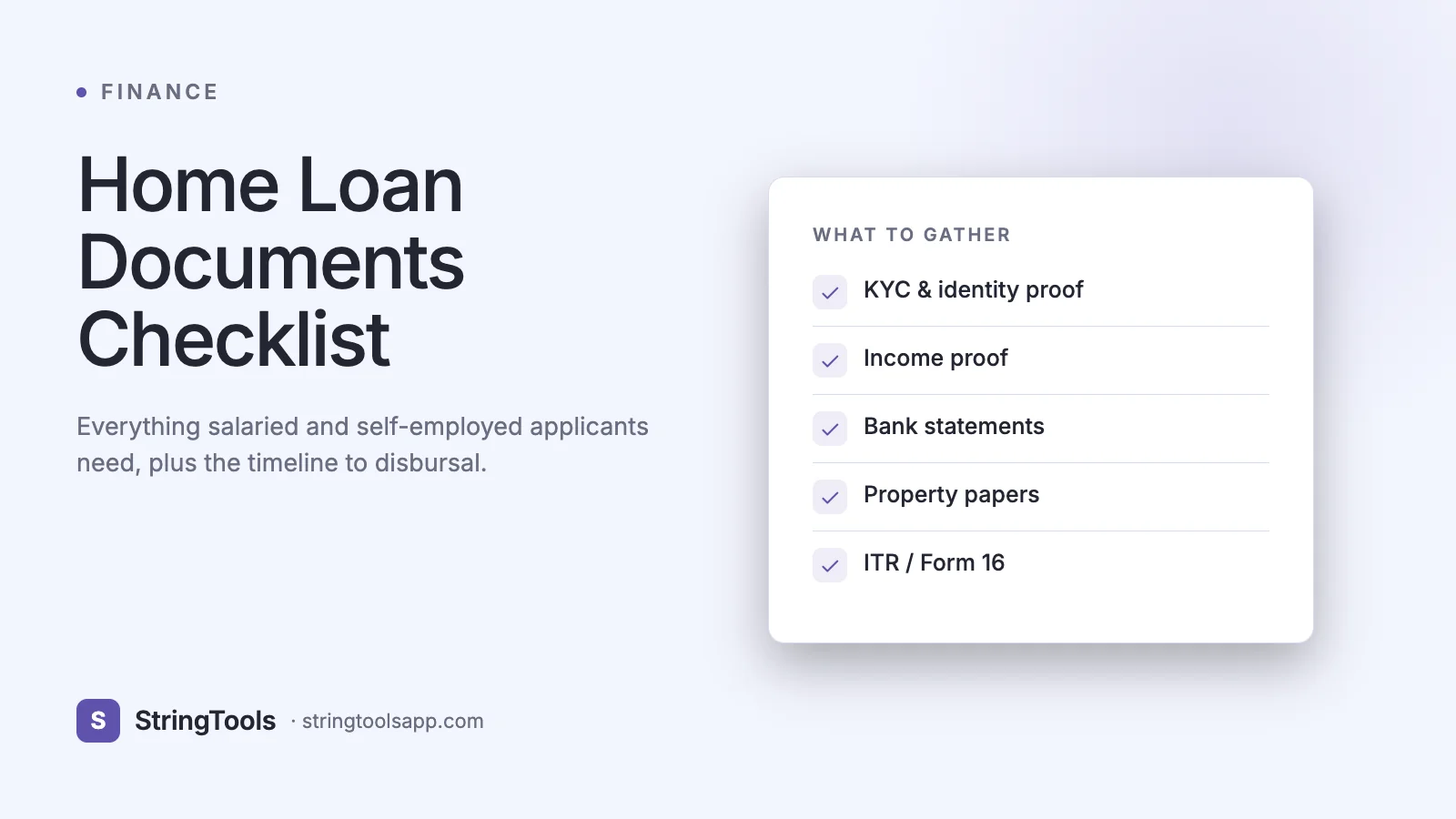
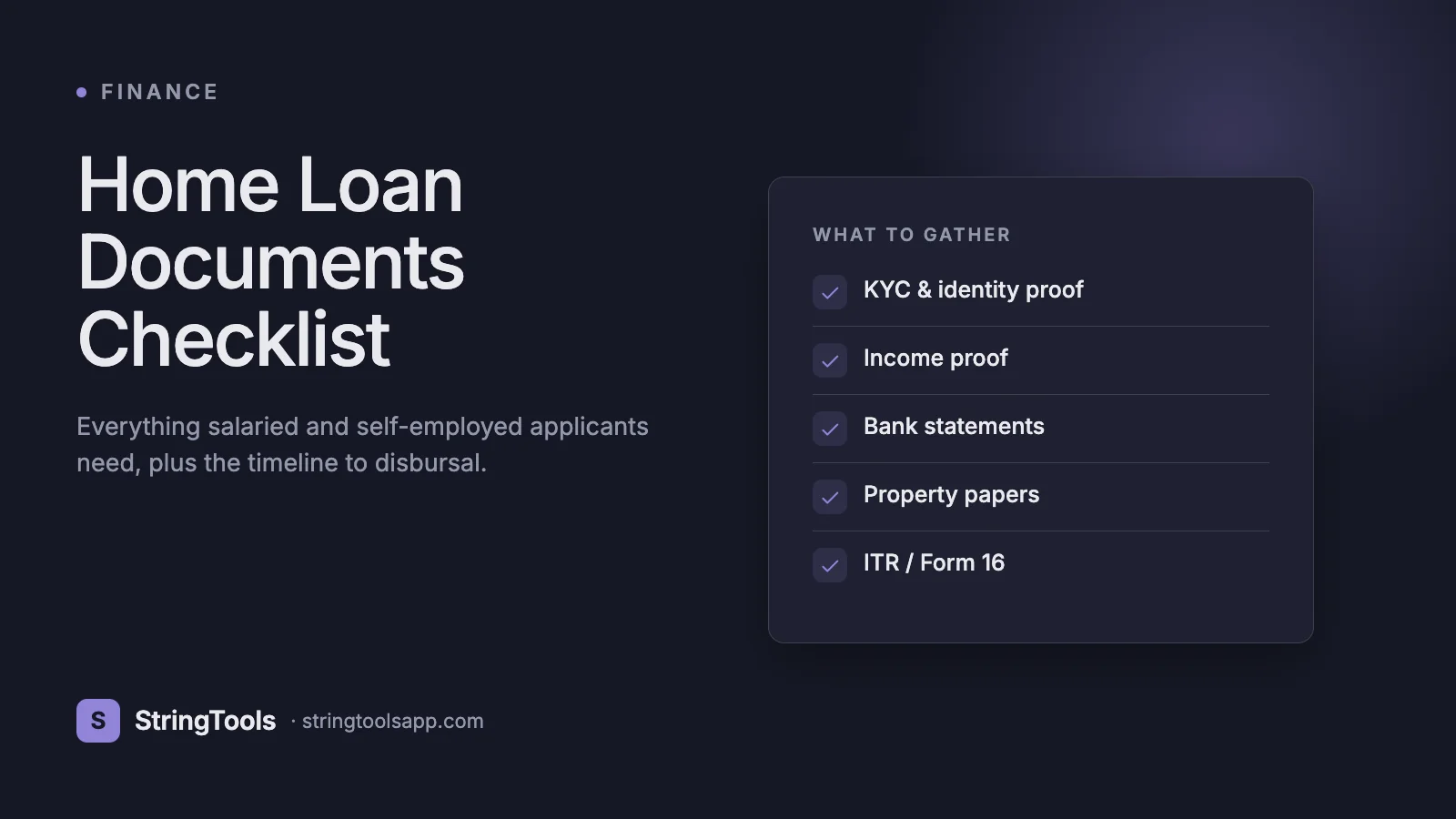
Here is the full checklist at a glance, before we go through each set in detail:
| Document category | Salaried | Self-employed |
|---|---|---|
| KYC | PAN, Aadhaar or another ID and address proof, photographs; same set for every co-applicant | Same KYC set for the applicant and every co-applicant |
| Income proof | Salary slips (last 3 to 6 months), Form 16 for 2 years, employment proof | ITRs for the last 2 to 3 years, CA-certified P&L and balance sheet, GST or other business-existence proof |
| Bank statements | 6 months of the salary-credit account | 6 to 12 months of both business and personal accounts |
| Property papers | Sale agreement, title chain, approvals, encumbrance certificate, NOCs | Same property document set |
KYC Documents: What Every Applicant Needs
A home loan needs three document sets from every applicant: KYC to prove identity (PAN plus Aadhaar or another ID and address proof), income proof to prove repayment capacity (salary slips and Form 16 if salaried; ITRs and audited financials if self-employed), and property papers to secure the loan. KYC is where you start. Every applicant and co-applicant must provide it, and in India the standard set looks like this.
PAN card. Effectively mandatory for a home loan in India. Your PAN links the application to your credit report and tax records, so the name on your PAN should match your other documents exactly.
Identity and address proof. Aadhaar is the most commonly used document and often covers both. Alternatives generally accepted include a passport, voter ID, or driving licence. If your Aadhaar address is outdated — very common after a job move — expect the lender to ask for a current address proof such as a utility bill or rent agreement.
Photographs and signature proof. Recent passport-size photographs, and in some cases a signature verification from your bank if signatures across documents do not match.
Co-applicant documents. If you are applying jointly, typically with a spouse or parent, the co-applicant needs the same KYC set even if their income is not being counted.
In the US, the equivalent is a government-issued photo ID plus your Social Security number, which the lender uses to pull your credit report. In the UK, lenders verify identity with a passport or driving licence and address with recent utility bills or bank statements, usually from the last three months.
The KYC stage is the easy part. Because it follows the Reserve Bank of India's standard customer-identification norms, the practical tip is consistency: your name, date of birth, and address should read identically across PAN, Aadhaar, bank records, and the application form. Mismatches here trigger manual verification, which adds days for no good reason.
Income Documents for Salaried Applicants
Salaried applicants need four income documents for a home loan in India: salary slips for the last 3 to 6 months, Form 16 for the last 2 years, bank statements of the salary-credit account for the last 6 months, and employment proof such as an offer letter or employment certificate.
For salaried borrowers, the income file is straightforward and lenders have seen thousands like yours. The typical Indian requirement is as follows.
Salary slips. Usually the last 3 months, sometimes 6. They should show gross salary, deductions, and net pay, and carry the employer's name.
Form 16. The tax certificate your employer issues each year, generally required for the last 2 years. It confirms your declared income matches what was reported to the tax department. If you have changed jobs recently, keep Form 16 from the previous employer too.
Bank statements. Statements of the account where your salary is credited, typically for the last 6 months. This is the document lenders scrutinise most, and the section on mistakes below explains why.
Employment proof. An offer letter or employment certificate, especially if you joined your current employer recently. Many lenders prefer at least 6 months to a year in the current job and 2 to 3 years of total work experience, though this varies by lender.
The US equivalent set is recent pay stubs (usually 30 days), W-2 forms for the last 2 years, federal tax returns, and 2 months of bank statements. In the UK, lenders ask for the last 3 months of payslips, your most recent P60, and 3 months of bank statements.
A practical note on how much loan your income supports: most Indian lenders size the loan so the EMI stays within roughly 40 to 50 percent of your net monthly income, with existing EMIs counted against that limit. A loan calculator lets you test this before applying, so you do not submit a file for an amount the income documents cannot support.
Income Documents for Self-Employed Applicants
Self-employed home loan applicants need income tax returns for the last 2 to 3 years, CA-certified profit and loss statements and balance sheets, 6 to 12 months of business and personal bank statements, business existence proof such as GST registration or a professional licence, and business address proof. Most lenders also want the business running for at least 3 years.
Self-employed borrowers — business owners, professionals, freelancers, consultants — face a heavier documentation load because there is no employer certifying the income. The lender reconstructs your earning capacity from tax and business records.
Income tax returns. ITRs for the last 2 to 3 years, filed on time, along with the computation of income. This is the backbone of a self-employed application. Lenders generally average your declared income across years rather than taking the best year.
Business financials. Profit and loss statements and balance sheets for the last 2 to 3 years, usually certified or audited by a chartered accountant depending on business size.
Bank statements. Both current account (business) and savings account statements, typically 6 to 12 months. Lenders look for regular credits consistent with the declared turnover.
Business existence proof. GST registration and GST returns where applicable, shop and establishment licence, professional licence for doctors, CAs, architects and similar, or a certificate of incorporation for companies. Most lenders want to see the business running for at least 3 years, though some accept 2.
Office or business address proof. Utility bills, lease deed, or property papers of the business premises.
The recurring tension for self-employed applicants is that minimising taxable income — a legitimate goal at tax time — directly shrinks the loan you qualify for, because the lender lends against declared income, not actual cash flow. If a home purchase is one or two years away, it can be worth declaring income more fully now.
In the US, self-employed borrowers provide 2 years of personal and business tax returns (Form 1040 with schedules) and profit and loss statements. In the UK, the standard ask is 2 to 3 years of SA302 tax calculations with corresponding tax year overviews from HMRC, or certified accounts.
Property Documents: Where Home Loans Actually Slow Down
Before approving a home loan, the bank's legal team verifies the sale or builder-buyer agreement, the title chain of previous deeds (commonly 13 to 30 years), sanctioned plans and approvals, an encumbrance certificate, applicable NOCs, the occupancy or completion certificate for ready property, and the latest property tax receipts. This property verification stage causes the longest delays.
Income verification is routine; property verification is where files stall for weeks. The lender's legal team must confirm the seller genuinely owns the property, the title is clean, and the construction is legally approved. The Indian checklist typically includes the following.
Sale agreement. The agreement to sell between you and the seller, stamped and signed, stating price and terms. For under-construction flats this is the builder-buyer agreement.
Title chain. Previous sale deeds tracing ownership backwards, commonly for 13 to 30 years depending on the lender and state. A single missing link — an old transfer never registered, an inheritance without a mutation entry — can hold up legal clearance indefinitely.
Approvals and plans. The sanctioned building plan, and for apartments the project approvals from the local development authority. For newer projects, RERA registration of the project is a standard check.
Encumbrance certificate. A state-issued record showing the property has no registered mortgage or charge over a given period.
NOCs. No-objection certificates as applicable: from the housing society for resale flats, from the builder confirming no dues, and from the existing lender if the seller's own loan is being closed from your payment.
Occupancy or completion certificate. For ready properties, this confirms the building was completed per approved plans and is legal to occupy.
Tax receipts. Latest property tax paid receipts, plus utility bills in the seller's name for resale purchases.
In the US and UK this burden shifts off the buyer: a title company or attorney runs the title search and issues title insurance in the US, while a solicitor or conveyancer handles searches in the UK. In India, the buyer assembles the papers and the bank's lawyers verify them — which is why a resale purchase with a long ownership history takes visibly longer than a new flat from a reputed, bank-pre-approved project, where the lender has already vetted the title once.
What a Clean File Is Worth: A Worked Example
A clean, consistent loan file can lower your interest rate by around half a percentage point, and on a ₹50 lakh, 20-year home loan that gap is worth about ₹1,595 per month — roughly ₹3.8 lakh in interest over the full tenure. Here is the calculation behind those numbers.
Documentation quality is not just about speed — it can affect price. Lenders tier their home loan rates by risk, and a borrower with strong, consistent documents (stable salary credits, on-time ITRs, high credit score) often qualifies for a lower rate band than a borrower whose file needed exceptions. The gap between rate bands at a single lender, or between a competitive offer and a lazy one, is commonly around half a percentage point. Here is what that is worth.
Take a ₹50 lakh loan for 20 years. Using the standard amortization formula, M = P × r × (1+r)^n / ((1+r)^n − 1), where r is the monthly rate and n is 240 months.
At 8.5 percent per year, r = 8.5/12/100 = 0.0070833. The EMI works out to approximately ₹43,391 per month. Over 240 months you pay about ₹1.04 crore in total, of which roughly ₹54.1 lakh is interest.
At 9.0 percent per year, r = 0.0075. The EMI is approximately ₹44,986 per month, with total interest of roughly ₹58 lakh.
The difference is about ₹1,595 per month, which adds up to roughly ₹3.8 lakh over the life of the loan — from half a percentage point. (These rates are illustrative; actual home loan rates vary by lender, borrower profile, whether you pick a fixed or floating rate, and the prevailing repo-linked benchmark.) You can reproduce these numbers, or run your own loan amount and tenure, in a mortgage calculator, and an EMI calculator will show the month-by-month split between principal and interest. If you want to understand why the interest total is so much larger than intuition suggests, a compound interest calculator makes the mechanics visible.
The lesson: the same checklist that gets you approved faster also strengthens your negotiating position. A complete, consistent file signals a low-risk borrower, and low-risk borrowers get the sharper rates — which is also why it pays to compare loan offers from several lenders rather than accepting the first sanction letter you receive.
Common Document Mistakes That Delay or Sink Approvals
The document mistakes that most often delay or sink a home loan approval are messy bank statements, name and address mismatches across KYC documents, late or freshly filed ITRs, a weak co-applicant file, missing or incomplete property papers, and scattershot applications to several lenders at once. Each one is avoidable before you apply.
Most home loan delays trace back to a handful of avoidable errors. These are the ones that come up again and again.
Messy bank statements. Lenders read your statements like a diary. Salary credits that arrive as irregular cash deposits, frequent cheque bounces, overdrafts, or unexplained large credits all raise questions. If a relative transferred you money for the down payment, be ready to explain and document it. Six months of clean, explainable banking is one of the most persuasive documents you have.
Name and address mismatches. "M. Sharma" on the PAN, "Mitesh Sharma" on Aadhaar, and a third spelling on the bank account will send your file to manual verification. Fix mismatches before applying, not during.
Late or revised ITRs. For self-employed applicants, ITRs filed just before the loan application, or filed for the first time in years, look like income manufactured for the loan. Lenders discount or reject such income. Two to three years of regularly filed returns is the standard they trust.
Ignoring the co-applicant's file. If your spouse's income is being counted, their documents get the same scrutiny as yours. A co-applicant with unpaid dues or a low credit score can drag the whole application down.
Property shortcuts. Skipping the encumbrance certificate, accepting a photocopied sale deed where the lender needs the original chain, or buying in a project without proper approvals. No income profile compensates for a title the bank's lawyers will not clear.
Applying scattershot. Submitting full applications to five lenders in a week can generate multiple hard inquiries on your credit report and, more practically, five parallel document chases. It is far more efficient to shortlist first and let lenders compete for a single, well-prepared file.
The Process Timeline — and an Easier Way to Reach Multiple Lenders
With documents ready, a typical Indian home loan moves through five stages. Application and login: you submit the form, KYC, and income documents, and pay a processing fee (commonly around 0.25 to 1 percent of the loan amount, varying by lender and often negotiable). Verification: the lender checks employment or business, pulls your credit report, and may visit your office or residence — usually a few days to two weeks. Sanction: you receive a sanction letter stating the approved amount, rate, and tenure, generally valid for 3 to 6 months. Legal and technical check: the lender's lawyers verify the property papers and a valuer inspects the property — often the longest stage, especially for resale properties. Disbursal: you sign the loan agreement, submit original property documents, and the lender releases funds — in one shot for ready property, in construction-linked tranches for under-construction homes. End to end, a clean file commonly takes 2 to 4 weeks for a ready property and longer where the title chain is complex.
The part borrowers control is the file; the part they under-use is competition. Rates, processing fees, and even how strictly the checklist is applied differ meaningfully across banks and NBFCs, and self-employed applicants in particular will find some lenders far more accommodating of their income pattern than others.
That is exactly why comparison matters here. Instead of accepting the first sanction, get quotes from several regulated banks and NBFCs and compare them — each lender makes its own credit decision, and self-employed applicants in particular will find some far more accommodating than others. When the sanction letters come in, do not compare on EMI alone: put each offer's rate, tenure, and fees through an EMI calculator or loan calculator to see the true total cost before you commit.
This article is general education, not financial advice; document requirements, rates, and terms vary by lender, so confirm the exact checklist with your chosen lender before applying.
Frequently Asked Questions
What documents are required for a home loan for salaried employees in India?
The standard set is PAN card, Aadhaar or another identity and address proof, last 3 to 6 months of salary slips, Form 16 for the last 2 years, 6 months of bank statements from your salary account, employment proof, photographs, and the complete property documents (sale agreement, title deeds, approvals). Co-applicants need the same KYC set. Exact requirements vary slightly by lender.
What documents do self-employed applicants need for a home loan?
In addition to KYC, self-employed borrowers typically need income tax returns for the last 2 to 3 years filed on time, CA-certified or audited profit and loss statements and balance sheets, 6 to 12 months of business and personal bank statements, business existence proof such as GST registration and returns or a professional licence, and business address proof. Most lenders also want the business to have been running for at least 2 to 3 years.
Which property documents does a bank check before approving a home loan?
Core property documents include the sale agreement or builder-buyer agreement, the chain of previous title deeds (often 13 to 30 years depending on the lender), sanctioned building plan and project approvals, an encumbrance certificate, applicable NOCs from the society, builder, or existing lender, the occupancy or completion certificate for ready property, and latest property tax receipts. The bank's legal team verifies these before disbursal, and this stage causes most delays.
How many months of bank statements do I need for a home loan?
Salaried applicants typically need 6 months of statements from the account where salary is credited; self-employed applicants are usually asked for 6 to 12 months of both business and personal accounts. Lenders check for regular income credits, cheque bounces, existing EMI debits, and unexplained large deposits, so clean and consistent statements materially speed up approval.
How long does the home loan process take from application to disbursal?
With a complete file, a home loan on a ready property commonly takes about 2 to 4 weeks end to end: a few days to two weeks for verification and sanction, then legal and technical checks on the property, then agreement signing and disbursal. Resale properties with long title chains, or files with document gaps, can take considerably longer. Timelines vary by lender and property type.
Can I get a home loan without Form 16 or ITR?
It is difficult with mainstream banks, which rely on Form 16 for salaried and 2 to 3 years of ITRs for self-employed applicants. Some NBFCs offer loans assessed on bank statements or business cash flow instead, but typically at higher interest rates and lower loan amounts. If you can wait, filing returns regularly for two years before applying usually gets you better terms than a no-ITR product.
Sources and references
credit report (cibil.com) · Reserve Bank of India (rbi.org.in). Content was reviewed against these sources as of the last-updated date above; external figures and rules may change after publication.