
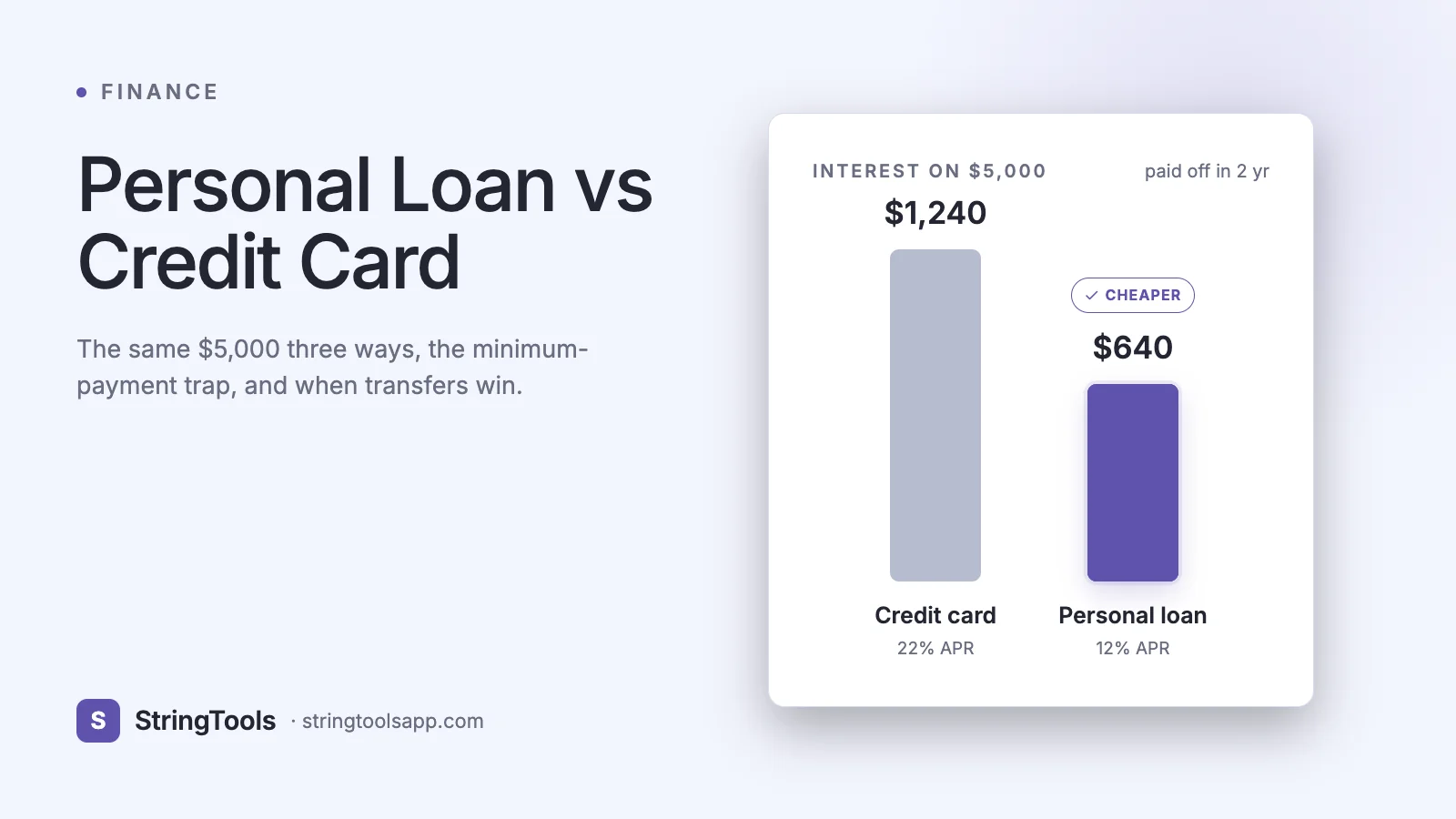
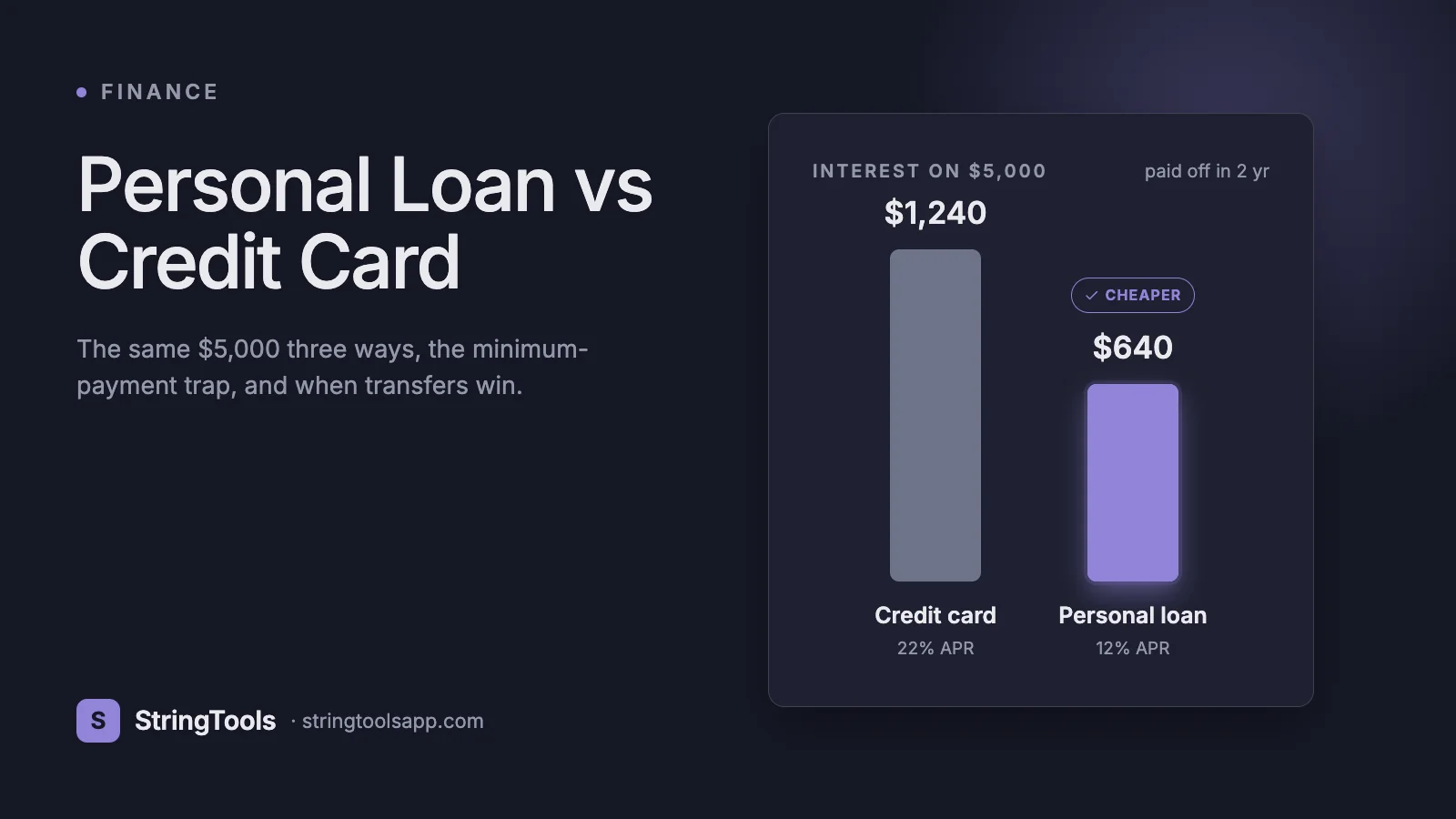
Quick answer: For debt you'll carry longer than a few months, a personal loan is usually cheaper: typical rates of 8–18% with simple amortizing interest beat card APRs above 20% that compound daily. Same $5,000, same ~$168 monthly payment: a 13% loan costs ≈ $1,065 in interest; a 24% card costs ≈ $2,680. For short-term borrowing you can clear within the card's grace period, the card wins — it's free. And for existing card debt, a 0% balance transfer (typical 3% fee) often beats both, if you can finish inside the promo window.
Same $5,000, Two Very Different Price Tags
Borrow $5,000 on a credit card and $5,000 with a personal loan, and you've borrowed the same money at two radically different prices — not just because the rates differ, but because the two products charge differently, amortize differently, and push your behavior in opposite directions. One has a scheduled final payment; the other is engineered to last forever.
This guide runs the actual numbers on both: how each one charges interest, what the same debt costs three different ways, why minimum payments are a two-decade trap, when consolidation with a personal loan genuinely saves four figures, when the humble credit card is actually the cheaper tool, and how the 0% balance-transfer play works — fee math included. Every figure can be verified in our loan calculator.
How Each One Charges Interest
Credit cards are revolving debt. There's no fixed end date: you carry whatever balance you carry, and the card divides its APR by 365 and charges that slice daily on the balance — yesterday's interest joins today's balance, so the interest compounds. A card advertising 24% APR effectively costs about 27.1% a year on a carried balance (the full math is in our APR vs APY guide). The card's one great mercy: the grace period. Pay the statement balance in full each month and purchases accrue no interest at all.
Personal loans are installment debt. A fixed amount, fixed rate, fixed monthly payment, fixed final payment date. Interest is simple and amortizing: each payment covers the month's interest on the remaining balance and retires a chunk of principal, exactly like a small mortgage (mechanics in our amortization guide). Typical APRs run 8–18% for solid credit — roughly half a card's rate — though some lenders add an origination fee of 1–8% taken from the proceeds, which is why you compare loans by APR, not the note rate.
Structure matters as much as rate. The loan's fixed schedule forces payoff; the card's minimum payment permits near-eternity. That difference in defaults — what happens if you just do the minimum asked of you — is where most of the real-world cost gap comes from.
The Same $5,000 Debt, Three Ways
Here's $5,000 of debt handled three different ways. The card charges 24% APR; the loan is 13% over 36 months (payment ≈ $168), and the middle column pays the card the same $168 to make the comparison fair:
| Card, minimum payments* | Card, fixed $168/mo | Personal loan, 13%, 36 mo | |
|---|---|---|---|
| Monthly payment | Starts ≈ $150, shrinks | $168 | $168 |
| Time to debt-free | ≈ 19.5 years | ≈ 46 months | 36 months |
| Total interest | ≈ $8,900 | ≈ $2,680 | ≈ $1,065 |
| End date fixed? | No | Only if you stay disciplined | Yes — contractual |
*Minimum = monthly interest + 1% of balance ($25 floor) — a common issuer formula. All rows computed month-by-month; verify in the loan calculator.
Two readings of the same table. Versus the minimum-payment path, the loan saves almost $7,800 and over 16 years. But even versus a disciplined card payer sending the identical $168 every month, the loan still saves ≈ $1,600 — that part is pure interest-rate arithmetic, no behavior required. Rate gap plus structure gap is why consolidation works when it's done right.
The Minimum Payment Trap
That 20-year number deserves a closer look, because it's not a rounding exaggeration — it's how the formula is built. A typical minimum is the month's interest plus just 1% of the balance. On $5,000 at 24%, that's about $100 of interest plus $50 of principal: a $150 payment of which two-thirds is interest. Next month the balance is $4,950 and the process repeats, each month microscopically smaller than the last.
Because the payment shrinks as the balance shrinks, the debt approaches zero asymptotically — nearly twenty years for a balance you could clear in three with a fixed payment. US card statements are required to show this in the "minimum payment warning" box, and it's worth reading once on your own statement: the disclosure exists precisely because the trap is real.
The escape is almost embarrassingly simple: fix your payment. Pick a number — even the same $150 the minimum starts at — and keep paying it as the minimum falls away beneath it. The fixed $168 column in the table above is nothing more than that one decision, and it's worth about $6,200 and almost 16 years versus the sliding minimum.
When the Personal Loan Wins
Consolidating card debt you can't clear quickly. This is the headline use case: swap 24%-compounding revolving debt for 13%-simple installment debt, cut the interest roughly in half, and gain a contractual end date. Three conditions make it work: the loan's APR (with origination fee included) is clearly below your cards' rates; the fixed payment genuinely fits your budget; and — the big one — the emptied cards stay empty. Consolidate-then-respend is how people end up with both debts, and it's common enough that it should be treated as the default risk, not an edge case.
Large planned expenses with a multi-year payoff. A medical bill, a roof, a cross-country move: if repayment will take more than a year, installment pricing beats revolving pricing by four figures at today's typical rates.
When you need your credit utilization down. Card balances count against your utilization ratio (a major credit-score factor); installment loan balances don't. Consolidating often improves scores within a few months — useful before a mortgage application, as covered in our home affordability guide.
One caution flag: personal-loan APRs are credit-dependent. Advertised single-digit rates go to 720+ scores; below the mid-600s, offers can reach 25–36% — at which point the loan's advantage evaporates. The rule is always: compare the rate you're offered, not the rate in the ad.
When the Credit Card Wins
Anything you'll pay off within the grace period. Pay the statement in full and the borrowing cost is zero — no personal loan can beat free. For monthly spending, the card plus full payment is the best short-term credit product ever invented (with rewards on top).
Small, short borrowing. Need $800 for two months? A personal loan's origination fee and minimum loan sizes make it clumsy; two months of card interest on a small balance is a few dozen dollars. Cheap, fast, done.
0% purchase promos. Many cards offer 0% on new purchases for 12–18 months. For a planned expense you can clear inside the window, that's free financing — same discipline warning as balance transfers below.
When you'd lose the loan on fees. A 5% origination fee on a small loan you'd repay in a year can exceed the interest a card would have charged. Always compute both totals — our loan calculator makes the loan side a 30-second job.
The 0% Balance Transfer Play
The third option, and for existing card debt often the best one: move the balance to a card offering 0% APR on transfers for 12–21 months, paying a one-time transfer fee of typically 3–5%.
The fee math is quick and satisfying. Transferring $5,000 at a 3% fee costs $150. Left on the 24% card, that balance accrues roughly $100 of interest per month — so the fee pays for itself in about six weeks, and every month after that is ~$100 kept. Clear the full balance inside an 18-month promo and the total cost of the debt is just the $150 fee — versus ≈ $1,065 on the 13% loan and ≈ $2,680 on the original card.
The catches, honestly stated: you generally need good credit to qualify; the transfer fee is charged upfront; and any balance remaining when the promo ends starts accruing at the card's full rate immediately. The discipline formula: divide the transferred balance by the promo months and automate that payment — $5,000 over 18 months is $278/month. Treat the promo end date like a loan maturity, because that's exactly what it is. And as with consolidation loans: the old card must stay at zero, or you've doubled your debts instead of halving your rate.
The Decision Framework
Can you pay it off this month? Use the card, pay in full, collect the rewards. Cost: $0.
Existing card debt, good credit, payoff possible in ~18 months? Balance transfer. Budget the fee, divide by the promo months, automate.
Debt that needs 2–5 years, or multiple cards to consolidate? Personal loan — provided the offered APR beats your cards by a clear margin and the cards stay empty afterward.
New large expense? If you can save for it even partially, do that first (our emergency fund guide is the playbook); finance the remainder with whichever product above matches your payoff horizon.
Offered a loan rate that doesn't beat your card? Skip the loan. Fix your card payment at the highest sustainable amount instead — the fixed-payment column in our table shows how much of the loan's advantage that one habit recaptures.
Frequently Asked Questions
Is a personal loan cheaper than a credit card?
For multi-month debt, usually: loan rates of 8–18% simple beat card rates of 20%+ compounding daily. On $5,000 at the same $168 monthly payment, the 13% loan costs ≈ $1,065 versus ≈ $2,680 on a 24% card. For spending cleared within the grace period, the card is cheaper — it's free.
How long does minimum-payment payoff really take?
On $5,000 at 24% with a typical interest-plus-1% minimum: nearly 20 years, with roughly $8,900 paid in interest — far more than the original balance. The fix is fixing your payment at any constant amount above the starting minimum.
Does a debt consolidation loan hurt your credit score?
A small, temporary dip from the inquiry and new account — then usually a net gain as card utilization falls to zero and on-time installment history builds. The real risk is behavioral: re-running the emptied cards.
Is a 0% balance transfer worth it?
Often the cheapest option of all: a 3% fee on $5,000 is $150, recovered in about six weeks of avoided 24% interest. It only works if you clear the balance inside the promo window — divide balance by months and automate that amount.
What credit score do you need for a personal loan?
Approvals commonly start in the mid-600s; the best rates go to roughly 720+. With lower scores, offered APRs of 25–36% can erase the advantage — always compare your actual offer against your card's actual rate.
What's the difference between revolving and installment debt?
Revolving (cards): flexible balance, minimum payments, no end date, daily compounding. Installment (loans): fixed amount, rate, payment, and payoff date. The contractual end date is the loan's structural advantage.
Should I use a personal loan to pay off credit cards?
Yes when three things hold: the loan APR (fee included) clearly beats the cards, the payment fits, and the cards stay empty. Miss the third condition and consolidation becomes debt multiplication.
Run Your Own Numbers
Your balance, rate, and budget aren't the example's — so run them. Open our free loan calculator: model the consolidation loan you've been offered (amount, APR, term) and read the total-interest line; then model your card as a loan at its APR with your realistic monthly payment to see the difference side by side. Add the extra-payment field to test paying the loan off early. Ten minutes of honest inputs turns this whole comparison into a decision — and if the winner is "fix my card payment and charge nothing new," the calculator will tell you that too.
This article is for general educational purposes and is not financial advice. Rates, fees, minimum-payment formulas, and approval criteria vary by issuer, lender, and credit profile — read your cardholder agreement and loan offers carefully, and confirm specifics with a licensed financial advisor before making decisions.