
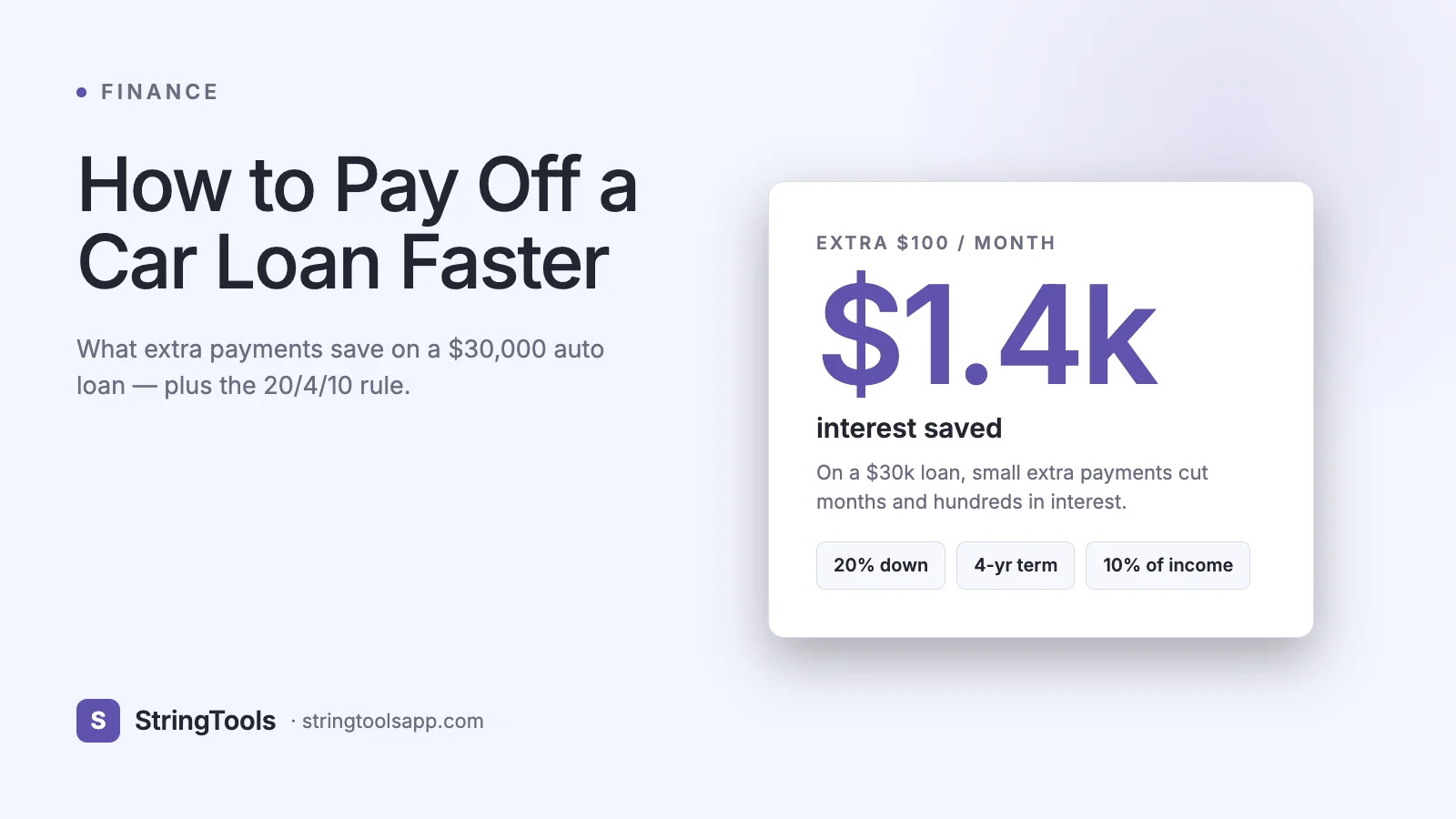
Quick answer: On a standard simple-interest auto loan, every extra dollar goes straight at the balance, and interest stops accruing on it the next day. On a $30,000, 72-month loan at 7% (payment ≈ $512), an extra $100/month finishes the loan about 14 months early and saves ≈ $1,380; even rounding the payment up to $550 saves ≈ $600 and 6 months. The five strategies that work: extra monthly principal, the biweekly trick, round-ups, lump sums, and refinancing when your credit has improved — never extending the term.
The Payment That Ate the Budget
Car payments have quietly become one of the biggest lines in the household budget — recent industry data puts the average new-car payment above $700 a month, with used-car payments not far behind. Stretching terms to 72 and even 84 months has made expensive cars feel affordable while making them cost thousands more, and it's left a record share of drivers owing more than their car is worth.
The good news: auto loans are the most prepayment-friendly debt most people hold. No compounding tricks, usually no penalties, and — unlike a mortgage — balances small enough that an ordinary budget can genuinely kill one years ahead of schedule. This guide shows you how the interest actually works, what the long-term trap costs, exactly what extra payments save (with verifiable numbers), when refinancing your car loan is worth it, how to escape negative equity, and the one rule that prevents the whole mess on your next car. Check any figure as you read with our free loan calculator — it doubles as an auto loan calculator with an extra-payment field.
How Car Loan Interest Really Works
Most US auto loans are simple-interest loans: interest accrues daily on your remaining balance (balance × annual rate ÷ 365, each day). No compounding on unpaid interest, no mystery — just a meter running on whatever you still owe.
That daily meter is exactly why prepayment works so well. Pay $500 extra today and the meter runs on a balance $500 smaller starting tomorrow — for the entire rest of the loan. It's the same principal-first logic as mortgage prepayment (see how loan amortization works), but on a shorter fuse, so results show up fast.
One critical exception to check for: precomputed-interest loans, where total interest is fixed at signing and baked into your payments. On those, early payoff saves little or nothing — refunds use formulas that favor the lender. They're a minority of loans, more common at buy-here-pay-here lots, and worth refusing outright when you're shopping. Find your loan type in your contract (look for "simple interest" vs "precomputed") before building a payoff plan.
Also confirm your extra money is posted as "principal only." Some servicers default to treating extra cash as an early next payment — which advances your due date and saves you nothing. It's a dropdown in most loan portals, or one phone call.
The Term Trap: What 72 Months Really Costs
Dealers sell payments, not prices — and the easiest way to shrink a payment is to stretch the term. Here's the true cost of that stretch on a $30,000 loan at 7%:
| Term | Monthly payment | Total interest | vs. 48-month cost |
|---|---|---|---|
| 36 months | $926 | ≈ $3,350 | −$1,130 |
| 48 months | $718 | ≈ $4,480 | — |
| 60 months | $594 | ≈ $5,640 | +$1,160 |
| 72 months | $512 | ≈ $6,830 | +$2,350 |
| 84 months | $453 | ≈ $8,040 | +$3,560 |
Standard amortization at 7% APR; verify any row in our loan calculator. Longer terms often carry higher rates too, making the real gap bigger.
Reading down the payment column explains the term creep: $926 feels impossible, $453 feels fine. But the interest column is the bill for that comfort — the 84-month loan costs 2.4× the interest of the 36-month loan on the identical car. Worse, slow early amortization on long loans is precisely what creates negative equity (more below). If you're already in a long loan, don't despair: extra payments effectively convert it into a shorter one, at your own pace.
What Extra Payments Actually Save
Take the common case from the table — $30,000 at 7% for 72 months, payment ≈ $512 — and add realistic extra amounts from month one:
| Strategy | Payoff time | Time saved | Interest saved |
|---|---|---|---|
| Minimum only | 72 mo | — | — |
| Round up to $550 (+$38) | ≈ 66 mo | ≈ 6 mo | ≈ $600 |
| Extra $50/month | ≈ 65 mo | ≈ 7 mo | ≈ $770 |
| Extra $100/month | ≈ 58 mo | ≈ 14 mo | ≈ $1,380 |
| Extra $200/month | ≈ 49 mo | ≈ 23 mo | ≈ $2,290 |
Month-by-month amortization at 7%; run your own loan in the calculator's extra-payment field.
Two things worth noticing. First, the savings are proportionally bigger than on a mortgage — not in dollars, but in time: $100 a month erases nearly 20% of this loan's life. Car-loan balances are small enough that ordinary amounts move the needle fast, which makes them the most satisfying debt to attack. Second, even the "painless" round-up — $38 you'll never miss — buys back half a year of payments. There is no minimum buy-in for this game.
The Five Payoff Strategies, Compared
1. Extra monthly principal. The workhorse. Fixed extra amount, marked principal-only, automated with your payment. Flexible — pause it any month money gets tight.
2. The biweekly trick. Pay half your payment every two weeks: 26 half-payments = 13 full payments a year. On our example loan that's like adding ~$43 a month. Do it yourself free; skip any service that charges for the privilege.
3. Round-up rules. $512 becomes $550 or $600. Psychologically invisible, mathematically real — see the table above.
4. Lump sums. Tax refund, bonus, side-gig income straight at the balance. On a simple-interest loan, the earlier the lump lands, the more daily interest it cancels. A $2,000 refund in month 6 of our example loan cuts roughly five months off the end.
5. Refinance — carefully. The only strategy with a trap door, so it gets its own section:
When Refinancing Your Car Loan Makes Sense
Auto refinancing is cheap (usually little or no fees, no appraisal circus) and fast — which makes it genuinely worth checking in two situations:
Your credit improved. Many buyers finance at the dealership on whatever their score qualified for that day. Two years of on-time payments later, their score may support a rate several points lower. On a $20,000 remaining balance, dropping from 10% to 7% saves roughly $28 a month and hundreds over the remaining term — for an hour of paperwork.
Rates fell. Same logic, market-wide. Compare your contract rate (the APR, not the note rate — our APR vs APY guide explains the difference) against current refinance offers.
The trap door: never extend the term. Refinancing 36 remaining months into a fresh 60-month loan can cut your payment and still cost more total interest, even at a lower rate — the extra 24 months of daily interest meter outweigh the rate cut. Rule: new term ≤ months you have left. If a lender's quote only looks good at a longer term, it isn't good.
Upside Down? Escaping Negative Equity
Owing more than the car is worth — negative equity, being "underwater" or "upside down" — is the natural byproduct of long terms plus fast depreciation: a new car can lose 20%+ of its value in year one while an 84-month loan has barely touched principal.
Escaping is unglamorous but simple: extra principal payments are the cure. Every prepaid dollar closes the gap from the loan side while depreciation slows on the car side; most underwater loans surface within a year or two of even modest extra payments. While you're under, two cautions: keep GAP coverage if you have it (it pays the loan-vs-value gap if the car is totaled — exactly the risk you're carrying), and resist trading in. Rolling negative equity into the next loan — financing more than the new car is worth on day one — is how a $3,000 problem becomes a $6,000 one. Drive the current car, close the gap, then trade from strength.
The 20/4/10 Rule for Your Next Car
The cheapest car loan payoff is the one you never need. A widely used affordability guideline — the 20/4/10 rule — prevents most of the situations this article fixes:
20% down, so depreciation never outruns your equity and you skip the underwater years entirely.
4 years maximum term, which caps total interest (see the term table — 48 months costs half the interest of 84) and gets you payment-free sooner.
10% of gross income as the ceiling for total transport costs — payment, insurance, and fuel together. On a $6,000 monthly gross, that's $600 for everything car-related, which honestly prices many new cars out — and that's the rule working, not failing.
If 20/4/10 feels impossible at current prices, treat it as a compass rather than a gate: more down, shorter term, cheaper car — every step toward it is money kept. And the payment you don't take on can compound somewhere better; $200 a month invested at 7% grows to about $34,600 in ten years (check it in our compound interest calculator).
Frequently Asked Questions
Is there a penalty for paying off a car loan early?
Usually not — most US auto loans are simple-interest with no prepayment penalty, but check your contract: a minority allow penalties, and precomputed-interest loans neutralize early-payoff savings by design. The contract language to search for is "prepayment" and "precomputed."
Does paying extra on a car loan reduce interest?
On a simple-interest loan, immediately: interest accrues daily on the balance, so every extra dollar shrinks tomorrow's charge. An extra $100/month on a $30,000, 72-month, 7% loan saves about $1,380 and 14 months.
Should I pay off my car loan or save the money?
Foundations first: starter emergency fund (see our emergency fund guide), employer match, then higher-interest debt like credit cards. After that, prepaying a 7–10% car loan is a guaranteed return at that rate — hard to beat safely.
Is refinancing a car loan worth it?
Yes when your credit has improved or rates have dropped, since fees are minimal — but only at a term equal to or shorter than what remains. Extending the term can cost more overall even at a lower rate.
What does it mean to be upside down on a car loan?
Owing more than the car's market value. Common in the early years of long loans. Extra principal payments close the gap; GAP coverage protects you meanwhile; avoid rolling the shortfall into a new loan.
Can I trade in a car I still owe money on?
Yes — the dealer pays off your loan, and any negative equity is added to the new loan. That's rarely in your favor: you start the next car underwater on day one. Surface first, then trade.
What is the 20/4/10 rule for buying a car?
Put 20% down, finance no longer than 4 years, keep total transport costs under 10% of gross income. It's a guideline, not a law — but every step toward it is interest you never pay.
Run Your Own Numbers
Your loan isn't the example loan — so run it. Open our free loan calculator (it's built to work as a car loan calculator and car payment calculator too): enter your balance, rate, and remaining months, then add the extra amount you could realistically sustain and watch the payoff date and interest-saved figures update. Testing three scenarios — round-up, +$100, and your tax refund as a lump sum — takes five minutes and turns this whole article into a plan with your name on it.
This article is for general educational purposes and is not financial advice. Rates are illustrative; loan contracts, prepayment terms, refinance offers, and state rules vary — read your agreement and confirm specifics with your lender or a licensed financial advisor before making decisions.