
Contribution Margin in One Calculation
Contribution margin is what one sale leaves behind after its own variable costs: selling price minus variable cost per unit. A candle sold for 24.00 with 9.00 of materials, packaging and fees contributes 15.00 toward fixed costs. As a ratio it is 15.00 divided by 24.00, or 62.5% of every pound, dollar or euro of revenue.
Key Takeaways
- Contribution per unit = price minus variable cost per unit. Contribution margin ratio = contribution divided by price.
- Contribution pays fixed costs first. Only after the fixed costs are covered does the same figure become profit.
- Gross profit allocates fixed overhead into the unit cost, which makes it the wrong number for decisions about one extra order.
- The highest-priced product is frequently not the most valuable one. Rank by contribution, and by contribution per hour of your bottleneck.
- A discount has to be paid for in volume, and the thinner the contribution margin the more volume it takes — a 10% cut on a 30% margin line needs 50% more units just to stand still.
Contribution margin is the one figure that turns "are we doing well" into arithmetic. Break-even, target profit, margin of safety, pricing, discounting and which product to drop all sit on top of it.
The break-even calculator shows contribution per unit alongside the volume it implies, and the profit margin calculator handles the pricing side, including margin against markup.
Per Unit or as a Ratio: When to Use Which
The same idea has two forms and they answer different questions.
Contribution per unit
Price minus variable cost, in currency. Use it when your question is about volume: how many units cover the fixed costs, how many more for a target profit, how much one extra order is worth. With fixed costs of 4,800 and a contribution of 15.00, break-even is 4,800 divided by 15.00 = 320 units.
Contribution margin ratio
Contribution divided by price, as a percentage. Use it when your question is about revenue, especially when you sell many things at different prices and counting units is meaningless. Divide fixed costs by the ratio and you get break-even revenue directly: 4,800 divided by 0.625 = 7,680, which is the same answer as 320 units times 24.00.
The ratio is the more portable of the two. It survives a product mix, it lets you compare a 12.00 product with a 65.00 one, and it tells you immediately how much of each extra unit of revenue actually survives to pay for the business. A 62.5% ratio means 62.5 pence in every pound is available for fixed costs and profit, and 37.5 pence has already left to pay for materials and fees.
Both forms depend entirely on having sorted your costs properly. Fixed vs variable costs covers the awkward cases, and a single misfiled cost is enough to move the contribution figure that every decision below rests on.
Why the Best-Selling Product Is Often the Wrong One
Here is a four-product line from a small maker, with the variable cost per unit and the production time each one takes on a single bottleneck machine.
| Product | Price | Variable cost | Contribution | Ratio | Hours per unit | Contribution per hour |
|---|---|---|---|---|---|---|
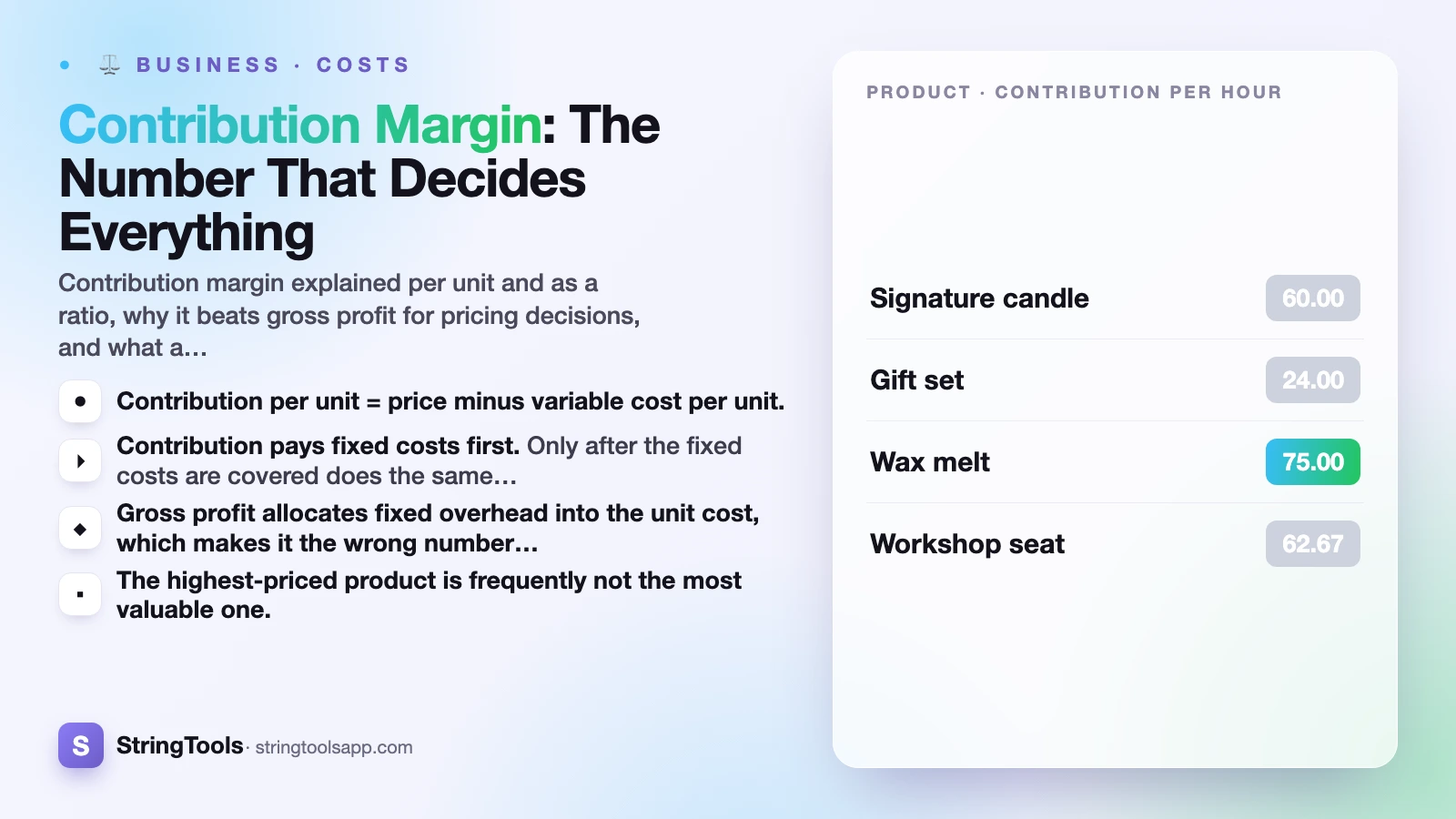
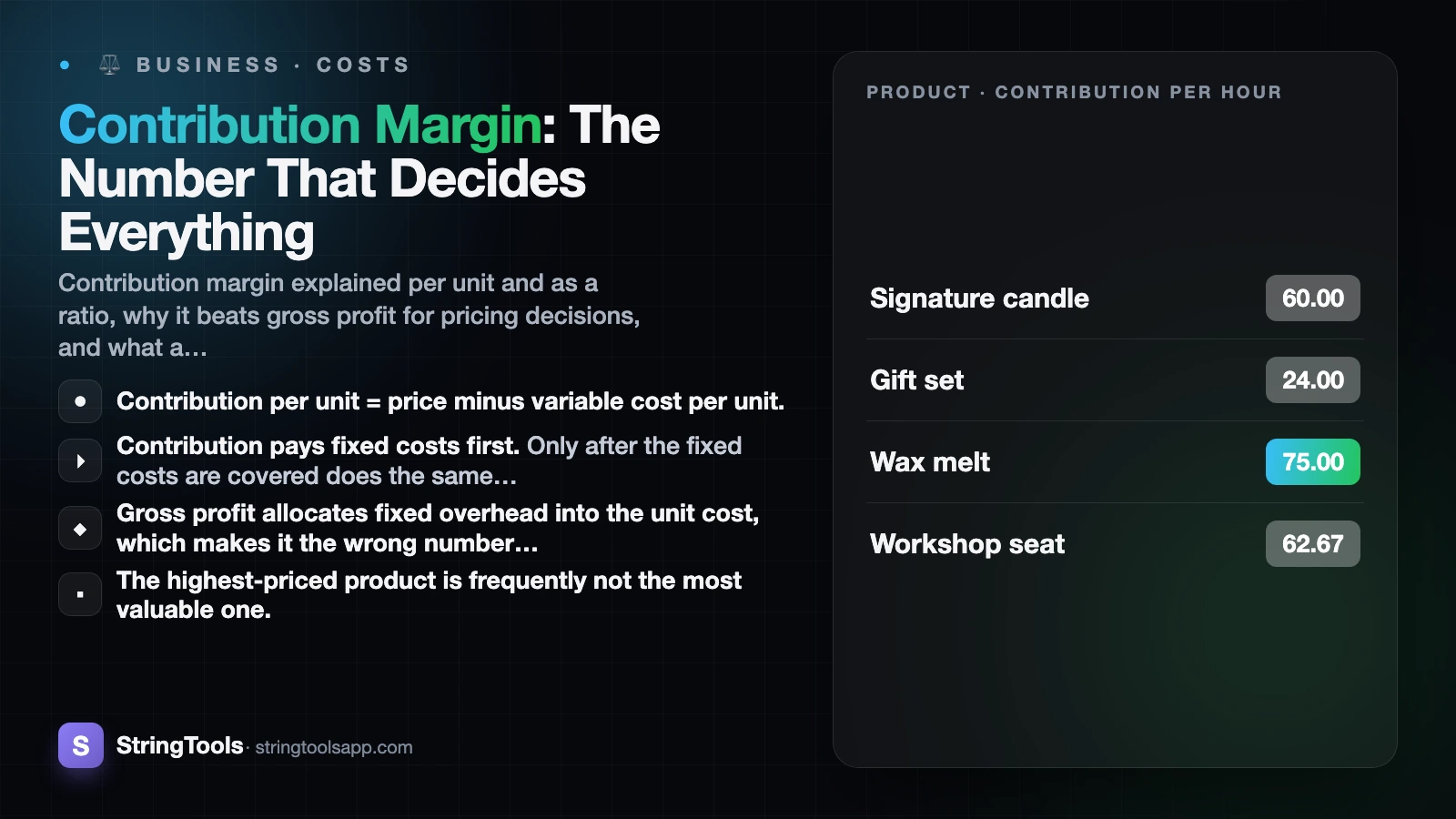
| Signature candle | 24.00 | 9.00 | 15.00 | 62.5% | 0.25 | 60.00 |
| Gift set | 40.00 | 28.00 | 12.00 | 30.0% | 0.50 | 24.00 |
| Wax melt | 12.00 | 4.50 | 7.50 | 62.5% | 0.10 | 75.00 |
| Workshop seat | 65.00 | 18.00 | 47.00 | 72.3% | 0.75 | 62.67 |
Three lessons sit in that table.
- Price ranks nothing. The gift set has the highest price of the three physical products and the worst contribution ratio of the four. Revenue from gift sets flatters the top line and does least for the bottom one.
- The ratio and the per-unit figure can disagree. The candle and the wax melt share a 62.5% ratio, but a candle contributes twice as much per sale. If demand is unlimited, the ratio tells you they are equally efficient; if your constraint is orders picked per day, the candle wins.
- Rank by the constraint. Once machine hours are the limit, the wax melt is the best use of an hour at 75.00 and the gift set the worst at 24.00. Whenever something is scarce — hours, kiln space, your own time — divide contribution by the units of that scarce thing rather than by the sale.
Mix matters more than most owners expect. Sell 100 gift sets and 200 candles in a month and total contribution is (100 times 12.00) + (200 times 15.00) = 4,200, which is 600 short of the 4,800 of fixed costs. Sell 320 candles and nothing else and you break even exactly. The mix that misses is the one that looks better on every vanity measure: 8,800 of revenue against 7,680, and 100 machine hours against 80. More revenue, more work, and still a loss — because fixed costs are paid out of contribution, not turnover.
Contribution Beats Gross Profit for Decisions
Gross profit subtracts cost of goods sold, and cost of goods sold usually includes an allocated share of fixed production overhead. That allocation is fine for reporting and wrong for deciding.
Take the maker again: 4,800 of fixed costs spread over an expected 320 candles is 15.00 per candle of allocated overhead. Add the 9.00 of genuine variable cost and the "full cost" of a candle is 24.00 — exactly the selling price. On that view every candle makes zero profit and a wholesale enquiry at 20.00 each looks like losing 4.00 a unit.
Contribution says something different. At 20.00 the variable cost is still 9.00, so each of those units contributes 11.00. A hundred of them add 1,100 of contribution that would not otherwise exist, because the 4,800 of fixed costs is being paid whether the order happens or not.
That does not make every discounted order a good idea, and the conditions matter:
- Fixed costs genuinely do not move. If the order forces overtime, extra storage or a second machine, that step cost belongs in the decision.
- The order does not cannibalise full-price sales or reset what the customer expects to pay next time.
- You have the capacity to spare. If the order displaces work contributing 15.00 a unit, the comparison is 11.00 against 15.00, and the answer flips.
The rule of thumb: use full cost for reporting and for setting a standard price, and use contribution for any decision about one more order, one more product or one more hour.
What a Discount Actually Costs
A discount comes entirely out of contribution, because the variable cost does not fall with the price. That makes the volume needed to stand still rise much faster than the discount itself.
The volume uplift needed to keep total contribution unchanged is the old contribution divided by the new one. Here are both products:
| Discount | Candle: new price | New contribution | Extra volume needed | Gift set: new price | New contribution | Extra volume needed |
|---|---|---|---|---|---|---|
| 5% | 22.80 | 13.80 | +8.7% | 38.00 | 10.00 | +20% |
| 10% | 21.60 | 12.60 | +19.0% | 36.00 | 8.00 | +50% |
| 15% | 20.40 | 11.40 | +31.6% | 34.00 | 6.00 | +100% |
| 20% | 19.20 | 10.20 | +47.1% | 32.00 | 4.00 | +200% |
A 20% sale on the gift set needs three times the units to leave you no worse off. On the candle, with its much healthier 62.5% ratio, the same discount needs a 47.1% volume lift — still a lot, but survivable.
This is the single most useful thing contribution margin tells you, and it works in reverse too. A price rise you can defend loses far less volume than intuition suggests: at a 10% higher price the candle's contribution goes from 15.00 to 17.40, so you could sell roughly 14% fewer units and be no worse off.
Before you run a promotion, work out the uplift it requires and then ask honestly whether the promotion will deliver it. Most do not, which is why thin-margin lines are the worst possible thing to discount.
Contribution Margin and the Break-Even Chain
Every figure in a break-even analysis is contribution wearing a different hat. With fixed costs of 4,800, a price of 24.00 and a variable cost of 9.00:
| Question | Calculation | Answer |
|---|---|---|
| Contribution per unit | 24.00 − 9.00 | 15.00 |
| Contribution ratio | 15.00 ÷ 24.00 | 62.5% |
| Break-even units | 4,800 ÷ 15.00 | 320 |
| Break-even revenue | 4,800 ÷ 0.625 | 7,680 |
| Units for 3,000 profit | (4,800 + 3,000) ÷ 15.00 | 520 |
| Profit at 420 units | (15.00 × 420) − 4,800 | 1,500 |
Read the last row carefully, because it is where contribution earns its name. At 420 units you are 100 units past break-even, and 100 times 15.00 is exactly the 1,500 of profit. Past break-even, contribution and profit become the same number.
Two practical notes on the arithmetic. Break-even units round up — you cannot sell a part unit, and rounding down leaves fixed costs uncovered. And if you build this in a spreadsheet, round prices and costs to the cent before dividing: binary floating point can hold 90 times 1.1 as 99.00000000000001, which is enough to make a rounding-up formula report one unit too many.
Once you have the break-even volume, the next question is how much room sits between it and what you actually expect to sell. That is the margin of safety.
Where Contribution Margin Misleads
Used carelessly it produces confident nonsense. Four failure modes worth knowing.
- It assumes variable costs really are linear. Bulk discounts, shipping bands and overtime rates all break that assumption. Check the contribution at the volume you are actually planning, not at the volume the spreadsheet was built on.
- It tempts you into permanent marginal pricing. Selling at contribution rather than full cost is a way to fill spare capacity, not a pricing strategy. If most of your book is priced marginally, fixed costs never get covered.
- It ignores step-fixed costs. Contribution treats fixed costs as a flat block. The moment growth requires another machine or another hire, the block steps up and the break-even volume moves with it.
- It says nothing about cash or tax. Contribution is a profit concept before tax and before payment terms. A month can be comfortably above break-even and still short of cash because customers pay in 60 days.
For the accounting definition and the standard treatment, the Corporate Finance Institute's contribution margin overview is a clear reference, and the US Small Business Administration's business plan guide explains where these figures belong in a plan a lender will actually read.
A closing habit worth adopting: write the contribution per unit for each product on the same sheet as the price list. Most bad pricing decisions happen because the person making them can see the price and cannot see the contribution.
This article is general business information, not accounting or tax advice. For decisions that affect your filings or your funding, speak to a qualified accountant in your own country.
Frequently Asked Questions
What is the contribution margin formula?
Contribution per unit = selling price minus variable cost per unit. The contribution margin ratio = contribution per unit divided by price, expressed as a percentage. A candle priced at 24.00 with 9.00 of variable cost contributes 15.00 per sale, a ratio of 62.5%. Total contribution for a period is contribution per unit times units sold, and profit is that total minus fixed costs.
What is the difference between contribution margin and gross profit?
Gross profit subtracts cost of goods sold, which normally includes an allocated share of fixed production overhead. Contribution subtracts only genuinely variable costs. Spreading 4,800 of fixed costs over 320 candles adds 15.00 of allocated overhead to a 9.00 variable cost, so full cost looks like 24.00 while true contribution is 15.00. Use gross profit for reporting and contribution for deciding on one more order.
What is a good contribution margin ratio?
There is no universal figure, because the ratio you need depends on how heavy your fixed costs are. A business with almost no fixed costs can run happily on a thin ratio; one with a workshop, staff and equipment leases cannot. The useful test is your own arithmetic: divide fixed costs by the ratio to get break-even revenue, and ask whether that revenue is realistic for you.
How much extra volume does a discount need to pay for itself?
Divide the old contribution by the new one. A candle priced at 24.00 with a 15.00 contribution, discounted 10% to 21.60, has a 12.60 contribution, so you need 15.00 divided by 12.60 = 19.0% more units to stand still. On a gift set at 40.00 with a 12.00 contribution, the same 10% discount cuts contribution to 8.00 and needs 50% more units. Thinner margins make discounts far more expensive.
Should I ever sell below full cost?
Sometimes, if the price still exceeds the variable cost and three conditions hold: fixed costs genuinely do not increase, you have idle capacity the order will fill, and the order will not cannibalise full-price sales or reset customer expectations. A hundred units at 20.00 with a 9.00 variable cost add 1,100 of contribution. If the same capacity could have been used for work contributing 15.00 a unit, the answer is no.
How do I use contribution margin when I sell several products?
Work in ratios rather than units. Calculate a weighted average contribution ratio across your expected sales mix, then divide fixed costs by that ratio to get break-even revenue. The answer only holds while the mix holds, so recheck it when the mix shifts. If something scarce limits you, such as machine hours, rank products by contribution per hour of that constraint instead of per unit.
Sources and references
Corporate Finance Institute's contribution margin overview (corporatefinanceinstitute.com) · US Small Business Administration's business plan guide (sba.gov). Content was reviewed against these sources as of the last-updated date above; external figures and rules may change after publication.