
The Unit Is an Hour
A service business breaks even the same way a product business does, once you decide what a unit is. For most, the unit is one billable hour: divide monthly overheads by the contribution each billable hour makes after its own direct costs, then round up. A studio with 3,600 of overheads and 63.00 of contribution an hour breaks even at 58 billable hours a month.
Key Takeaways
- Pick a unit you can count and invoice — usually a billable hour, sometimes a day, a seat or a standard job.
- Contribution per hour = your rate minus the costs that exist only because that hour was sold, such as subcontracted time, card fees and per-project licences.
- Your own pay is the item most service businesses forget. Put it in fixed costs, or use the target-profit version — both give the same answer, but doing neither gives a break-even that leaves you unpaid.
- Break-even hours are meaningless until you compare them with the hours you can realistically bill. Utilisation, not capacity, is the constraint.
- On fixed-price work the unit still exists, it just moves. An overrun cuts your effective hourly rate and your contribution with it.
The break-even calculator takes an itemised list of fixed costs, a price per unit and a variable cost per unit, so you can enter your hourly rate as the price and your direct cost per hour as the variable cost. The freelance rate calculator works the problem from the other end, starting with the take-home you want.
Choosing the Unit You Can Actually Count
Service businesses stall on break-even because nothing obviously plays the role of a unit. Four workable choices:
- The billable hour. The default, and the right one if you track time, quote hourly, or want to compare projects. Everything below uses it.
- The billable day. Better for consultants and contractors who quote in days and never sell half of one. Convert by multiplying: a day rate is simply a bundled set of hours.
- The standard job. Best where work is genuinely repeatable — a service, a clean, a haircut, a standard audit. Use the average price and the average direct cost of that job.
- The client month. For retainers, one client-month is a clean unit: the monthly fee is the price, and the direct delivery cost is the variable cost.
Mixing units in one model is where it goes wrong. Pick one, express everything in it, and convert the rest. If half your work is hourly and half is fixed price, convert the fixed-price work into its implied hours at the effort you actually expect, not the effort you quoted.
Whatever you pick, the only genuinely variable costs are the ones that would not have happened without that sale. Fixed vs variable costs covers the sorting, and in service businesses the answer is uncomfortable: most of your costs, including salaried people, are fixed.
A Worked Example: A Two-Person Design Studio
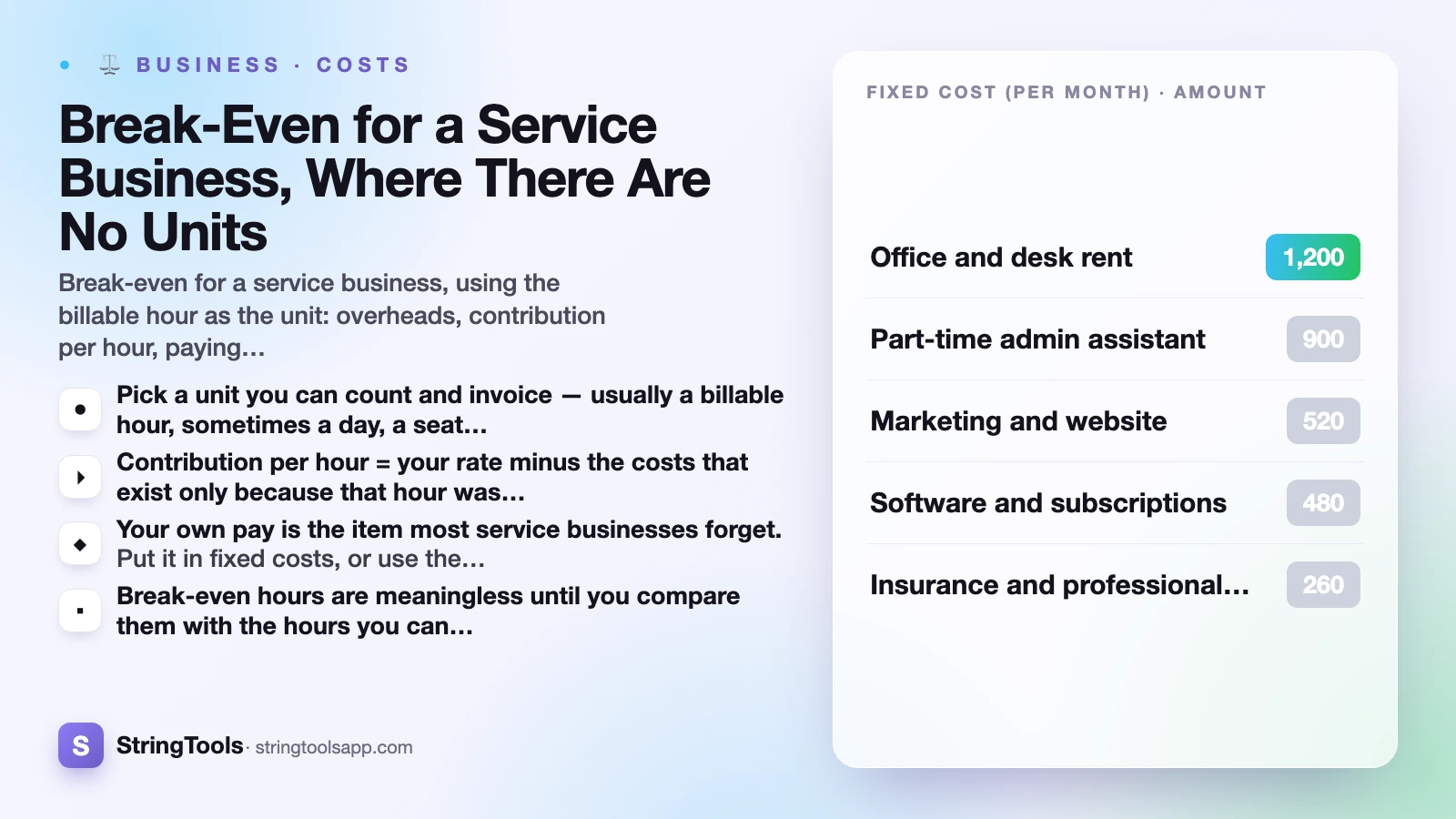
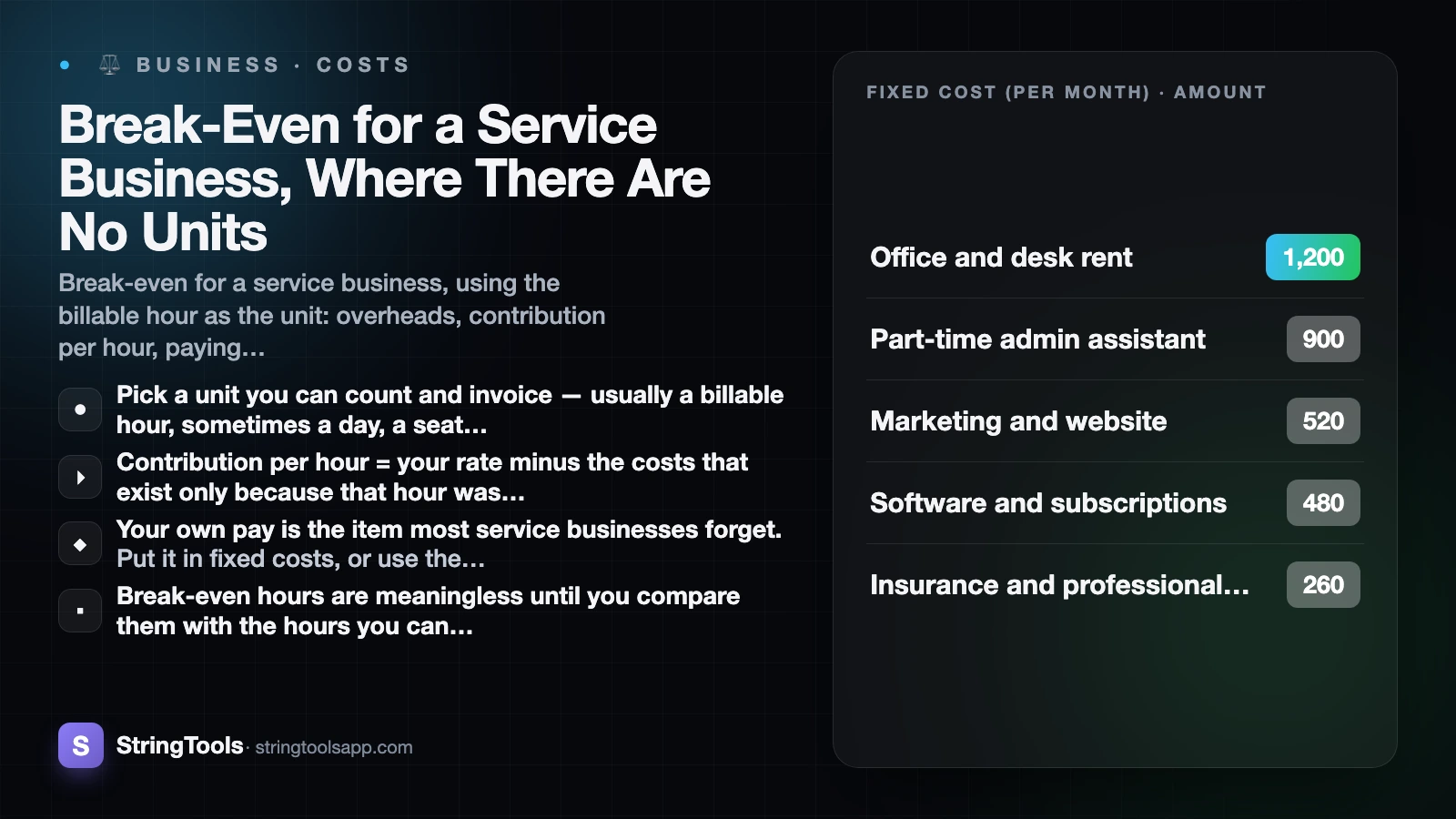
A small studio bills at 75.00 an hour. Here are the monthly overheads, all of which arrive whether or not a single hour is billed:
| Fixed cost (per month) | Amount |
|---|---|
| Office and desk rent | 1,200 |
| Part-time admin assistant | 900 |
| Marketing and website | 520 |
| Software and subscriptions | 480 |
| Insurance and professional fees | 260 |
| Accountant | 240 |
| Total overheads | 3,600 |
And here is what one billable hour costs to deliver:
| Direct cost (per billable hour) | Amount |
|---|---|
| Subcontracted specialist time | 7.50 |
| Payment processing, at 3% of the rate | 2.25 |
| Per-project licences and stock assets | 1.25 |
| Travel and printing | 1.00 |
| Total variable cost | 12.00 |
Contribution per billable hour is 75.00 − 12.00 = 63.00. Break-even is 3,600 divided by 63.00 = 57.14 hours, and since you cannot invoice a fraction of an hour and 57 would leave overheads uncovered, the answer rounds up to 58 billable hours, or 4,350 of revenue.
Notice what the model says about the studio's costs. Only 12.00 of a 75.00 hour is variable; 84% of the rate is contribution. That is typical of services and it has a consequence: because so little of the cost base flexes with volume, a quiet month hurts far more than it would in a product business. Hours you do not bill are gone — there is no inventory to sell next month.
The Version That Pays You
The example above covers the overheads and pays the studio owners nothing. That is a break-even worth knowing and a terrible target.
Say the owners need 3,500 a month between them, before tax. Two routes, and they agree exactly.
Route one: put your pay in fixed costs
Overheads become 3,600 + 3,500 = 7,100. Break-even is 7,100 divided by 63.00 = 112.7 hours, which rounds up to 113 billable hours and 8,475 of revenue.
Route two: treat your pay as the profit target
Keep overheads at 3,600 and set a target profit of 3,500. Units for a target profit = (fixed costs + target profit) divided by contribution = (3,600 + 3,500) divided by 63.00 = the same 113 hours.
Use whichever you find easier to think about, but never both at once — paying yourself a salary inside fixed costs and then also setting your pay as the profit target double counts and inflates the target by thousands.
The important number here is the jump: covering overheads takes 58 hours, and getting paid takes 113. Almost doubling. If you have ever had a month where the work felt constant and the bank balance did not move, that gap is the explanation. Only the hours above 58 do anything for you, and each one is worth 63.00.
One caution: 3,500 here is pre-tax profit, not take-home. Income tax, self-employment or payroll taxes and any pension contributions come out of it, and the treatment differs by country. Work out the pre-tax figure your desired take-home requires before you set a target, and check it with an accountant.
Break-Even Hours Versus Hours You Can Bill
A break-even of 113 hours only means something next to the hours you can realistically sell. 113 hours a month is about 26 hours a week — roughly 65% of a 40-hour week spent on billable work.
That is at the upper end of what most service businesses sustain, because the rest of the week goes on selling, quoting, admin, invoicing, learning and the work that never appears on a timesheet. Billable hours and utilisation covers the ladder in detail; the short version is that utilisation above roughly two thirds is hard to hold for long.
Raising the rate is the lever that moves this fastest. Here is the studio's break-even at different rates, with the payment fee correctly scaling at 3% of whatever the rate is:
| Hourly rate | Variable cost | Contribution | Break-even hours | Break-even revenue |
|---|---|---|---|---|
| 45.00 | 11.10 | 33.90 | 107 | 4,815 |
| 60.00 | 11.55 | 48.45 | 75 | 4,500 |
| 75.00 | 12.00 | 63.00 | 58 | 4,350 |
| 90.00 | 12.45 | 77.55 | 47 | 4,230 |
| 120.00 | 13.35 | 106.65 | 34 | 4,080 |
Two readings. First, a rate rise from 60.00 to 75.00 — 25% — removes 17 hours a month from the break-even, which is more than two working days back. Second, break-even revenue barely moves while break-even hours collapse. That is the whole argument for pricing work rather than selling time: the overheads need a fixed amount of contribution, and a higher rate delivers it in fewer hours, leaving the rest of the month for work that is actually profitable.
Contribution margin explains why the per-hour contribution, rather than the headline rate, is the figure to compare across different kinds of work.
Fixed-Price Work: The Unit Moves
Quote a project at a fixed 3,000 and the unit does not disappear, it just stops being visible. Estimate 40 hours and the implied rate is 75.00. Then the scope drifts.
| Hours actually spent | Effective hourly rate | Direct costs at 12.00 an hour | Contribution | Contribution per hour |
|---|---|---|---|---|
| 40 (as quoted) | 75.00 | 480 | 2,520 | 63.00 |
| 44 (+10%) | 68.18 | 528 | 2,472 | 56.18 |
| 52 (+30%) | 57.69 | 624 | 2,376 | 45.69 |
| 60 (+50%) | 50.00 | 720 | 2,280 | 38.00 |
The contribution total barely moves — 2,520 down to 2,280 — which is why overruns feel survivable. The damage is in the last column. At a 30% overrun the contribution per hour falls from 63.00 to 45.69, and your break-even rises from 58 hours to 79 hours of the same kind of work, because each hour now does less. At a 50% overrun you are working half a week for free.
So the discipline for fixed-price work is not to track profit per project, which will usually look fine, but contribution per hour. Log the hours even when the client is not paying by the hour, compare the effective rate with your target, and price the next one accordingly. A project that "made money" at 38.00 an hour is quietly crowding out work that would have contributed 63.00.
What This Model Leaves Out
The single-unit model is a decision aid, not a forecast. Five things it does not handle, all of which matter more in services than in products.
- A mix of work. Different services carry different contributions per hour. A blended average works only while the mix holds, and the mix is usually the first thing to change.
- Step-fixed costs. Overheads are flat until you need a third desk, a bigger licence tier or another employee, and then they jump. Model the step where you expect it.
- Idle time is not free. In a service business unsold capacity is destroyed rather than stored. A month at 40 billable hours cannot be made up by a month at 76 unless you genuinely have the room.
- Tax. All figures here are pre-tax. Treatment of allowable expenses and of your own pay differs by country: the IRS small business pages and GOV.UK expenses guidance for the self-employed are the right starting points in the US and UK.
- Payment timing. Break-even is a profit measure. A studio can clear 113 hours and still be short of cash if invoices sit unpaid for 60 days.
Run it monthly. Overheads creep, subscriptions renew at higher tiers, and every addition converts directly into hours you are committed to bill. The US Small Business Administration's guidance on managing business finances covers the wider routine this fits into, and how to calculate your break-even point sets out the underlying formula in its product form.
Then write two numbers where you can see them: the hours that cover the overheads, and the hours that pay you. For this studio, 58 and 113. Everything about how you quote, schedule and say no gets easier once both are on the wall.
This article is general business information, not accounting or tax advice. For decisions about your pay, your filings or your business structure, speak to a qualified accountant in your own country.
Frequently Asked Questions
How do you calculate break-even for a service business?
Use the billable hour as the unit. Total your monthly overheads, work out the contribution per billable hour — your rate minus the costs caused only by that hour, such as subcontracted time, card fees and per-project licences — then divide and round up. A studio with 3,600 of overheads billing at 75.00 with 12.00 of direct cost has a 63.00 contribution, so break-even is 3,600 divided by 63.00 = 58 billable hours.
Should my own salary count as a fixed cost?
Either put it in fixed costs or treat it as a target profit, but not both. With 3,600 of overheads, a 63.00 contribution and 3,500 of owner pay, adding the pay to fixed costs gives 7,100 divided by 63.00 = 113 hours, and treating it as a profit target gives (3,600 + 3,500) divided by 63.00 = the same 113 hours. Doing both double counts and roughly doubles the target.
What counts as a variable cost when I sell time?
Only costs caused by the sale of that hour: subcontracted or freelance time bought in for the job, payment-processing fees, per-project licences or stock assets, and job-specific travel or printing. Rent, salaried staff, your flat software subscriptions, insurance and marketing are fixed, because they arrive whether or not the hour was sold. In services the variable share is usually small, which makes quiet months expensive.
How many hours a week is a realistic billable target?
Fewer than the hours you work. Selling, quoting, admin, invoicing and learning are all unbilled, so utilisation much above two thirds of a working week is difficult to hold. A break-even of 113 hours a month is about 26 hours a week, or roughly 65% of a 40-hour week. If your break-even hours imply utilisation you have never achieved, the rate or the cost base has to change rather than the effort.
How do I handle fixed-price projects in a break-even model?
Convert the project into implied hours. A 3,000 project delivered in 40 hours is an effective rate of 75.00 and a contribution of 2,520, or 63.00 an hour. Deliver the same project in 52 hours and the effective rate drops to 57.69, contribution falls to 2,376 and contribution per hour to 45.69 — which pushes break-even from 58 hours to 79. Track hours even on fixed-price work so you can see this.
Why does my break-even feel higher than the formula says?
Usually because the first calculation left something out. The three common omissions are your own pay, a variable cost you filed as fixed, and step costs that arrived with growth. Also check the unit: if fixed-price projects routinely overrun, your real contribution per hour is lower than your quoted rate implies, and every figure built on that rate is optimistic.
Sources and references
IRS small business pages (irs.gov) · GOV.UK expenses guidance for the self-employed (gov.uk) · US Small Business Administration's guidance on managing business finances (sba.gov). Content was reviewed against these sources as of the last-updated date above; external figures and rules may change after publication.