
You Work Forty Hours and Invoice Twenty-Eight
Billable utilisation is the share of the hours you work that actually reach an invoice. A freelancer at a desk for forty hours a week typically invoices far fewer, because selling, quoting, invoicing, bookkeeping, learning and unpaid client conversations all consume working time. Utilisation, not effort, is what decides the rate you need.
Key Takeaways
- Utilisation = billable hours ÷ hours worked. At 70%, a forty-hour week produces 28 invoiced hours.
- Billable hours for the year = billable days × hours per day × utilisation. In the running example: 198 × 8 × 70% = 1,108.8 hours.
- Utilisation moves the required rate more sharply than almost any other input. At 40% the floor is 149.49 an hour; at 90% the same year needs only 66.44.
- Raising utilisation from 70% to 80% is worth 158.4 extra billable hours a year — 13,531 at the example's rate — without asking a single client for more money.
- Anything above 85% should be treated as suspicious until a real month proves it.
- Utilisation is measured, not estimated. Guessing it high is the most common way a correct-looking rate produces a short year.
This is general business information rather than accounting advice.
What Utilisation Actually Measures
There are three different hour counts in a freelance year and they are routinely confused.
Calendar hours are the notional full-time year, usually quoted as 2,080 hours from forty hours across 52 weeks. Nobody works this. It includes your leave, the public holidays and every day you were ill.
Worked hours are the hours you are genuinely at work on the days you work. In the running example used across this cluster, 198 billable days at eight hours gives 1,584 worked hours.
Billable hours are the subset of worked hours that appear on an invoice. At 70% utilisation, 1,584 worked hours produce 1,108.8 billable ones.
The gap between the second and third figures is unpaid, and it is not waste. Pitching that wins work, invoices that get paid and skills that stay current are all productive. They are simply not chargeable, which means the chargeable hours have to carry them.
The freelance rate calculator treats utilisation as a separate input for exactly this reason, rather than folding it into a fudge factor.
Where the Other Thirty Per Cent Goes
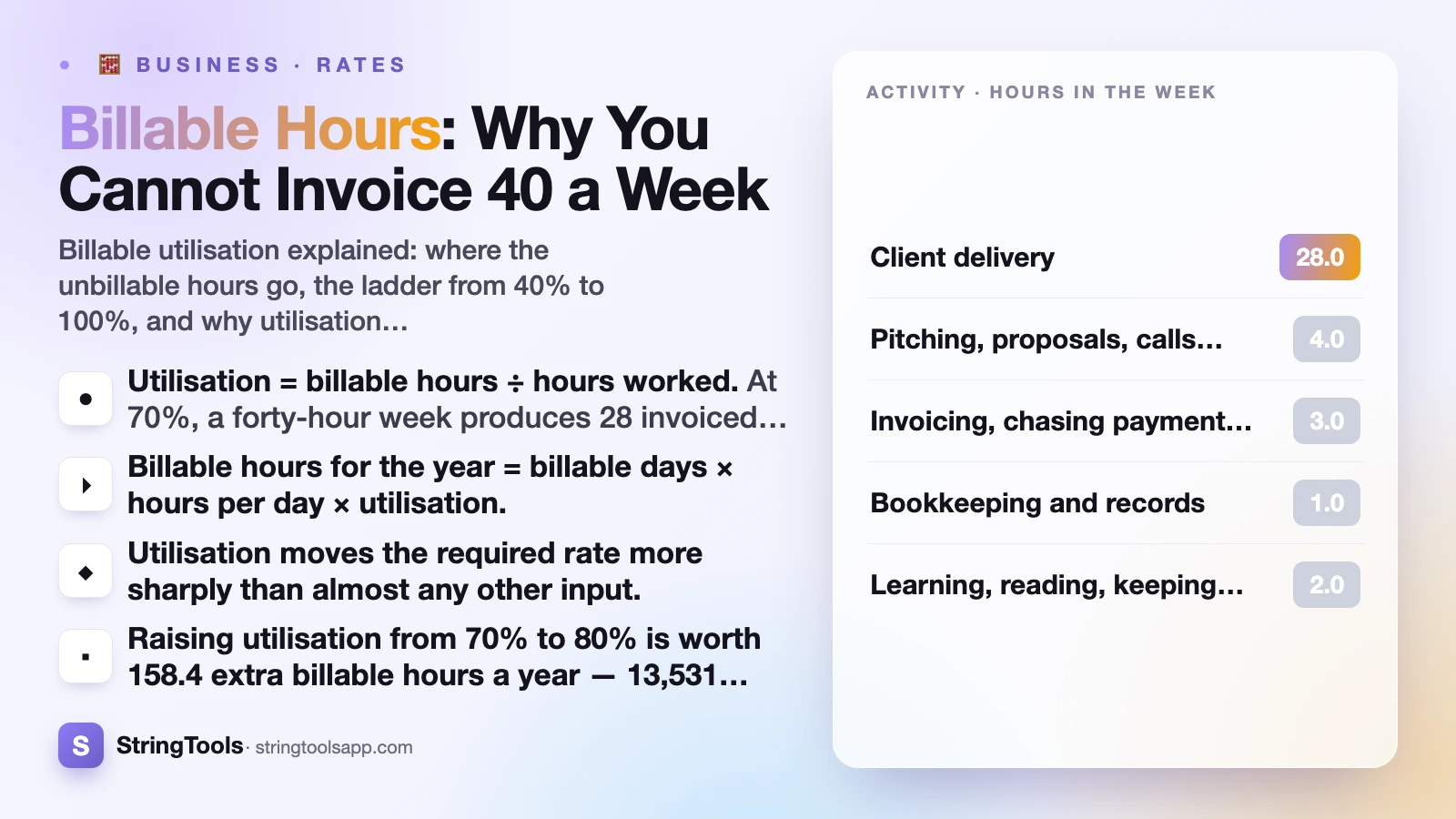
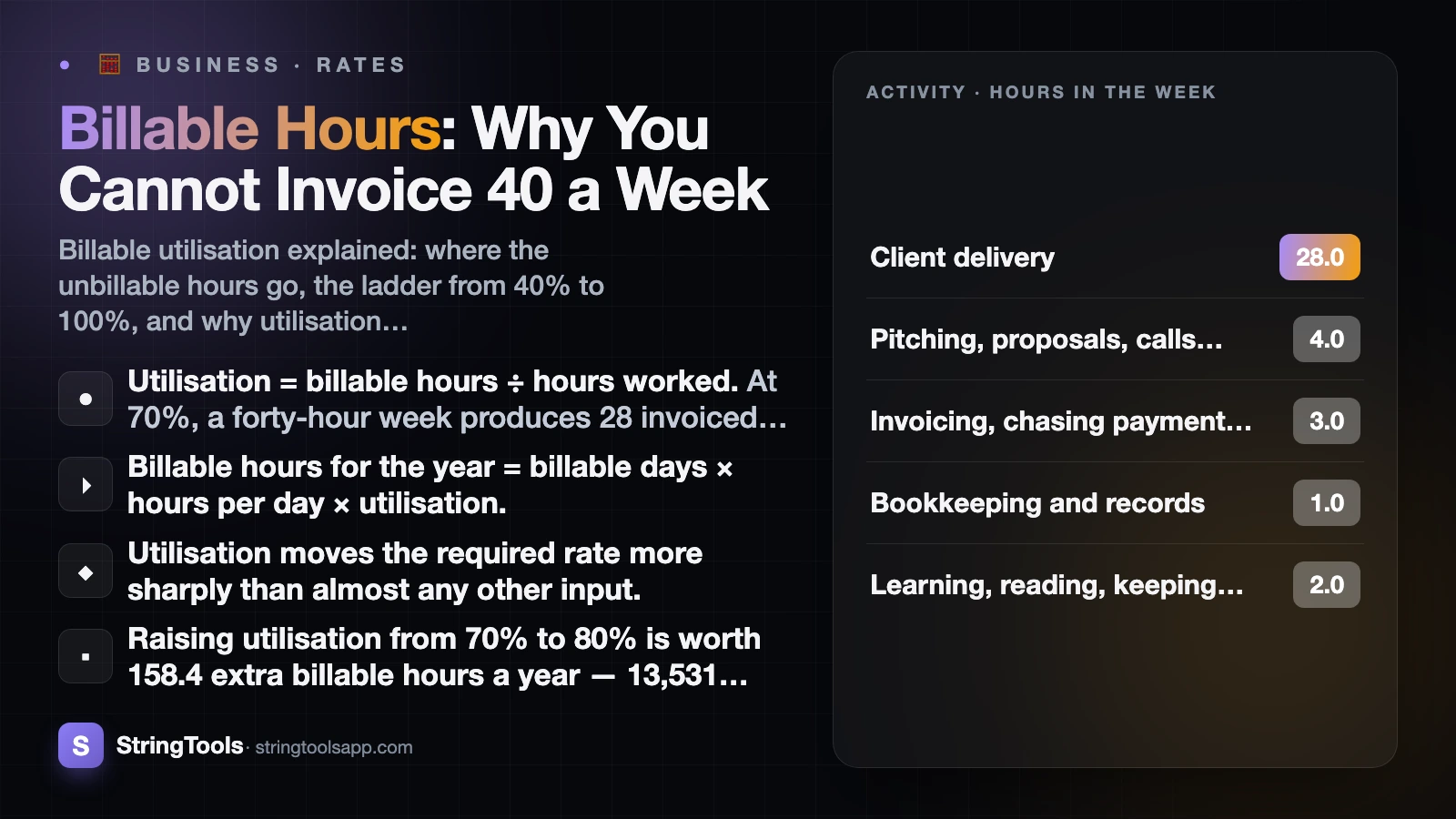
Here is one illustrative week that produces 70% utilisation. The point is not that your week looks like this — it is that the non-delivery lines are real work with real hours attached, and they add up faster than people expect.
| Activity | Hours in the week | Billable |
|---|---|---|
| Client delivery | 28.0 | yes |
| Pitching, proposals, calls with prospects | 4.0 | no |
| Invoicing, chasing payment, admin | 3.0 | no |
| Bookkeeping and records | 1.0 | no |
| Learning, reading, keeping current | 2.0 | no |
| Unpaid client communication and scope discussion | 2.0 | no |
| Total | 40.0 | 28.0 billable, 70% |
Two of those lines deserve attention. Unpaid scope discussion is the one that quietly grows: a fifteen-minute call that becomes an hour, repeated across four clients, is a working day a month. And the invoicing line shrinks when the process is boring and repeatable, which is the practical argument for a consistent template — the invoice generator exists for that, and invoice payment terms explained covers what to put on it so chasing takes less time.
Note also what is not on the list: the 62 days a year of leave, public holidays, illness and whole-day admin. Those are removed before this week exists. Utilisation is measured across the days you actually work, which is why counting a holiday as "0% utilisation" double-counts it.
The Utilisation Ladder
Holding every other figure in the running example constant — a 60,000 target take-home, 198 billable days of eight hours, 9,000 of annual overheads, an illustrative 30% set-aside, so 94,714 of revenue to invoice — only the utilisation changes here.
| Utilisation | Billable hours a year | Billable hours a week | Hours billed in an eight-hour day | Hourly floor | Multiple of the naive rate |
|---|---|---|---|---|---|
| 40% | 633.6 | 16.0 | 3.2 | 149.49 | 5.18× |
| 50% | 792.0 | 20.0 | 4.0 | 119.59 | 4.15× |
| 60% | 950.4 | 24.0 | 4.8 | 99.66 | 3.45× |
| 70% | 1,108.8 | 28.0 | 5.6 | 85.42 | 2.96× |
| 80% | 1,267.2 | 32.0 | 6.4 | 74.74 | 2.59× |
| 90% | 1,425.6 | 36.0 | 7.2 | 66.44 | 2.30× |
| 100% | 1,584.0 | 40.0 | 8.0 | 59.79 | 2.07× |
The last column compares each floor to 60,000 ÷ 2,080 hours, which is 28.85. Even at a fictional 100% utilisation, where you invoice every hour you work and never pitch or invoice or learn, the floor is still more than twice the naive figure, because overheads, the set-aside and 62 non-working days have not gone anywhere.
Between 40% and 80%, the required rate doubles. No other input in the calculation has that kind of leverage.
Why Raising Utilisation Beats Raising the Rate
Suppose the example freelancer improves utilisation from 70% to 80% — one extra billable hour a day, found by tightening the sales process and batching admin rather than working longer.
At the same 85.42 rate, that is 158.4 extra billable hours a year, worth 13,531. Alternatively, keeping revenue flat at 94,714, it lets the floor fall from 85.42 to 74.74, a 12.5% cut in the rate needed to hit exactly the same take-home.
Compare that with a 10% rate rise, which is worth about 9,471 on the same revenue and requires a conversation with every client. The utilisation route needs no client to agree to anything.
It is not free, though, and the honest version of this advice says so:
- Fewer, larger engagements raise utilisation and concentrate risk. Losing one client hurts more.
- Retainers raise utilisation by removing repeated selling, at the cost of flexibility.
- Batching admin into a single half-day works, but the half-day still exists — it moves into the whole-day admin count rather than vanishing.
- Automating quoting and invoicing genuinely removes hours. So does saying no earlier to work you will not win.
Both levers are real. The point is that most freelancers reach for the rate first because it is the number on the rate card, and reach for utilisation last because nobody bills for it.
How to Measure Yours Instead of Guessing
Take last month, not a typical month, and certainly not next month.
Count the hours you invoiced. Read them off the invoices you actually sent, not off your intentions.
Count the hours you worked. Days worked multiplied by hours at the desk. Include the evening you spent on a proposal.
Divide. That is your utilisation for the month. Do it for three months and use the lowest of the three in your rate calculation, because your rate has to survive a bad month rather than a flattering one.
Keeping the underlying records properly is worth the effort for a second reason: tax authorities expect them. Both the IRS small business and self-employed section and GOV.UK's working-for-yourself guidance set out record-keeping duties in their own jurisdictions, and the same records give you your utilisation for free.
If you have never tracked hours, track them for four weeks before you set a rate. Nothing else in the calculation is as commonly wrong by as much, and the error always runs the same way: people remember delivery and forget everything around it.
Two cautions on the result. A brand-new freelance business usually runs low, because the selling has not yet been amortised over repeat clients. And a month that included a big pitch will look terrible while being time well spent.
When High Utilisation Is a Warning Rather Than a Win
A sustained figure above 85% usually means one of three things, and only one of them is good.
You have genuinely efficient operations. Repeat clients, standard contracts, little unpaid scoping. Rare, and it tends not to last through a client change.
You are not selling. Utilisation looks excellent right up until the current project ends and there is nothing behind it, because none of the hours that would have built a pipeline were spent. This is the most common cause, and the figure peaks just before a bad quarter.
You are counting wrong. Unpaid revisions, the proposal you wrote on Sunday and the hour on the phone about next quarter are all quietly missing from the worked-hours total.
There is also a rate consequence. Setting a rate on 90% utilisation and delivering 65% leaves a gap of roughly a quarter of the year's revenue, and it will not be visible until the money is already missing. Pricing on an ambitious utilisation figure is the same mistake as pricing on an ambitious sales forecast.
The other side of the coin is that low utilisation has to be funded while you fix it. Irregular, lumpy income is a cash-flow problem more than a pricing problem, and it is answered with a buffer — the emergency fund calculator measures that in months of essential expenses rather than as a savings total, which is the right unit when the income arrives unevenly.
Which Lever to Pull First
Work through them in this order, because they run from cheapest to hardest.
Stop losing billable hours you have already won. Unbilled revisions, unbilled meetings and unbilled scope creep are the fastest wins, and they are a contracting problem rather than a pricing one. How you quote decides how much of this you absorb, which is the subject of hourly, day rate or fixed price.
Reduce the cost of the unbillable work. Templates, a standard proposal, a standard contract, one invoicing session a week. This moves the utilisation number without changing what you sell.
Reduce the amount of selling per unit of work. Longer engagements, retainers, repeat clients and referrals all lower the selling hours per project.
Then, and only then, look at the rate. By this point you know your real utilisation, which means you know your real floor, and the conversation with a client is about a number you can defend. How to raise your rates covers that conversation.
The order matters because the first three cost you nothing in client goodwill and the fourth spends some. Spend it when the arithmetic says you have to, and check the floor first with the freelance rate calculator so you know how much you are asking for and why.
Frequently Asked Questions
What is a billable utilisation rate?
It is billable hours divided by hours worked, expressed as a percentage. If you work forty hours in a week and invoice 28 of them, your utilisation is 70%. It is measured across the days you actually work, so leave and public holidays are removed before the calculation rather than counted as zero-utilisation days.
How many hours a week can a freelancer actually bill?
Fewer than they work, and the honest answer comes from measurement rather than a benchmark. At 70% utilisation a forty-hour week yields 28 billable hours; at 60% it is 24 and at 80% it is 32. Track the hours you invoiced against the hours you worked for three months and use the lowest figure when setting a rate.
How does utilisation change the rate I need to charge?
Sharply. In the worked example, 94,714 of revenue must come from 198 billable days of eight hours. At 40% utilisation that is 633.6 billable hours and a floor of 149.49 an hour. At 70% it is 1,108.8 hours and 85.42. At 90% it is 1,425.6 hours and 66.44. Halving your unbillable time does not halve the rate: going from 70% utilisation to 85% takes the floor from 85.42 to 70.35, a cut of about a sixth.
Is it better to raise my rate or my utilisation?
Utilisation first, because it needs no client to agree. Moving from 70% to 80% in the example adds 158.4 billable hours a year, worth 13,531 at the same rate, or allows a 12.5% lower rate for the same take-home. A 10% rate rise on the same revenue is worth about 9,471 and requires every client to accept it.
What counts as non-billable time?
Pitching and proposals, invoicing and chasing payment, bookkeeping, learning and keeping current, unpaid scope discussion, and admin of every kind. In the illustrative week these come to twelve hours out of forty. Whole days lost to leave, public holidays, illness and full-day administration are handled separately, by reducing the billable-day count.
Why is utilisation above 85% a warning sign?
Usually because the hours that should be building a pipeline are being spent on delivery instead, so the figure peaks shortly before a quiet quarter. It can also mean unpaid meetings and revisions are missing from the worked-hours total. Setting a rate on an optimistic utilisation figure creates a shortfall that only becomes visible once the money is already missing.
Sources and references
the IRS small business and self-employed section (irs.gov) · GOV.UK's working-for-yourself guidance (gov.uk). Content was reviewed against these sources as of the last-updated date above; external figures and rules may change after publication.