
Decide the Number Before You Decide the Conversation
Raising your rates starts with arithmetic, not a script. Work out the rate your costs and billable hours actually require, work out how much work you could lose and still be even, then give existing clients notice in writing with a date. The number makes the conversation possible; it does not make it comfortable.
Key Takeaways
- Calculate the new floor first. A rise you cannot justify to yourself is hard to hold when a client pushes back.
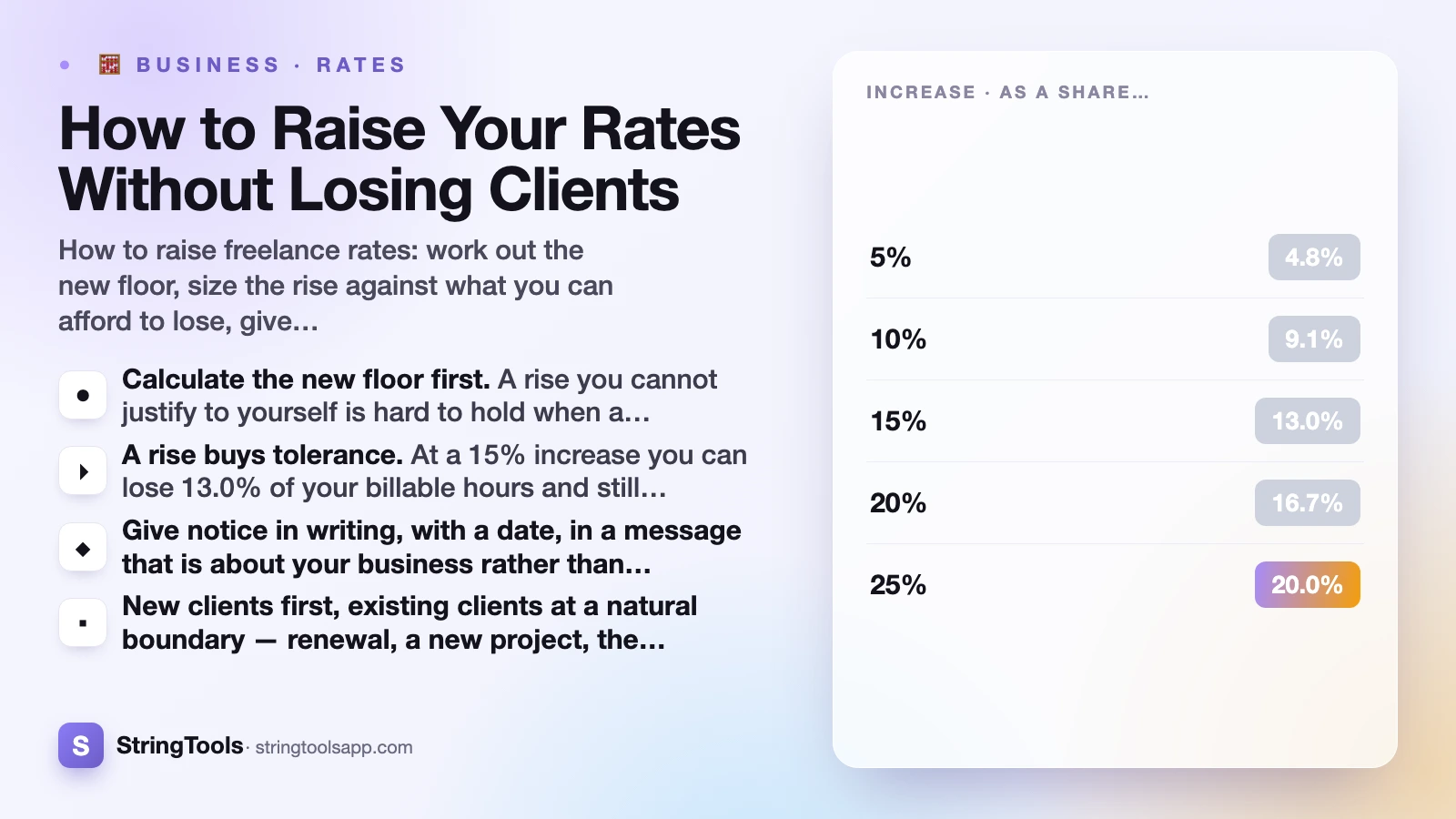
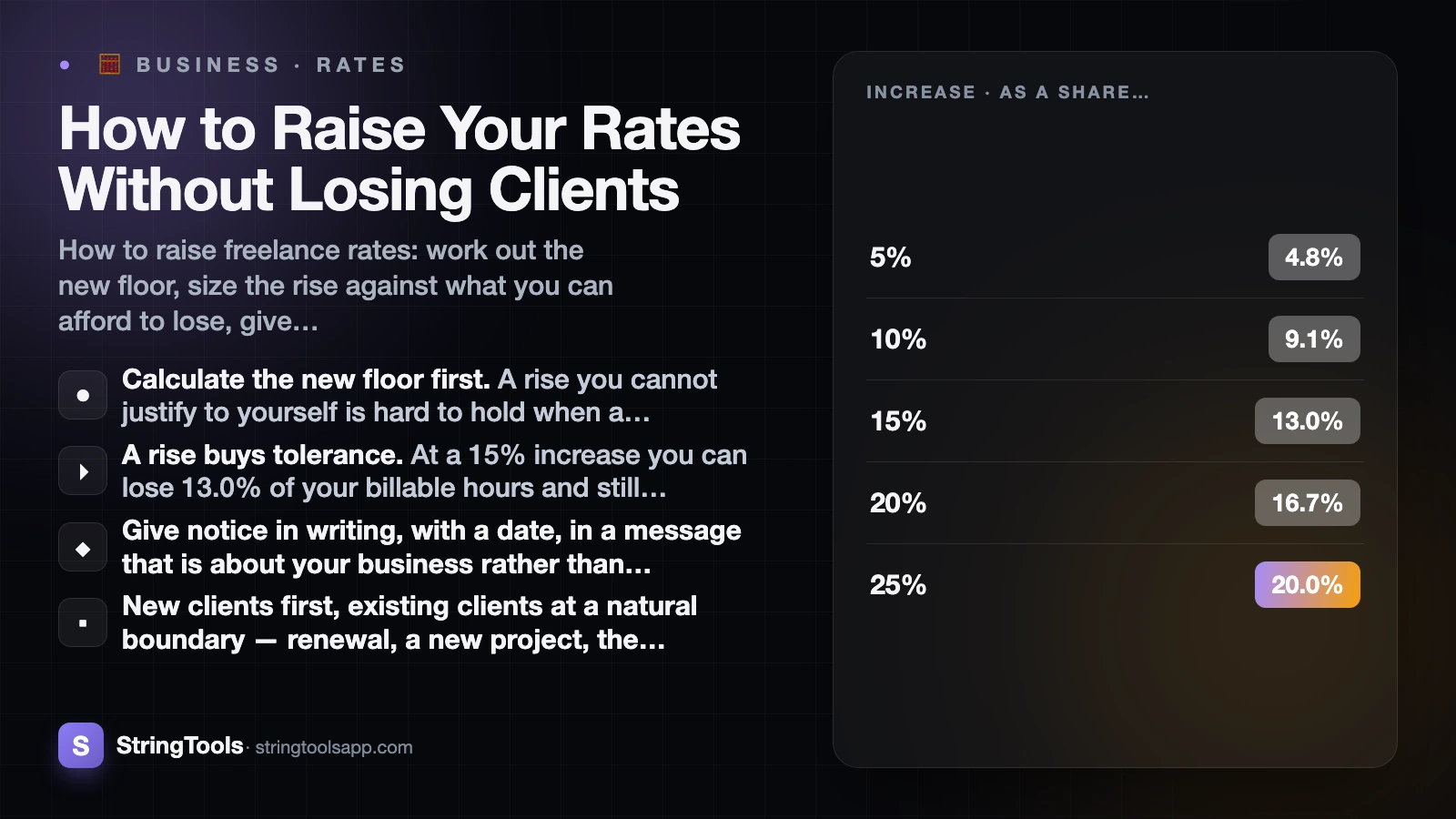
- A rise buys tolerance. At a 15% increase you can lose 13.0% of your billable hours and still end the year in the same place.
- Give notice in writing, with a date, in a message that is about your business rather than about the client.
- New clients first, existing clients at a natural boundary — renewal, a new project, the start of a quarter.
- A client saying no is information, not a verdict. Decide in advance what you will do with each possible answer.
- Nobody can tell you how your clients will react. Anyone quoting a percentage who keeps or loses work is guessing.
This is general business information rather than legal, financial, accounting or tax advice.
Work Out the New Floor, Not a Round Number
The worst version of a rate rise is a round number chosen because it sounded bold. The good version is a figure you can explain in one sentence because it came from your own costs.
Use the same funnel as how to set your freelance rate: the income you want to keep, divided by one minus your tax set-aside, plus your annual overheads, divided by the hours you can genuinely invoice. The freelance rate calculator does this with itemised overheads and a utilisation figure you choose.
Four things move that floor, and any of them is a legitimate reason to reprice:
- Your overheads went up. Software, insurance, accountancy and hardware all drift upward. In the running example, overheads rising from 9,000 to 15,000 a year moves the floor from 85.42 to 90.83 on its own.
- Your utilisation went down. More selling, more admin, more unpaid meetings. Falling from 70% to 60% moves the same floor from 85.42 to 99.66.
- Your target income changed. A larger household, a pension you are now funding properly, a buffer you want to build.
- You set the rate before you understood the year. Very common in a first or second year of freelancing, and the honest fix is a correction rather than an apology.
Note what is not on that list: a vague sense that you are worth more. That may well be true, but it is an argument about value, and it needs different evidence — results, outcomes, work you can point at — rather than a cost calculation.
What a Rise Is Actually Worth, and What It Can Survive
Take the running example: a floor of 85.42 an hour, 1,108.8 billable hours, 94,714 of revenue for the year. Here is what each size of increase adds if you keep all your work, and how much work you could lose before you are back where you started.
| Increase | New hourly | Extra revenue if nothing is lost | Hours you could lose and break even | As a share of your billable hours |
|---|---|---|---|---|
| 5% | 89.69 | 4,735.71 | 53 | 4.8% |
| 10% | 93.96 | 9,471.43 | 101 | 9.1% |
| 15% | 98.23 | 14,207.14 | 145 | 13.0% |
| 20% | 102.50 | 18,942.86 | 185 | 16.7% |
| 25% | 106.78 | 23,678.57 | 222 | 20.0% |
| 50% | 128.13 | 47,357.14 | 370 | 33.3% |
The break-even column is the useful one, and the formula behind it is simple: tolerable loss = increase ÷ (1 + increase). A 25% rise means you can lose a fifth of your hours and still bank the same revenue, with a fifth of your year freed up.
That is the argument for a meaningful rise rather than a nervous one. A 5% increase buys almost no tolerance — lose one small client and it is gone — while consuming the same amount of awkwardness as a larger number.
It is also not a prediction. Nothing here says a client will or will not accept anything. It tells you what the downside would have to look like before the rise costs you money, which is the only part you can know in advance.
Timing: The Moments That Make It Straightforward
Rate changes are easiest at a boundary, because a boundary supplies a reason that has nothing to do with the client.
At renewal or contract end. The natural moment. Nothing is being reopened; a new agreement is being written.
At the start of a new project. A new scope is a new quote. This is the least confrontational route with a long-standing client.
At a fixed point in the year. Announcing in advance that rates are reviewed each year in, say, January turns every future rise into a policy rather than an event. If you do nothing else from this page, start doing this.
When the scope has visibly changed. More responsibility, a wider remit, more stakeholders. Reprice the work rather than the relationship.
When you are close to capacity. Not because you should exploit it, but because a rise you can afford to lose is a rise you can hold calmly. This is the practical case for building a cash buffer first — the emergency fund calculator measures a cushion in months of essential expenses, which is the unit that matters when income is lumpy.
The moment to avoid is immediately after a problem on your side. A missed deadline followed by a price rise reads as an invoice for your own mistake, whatever the arithmetic says.
How to Say It
Written, short, with a date, and about your business rather than about them. A long message signals that you expect an argument.
The shape that works:
- State the change and the date it applies from, clearly and in one line.
- Give enough notice that the client can plan — a full billing cycle at minimum, and more for a client with an annual budget.
- Say what is not changing, so the message is not read as the start of a general renegotiation.
- Offer one concrete accommodation if you are willing to give one, such as the current rate for work already booked.
- Stop. Do not justify at length.
A workable example: "From 1 March my rate moves to 98.23 an hour. Work already booked before that date stays at the current rate. Everything else about how we work together is unchanged, and I am glad to talk it through if that is useful."
Things worth avoiding:
- Apologising. It invites a negotiation about whether the rise should happen at all.
- Blaming external conditions you cannot evidence. Your costs are yours; you do not need a wider narrative.
- Comparing yourself to other freelancers' prices. You do not know theirs, and it invites the client to go and find out.
- Raising it verbally in passing. The date and the number need to exist in writing, and the same discipline applies to the paperwork that follows — invoice payment terms explained covers what belongs on the document, and the invoice generator produces a clean one.
When a Client Says No
Decide your response before you send the message, because deciding it afterwards, under pressure, produces the concession you regret.
There are four answers, and each has a sensible response.
Yes. Update your records, your template and your invoices the same day. The rate that only exists in an email is the rate you forget to charge.
Yes, but later. Often reasonable, particularly with annual budgets. Agree a specific date in writing rather than an intention, and keep to it.
No, but stay at the current rate. Now it is a capacity question rather than a pricing one. If the work is at or near your floor, keeping it while you find replacement work is a legitimate choice, as long as you know which it is. If it is below your floor, it is being subsidised by the rest of your year.
No, and we will stop. This is the outcome people fear and it is genuinely a real cost, especially if that client is a large share of your income. Go back to the break-even table: it tells you how many hours you could lose and still be level. If losing this client puts you past that line, you need replacement work rather than a smaller rise.
One honest caveat that applies to all four. Anyone who tells you what proportion of clients accept a rate rise is making it up — it depends on your work, your client mix and your market, and the only data that describes your situation is your own. What you can control is that you can afford the worst answer before you ask.
Raise New-Client Rates First
If the conversation with existing clients feels impossible, there is a lower-risk route, and it is the one most freelancers should take first.
Quote the new rate to every new client from today. Nothing changes for anyone you already work with. You find out quickly whether the number wins work, at no risk to your existing income, and you build a body of evidence that makes the later conversation easier.
Over time this splits your client list into two tiers, and that split is useful information. If the new-rate clients are as pleasant to work with as the old ones, the case for repricing the older relationships is settled. If the new rate is not winning anything after a genuine run of quotes, the issue may not be the number — it may be who you are quoting to, or what the proposal says about the outcome rather than the hours.
The second lever, and often the better one, is to bill more of the time you already work. Moving utilisation from 70% to 80% in the running example adds 158.4 billable hours a year, worth 13,531 at the old rate, without anyone agreeing to anything — billable hours and utilisation sets out how. It is worth exhausting that lever before spending goodwill on a rise.
After the Rise, Make It Stick
The rise is not finished when the client agrees. It is finished when it is in every document.
Change the template the same day. Proposal, contract, invoice, the note in your accounting software. Rates that live only in memory decay back to the old number.
Hold the rate for the next quote. The first time you discount back to the old rate for a client who pushes, the new rate stops being a rate and becomes an opening position.
Reprice the work, not only the hour. If a client resists the hourly figure, changing what you sell is often easier than changing the price of an hour — a fixed price for a defined outcome removes the comparison entirely. Hourly, day rate or fixed price covers when each unit fits.
Set a review date. A year from now, in the calendar, with the calculator run again. Rates that are reviewed on a schedule need small corrections; rates that are reviewed when you are desperate need large ones.
Keep the underlying records straight. Your tax position changes as your income does, and both the IRS small business and self-employed section and GOV.UK's working-for-yourself guidance set out what is expected in their own jurisdictions. A rate rise is a good prompt to check that your set-aside percentage is still the right one, because that figure is a question for your tax authority or your accountant and for nobody else.
Frequently Asked Questions
How much should I raise my freelance rates by?
By enough to reach the floor your own costs and billable hours require, worked out from target take-home, tax set-aside, overheads and utilisation. Size it against the break-even table too: a 15% rise lets you lose 13.0% of your billable hours and still bank the same revenue, while a 5% rise buys almost no tolerance for the same amount of awkwardness.
How much notice should I give before raising my rates?
A full billing cycle at minimum, and longer for a client working to an annual budget. Put the new figure and the date it applies from in writing. Announcing that you review rates at a fixed point each year turns future changes into a policy rather than an event, which makes each one easier.
What do I say when a client asks why my rate is going up?
Keep it short and about your business. State the new rate, the date, and what is not changing. If pressed, your costs and your capacity are sufficient reason and you do not owe a detailed breakdown. Avoid apologising, avoid comparing yourself to other freelancers' prices, and avoid blaming conditions you cannot evidence.
What if a client refuses a rate increase?
Decide your response before you ask. If the current rate is at or above your floor, keeping the client while you find replacement work is a legitimate choice. If it is below your floor, the rest of your year is subsidising it. Use the break-even figures: at a 15% rise you could lose 145 of 1,108.8 billable hours before you are worse off than before.
Should I raise rates for existing clients or only new ones?
New clients first is the lower-risk route. Quote the new rate to everyone new from today and leave existing arrangements alone. You learn whether the number wins work without putting current income at risk, and you build evidence that makes the existing-client conversation easier later.
How often should freelancers review their rates?
At least once a year, on a fixed date, and additionally whenever an input changes materially — overheads rising, utilisation falling, or a change in the income you need. In the worked example, overheads moving from 9,000 to 15,000 raises the floor from 85.42 to 90.83, and utilisation falling from 70% to 60% raises it to 99.66.
Sources and references
the IRS small business and self-employed section (irs.gov) · GOV.UK's working-for-yourself guidance (gov.uk). Content was reviewed against these sources as of the last-updated date above; external figures and rules may change after publication.