
Work Back From the Income You Want
To set a freelance rate, start with the income you want to keep, divide it by one minus the share you set aside for tax, add your annual business costs, and divide that total by the hours you can genuinely invoice in a year. The answer is the floor you must charge, not the price the market has agreed to pay.
Key Takeaways
- A rate is an output, not a guess. Four inputs decide it: target take-home, tax set-aside, overheads and billable hours.
- The arithmetic is
revenue needed = (take-home ÷ (1 − tax set-aside)) + overheads, thenhourly = revenue ÷ billable hours. - Billable hours are far fewer than the hours you work. In the worked example below, 1,584 worked hours produce 1,108.8 invoiced ones.
- Dividing your target income by 2,080 hours, the figure most people reach for first, understates the required rate by roughly three times.
- Never copy a set-aside percentage from an article. The correct share depends on your country, your legal structure and your total income, so it comes from your own tax authority.
- The rate you calculate is a floor. Whether clients will pay it is a separate question about positioning and evidence.
This is general business information, not accounting or tax advice. For anything binding, talk to an accountant in your own country.
The Four Numbers That Decide Everything
Almost every freelancer who is underpaid got there the same way: they picked a number that sounded plausible, or they took what a previous employer paid them per hour and added a bit. Both methods skip the three costs that an employer used to absorb quietly.
Only four inputs matter, and the freelance rate calculator asks for exactly these.
Target take-home. The money you want left in your pocket for the year, after tax and after business costs. Not revenue. Not turnover. The number you would live on.
The tax and contributions set-aside. A percentage you reserve from every payment. This is not a tax calculation and no browser tool can do one for you. Look it up: the IRS self-employed tax center and GOV.UK's guide to working for yourself both explain how self-employed liability is assessed in their jurisdiction. Whatever percentage your own authority implies, that is the one to use.
Overheads. Every annual business cost, itemised: software, insurance, accountancy, hardware amortised across its life, a desk, a phone line, professional bodies, training. These are paid out of the same rate.
Billable hours. Not the hours in a year. Not the hours you work. The hours that end up on an invoice.
Get those four right and the rate falls out of the arithmetic. Get any of them wrong and no amount of negotiation will fix the year.
The Funnel, Worked End to End
Here is a complete example. Every figure is illustrative and chosen to keep the arithmetic clean; none of it is a claim about what anyone is paid.
Assume you want to keep 60,000 a year. You work five days a week, eight hours a day. You price in 25 days of leave, 8 public holidays, 5 sick days and 24 days of admin, pitching and bookkeeping. You reckon 70% of the hours in a working day reach an invoice. Your annual overheads come to 9,000, and you reserve 30% of profit for tax and contributions.
| Step | Working | Result |
|---|---|---|
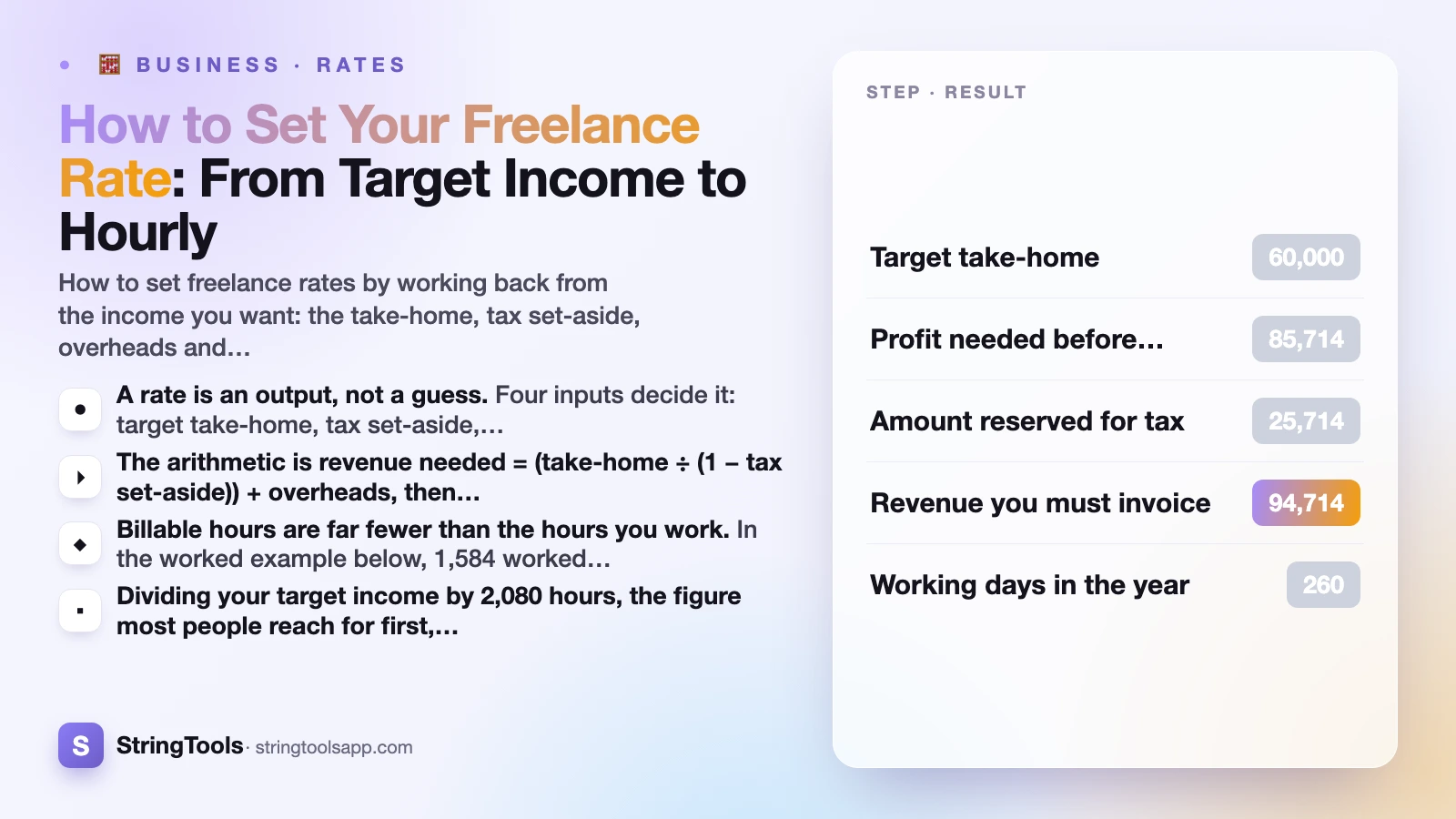
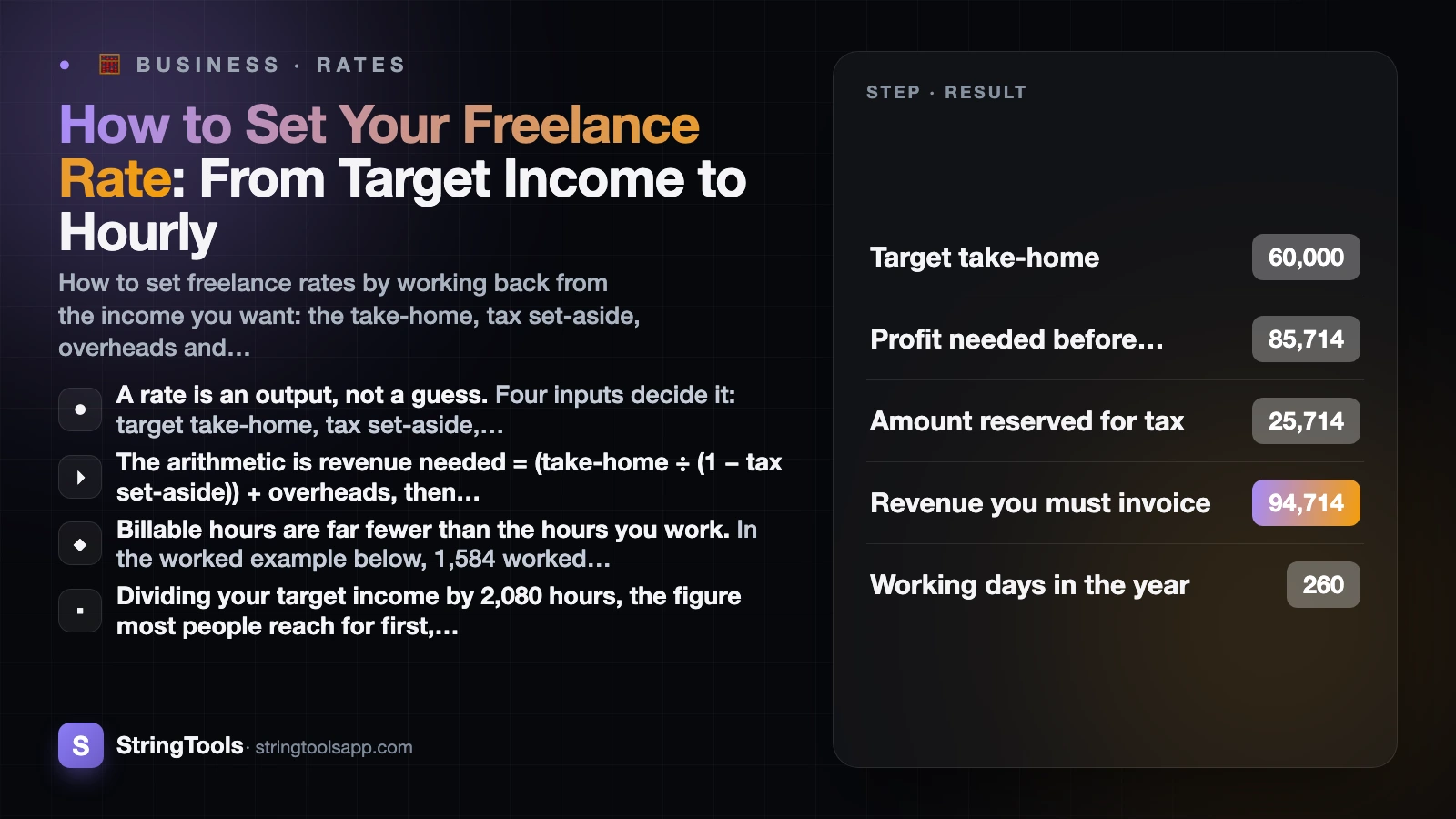
| Target take-home | given | 60,000 |
| Profit needed before set-aside | 60,000 ÷ (1 − 0.30) | 85,714 |
| Amount reserved for tax | 85,714 − 60,000 | 25,714 |
| Revenue you must invoice | 85,714 + 9,000 overheads | 94,714 |
| Working days in the year | 5 × 52 | 260 |
| Days off you self-fund | 25 + 8 + 5 + 24 | 62 |
| Billable days left | 260 − 62 | 198 |
| Hours at the desk | 198 × 8 | 1,584 |
| Hours actually invoiced | 1,584 × 70% | 1,108.8 |
| Hourly rate | 94,714 ÷ 1,108.8 | 85.42 |
| Day rate | 94,714 ÷ 198 | 478.35 |
| Week rate | 94,714 ÷ 39.6 billable weeks | 2,391.77 |
Note the shape of it. To keep 60,000 you have to invoice 94,714, and you have 1,108.8 hours in which to do it. Of every hour you bill, 63% reaches you, 27% is set aside, and 10% pays business costs.
The naive method — 60,000 ÷ 2,080 hours — gives 28.85. The real requirement is 2.96 times that. That multiplier is the whole reason freelance rates look expensive next to salaries and are frequently not.
Why the Day Rate Is Not the Hourly Rate Times Eight
This trips up almost everyone, and it trips them in the expensive direction as well as the cheap one.
In the example, the hourly rate is 85.42 and the day rate is 478.35. Multiply 85.42 by eight and you get 683.36, which is 42.9% higher than the day rate. The two are not inconsistent. A billed day contains eight hours at the desk but only 5.6 of them are billable, and 85.42 × 5.6 = 478.35 exactly.
So the two rates recover the same year by different routes:
- The hourly rate assumes you charge only for invoiced hours and absorb the rest.
- The day rate assumes the client books the whole day and you charge for the whole day, unbilled fractions included.
Quoting a day rate of eight times your hourly is not a clever uplift, it is double-counting the unbillable time you already priced into the hourly figure. Quoting a day rate of revenue ÷ billable days, on the other hand, is the honest version, and it is usually easier for a client to buy.
Whichever unit you quote in, quote one. Mixing them mid-negotiation is how you end up billing eight-hour days at a rate built for 5.6.
The Rate Ladder: What Different Targets Require
Holding everything else in the worked example constant — same days, same 70% utilisation, same 9,000 of overheads, same 30% set-aside — this is how the required rate moves with the income you want.
| Target take-home | Revenue to invoice | Hourly floor | Day rate | Naive target ÷ 2,080 | Multiplier |
|---|---|---|---|---|---|
| 30,000 | 51,857 | 46.77 | 261.90 | 14.42 | 3.24× |
| 40,000 | 66,143 | 59.65 | 334.05 | 19.23 | 3.10× |
| 50,000 | 80,429 | 72.54 | 406.20 | 24.04 | 3.02× |
| 60,000 | 94,714 | 85.42 | 478.35 | 28.85 | 2.96× |
| 75,000 | 116,143 | 104.75 | 586.58 | 36.06 | 2.90× |
| 100,000 | 151,857 | 136.96 | 766.96 | 48.08 | 2.85× |
Two things are worth reading off that table. The multiplier is always close to three and never below 2.8, which means the "divide by 2,080" instinct is not slightly wrong, it is wrong by a factor. And the multiplier falls as the target rises, because fixed overheads are spread over more revenue. Overheads hurt small targets disproportionately.
Where the Biggest Leaks Are
Run the example again changing one input at a time and the leaks rank themselves.
| Change from the example | Billable days | Hourly floor | Change |
|---|---|---|---|
| The example as written (62 days off) | 198 | 85.42 | — |
| Leave not priced in at all | 223 | 75.84 | −11.2% |
| Admin and pitching days not counted | 222 | 76.19 | −10.8% |
| Public holidays ignored | 206 | 82.10 | −3.9% |
| No allowance for illness | 203 | 83.32 | −2.5% |
| All 62 days ignored | 260 | 65.05 | −23.8% |
Read that table backwards and it says something uncomfortable. A freelancer who quotes 65 an hour believing it delivers 60,000 of take-home is quietly assuming they will work every weekday of the year, never be ill, never pitch, and never do their own bookkeeping. They will miss by about a quarter.
Overheads behave the same way. At 9,000 a year they are 9.5% of everything you invoice; at 25,000 they are 22.6%, and the floor climbs from 85.42 to 99.85. Anything you cut on the overhead line comes straight off the rate you have to win, which is why the itemised list is worth doing properly rather than guessing a round number.
The Rate Is a Floor, Not a Price
This is the part that calculators, including this one, cannot do for you.
What you have worked out is the minimum you must charge to end the year with the income you targeted. It carries no information whatsoever about whether clients in your field will pay it. Those are different questions with different evidence behind them.
If the floor lands well above what you are currently charging, you have three levers and only three:
- Raise the rate. Covered properly in how to raise your rates, including what to do when a client says no.
- Raise utilisation. Bill more of the hours you already work. Usually the easiest of the three, and the subject of billable hours and utilisation.
- Lower the target or the overheads. Legitimate, and better done deliberately than by accident.
What does not work is shaving the sick days or pretending admin is free. That does not change the year, it only changes the spreadsheet.
If the gap between your floor and what the market pays is large and persistent, the fix is almost always positioning rather than arithmetic — different clients, a narrower specialism, outcomes instead of hours. That is a slow project, and it starts with knowing the number.
Before You Quote It, Check These Five Things
Check the set-aside against reality, not against a blog. Including a blog like this one. Ask your accountant or read your own tax authority's guidance, and set the money aside in a separate account the day each payment lands.
Check your utilisation against a real month. Not an ambitious one. Look at last month's invoices, divide the hours billed by the hours you actually worked, and use that. Anything above 85% should be treated with suspicion.
Check that your overhead list is complete. People remember software and forget insurance, accountancy, the laptop replacement cycle and training.
Check that your payment terms match your cash flow. A correct rate paid 60 days late still produces a bad year. Fixed terms, clear invoices and a chasing habit matter as much as the number — see invoice payment terms explained, and the invoice generator if you want something clean to send.
Check that you have a buffer for the gaps. Freelance income is lumpy, and a rate calculated over a full year assumes a full year of work. A cash cushion is what stops one quiet month from forcing you to accept underpriced work. The emergency fund calculator works in months of runway rather than a lump sum, which is the right unit for irregular income.
Then quote it, in one unit, without apologising for it. The number came from your costs, not your confidence.
Frequently Asked Questions
How do I calculate my freelance hourly rate?
Take the annual income you want to keep, divide it by one minus your tax set-aside, add your total annual overheads, then divide by the hours you can genuinely invoice in a year. With a 60,000 target, a 30% set-aside and 9,000 of overheads, you need to invoice 94,714. Spread over 1,108.8 billable hours that is 85.42 an hour.
Why is my freelance rate three times what I earned as an employee per hour?
Because it is paying for things an employer used to pay for separately. In the worked example, 60,000 ÷ 2,080 hours gives 28.85, but the real floor is 85.42 — a multiplier of 2.96. The difference covers the tax set-aside, the business overheads, the 62 days a year you are not working, and the 30% of working hours that never reach an invoice.
Should I set a day rate or an hourly rate?
Either, but never both from the same figure. The day rate is revenue ÷ billable days, which in the example is 478.35, not the hourly rate times eight. Eight times 85.42 would be 683.36 and would double-count unbillable time you have already priced in. Day rates suit booked blocks of work; hourly suits work you can genuinely meter.
What percentage should I set aside for tax as a freelancer?
The percentage your own tax authority requires, which depends on your country, your legal structure and your total income for the year. No article can tell you the right figure and you should not copy one from a calculator's default. Look it up with your tax authority or your accountant, and move the money to a separate account as each payment arrives.
Does the calculated rate mean clients will pay it?
No, and that distinction matters. The figure is a floor — the minimum that delivers the income you targeted. It says nothing about demand. If the floor is far above what you currently charge, your options are to raise the rate, raise the share of your hours that are billable, or reduce the target or the overheads. If the gap persists, the problem is usually positioning rather than pricing.
What counts as an overhead when setting a freelance rate?
Any cost you carry because you run a business rather than hold a job: software subscriptions, professional insurance, accountancy fees, hardware spread over its useful life, a workspace, a business phone, professional memberships, training and conferences. Itemise them annually rather than estimating. In the example they total 9,000, which is 9.5% of everything invoiced.
Sources and references
IRS self-employed tax center (irs.gov) · GOV.UK's guide to working for yourself (gov.uk). Content was reviewed against these sources as of the last-updated date above; external figures and rules may change after publication.