
Three Units, One Question: Who Carries the Risk
Hourly billing puts the risk of an overrun on the client. A fixed price puts it on you. A day rate sits between them, pricing a block of time rather than a result. All three can recover the same year, so the choice is not about which pays more — it is about which side of the estimate you are willing to be wrong on.
Key Takeaways
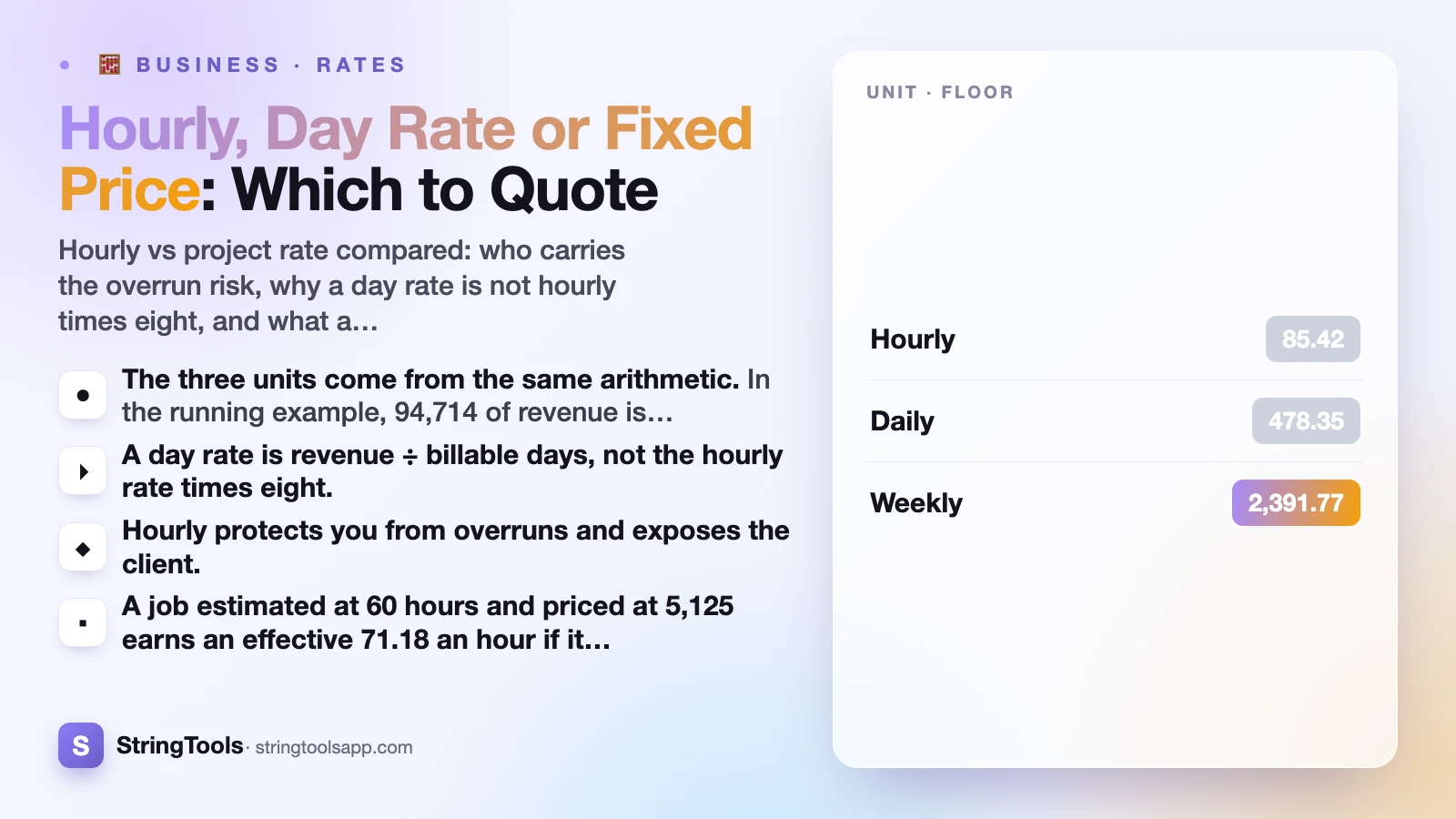
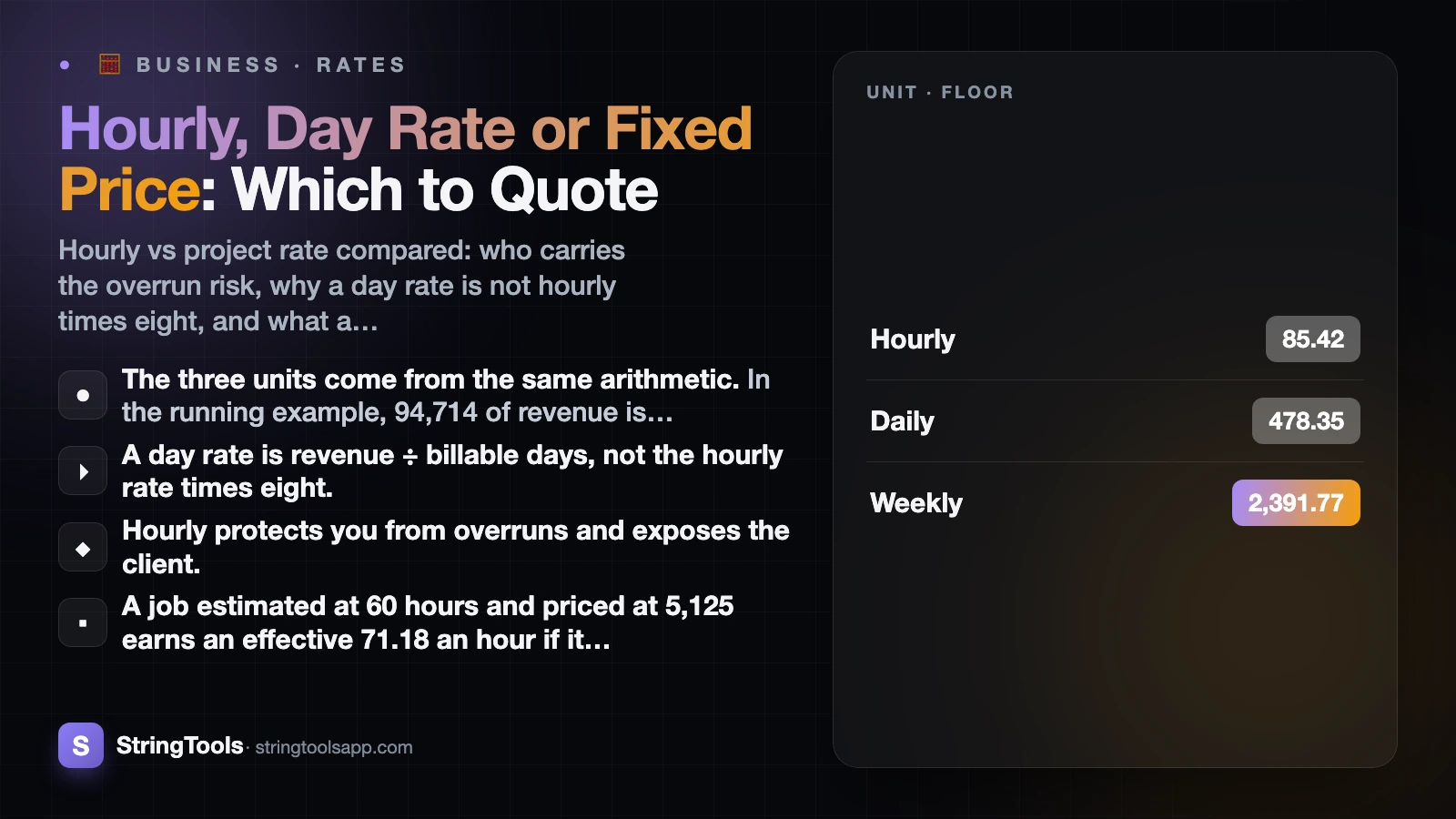
- The three units come from the same arithmetic. In the running example, 94,714 of revenue is spread over 1,108.8 billable hours or 198 billable days, giving 85.42 an hour and 478.35 a day.
- A day rate is revenue ÷ billable days, not the hourly rate times eight. Eight times 85.42 is 683.36, which double-counts unbillable time.
- Hourly protects you from overruns and exposes the client. Fixed price does the reverse. A day rate protects the calendar rather than the outcome.
- A job estimated at 60 hours and priced at 5,125 earns an effective 71.18 an hour if it takes 72 hours, and 56.95 if it takes 90.
- Fixed price only works with a written scope, a defined number of revisions and a named change process.
- Whatever you quote in, quote one unit and hold it. Switching mid-negotiation is how the unbillable time gets billed twice, or not at all.
This is general business information, not legal or accounting advice.
All Three Come From the Same Floor
Before comparing units, there has to be a floor. The freelance rate calculator produces one by working back from the income you want: take-home ÷ (1 − tax set-aside), plus overheads, divided by the time you can actually invoice.
The running example across this cluster: a 60,000 target take-home, an illustrative 30% set-aside, 9,000 of annual overheads, five eight-hour days a week, 62 non-working days priced in, and 70% of working hours reaching an invoice. That produces 94,714 of revenue to invoice, spread across 198 billable days or 1,108.8 billable hours.
| Unit | Working | Floor |
|---|---|---|
| Hourly | 94,714 ÷ 1,108.8 billable hours | 85.42 |
| Daily | 94,714 ÷ 198 billable days | 478.35 |
| Weekly | 94,714 ÷ 39.6 billable weeks | 2,391.77 |
Every figure is illustrative. What matters is that all three are the same year expressed differently, so a quote in any unit that lands below its row is a quote that misses the target — how to set your freelance rate goes through the funnel in full.
A Day Rate Is Not Eight Times the Hourly Rate
This is the most common pricing error in the cluster, and it runs in both directions.
The hourly floor is 85.42 and the day floor is 478.35. Multiply the hourly figure by eight and you get 683.36, which is 42.9% higher than the day rate. The two are not contradictory, because a working day contains eight hours but only 5.6 billable ones at 70% utilisation, and 85.42 × 5.6 = 478.35 exactly.
| Way of quoting a day | Working | Result | What it assumes |
|---|---|---|---|
| Hourly rate × 8 | 85.42 × 8 | 683.36 | Every hour of the day is billable and unbillable time is charged twice |
| Hourly rate × billable hours in a day | 85.42 × 5.6 | 478.35 | The client buys the day, you absorb the unbillable parts |
| Revenue ÷ billable days | 94,714 ÷ 198 | 478.35 | The same, derived directly |
The practical reading is that the hourly rate already contains the unbillable time — that is why it is 2.96 times the naive figure of 60,000 ÷ 2,080 hours. Multiplying it by a full eight-hour day adds that loading a second time.
If you do quote day rates, be explicit about what a day is. A day usually means the client has your attention and you take no other work, which is different from eight metered hours. Billable hours and utilisation explains why the distinction moves the numbers as much as it does.
The Same Project, Quoted Three Ways
Take a piece of work you genuinely believe is 60 hours. On the floor above, the three quotes are:
- Hourly: 60 hours at 85.42, billed as worked, so 5,125.23 if the estimate is right.
- Day rate: 60 billable hours is 10.71 billable days at 5.6 each, so 5,125.23 at 478.35 a day.
- Fixed price: 5,125.23 agreed in advance, whatever it takes.
They are identical when the estimate is correct. They stop being identical the moment it is not.
| What actually happens | Hourly bills | Fixed price bills | Effective hourly on fixed price |
|---|---|---|---|
| 54 hours, ten per cent under | 4,612.71 | 5,125.23 | 94.91 |
| 60 hours, as estimated | 5,125.23 | 5,125.23 | 85.42 |
| 72 hours, twenty per cent over | 6,150.28 | 5,125.23 | 71.18 |
| 90 hours, fifty per cent over | 7,687.85 | 5,125.23 | 56.95 |
A fifty per cent overrun turns an 85.42 rate into 56.95, which is below the floor by a third. The year does not survive many of those.
The mirror image is the row above the middle. If you finish early on a fixed price you keep the difference, which is the legitimate reward for carrying the risk, and the reason experienced freelancers with a repeatable process often prefer fixed pricing. The reward only exists if the estimates are usually right.
Who Carries What
| Hourly | Day rate | Fixed price | |
|---|---|---|---|
| Overrun risk | Client | Shared, by the day | You |
| Upside if you are fast | Client keeps it | Client keeps it | You keep it |
| Scope creep | Bills automatically | Extends the booking | Eats the margin |
| Client's budget certainty | Poor | Moderate | Total |
| Admin burden | High — hours must be tracked and justified | Low | Lowest after signing |
| What you must be good at | Tracking honestly | Calendar discipline | Estimating and scoping |
| Worst failure mode | Client queries every line | Half-days and fragmented weeks | An unbounded revision loop |
Reading down the columns is more useful than reading across the rows. Hourly is an administration cost you pay in exchange for never losing on an estimate. Fixed price is an estimating skill you are paid for. Day rates are a calendar discipline — they only work if a booked day is genuinely reserved and half-days do not quietly become the norm.
Scope Creep Behaves Differently in Each Unit
Scope creep is not an unusual event, it is the normal condition of client work, and each unit handles it differently.
Under hourly billing it prices itself. The extra work appears on the invoice. The risk is relational rather than financial: a client who did not expect the total will query it, so the protection is a written estimate and a standing rule that you flag before you cross it, not after.
Under a day rate it extends the booking. This is the cleanest conversation of the three, because the unit is time and everyone can count days. It fails when extra work is squeezed into the days already booked.
Under a fixed price it comes straight out of your margin, which is why the fixed-price contract is where the definitions have to live:
- What is included, written as deliverables rather than intentions.
- How many rounds of revision, with a stated rate for further ones.
- What counts as a change of scope, and that changes are quoted before they start.
- What the client must supply and by when, because waiting is your cost in a fixed-price job.
- A payment schedule, so a long job does not finance itself out of your cash.
That last point is where pricing meets cash flow. A correctly priced project paid ninety days late still causes a bad quarter — see invoice payment terms explained for the terms themselves, and the invoice generator if you want a clean document to send. General guidance on managing small-business finances is available from the SBA business guide and, for the UK, GOV.UK's working-for-yourself pages.
When Each One Actually Fits
Quote hourly when the work cannot be specified. Ongoing support, debugging, advisory work, anything where the client's own decisions determine the size of the job. Also quote hourly for a first engagement with a client you do not know yet, because you are estimating their process as well as the work.
Quote a day rate when the client is buying your presence. On-site work, workshops, embedded work inside a team, anything with a shape set by the calendar rather than a deliverable. Day rates suit clients who need to book capacity, and they make a diary easy to manage.
Quote a fixed price when you have done this before. A defined deliverable, a process you have repeated, a client who can specify what they want, and enough history for your estimate to be more than a hope. Fixed price also suits clients with procurement rules that need a number, and it is the unit that decouples your income from hours, which is where growth eventually comes from.
Quote a retainer when the value is availability. A monthly fee for a capped amount of work smooths income and removes the repeated selling, which lifts utilisation. Cap it in writing or it becomes unlimited access at a fixed price.
The pattern over a career tends to run hourly, then day rate, then fixed price, then value-based, as estimating improves and as the work becomes repeatable. There is no obligation to move along it, and moving too early is expensive.
Quoting Fixed Price Without Losing on It
If you take the fixed-price route, four habits do most of the work.
Estimate in the same unit as your floor. Estimate the hours, price them at your hourly floor, then present a single number. Never estimate the price directly, because a round number is a wish rather than a calculation.
Add contingency openly to yourself, not to the client. If your estimate is 60 hours and your history says you run twenty per cent over, quote 72 hours of work — 6,150.28 — and treat the extra as the price of carrying the risk, not as padding. At 72 actual hours that quote still returns exactly 85.42 an hour.
Track hours on fixed-price work anyway. The invoice does not need them but your next estimate does. A freelancer who does not know their effective hourly on past fixed-price jobs is guessing with every quote.
Review effective rate per job, not per month. One job at 56.95 an hour hidden inside a busy month is invisible until the year is short. Comparing each finished job against the floor makes the pattern obvious while there is still time to change what you quote.
And keep a buffer. Fixed-price work concentrates risk into fewer, larger payments, so a slipped project or a slow payer hits harder — the emergency fund calculator measures that cushion in months of essential expenses, which is the right unit for lumpy income. When a client eventually tells you the number is too high, how to raise your rates covers what to say.
Frequently Asked Questions
Should I charge hourly or a fixed price?
It depends on who should carry the risk of the estimate being wrong. Hourly puts that risk on the client and suits work that cannot be specified in advance. Fixed price puts it on you and suits repeatable work with a written scope. On a 60-hour job priced at 5,125.23, a fifty per cent overrun drops your effective rate from 85.42 to 56.95 an hour.
How do I work out my day rate from my hourly rate?
Divide the revenue you need by your billable days, not by hours. In the worked example, 94,714 over 198 billable days gives 478.35. That equals the hourly rate times the billable hours in a day, 85.42 × 5.6, because only 5.6 of the eight hours are billable. Multiplying the hourly rate by a full eight hours gives 683.36 and charges for unbillable time twice.
Is a day rate better than an hourly rate?
A day rate is simpler to administer and suits work where the client books your attention rather than metered hours, such as on-site work or workshops. An hourly rate suits work billed as it is used. The risk with day rates is fragmentation: half-days and interrupted days that are paid as fractions but consume the whole day.
How much contingency should I add to a fixed price?
Enough to cover your own history of overrunning, decided from tracked hours rather than instinct. If your estimates typically run twenty per cent over, quote the higher hour count. An estimate of 60 hours at 85.42 is 5,125.23; quoting 72 hours gives 6,150.28, which still returns exactly 85.42 an hour if the job does take 72 hours.
How do I stop scope creep eating a fixed-price project?
Define the deliverables rather than the intentions, state how many rounds of revision are included and the rate for further rounds, name what counts as a change and require changes to be quoted before work starts, and list what the client must supply and by when. Under hourly billing scope creep bills itself; under a fixed price it comes out of your margin.
Can I switch a client from hourly to a fixed price?
Yes, and the natural moment is at the start of a new phase of work rather than partway through one. The prerequisite is enough history with that client to estimate well, because switching moves the overrun risk from them to you. Price the fixed quote from tracked hours on the work you have already done for them.
Sources and references
SBA business guide (sba.gov) · GOV.UK's working-for-yourself pages (gov.uk). Content was reviewed against these sources as of the last-updated date above; external figures and rules may change after publication.