
The Equivalent Rate Is Not the Salary Divided by 2,080
A freelance rate equivalent to a salary has to fund everything the salary quietly came with: paid leave, public holidays, sick pay, pension contributions, equipment, training and a notice period. Once those are priced back in, the freelance rate that merely matches a salary works out at roughly double the salary's own hourly figure — and that is the break-even point, not a win.
Key Takeaways
- Comparing a salary to a freelance rate is not a units problem. Converting gross pay between hourly, monthly and annual is a separate job, and the salary calculator already does it.
- The real comparison is about what an employer funds on your behalf and a freelancer funds out of the same rate.
- Seven things transfer to you: paid leave, public holidays, sick pay, pension or retirement contributions, equipment and software, training, and paid notice.
- In the worked example, self-funding 62 non-working days a year raises the required hourly floor by 23.8% on its own.
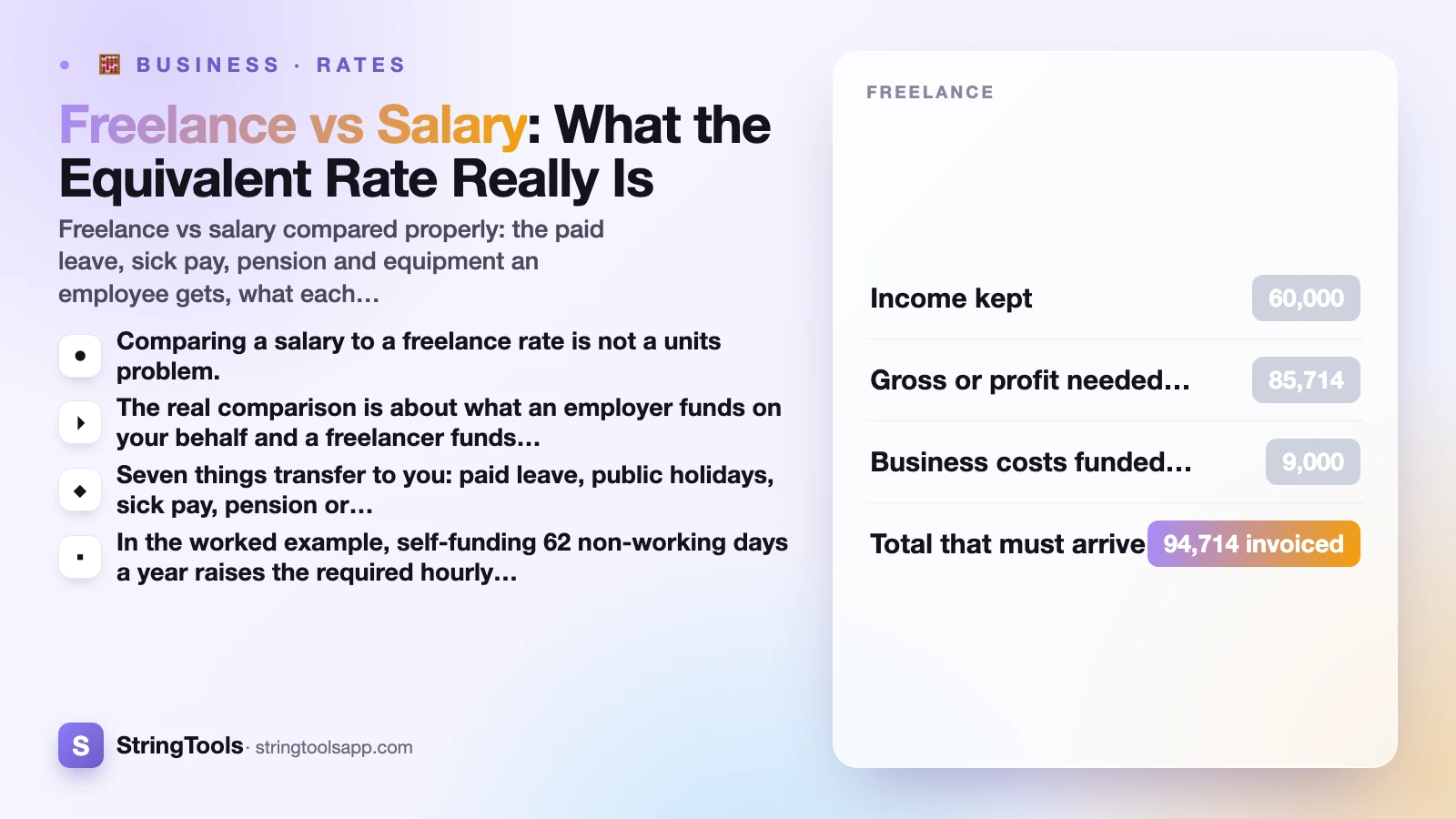
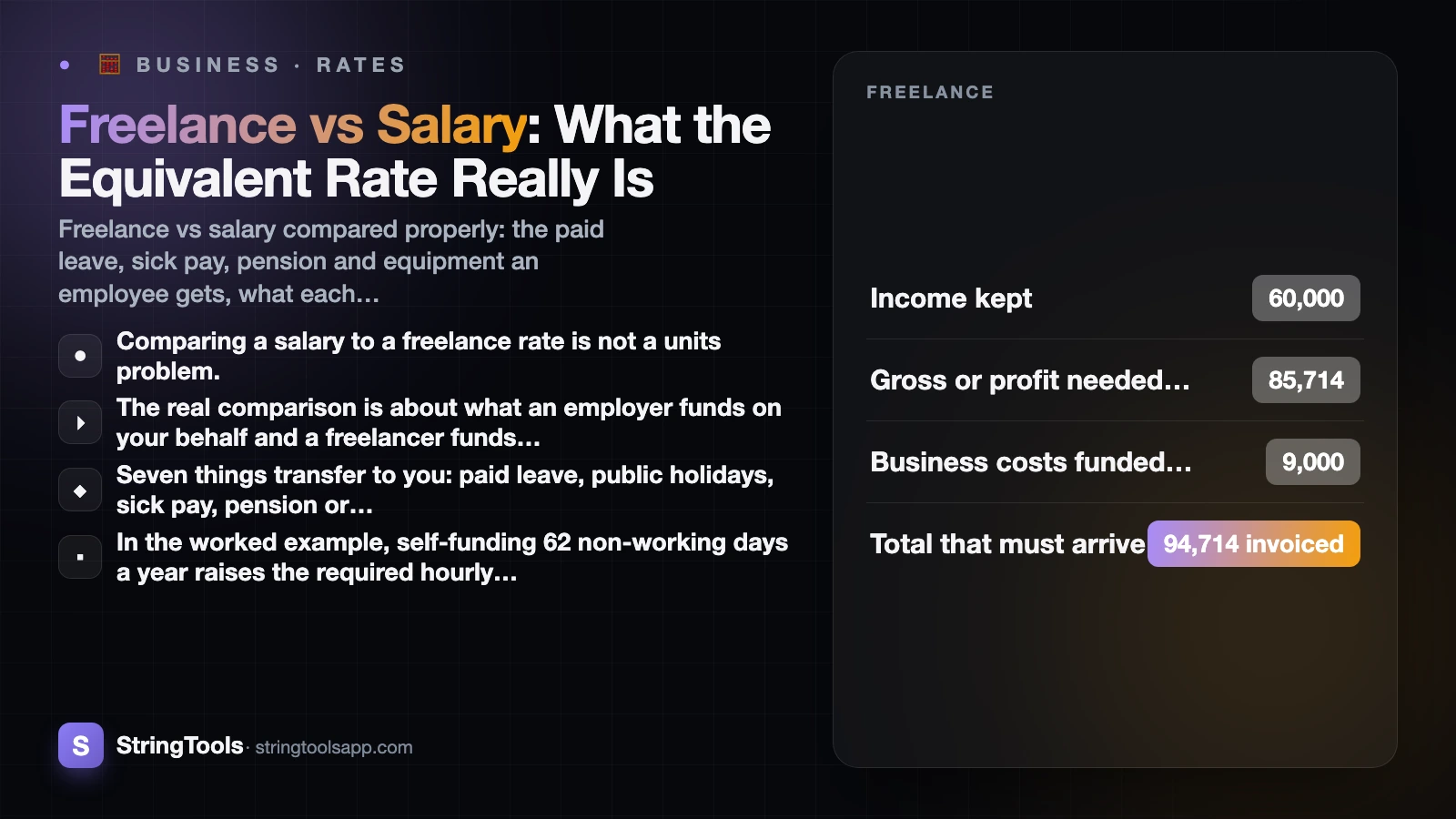
- A salaried worker facing the same illustrative 30% deduction would need 85,714 gross to keep 60,000. A freelancer needs to invoice 94,714, and has fewer hours in which to do it.
- Some of the comparison cannot be priced at all, in either direction. Name those parts rather than pretending a number covers them.
This is general business information, not tax, legal or accounting advice.
Two Different Questions, Often Confused
There are two questions people ask when they say "what salary is my freelance rate worth", and they have different answers.
The first is arithmetic about pay frequency: if I earn X an hour, what is that a year, and what reaches my bank after deductions. That is a conversion, it depends on your country's payroll rules, and it is what the salary calculator is for. Nothing on this page replaces it.
The second question is the one worth the effort: a salary is a package, a freelance rate is a single number, so what would the rate have to be for the two to leave you in the same place. That is not a conversion. It is a list of things that move from the employer's budget to yours, and an adjustment to the hours over which you can recover them.
The second question is what the freelance rate calculator and the rest of this post are about.
What an Employer Funds That You Would Not See on a Payslip
None of these can be given a universal monetary value. What the employer contributes varies by country, by employer and by contract, so putting a percentage on any line would be inventing a figure. What can be stated is where each one reappears in a freelance rate.
| What the job provides | What it becomes when you freelance | Where it lands in the rate |
|---|---|---|
| Paid annual leave | Every day off is a day not invoiced | Fewer billable days |
| Public holidays | Closed offices and quiet clients still cost billable days | Fewer billable days |
| Sick pay | Illness stops the invoice as well as the work | Fewer billable days |
| Pension or retirement contributions | Funded entirely from your own income | Inside your target take-home |
| Laptop, software, desk, phone | Bought and replaced by you | An overhead line |
| Employer-side payroll contributions | Typically fall on you as a self-employed contributor | Part of your set-aside |
| Training and conference budget | Both the fee and the unbilled days are yours | Overheads plus fewer billable days |
| Paid notice and a steady pipeline | Gaps between contracts are unpaid | Not in the rate at all, which is the problem |
The last row is the one that catches people. Leave, kit and contributions can all be priced. A three-week gap between contracts cannot be priced into an hourly rate, because you do not know in advance how many of them there will be. That risk is carried by a cash buffer instead, which is why an emergency fund calculator that thinks in months of runway is more useful to a freelancer than a savings total.
The Same Take-Home, Both Ways
Take the worked example used across this cluster. You want to keep 60,000 a year. You work five days a week, eight hours a day. You price in 25 days of leave, 8 public holidays, 5 sick days and 24 days of admin. You bill 70% of the hours in a working day. Overheads are 9,000 a year, and you reserve 30% for tax and contributions. Every figure here is illustrative, chosen to keep the arithmetic clean.
| Employed | Freelance | |
|---|---|---|
| Income kept | 60,000 | 60,000 |
| Gross or profit needed before deductions | 85,714 | 85,714 |
| Business costs funded from it | none — employer provides | 9,000 |
| Total that must arrive | 85,714 salary | 94,714 invoiced |
| Days not worked, still paid | 38 paid by employer | 62 funded by you |
| Hours available to earn it | fixed by contract | 1,108.8 billable |
| Rate needed | — | 85.42 an hour, 478.35 a day |
Both columns end with 60,000 in your pocket, and the freelance column still understates the gap. The employed column assumes the employer's contributions match your 30% set-aside exactly, which is a simplification, and it gives no value at all to the pension contributions, the equipment or the paid notice period that sit outside the salary line.
Read across the bottom row and the practical conclusion is plain. A salary of 85,714 and a freelance rate of 85.42 an hour are not a generous comparison for the freelancer. They are roughly the break-even point, before any allowance for gaps between contracts.
What the Non-Working Days Alone Are Worth
Of everything on the list, the self-funded days are the easiest to quantify, and they are larger than most people expect. Holding the rest of the example constant and changing only what you price in:
| What you price in | Billable days | Hourly floor | Difference |
|---|---|---|---|
| All 62 days, as in the example | 198 | 85.42 | — |
| Leave left out | 223 | 75.84 | −11.2% |
| Admin and pitching left out | 222 | 76.19 | −10.8% |
| Public holidays left out | 206 | 82.10 | −3.9% |
| Illness left out | 203 | 83.32 | −2.5% |
| Everything left out | 260 | 65.05 | −23.8% |
A freelancer charging 65.05 an hour and expecting 60,000 of take-home is, in effect, assuming they will work every single weekday, never be ill, never pitch for work and never do their own books. A salaried colleague on the same money is not making that assumption, because their employer is not asking them to.
The statutory minimum for paid leave differs by country — GOV.UK sets out the UK entitlement, and other jurisdictions differ widely — but whatever the local floor is, an employee receives it and a freelancer prices it.
The Salary Ladder in Freelance Terms
Working the same illustrative assumptions across a range of targets gives a rough translation table. Read it as "to end up where this salary leaves you, this is the floor you need", not as a market rate for anyone's work.
| Income you keep | Salaried gross needed at the same 30% deduction | Freelance revenue to invoice | Hourly floor | Day rate |
|---|---|---|---|---|
| 30,000 | 42,857 | 51,857 | 46.77 | 261.90 |
| 40,000 | 57,143 | 66,143 | 59.65 | 334.05 |
| 50,000 | 71,429 | 80,429 | 72.54 | 406.20 |
| 60,000 | 85,714 | 94,714 | 85.42 | 478.35 |
| 75,000 | 107,143 | 116,143 | 104.75 | 586.58 |
| 100,000 | 142,857 | 151,857 | 136.96 | 766.96 |
The gap between the second and third columns is the 9,000 of overheads, unchanged all the way down, which is why fixed business costs weigh most heavily on the smallest targets. At a 30,000 target they are 17.4% of everything you invoice; at 100,000 they are 5.9%.
Nothing in this table tells you what anyone will pay. It tells you what to stop agreeing to.
The Parts That Do Not Fit in a Table
An honest comparison has to include the things neither side can price, because they decide as many careers as the arithmetic does.
What the salary buys that a rate cannot. Predictability, first of all: the money arrives on the same day whether the month was busy or dead. Then paid notice, employment protections that vary by country, a pipeline someone else worries about, colleagues, and the fact that when you are ill you are simply ill rather than ill and losing money.
What the rate buys that a salary cannot. Control over what you take on and what you refuse. Multiple clients, which means losing one is a bad quarter rather than unemployment. Legitimate business expenses handled through the business, though the rules for that are strictly national — the IRS guidance for the self-employed and GOV.UK's working-for-yourself pages are the right starting points rather than a forum. And an income ceiling set by your rate and capacity rather than a band.
What is genuinely worse and rarely admitted. Unpaid selling time. Late payers. Administration that no one else will do. The tax bill that arrives in one lump if you did not set the money aside as you went.
None of that belongs in a rate calculation. All of it belongs in the decision.
How to Run the Comparison on a Real Offer
If you have a concrete salary offer on one side and freelance work on the other, this is the order that keeps it honest.
Start from take-home, on both sides. Not gross against rate. Work out what the salary actually leaves you using the salary calculator, then use that figure as the target take-home in the freelance rate calculator. Now both sides are measured in the same unit.
Add the employer's non-salary contributions to the employed side. Pension contributions, equipment, training budget, anything with a number attached. Do not guess at the ones without numbers; list them instead.
Be realistic about the freelance side's hours. The single biggest error is assuming full-year, full-utilisation work. Use last year's actual billed hours if you have them, and see billable hours and utilisation for how quickly that assumption bends the answer.
Price the gaps separately, in months of buffer. A freelance year with two quiet months is not a rate problem, it is a cash-flow problem, and it is solved with savings rather than pricing. Late payment is the same category — clear terms help, and invoice payment terms explained covers what to put on the document.
Then compare, and accept that the answer may be close. Often the rate that matches a salary is achievable and the question becomes which set of trade-offs you prefer. That is a legitimate place to land. What is not legitimate is discovering in March that the rate never covered the year.
Frequently Asked Questions
What freelance rate is equivalent to a salary?
Work back from take-home rather than gross. In the illustrative example, keeping 60,000 requires 85,714 of profit before a 30% set-aside, plus 9,000 of overheads, so 94,714 must be invoiced across 1,108.8 billable hours — a floor of 85.42 an hour or 478.35 a day. A salary of 85,714 and that rate are roughly break-even, before any allowance for gaps between contracts.
Why do freelancers charge so much more per hour than employees earn?
Because the rate is funding a package, not a wage. It has to cover the tax set-aside, business overheads, paid leave, public holidays, sick days, pension contributions, equipment, training, and the working hours that never reach an invoice. In the worked example those together make the required rate 2.96 times the naive figure of target income divided by 2,080 hours.
How do I convert my hourly rate into an annual salary?
That is a pay-frequency conversion rather than a freelance question, and it depends on your country's payroll deductions. Use the salary calculator at /salary-calculator for it. Converting the other way — from a salary you want to the rate you must charge — is a different calculation, because it has to add overheads and remove non-billable time.
What benefits do employees get that freelancers have to pay for themselves?
Paid annual leave, public holidays, sick pay, employer pension or retirement contributions, equipment and software, a workspace, training and conference budgets, employer-side payroll contributions, and paid notice or redundancy. The first three become fewer billable days, the middle ones become overheads or part of your target income, and paid notice cannot be priced into a rate at all — it is why a cash buffer matters.
How many days a year should a freelancer price as non-working?
The example uses 62: 25 days of leave, 8 public holidays, 5 sick days and 24 days of admin, pitching and bookkeeping. That leaves 198 billable days out of 260. Leaving all 62 out of the calculation drops the apparent hourly requirement from 85.42 to 65.05, which is a 23.8% shortfall against the same take-home target.
Is freelancing better paid than employment?
It can be, but not automatically, and the comparison is not the headline rate. Freelancing pays more only when the rate clears the floor set by your costs and non-billable time, and when you win enough work to fill the year. The parts that decide it most often are utilisation and the length of the gaps between contracts, neither of which appears on a rate card.
Sources and references
GOV.UK sets out the UK entitlement (gov.uk) · the IRS guidance for the self-employed (irs.gov) · GOV.UK's working-for-yourself pages (gov.uk). Content was reviewed against these sources as of the last-updated date above; external figures and rules may change after publication.