
What Invoice Payment Terms Actually Mean
Invoice payment terms are the conditions that set when and how a customer must pay you. "Net 30" means the full amount is due 30 days after the invoice date. Terms also cover deposits, early-payment discounts, accepted payment methods, and what happens if the money arrives late.
The shorthand comes from trade credit: a supplier lending a customer time. Writing "Net 30" hands over 30 days of free credit, a commercial decision with a price attached that nobody prints on the invoice.
Key Takeaways
- "Net" means the full amount with nothing deducted, and the number after it is the number of days until it falls due.
- Always state the due date as a calendar date, not just "Net 30". It removes every argument about which day the clock started.
- "2/10 net 30" is an early-payment discount: take 2% off if you pay within 10 days, otherwise pay in full by day 30.
- That 2% is not a 2% cost to the supplier. It works out at roughly 37% a year on simple terms, because you are only buying 20 days.
- Shorter terms suit small suppliers. Net 14 is a normal ask; Net 60 is a loan you did not agree to make.
- Late-payment interest rules differ by country and change over time, so check the relevant authority rather than copying a clause off the internet.
The Net Terms Family: Net 7 to Net 90
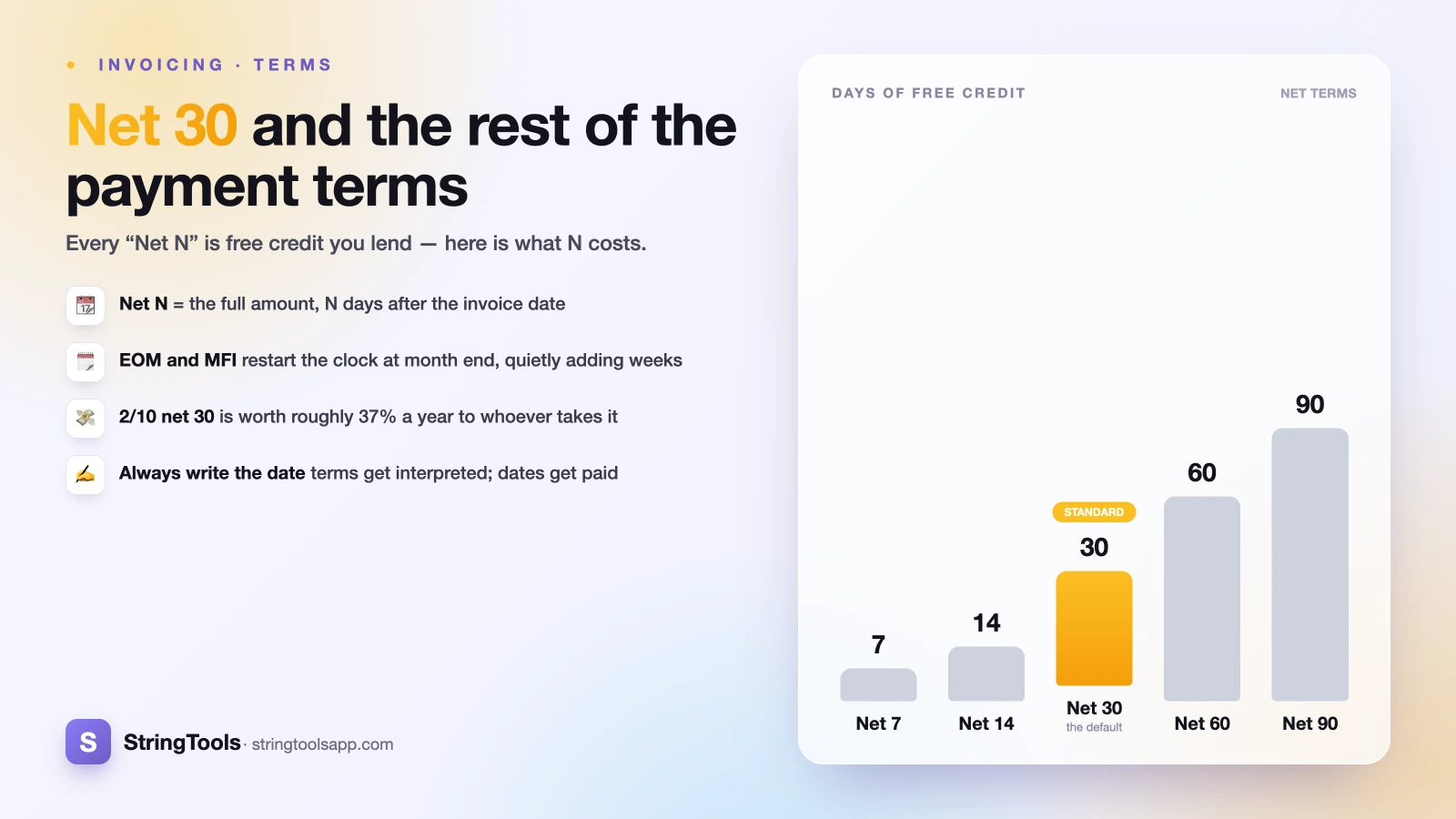
Every "Net N" term works the same way: the full invoice value, with no deduction, falls due N days after the invoice date. Only N changes, and N is negotiable far more often than people assume.
Net 30 became the default because it suited monthly accounting cycles in an era of posted cheques, and has survived out of habit. Plenty of small suppliers moved to Net 14 without losing a client.
| Term | What it means | When payment is due | Typical use |
|---|---|---|---|
| Due on receipt | Payable as soon as the invoice arrives | Immediately, in practice within 1-3 days | New clients, one-off jobs, small amounts |
| CIA / PIA | Cash in advance / payment in advance | Before work starts or goods ship | First orders, custom work, high-risk accounts |
| COD | Cash on delivery | At the point of handover | Trades, deliveries, perishable goods |
| Net 7 | Full amount seven days after the invoice date | Day 7 | Freelancers, short jobs, sole traders |
| Net 14 / Net 15 | Full amount 14 or 15 days after the invoice date | Day 14 or 15 | Consultants and agencies; the common compromise |
| Net 30 | Full amount thirty days after the invoice date | Day 30 | The default across most B2B trade |
| Net 45 | Full amount forty-five days after the invoice date | Day 45 | Negotiated supply to larger firms |
| Net 60 | Full amount sixty days after the invoice date | Day 60 | Large retailers, manufacturers, some public bodies |
| Net 90 | Full amount ninety days after the invoice date | Day 90 | Rare, and usually imposed rather than agreed |
| Net 30 EOM | Thirty days from the end of the invoice month | End of the following month | Monthly billing cycles |
| 15 MFI | The 15th of the month following the invoice | Day 15 of next month | Bookkeeping-friendly monthly runs |
| 2/10 net 30 | 2% off if paid within 10 days, else full at 30 | Day 10 discounted, day 30 in full | Suppliers buying back their own cash |
The long end of that table is not a neutral convenience. A supplier on Net 60 finances their customer's working capital for two months while paying their own staff on far shorter terms, so it is reasonable to price it in or ask for a deposit against it.
Due on Receipt, EOM and the Rest of the Shorthand
The Net family is the easy part. The abbreviations around it cause most of the disputes, because two people read the same three letters differently.
Due on receipt
Payable when the invoice arrives. In practice it collides with how companies pay: most run a payment batch weekly or fortnightly, so the invoice simply joins the next run. It works with consumers and small clients, and means little to a large accounts payable department.
EOM (end of month)
EOM shifts the starting line. Under "Net 30 EOM", the 30 days run from the last day of the month the invoice was issued in, not from the invoice date. An invoice dated 3 September is not due on 3 October; it is due around 30 October. Invoice early in the month under EOM terms and you have quietly granted close to 60 days.
MFI (month following invoice)
"15 MFI" means payment on the 15th of the month after the invoice date. It suits clients with one payment day a month, and carries the same catch as EOM: an invoice issued on the 16th waits almost a full extra month.
Which date starts the clock
This is the most common source of a fortnight's delay. "Net 30" can plausibly run from the invoice date, the date the customer received it, the delivery date, or the date it was approved internally, and those sit a week or more apart. Write it out: Net 30 from the invoice date. Payment due 26 September 2026. A named date cannot be re-interpreted. The invoice generator works that date out from the terms you pick, and how to write an invoice covers where the terms line sits and what belongs beside it.
How to Read 2/10 Net 30 (and What It Really Costs)
An early-payment discount is written as three numbers: discount / days to qualify, then the normal term. "2/10 net 30" reads as: take 2% off if you pay within 10 days; otherwise the full amount is due on day 30.
On a 1,000 invoice, that means paying 980 by day 10 or 1,000 by day 30. What almost nobody works out is what those options are worth as an interest rate, and that is where the decision sits.
The arithmetic
You are not giving away 2%. You are giving away 20 on the 980 you actually collect, to get paid 20 days sooner. That is 20 / 980 = 2.04% for 20 days, and there are 18.25 twenty-day periods in a year:
(discount / (1 - discount)) x (365 / (net days - discount days))
(0.02 / 0.98) x (365 / 20) = 2.04% x 18.25 = 37.2% a year
Compound rather than multiply, and (1 / 0.98)^18.25 - 1 gives about 44.6%. Either way, 2/10 net 30 is expensive money: the annualised cost of a very short, very frequent loan.
| Term | Days bought | Cost per period | Simple annualised | Compounded |
|---|---|---|---|---|
| 1/10 net 30 | 20 | 1.01% | 18.4% | 20.1% |
| 1.5/10 net 30 | 20 | 1.52% | 27.8% | 31.8% |
| 2/10 net 30 | 20 | 2.04% | 37.2% | 44.6% |
| 3/10 net 30 | 20 | 3.09% | 56.4% | 74.3% |
| 2/10 net 45 | 35 | 2.04% | 21.3% | 23.5% |
| 2/10 net 60 | 50 | 2.04% | 14.9% | 15.9% |
| 1/15 net 60 | 45 | 1.01% | 8.2% | 8.5% |
The same 2% gets cheaper the longer the gap you are buying, and shrinking the discount moves the number just as hard.
What to do with that number
As the buyer, compare the annualised figure with what your own money costs. If your credit line sits well below 37%, the discount is one of the better short-term returns available. The discipline is the hard part: it is worth nothing if approvals cannot clear an invoice inside 10 days.
As the supplier, treat it as a borrowing rate you have chosen to pay. It can be the right call when the alternative is factoring or an overdraft, and a poor one when offered out of habit to customers who would have paid on day 25 anyway. There is an admin cost too: someone has to check that payment landed inside the window, and chase those who take the 2% on day 19. A smaller discount over a longer window, such as 1/15 net 60, rewards early payers at a fraction of the cost.
Choosing Terms as a Freelancer or Small Business
Terms are not a formality you copy from the last invoice. They set how long you fund somebody else's business.
- Start shorter than feels polite. Net 14 is normal for professional services, and clients who object will tell you their standard terms.
- Match terms to your own outgoings. If your bills fall due on day 30 and your invoices land on day 45, you are carrying a permanent 15-day hole. Work out the gap before agreeing to anything.
- Price long terms in. Net 60 is a commercial position, not a rule of nature. Accept it if you want the work, but the rate should reflect two months of financing, or include a deposit.
- Terms belong in the contract, not just the invoice. A term printed for the first time after the work is done is a weak position, and where a signed agreement says otherwise, it usually wins.
- Ask about the payment run at onboarding. Who approves invoices, which day payments go out, whether a purchase order number is required. Missing a weekly cut-off costs seven days whatever your terms say.
Public bodies and large corporates often publish standard supplier terms and will not move on them, so read those before quoting. Guidance from the US Small Business Administration and its equivalents elsewhere beats a template from a forum.
Deposits, Milestones and Staged Payments
For project work, the structure of the payments matters more than the length of the credit period.
Deposits
A deposit taken before work starts covers your early costs, filters out clients who were never going to pay, and commits both sides. Something in the range of 25% to 50% is common for custom work, though that is negotiation and industry norm rather than any rule.
Milestones
Tie milestones to deliverables, not dates. "On delivery of the first draft" is verifiable; "at the end of month two" invites an argument about whether month two produced anything. Each milestone should be its own invoice with its own due date.
Do not back-load the money
The common structural mistake is leaving a large final payment until after handover, when you have no leverage left. Arrange the stages so the final tranche is the smallest.
Retainers
Retainers are billed in advance for the coming period, which reverses the credit direction entirely. They suit ongoing work with predictable scope.
One tax note: in VAT and GST countries, taking a deposit can create a tax point before the work is finished, changing when the tax is due rather than whether it is owed. The rules differ by country and by what the deposit is for, so check with your national tax authority or accountant.
Late Payment: Interest, Fees and What the Law Provides
When an invoice passes its due date, two separate sources can give you a right to charge interest: your contract, and statute.
Your contract. If your terms include a late-payment clause with a stated rate and trigger, that clause governs. It must have been agreed before the work, which is why terms belong in the engagement letter.
Statute. Many jurisdictions give commercial suppliers a right to claim interest on late payment even without a contract clause, and some also allow a fixed sum towards debt recovery costs.
- United Kingdom. Businesses have a statutory right to claim interest and reasonable debt recovery costs on late commercial payments. The rate is set by reference to the Bank of England base rate plus a fixed margin, so it moves whenever the base rate moves. Current figures and the conditions that apply are published on GOV.UK.
- European Union. The EU's late payment framework sets default payment periods and a statutory interest entitlement for commercial transactions, implemented through each member state's national law, where the operative detail sits. Start at the European Commission's single market pages.
- United States. There is no single federal rule for private business-to-business invoices. What you can charge is generally a matter of contract and state law, some of which caps interest on commercial debts. Federal agencies paying suppliers fall under separate prompt-payment rules.
- Elsewhere. Most developed economies have something comparable. Find your national business or trade authority rather than reasoning by analogy from abroad.
Interest normally runs from the day after the due date until the invoice is paid, so a clear due date again does the heavy lifting. Being entitled to charge it and actually charging it are different decisions, and many suppliers keep the entitlement in reserve as negotiating room. A clause is a lever, not a collections process; the sequencing of reminders and escalation is what moves money, which is the subject of how to get clients to pay on time.
None of this is legal advice. Rules change and vary by jurisdiction and customer type, so confirm your position with the relevant authority or a qualified adviser.
Writing Terms That Actually Get Paid
Most late payments are not refusals. They are invoices that could not be processed, sat in the wrong inbox, or lacked a reference number. Terms only work when the invoice around them is easy to pay. Before you send, check that it carries:
- A due date as a calendar date, with the term beside it: Net 14, due 26 September 2026.
- Which date the clock runs from, stated once and unambiguously.
- A unique invoice number, plus the customer's purchase order reference where they use one. A missing PO number is the most reliable way to get quietly rejected.
- Payment methods and full bank details, including whatever your client's country needs to make the transfer.
- A named contact for queries, so accounts payable does not have to hunt.
Then handle the two failure points no invoice design can fix. Send it the same day you date it, because a Net 30 invoice emailed a week late has burned a quarter of its term. And send it to the address that pays, not the person who hired you, unless they are the same.
Finally, diary a terms review once a year; it takes ten minutes, and terms set when you had two clients and no fixed costs are rarely right three years later. Cash flow trouble in small businesses is more often a timing problem than a profit problem, and timing is what payment terms control.
Frequently Asked Questions
What does Net 30 mean on an invoice?
Net 30 means the full invoice amount, with nothing deducted, is due 30 days after the invoice date. "Net" refers to the net total rather than any discounted figure. It is the most common term in business-to-business trade, though nothing obliges you to offer it. Net 14 and Net 15 are increasingly used by freelancers and small suppliers who cannot afford to finance a month of someone else's costs.
Is Net 30 counted from the invoice date or the delivery date?
By default it is counted from the invoice date, but this is genuinely ambiguous unless you say so. Customers may count from when they received the invoice, when goods were delivered, or when the invoice was approved internally, and those can be a week or more apart. Remove the ambiguity by writing both the basis and the resulting date on the invoice: Net 30 from the invoice date, payment due 26 September 2026.
What does 2/10 net 30 mean, and should I take the discount?
It means you can deduct 2% if you pay within 10 days; otherwise the full amount is due on day 30. As a buyer, the discount is worth about 37% a year on simple terms, because you are giving up 2.04% of what you actually pay to move 20 days earlier. If your own borrowing costs less than that, taking the discount is a good use of cash, provided your approvals process can genuinely clear the invoice inside 10 days.
What does EOM mean on an invoice?
EOM means end of month, and it changes where the countdown starts. Under Net 30 EOM, the 30 days run from the last day of the month the invoice was issued in, not from the invoice date. An invoice dated 3 September is therefore due at the end of October rather than on 3 October. Invoicing early in the month under EOM terms grants close to 60 days without anyone intending it.
Can I charge interest on a late invoice?
Often yes, either because your contract includes an agreed late-payment clause or because statute gives you the right. In the UK there is a statutory right for businesses to claim interest and reasonable debt recovery costs on late commercial payments, at a rate tied to the Bank of England base rate plus a fixed margin, with the current figures published on GOV.UK. The EU has a late payment framework implemented through national law. In the US it is largely a matter of contract and state law. Check the relevant authority for your country rather than copying a clause, and take advice before relying on it.
What payment terms should a freelancer use?
Net 14 is a sensible default for most freelance work, with a deposit for anything large or from a new client. Shorter terms are rarely refused and materially reduce the amount of your own money tied up in someone else's business. Set the terms in the contract before work starts, state the due date as a calendar date on every invoice, and ask new clients at onboarding which day their payment run goes out.
Sources and references
US Small Business Administration (sba.gov) · GOV.UK (gov.uk) · European Commission's single market pages (single-market-economy.ec.europa.eu). Content was reviewed against these sources as of the last-updated date above; external figures and rules may change after publication.