
Why invoices get paid late, and what actually changes it
Clients pay on time when paying is easy and the terms were agreed in writing before work started. Take a deposit, invoice the day you finish, include a payment link and the client's purchase order number, and follow a fixed reminder schedule instead of waiting and hoping.
Key Takeaways
- Most late payment is friction and process, not bad faith.
- Terms agreed after the work is done are not terms. Put them in writing before the first hour.
- A deposit filters out the clients who were never going to pay, at the cheapest moment.
- Invoice the day you deliver. Waiting for month end can add weeks to when the money lands.
- Use a fixed escalation ladder so chasing is routine, not an emotional decision at 11pm.
- Late-payment interest and formal recovery routes differ by country. Check your own authority.
It helps to know what sits behind the silence. In a small business your invoice competes with the owner's inbox. In a larger one it enters an accounts payable process with its own rules: invoices are batched, run once or twice a month, and anything that fails validation is quietly set aside. A missing purchase order number, a name that doesn't match the contract, a bank detail typo — none produce a phone call. They produce a delay you never hear about.
Process problems have process fixes. The habits below are ordered by how much they move the needle.
Agree the terms in writing before you start
The biggest predictor of getting paid on time is whether both sides agreed, in writing and in advance, what "on time" means. It need not be a twenty-page contract: an email the client answers with "yes, confirmed" is a written agreement, and far better than an assumption.
Cover these, briefly:
- Scope: what is delivered, and what counts as a revision versus new work.
- Price and currency: the total, or the rate and an estimate of hours.
- Payment terms: net 7, net 14, net 30 — days from invoice date to due date. Larger companies often impose their own, so ask before you quote.
- Deposit: how much, and that work begins once it clears.
- Invoicing schedule: on delivery, monthly, or at named milestones.
- What happens if payment is late: any interest or fee provision, and that work pauses.
- Who to invoice: the exact legal entity name, the billing email, and whether a purchase order is required. If their system needs a PO and your invoice arrives without one, it will not be paid, and often nobody will tell you why.
Decide your default terms once and apply them consistently. Net 30 is a convention from the era of posted cheques; net 14 is entirely defensible for small engagements. Our guide to invoice payment terms explained covers what each term commits you to.
Take a deposit
A deposit covers your downside if the project dies, gives the client a stake in the work, and tells you early whether their payment process works at all — while you have risked a conversation rather than six weeks of unpaid work.
New freelancers worry that asking will lose the job. Deposits are standard practice in trades, design, construction and consulting, and clients who mean to pay rarely blink. The ones who push back hard on a modest deposit are usually the ones you would be chasing in month three anyway.
Common structures, none of them rules — pick what fits the risk:
| Engagement | Typical up-front portion | Balance |
|---|---|---|
| Small one-off job | 50% | On delivery, net 7-14 |
| Project of a few weeks | 30-40% | Milestones, final on delivery |
| Multi-month build | 25-33% | Monthly progress invoices |
| Ongoing retainer | First month in advance | Monthly in advance |
| Brand-new client | 50%, or full payment up front on small jobs | — |
Say plainly that the schedule starts when the deposit clears, not when it is promised, or you will end up working while the money is still "with finance". And invoice the deposit properly: a request buried in an email is easy to lose, while a numbered invoice enters their system and gets processed like any other.
Invoice immediately, not at month end
Batching invoices at month end feels tidy and costs real money. Finish a job on the 4th, hold the invoice until the 30th, and on net 30 terms you have turned a 30-day wait into a 56-day one.
Worse, most companies run payment batches on a schedule: miss the cut-off by a day and the invoice waits for the next run. Invoicing on the day of delivery is the cheapest improvement you can make to your cash flow — no negotiation, no awkwardness, no change to your rates.
Two habits make it stick:
- Treat the invoice as part of delivery. The email handing over the work carries the invoice, so it arrives with context rather than as a cold document weeks later.
- On long engagements, invoice at agreed milestones. It smooths your income and surfaces a payment problem while you still have leverage.
If you need a standard layout to reuse, how to write an invoice covers each required field, and the invoice generator lays one out in the browser.
Make the invoice trivially easy to pay
Assume the person opening your invoice never hired you, has never spoken to you, and is processing forty documents that afternoon. Anything they must work out or chase becomes a delay. Leave them nothing to do but pay.
Check every invoice against this list:
- The exact legal entity as the client, as it appears on the contract — not the trading name or your contact's first name.
- The purchase order or reference number, if they use them, near the top where their system expects it.
- A unique invoice number, the invoice date, and a due date written as a date — "due 12 September", not "net 30" for them to work out.
- A clear description of what was delivered, dated and tied to whatever they approved.
- Complete payment details: account name and number, sort code, IBAN and BIC, or routing details. Never change bank details by email mid-engagement without a confirming phone call; that is a known fraud pattern and clients are rightly wary of it.
- A payment link, if you accept card or a hosted payment page.
- The correct tax treatment for your country and the client's. Sales tax, VAT and GST rules differ by jurisdiction and by whether the client is overseas, so confirm your position with your tax authority or an accountant.
Send it as an attached PDF and as readable text in the email body, since some finance inboxes ignore attachments — and send it to the billing address as well as your day-to-day contact.
The escalation ladder
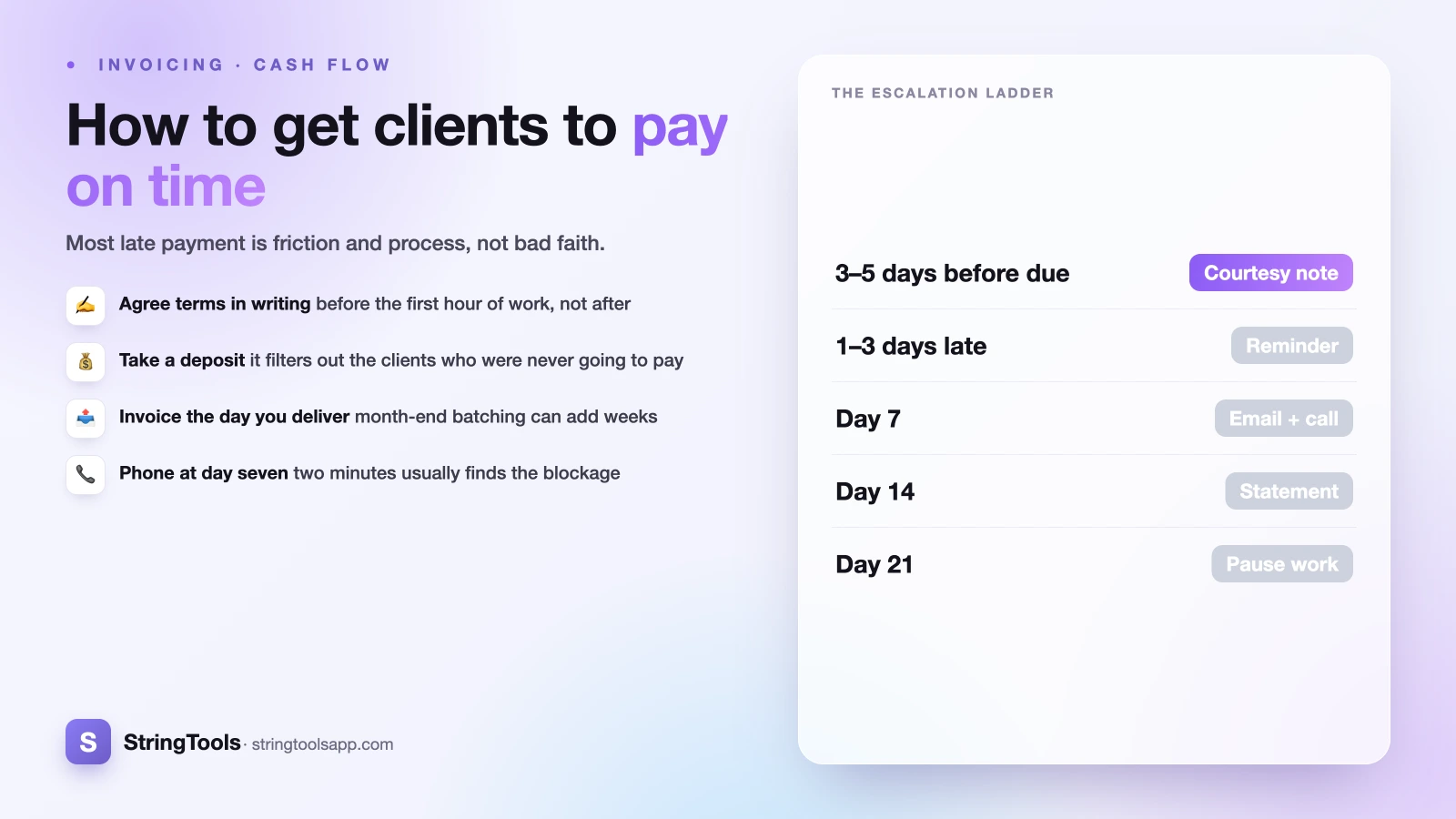
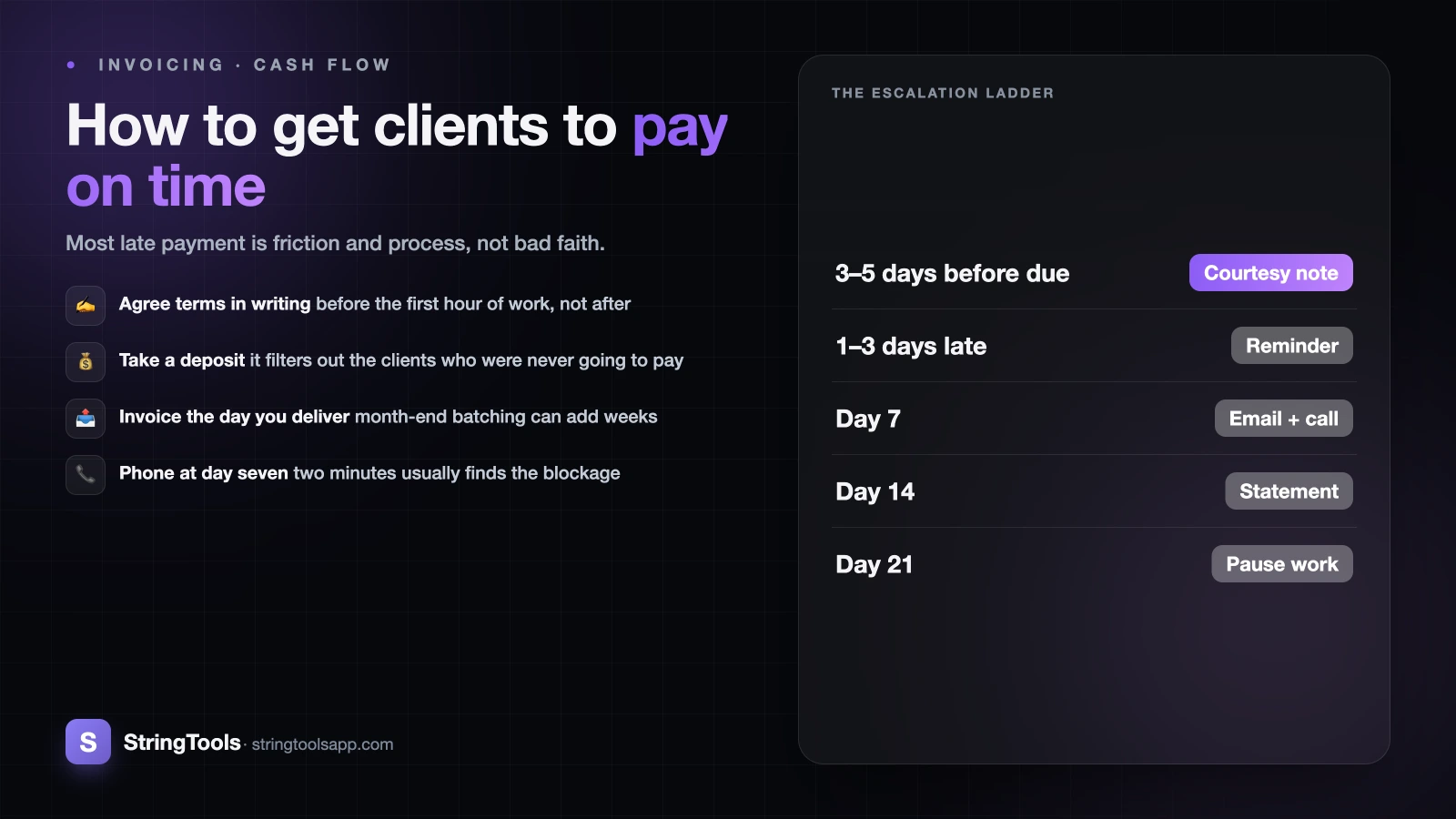
Decide the ladder once and apply it to everyone, and you never have to weigh up whether today is the day to chase. Consistency also protects the relationship: a client who gets a reminder on day three every time reads it as your process, not a judgement about them.
| When | What you send | Tone |
|---|---|---|
| 3-5 days before due | Courtesy note confirming the due date, invoice attached again | Friendly, informational |
| Due date | Nothing new — the invoice already says what is needed | — |
| 1-3 days overdue | First reminder, assuming an oversight | Warm, no blame |
| 7 days overdue | Second reminder, plus a call to the finance contact | Direct, still cordial |
| 14 days overdue | Statement of account; ask for a payment date in writing | Businesslike, firm |
| 21 days overdue | Written notice that work is paused, quoting the agreed terms | Formal, unemotional |
| 30+ days overdue | Final demand with a deadline and the next step you will take | Formal, final |
Two rules matter most.
Send the pre-due reminder. It is the most valuable message in the sequence and the one people skip. Nothing is late yet, so it costs nothing socially, and it lands while the invoice can still make the next run.
Phone at day seven. A two-minute call to accounts payable often reveals why the invoice stalled — wrong entity, no PO, missed the batch — and that is usually fixable the same day.
Wording you can reuse
Keep these short — long chasing emails invite long replies and slow decisions — and never sarcastic.
Reminder before the due date
Subject: Invoice 1043 — due 12 September
Hi Priya,
A quick note that invoice 1043 for £2,400 is due on Friday 12 September. I've attached it again, with the payment details at the bottom.
If anything is needed from my side — a PO number, a different billing address — let me know and I'll sort it today.
Thanks, Mitul
First reminder, a few days late
Subject: Invoice 1043 — now overdue
Hi Priya,
Invoice 1043 for £2,400 was due on 12 September and I can't see the payment yet. It may well be sitting in the approval process — could you let me know where it has got to?
I've attached it again, and can resend elsewhere if that helps.
Thanks, Mitul
Firmer follow-up, two weeks overdue
Subject: Invoice 1043 — 14 days overdue, payment date needed
Hi Priya,
Invoice 1043 for £2,400 is now 14 days past its due date of 12 September, and I've not had a payment date yet.
Could you confirm by Friday when it will be paid? If there's a problem with the invoice, tell me and I'll correct it straight away. Otherwise, our agreed terms were net 14 and I'd like to close this out.
I've attached a statement of everything currently open on the account.
Thanks, Mitul
Each names the invoice number, amount and due date, so nobody has to look anything up, asks one specific question, and gives the client a way to say what is wrong. None apologise for asking: "sorry to bother you" invites the reply that it can wait.
Pausing work, and the formal routes after that
There is a point where continuing to work makes the problem worse, and it arrives earlier than most freelancers allow. A reasonable default: once an invoice is roughly three weeks overdue with no payment date agreed, pause new work and say so in writing, referring to the term you agreed at the start. That clause is what makes pausing contractual rather than looking like you walked off the job. Say it without threat — work is on hold pending payment of invoice 1043 and resumes as soon as that clears — and keep delivering anything already paid for.
Beyond that, remedies vary by country, so treat this as a map rather than advice.
- A formal demand letter — a final written notice stating the amount, the dates and a deadline — is the usual last step before anything official.
- Statutory interest and recovery costs exist in some jurisdictions and not others. UK businesses, for instance, have a statutory right to claim interest and fixed recovery costs on late commercial payments, set out by GOV.UK. Elsewhere your right to charge interest may rest entirely on your contract.
- Small claims procedures exist in most countries for modest sums and are designed to be used without a lawyer, but limits, fees and forms are local.
- Debt collection or factoring costs a percentage of the debt and usually ends the client relationship.
In the United States, general small-business guidance sits in the SBA's business guide. Wherever you are, check your national or state authority before stating a right or a rate on an invoice, and take proper advice before starting formal action. None of this is legal advice.
Build the system once
The freelancers who get paid on time are rarely more assertive than everyone else. They have moved the decision out of the moment: the chasing is on a schedule, the wording is already written, and none of it requires feeling brave on a Tuesday afternoon.
A version you can set up in an afternoon:
- One spreadsheet, a row per invoice: number, client, amount, sent date, due date, paid date, days overdue. The unpaid column is your accounts receivable, and watching it is the closest thing to a health check a small business gets.
- Three saved email drafts — pre-due note, first reminder, firm follow-up — with the invoice number, amount and date the only things you change.
- Calendar reminders at minus five days, plus three and plus fourteen, set when you send the invoice.
- A standing rule about deposits and one about pausing work, written into the terms every new client gets.
- A quarterly look at who paid late and by how much. Chronic late payers are a real cost, and the honest response is to raise their price, move them to payment in advance, or let them go.
Then spend the saved energy on what matters more: keeping the relationship warm and the work good. Chasing is much easier when the person on the other end likes working with you.
Frequently Asked Questions
What payment terms should a freelancer use?
There is no universal answer, but net 14 is a reasonable default for small engagements and net 30 is the common convention for larger companies, which often impose their own standard terms regardless of what you ask for. What matters more than the number is that the term was agreed in writing before work started, that the due date appears on the invoice as an actual date, and that you invoice on the day of delivery rather than at month end. A generous term applied consistently beats a short term that nobody agreed to.
Is it unprofessional to ask a client for a deposit?
No. Deposits are standard commercial practice in construction, design, consulting and most trades, and clients who intend to pay you rarely object. A 30-50% deposit is common for project work, with the balance due on delivery or at agreed milestones. Frame it as your standard process rather than as a comment on that particular client, and state clearly that the schedule begins once the deposit clears. If a client refuses a modest deposit outright, that is useful information at the cheapest possible moment.
Can I charge interest on late payments?
Sometimes, and it depends entirely on where you and your client are based and what your contract says. Some countries give businesses a statutory right to claim interest and recovery costs on late commercial payments — the UK is one, and the rules are published on GOV.UK. In other places your ability to charge interest comes only from a clause in your own agreement, and there may be caps on the rate. Check your national or state authority, or ask an accountant, before you print an interest rate on an invoice.
How many reminders should I send before escalating?
A workable pattern is one courtesy note before the due date, a warm reminder at one to three days overdue, a second reminder plus a phone call at around a week, a statement of account and a request for a payment date at two weeks, and a written notice that work is pausing at around three weeks. That is three to four contacts before anything formal. The value is in the consistency: sending the same sequence to every client makes chasing routine rather than personal.
Should I stop working when an invoice is overdue?
Usually yes, once it is meaningfully overdue and no payment date has been agreed — roughly three weeks is a common line. Continuing to work increases the amount at risk and removes your only real leverage. Say it in writing, without threat: work is on hold pending payment of the named invoice and resumes as soon as it clears. This is far easier if your original terms said that late payment pauses work, which is one of the reasons to agree terms up front.
The client says they never received my invoice. What now?
Take it at face value, resend it immediately, and then close the gap so it cannot recur. Send it to the billing or accounts payable address as well as your day-to-day contact, include the invoice as both a PDF attachment and readable text in the email body, and ask them to confirm receipt and the expected payment date in the same reply. Ask at the same time whether their system needs a purchase order number or a specific entity name, since a silently rejected invoice often looks exactly like one that never arrived.
Sources and references
GOV.UK (gov.uk) · SBA's business guide (sba.gov) · accounts receivable (investopedia.com). Content was reviewed against these sources as of the last-updated date above; external figures and rules may change after publication.