
What an invoice has to do
To write an invoice, put your business name and address at the top, add the client's details, give it a unique sequential invoice number, state the issue and due dates, list each item with quantity and rate, show the subtotal, any tax, and the total due, then state how you want to be paid.
Key Takeaways
- An invoice is a payment request and an accounting record at once, which is why the boring fields matter as much as the total.
- Every invoice needs a unique number, and an unbroken sequence is what makes your books auditable.
- Show quantity and rate on every line so the client can approve the work line by line.
- Write an actual due date. "Net 30" on its own invites arguments about which day the clock started.
- State the currency in ISO form (USD, GBP, EUR, AUD), never a bare currency symbol.
- Tax rules, registration thresholds and mandatory fields differ by country. Check your own tax authority.
An invoice does three jobs. It tells the client how much to pay and by when, it gives their finance team enough to push it through approval without emailing you, and it becomes the record you both rely on at tax time. Most invoices that sit unpaid for months are not the victims of a difficult client: a purchase order number was missing, the entity name was wrong, or nobody could tell which of three emails was the actual bill.
The layout is rarely fixed by law. The content often is. The UK sets out what a commercial invoice must contain in GOV.UK's guidance on invoicing and taking payment from customers, including marking the document clearly with the word "invoice". The US has no single federal format, but the record-keeping behind it is governed by the IRS, with general small-business guidance from the SBA. Wherever you bill from, the checklist below covers the fields that keep an invoice from bouncing.
The elements every invoice needs
This is the table to work from. Not every row applies to every freelancer, but if a row does apply and you leave it out, you have handed someone a reason to delay paying you.
| Element | Why it matters |
|---|---|
| The word "Invoice" | Separates it from a quote, estimate or proforma, none of which are payable |
| Your business or trading name | Tells the client who they are paying and who to record as the supplier |
| Your address and contact details | Queries get resolved in an hour instead of sitting in an inbox |
| Your tax or company registration number | Often required before a client can reclaim tax or onboard you as a supplier |
| Client's legal entity name | An invoice made out to the wrong company in a group is routinely rejected |
| Client's billing address and contact | Routes it to accounts payable, not the person you actually work with |
| Client PO or reference number | Larger firms will not pay an invoice that matches no open PO |
| Unique invoice number | Lets both sides refer to one exact document, and anchors your bookkeeping |
| Issue date | Starts the payment clock and fixes which tax period the sale falls into |
| Supply or service date | Some tax regimes key the tax point to the date of supply, not the invoice date |
| Due date, as a date | Removes any argument about what "30 days" counted from |
| Line items with description, quantity and rate | Lets the client approve the work piece by piece instead of querying the lot |
| Subtotal | The pre-tax figure both parties agreed, before anything is added or taken off |
| Tax line, shown separately | A client normally cannot reclaim tax that is buried inside the total |
| Total due and the currency | "$1,800" means four different amounts depending on the country |
| Payment methods and account details | Every extra email needed to pay you adds days |
| Payment terms and late-payment policy | You cannot enforce a late fee you never stated |
A useful test: hand the invoice to someone who has never heard of the project and ask who owes what to whom, by when, and how. If they can answer all four in ten seconds, it is finished. My companion post on what to include on an invoice works through the edge cases.
Your details, and your client's
Start with the header block: your trading name, address, email and phone, plus your tax or business registration number if you have one. If your trading name differs from your legal name, show both: the client's accounts system usually needs the legal entity, while your contact recognises the trading name.
The client block matters more than people expect, because you are billing an entity, not a person. Ask for the exact legal name rather than the brand. A group might trade as "Northwind" but pay from "Northwind Media Services Ltd", and an invoice addressed to the brand can come back weeks later. Where the client has given you a purchase order number, cost centre or supplier ID, put each on a labelled line of its own. In a large organisation those references are what the approval workflow matches on.
Settle four things before the first invoice rather than after it:
- Who receives it. Get the accounts payable address, and copy your day-to-day contact.
- What entity to bill. Ask directly. One message saves a rejected invoice.
- Whether a PO is needed. If it is, no PO means no payment, however good the work was.
- Whether they use a supplier portal. Some clients accept invoices only through a portal, and emailing one there does nothing at all.
Invoice numbers, and why sequential numbering matters
Every invoice needs a unique identifier, and the safest scheme is a simple unbroken sequence, because it makes gaps obvious. If your invoices run 011, 012, 013, 015, anyone reviewing the books, including you in eleven months, can see that 014 is missing and ask why. Was it cancelled, credited, or was the income never recorded? Random or per-client numbering hides the question entirely. Tax authorities generally expect invoice records to be complete and traceable, and a sequence is the cheapest way to show that they are.
Rules that hold up over years of trading:
- Never reuse a number. Void an invoice by keeping its number and marking it cancelled.
- Never renumber retrospectively. Once a number has left your outbox, it is fixed.
- Correct with a credit note, not an edit. Reference the original number, then issue a fresh invoice with a new one.
- Include the year if you want readable numbers.
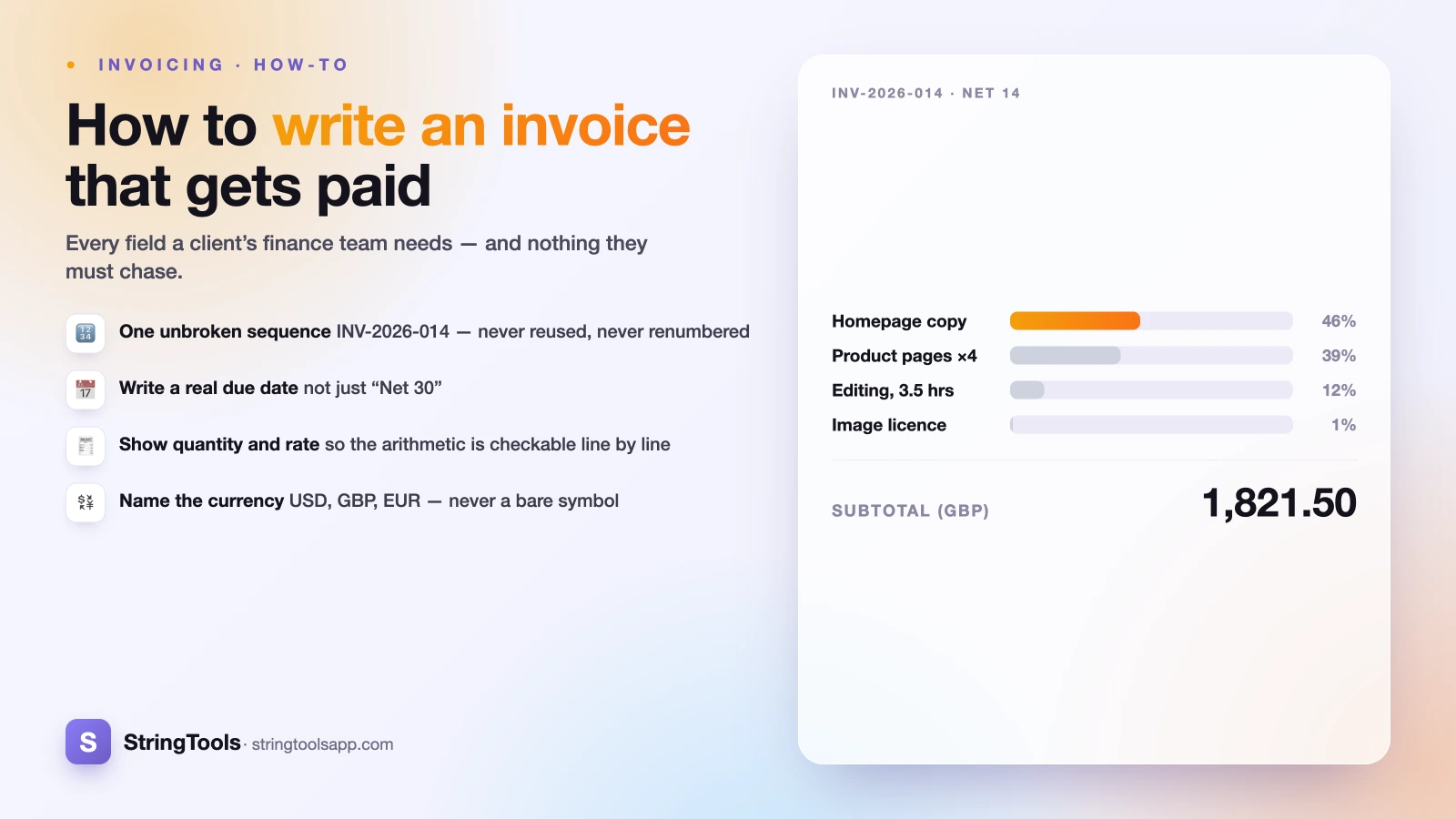
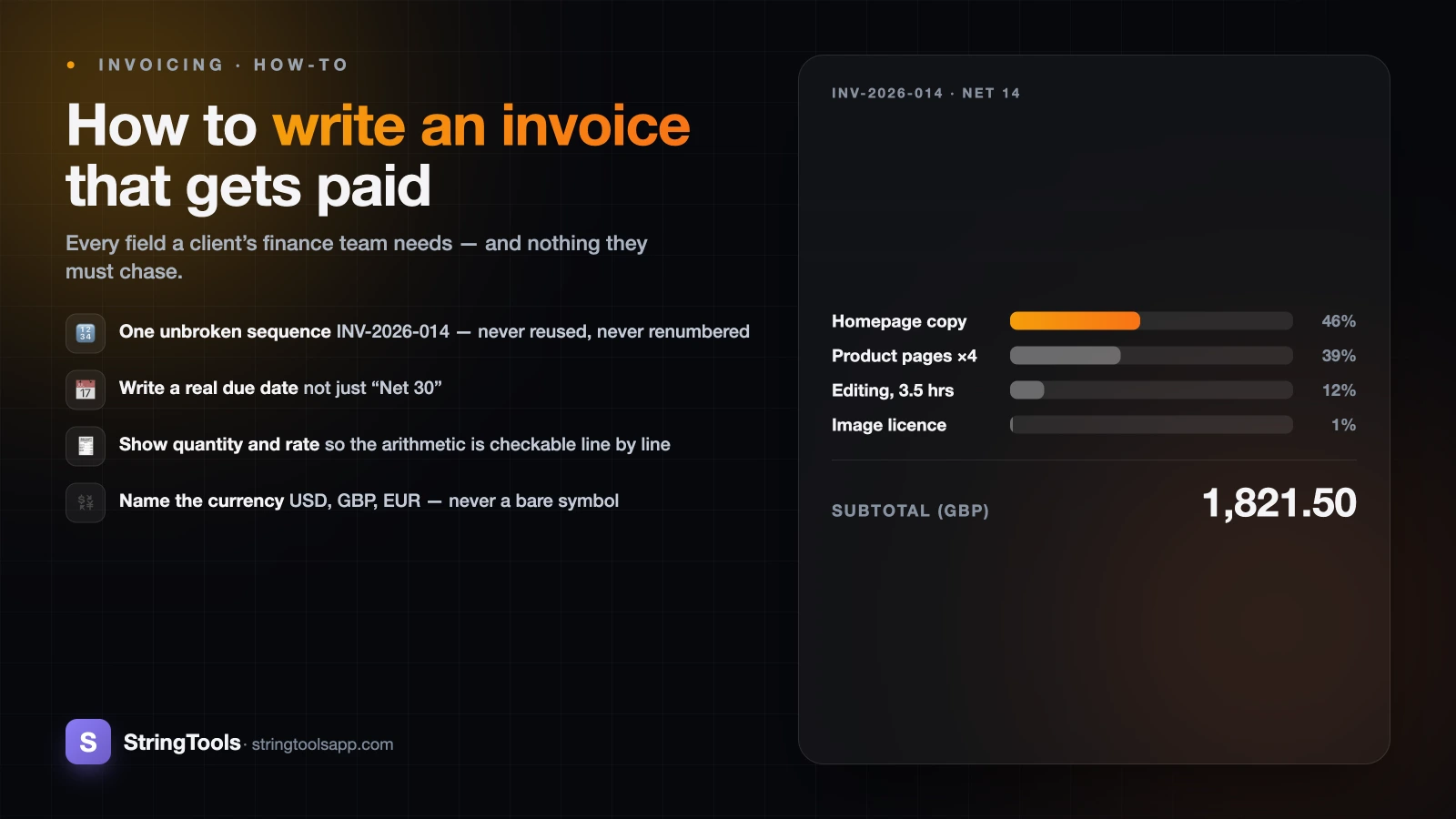
INV-2026-014sorts cleanly and shows the period at a glance.
One sequence for the whole business is simpler than one per client. Per-client sequences produce duplicate numbers across your ledger and make reconciliation harder than it needs to be. Starting at 001 is perfectly legitimate; so is starting at 100. What matters is that the sequence never goes backwards.
Itemising the work
The body of the invoice is a table of what you did: description, quantity, unit rate, line total. Even on a fixed-price project, splitting the work into three or four lines helps whoever approves it recognise what they signed off.
Write descriptions the client would recognise, not the ones in your project notes. "Homepage copy rewrite, final version delivered 18 Aug" is approvable. "Phase 2" is not. For hourly work, show the hours and the rate rather than a blended figure, so the arithmetic is visible and there is nothing to query.
Handle these cases explicitly:
- Hourly work. Quantity is hours to one decimal place: 3.5 hrs at 65.00.
- Per-unit work. Quantity is the count: 4 product pages at 180.00 each.
- Fixed-price deliverables. Quantity 1, rate equal to the agreed fee, description naming the deliverable.
- Recharged expenses. Their own line, labelled at cost. Whether tax applies to a recharge depends on your country and on how the expense was incurred, so check rather than guess.
- Out-of-scope work. Its own line, referencing the email where it was approved.
Round each line to two decimal places and let the subtotal be the sum of the rounded lines. Rounding only at the end can leave a total that does not match the lines above it, and a single penny is enough to trigger a query.
Subtotal, tax, discounts and the total
Below the line items the arithmetic runs in a fixed order: subtotal, then any discount, then tax, then the total. Deposits and payments already received come off last, leaving a balance due.
Show tax on its own line with the rate named, never folded into item prices. A business client normally needs the tax stated separately in order to reclaim it, and a tax-inclusive total with no breakdown is a common reason for an invoice to be sent back.
What you cannot do is copy someone else's tax treatment. Whether you charge tax at all depends on your country, your registration status, what you sold and where the client is. In the UK that means VAT, with registration tied to a turnover threshold HMRC reviews periodically. In the US it means state-level sales tax, which mostly does not apply to professional services but varies by state. Australia and Canada use GST; India uses GST with its own invoice-format rules. Check your own tax authority's current guidance and take advice if the answer is not obvious. Nothing here is tax advice.
Discounts and deposits
- Percentage discounts go after the subtotal and before tax, so the tax lands on what the client actually pays.
- Early-payment discounts change the tax treatment in some countries. Check before offering one.
- Deposits already paid come off after tax, on a labelled line, with the date received.
- The final figure is Balance due, not Total, whenever a deposit has been deducted.
State the currency in the total and, ideally, against each rate. Use ISO codes: USD, CAD, AUD, GBP, EUR, INR. A bare dollar sign on a cross-border invoice is a genuine source of underpayment.
Getting paid: methods, bank details and terms
The bottom third of the invoice tells the client how to pay. Make it complete enough that nobody has to email you first.
For bank transfer, give the account name exactly as the bank holds it, plus the fields your country uses: sort code and account number in the UK, routing and account number in the US, BSB and account number in Australia, IBAN and BIC for cross-border European payments. If you accept cards or a payment service, say so, and say who covers the fee. Silence on fees means you absorb them.
Terms
Write the terms as a date, then the rule behind it: "Payment due within 14 days of the invoice date: due 10 September 2026". Common terms run from due on receipt through Net 7, Net 14, Net 30 and, for large corporates, Net 60. Short terms are normal for freelancers and you are entitled to set them, though a client with a fixed payment run may pay on their own cycle regardless. My post on invoice payment terms explained covers how to choose terms and what each one signals.
State your late-payment policy on the invoice itself if you intend to use it. In the UK, businesses have a statutory right to claim interest and recovery costs on late commercial payments, described on GOV.UK. Other countries have their own regimes and some have none, so check locally rather than copying a clause found online.
One security point is worth more than it looks. Invoice fraud usually works by intercepting an emailed invoice and swapping the bank details. Send a PDF rather than an editable file, and when a client pays you for the first time, confirm the account details by phone on a number they gave you. If your own details change, phone your regular clients rather than announcing it by email alone.
A worked example
Here is a complete small freelance invoice: one client, a mix of fixed-fee and hourly work, one recharged expense and a deposit already taken.
Invoice INV-2026-014 — Issued 27 August 2026 — Due 10 September 2026 (Net 14) — Currency: GBP
From: M. Mandanka, 14 Bridge Road, Leeds LS1 1AA
To: Northwind Media Services Ltd, Accounts Payable, 2 Quay Street, Manchester M3 3JE — PO 4471
| Description | Qty | Rate | Amount |
|---|---|---|---|
| Homepage copy rewrite, final version delivered 18 Aug | 1 | 850.00 | 850.00 |
| Product page copy | 4 pages | 180.00 | 720.00 |
| Editing round, hourly | 3.5 hrs | 65.00 | 227.50 |
| Stock image licence, recharged at cost | 1 | 24.00 | 24.00 |
| Subtotal | 1,821.50 | ||
| VAT at 20% (UK standard rate, shown as an illustration) | 364.30 | ||
| Total | 2,185.80 | ||
| Less deposit received 10 Aug 2026 | -400.00 | ||
| Balance due (GBP) | 1,785.80 |
Payment: Bank transfer to M. Mandanka, sort code 00-00-00, account 00000000. Please quote INV-2026-014 as the reference.
Every figure is the sum of the ones above it, which is the first property a reviewer checks. The tax line names its rate. The deposit is dated. The reference the client should quote sits in the payment block, so it comes back on the bank statement and you can match the payment in seconds.
Whether you charge VAT at all, and at what rate, depends entirely on where you are and whether you are registered; the 20% here is the UK standard rate and appears only to show where a tax line sits. If you would rather not build the layout yourself, the invoice generator assembles all of this in the browser: your details, the client's, line items with quantity and rate, tax and discount, a choice of currencies, then print or save as a PDF. Nothing is uploaded or stored.
After you send it
Sending the invoice is the middle of the process. What you do over the following month decides how quickly you get paid.
A chasing schedule that works
- Day 0. Send it to accounts payable, copy your contact, and ask for a one-line confirmation that it has been received and entered.
- Day 3. If no confirmation, chase once. Most problems (wrong entity, missing PO, wrong portal) surface here and are trivial to fix.
- Due date minus 3. A short note confirming the payment is scheduled.
- Due date plus 1. State plainly that it is overdue, restate the amount and reference, and ask for a payment date.
- Due date plus 14. Escalate to a named person above your contact, and mention your late-payment terms if you have them.
Nothing there is aggressive. It is a written record, which is what you need if the conversation ever turns formal.
Keep the records, and reconcile monthly
Keep a copy of every invoice you issue, in sequence, together with any credit notes. Retention periods differ by country and by record type: HMRC expects self-employed records to be kept for several years after the relevant filing deadline, and the IRS sets its own minimum periods that vary with the situation. Both publish current guidance, on GOV.UK and IRS.gov respectively, and each is worth reading once rather than guessing.
Then, once a month, list every invoice number you issued and mark it paid, part-paid or open. Fifteen minutes of that catches the invoice that was never received, the payment that arrived without a reference, and the client who has quietly slipped from Net 14 to Net 45. All three are far cheaper to fix in September than in January.
Frequently Asked Questions
Do I need to be a registered company to send an invoice?
No. In most countries a sole trader or self-employed individual can invoice under their own name and address. What changes with registration is what you must show on the invoice, such as a company number or a tax registration number, and whether you are obliged to charge tax. Thresholds and required fields differ by country, so check your own authority, for example GOV.UK in the UK or the IRS in the US, before your first invoice.
What invoice number should I start with?
Anything, as long as it is unique and moves forward. INV-001 and INV-2026-001 are both fine. Some freelancers start at 100 or 1000 so an early invoice does not advertise that it is their first, which is legitimate. The rule that actually matters is the next one: never reuse a number, never renumber an invoice you have already sent, and if you cancel one, keep the number and mark it cancelled so the sequence has no unexplained gaps.
What is the difference between an invoice, a quote and a receipt?
A quote or estimate comes before the work: it proposes a price and is not payable. An invoice is issued after the work or delivery and is a formal request for payment by a stated date. A receipt confirms payment was made and is issued afterwards. A proforma invoice looks like an invoice but is a preview, often used to request payment up front, and in most systems is not a tax document. Labelling each clearly stops a client treating your invoice as a quote.
Do I have to charge VAT or sales tax on my invoices?
It depends on your country, your registration status, what you sold and where your client is. UK freelancers charge VAT only once registered, which is tied to a turnover threshold. US freelancers usually do not charge sales tax on professional services, but the rules vary by state. Australia and Canada use GST, and India uses GST with its own invoice-format requirements. This is not tax advice: check your own authority's current guidance, and take professional advice if your situation is not clear-cut.
Can I charge a late fee if a client does not pay on time?
Often yes, but it depends on your jurisdiction and on what your contract and invoice say. In the UK, businesses have a statutory right to claim interest and reasonable recovery costs on late commercial payments, set out on GOV.UK. Elsewhere the position varies, and some regimes rely entirely on what you agreed in writing. State your late-payment terms on the invoice if you intend to rely on them, and confirm the local position before applying a charge.
What should I do if a client ignores my invoice?
Work through the boring causes first, because they explain most silences: wrong entity name, missing purchase order number, invoice sent to a person rather than accounts payable, or a supplier portal you were meant to upload to. Rule those out, chase in writing on a schedule, escalate to a named person above your contact, and keep every message. If it stays unpaid, the next steps, whether a formal demand, statutory interest or a small claim, depend on your country and are worth checking with the relevant authority or a solicitor.
Sources and references
GOV.UK's guidance on invoicing and taking payment from customers (gov.uk) · IRS (irs.gov) · SBA (sba.gov) · GOV.UK (gov.uk) · GOV.UK (gov.uk). Content was reviewed against these sources as of the last-updated date above; external figures and rules may change after publication.