
The Short Answer: Eleven Elements Every Invoice Needs
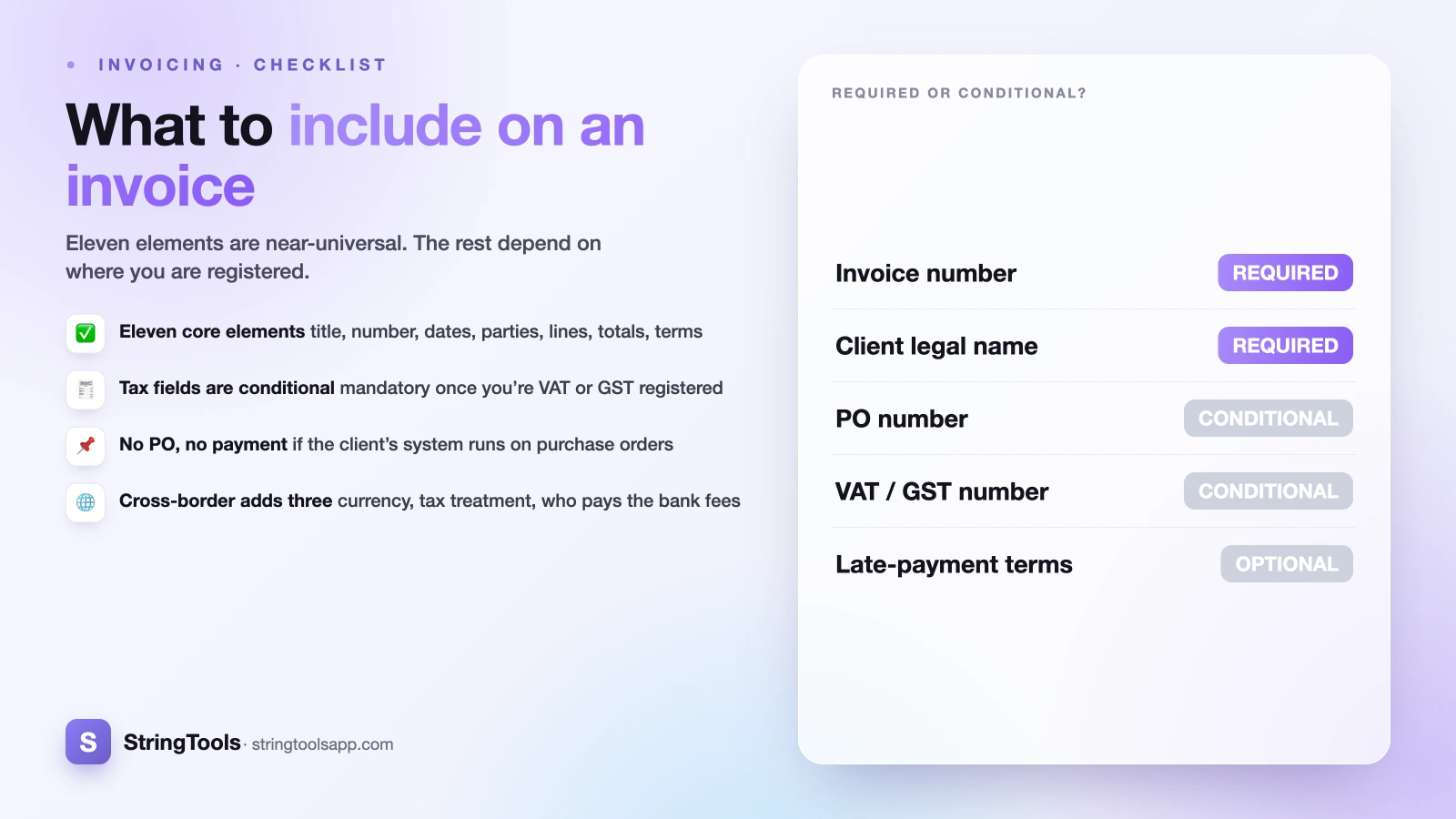
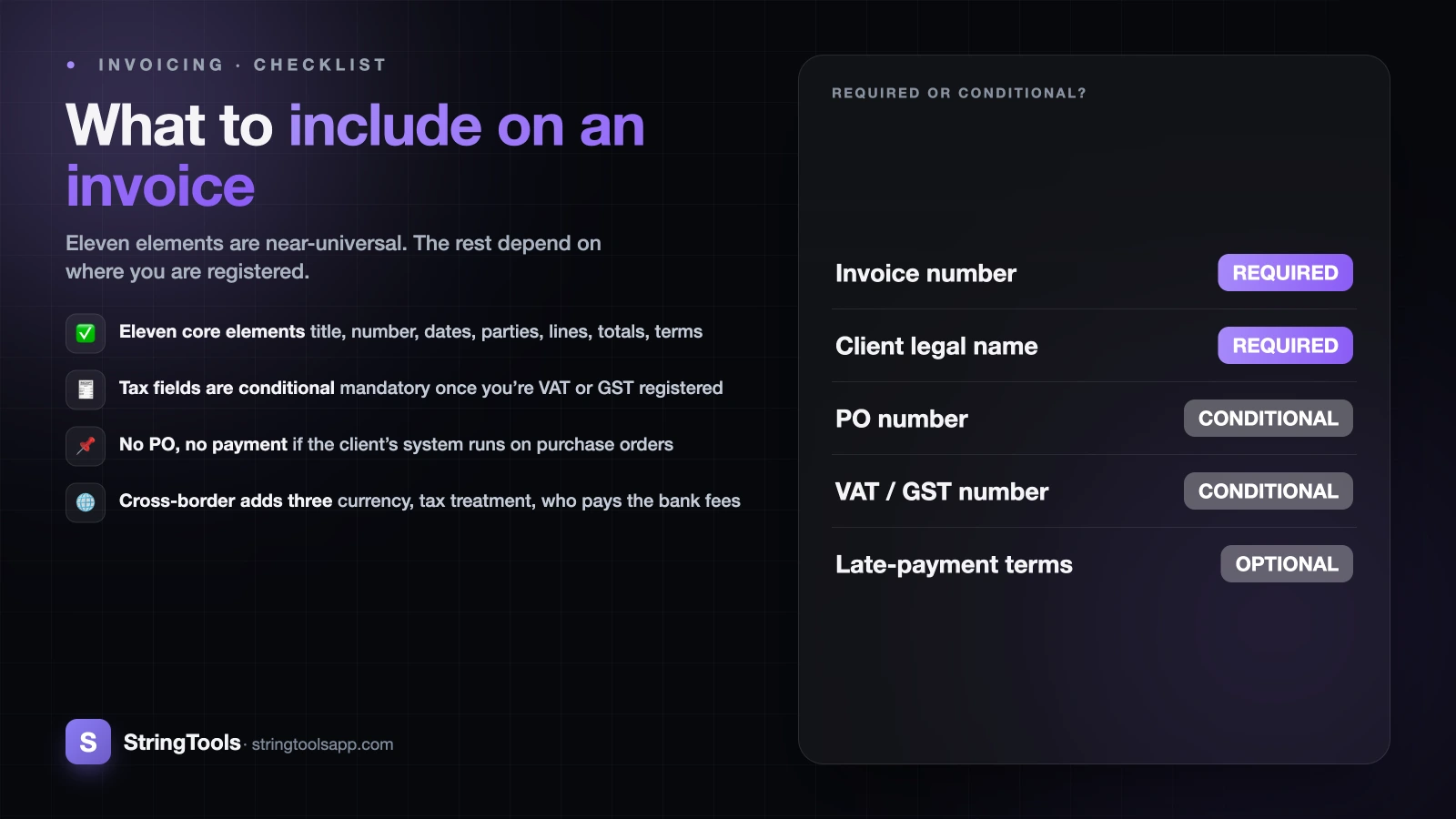
Every invoice needs eleven core elements: the word "Invoice", a unique invoice number, the issue date, your business name and address, the client's name and address, a description of what was supplied, quantities and unit prices, the total due, payment terms, the due date, and payment instructions.
Miss any of those and you have created work for somebody. A missing invoice number means the client's accounts payable system cannot log it. A missing purchase order reference, in a company that runs on purchase orders, means the invoice is rejected by software before a human ever sees it.
Everything past those eleven is either a legal requirement that depends on where you and your client are registered, or an optional extra that makes payment faster. This page separates the two.
Key Takeaways
- Eleven elements are near-universal: title, number, dates, both parties' details, line items, totals, terms and payment instructions. Build every invoice on those.
- Tax fields are conditional, not optional. If you are VAT or GST registered, your registration number and a tax breakdown become mandatory. If you are not registered, you must not charge or imply tax.
- A purchase order number is not admin theatre. In companies that use them, an invoice without a matching PO is auto-rejected by the accounts payable system.
- International invoices need three extra decisions: which currency, how tax is treated across the border, and who pays the bank transfer fees.
- Requirements differ by country and by registration status. Nothing here is legal or tax advice — check with the tax authority where you are registered, and with an accountant for your own situation.
The Complete Invoice Checklist
This is the "did I miss anything" table. "Required" means required in most jurisdictions for a valid commercial invoice; "Conditional" means it becomes mandatory once a specific fact is true about you or your client.
| Element | Required or optional | Notes |
|---|---|---|
| The word "Invoice" | Required | Distinguishes it from a quote, a proforma or a statement. Some systems route documents on this word alone. |
| Unique invoice number | Required | Sequential, no gaps, never reused. Many tax authorities require a sequence that can be audited. |
| Invoice issue date | Required | Drives the due date and, in most systems, the accounting period the income falls into. |
| Payment due date | Required in practice | Write the actual date, not just "Net 30". Dates get paid; terms get interpreted. |
| Your business name and trading name | Required | Use the registered legal name; add "trading as" if you invoice under a different brand. |
| Your business address | Required | A registered or principal place of business. A PO box alone is not accepted everywhere. |
| Your contact details | Required in practice | Email and phone. Accounts payable will query something eventually. |
| Company or business registration number | Conditional | Required for incorporated companies in many countries (UK company number, Australian ABN, India CIN/PAN, EU trade register number). |
| Client's legal entity name | Required | The entity that owes the money, not your day-to-day contact's team name. Getting this wrong delays payment. |
| Client's billing address | Required | Often different from the site or delivery address. Ask; do not assume. |
| Client contact / "attention to" | Optional | Speeds internal routing in larger organisations. |
| Purchase order (PO) number | Conditional | Mandatory if the client issued one. See the PO section below. |
| Description of goods or services | Required | Specific enough that a stranger in finance can match it to something they approved. |
| Quantity, unit and unit price | Required | Hours, days, units, words, licences. Show the rate so the arithmetic is checkable. |
| Date or period of supply | Conditional | Required on a VAT invoice ("tax point") and useful everywhere for retainers and monthly work. |
| Subtotal before tax | Required | Must be shown separately once any tax is applied. |
| Tax rate, tax amount and tax code | Conditional | Mandatory if you are VAT/GST/sales tax registered. Must not appear if you are not. |
| Your VAT/GST/tax registration number | Conditional | Mandatory once registered. Never display a number you do not hold. |
| Client's VAT/GST number | Conditional | Required for cross-border B2B supplies within the EU and for some reverse-charge situations. |
| Discounts and credits applied | Conditional | Show as a separate line, before tax, with the reason. |
| Deposit or part-payment already received | Conditional | Show the gross amount, then the deduction, then the balance due. |
| Total amount due | Required | One number, in bold, in the stated currency. |
| Currency | Required | Say "USD 1,200" rather than "$1,200" the moment more than one country is involved. |
| Payment terms | Required in practice | Net 14, Net 30, on receipt, 50% up front. Agree these before the work, not on the invoice. |
| Payment methods and account details | Required in practice | Bank name, account name, account number, sort code / routing number, IBAN and BIC/SWIFT for international. |
| Payment reference to quote | Optional | Usually the invoice number. Reduces unmatched payments sitting in a suspense account. |
| Late payment terms or interest | Optional | Only enforceable if it was in the contract or is provided by statute where you are. |
| Notes, thanks, next steps | Optional | A line of plain English costs nothing and softens the document. |
If you build invoices by hand, the invoice generator lays out these fields in the right order and does the line-item and tax arithmetic for you. If you are starting from nothing, how to write an invoice walks through the process end to end rather than element by element.
The Elements People Actually Get Wrong
Four fields cause most of the friction, and none of them are the obvious ones.
The invoice number. Unique, and sequential without gaps: auditors and tax authorities read a gap as a deleted invoice. Pick one scheme and stay with it. 2026-001 upward is fine; a date stamp like 20260827 breaks the moment you issue two invoices in a day. To cancel an invoice, issue a credit note rather than deleting the number.
The client's legal entity. Large groups contain many registered companies, and accounts payable pays only the one named on the purchase order. "Acme" is not an entity; "Acme Retail Holdings Ltd" is. Ask the finance contact in writing for the exact billing entity and address before the first invoice.
The date of supply. When the work was done or the goods were delivered, which is often not the day you got round to invoicing. It can determine which tax period and rate apply, and on a VAT invoice it is a required field. For retainers, write the period: "Services, 1-31 July 2026".
The description. "Consulting - July" tells a finance clerk nothing and gets bounced back for approval, which adds a week. "Brand strategy workshop (2 days) and written recommendations, delivered 14-15 July 2026, per SOW dated 2 June 2026" is approved without a conversation. Be specific enough that somebody who has never met you can match the line to something their company agreed to buy.
What Changes When You Are VAT or GST Registered
This is the biggest fork in the checklist. An invoice from an unregistered sole trader and a tax invoice from a registered business are different documents with different legal weight.
If you are not registered, keep it simple. Charge your fee, show no tax rate and no tax line, and do not display a VAT or GST number. Adding tax you are not entitled to collect is a serious problem rather than a rounding error.
If you are registered, the document usually has to be labelled a tax invoice and carry more fields. In the UK, HMRC's full VAT invoice expects a unique sequential number, your name, address and VAT registration number, the invoice date, the time of supply (the tax point), the customer's name and address, a description of each supply with quantity and unit price excluding VAT, the VAT rate, the total excluding VAT, the VAT amount and the total including VAT. GOV.UK sets out the rules, and a simplified version for smaller retail supplies, in its guidance on invoicing and taking payment from customers.
Other systems ask for their own fields. An Australian tax invoice needs your ABN and must show the GST amount or state that the total includes GST. An Indian GST tax invoice needs both parties' GSTIN, an HSN or SAC code per line, the place of supply, and a CGST/SGST or IGST split rather than a single tax line. EU invoices for cross-border B2B supplies typically carry both VAT numbers and, where the reverse charge applies, wording that says so.
Registration itself is usually triggered by turnover, and the thresholds are national.
| Country | Standard registration threshold | Identifier on the invoice |
|---|---|---|
| United Kingdom | GBP 90,000 taxable turnover | VAT registration number |
| Australia | AUD 75,000 (AUD 150,000 for non-profits) | ABN, plus GST shown or stated |
| Canada | CAD 30,000 (small supplier limit) | GST/HST business number |
| India | INR 40 lakh for goods, INR 20 lakh for services (lower in special category states) | GSTIN |
| Singapore | SGD 1 million | GST registration number |
| United States | No federal VAT/GST; sales tax is set state by state | State sales tax permit number where applicable |
Those thresholds change and there are exceptions in every row, so treat the table as orientation and confirm the current figure with your own authority. The IRS small business and self-employed section covers the US, where there is no national invoice format at all and the questions are instead about sales tax nexus and contractor reporting; in Australia the tax invoice rules come from the Australian Taxation Office and are summarised for small businesses on business.gov.au. Nothing here is tax or legal advice, and an accountant in your own jurisdiction is worth an hour of fees on this specific question.
Purchase Order Numbers: Why Some Clients Will Not Pay Without One
A purchase order is a document the buyer issues before the work, committing to buy a defined thing at a defined price. It carries a PO number. When your invoice arrives, the accounts payable system matches three documents - the purchase order, the goods receipt or approval, and the invoice - and releases payment only if all three agree. This is three-way matching, and it exists so nobody can quietly authorise spending.
The consequence for you: in a company that runs on purchase orders, an invoice with no PO number does not sit in a queue waiting for goodwill. It fails validation and is returned or ignored, often without your contact hearing about it. Chasing is slow because the problem sits in a finance system your contact does not use.
Three rules keep you out of that loop:
- Ask before you start. "Do you raise purchase orders, and can you send me the number before I invoice?" is a one-line email that saves weeks.
- Quote it exactly. Put it near the top, labelled
PO Number, copied character by character. A transposed digit fails the match as completely as a missing one. - Do not exceed it. If the PO is for GBP 5,000 and you invoice GBP 5,400, the match fails on value. Extra work needs a revised or additional PO before you invoice it.
Smaller clients often have no PO process, in which case the field simply does not appear. The mistake is assuming which kind of client you have.
International Invoices: Currency, Tax Treatment and Bank Fees
Cross-border invoicing adds three decisions that are easy to leave vague and expensive to leave vague.
Currency. State it as an ISO code: USD 4,500, EUR 4,100, AUD 6,800. A bare dollar sign is ambiguous across the US, Canada, Australia and Singapore. Agree the invoicing currency in the contract, and remember that if you bill in a currency you do not hold, your bank converts at the rate on the day it arrives, not the day you invoiced. Adding the rate used and the home-currency equivalent as a note is optional, but it makes year-end reconciliation far easier.
Tax treatment. Do not guess. Whether you charge domestic tax, charge nothing, or apply a reverse charge depends on what you supply, where the client belongs, and whether the client is a registered business. Within the EU, cross-border B2B services often shift the obligation to the customer under the reverse charge, and the invoice is expected to carry both VAT numbers and explicit reverse-charge wording. Outside that system the answer varies country by country. Ask your accountant once and reuse the answer: getting it wrong is a correction with a tax authority rather than an awkward email.
Bank transfer fees. International payments carry charges at both ends and often an intermediary bank in the middle, and the SWIFT system has three standard codes for who absorbs them.
| Charge code | Who pays | What you receive |
|---|---|---|
| OUR | The sender pays all charges | The full invoice amount |
| SHA | Sender pays their bank's fees, you pay the rest | Invoice amount minus receiving and intermediary fees |
| BEN | You, the beneficiary, pay all charges | Invoice amount minus every fee in the chain |
SHA is the common default, which is why a EUR 2,000 invoice can land as EUR 1,978. Nobody is cheating you; the deduction happened in transit. Decide it in advance and put a line on the invoice: "Payable in USD; sender to cover all transfer charges (OUR)". Far easier to state up front than to reclaim afterwards.
Then give the payer everything their bank will ask for: account name exactly as registered, IBAN where the country uses one, BIC/SWIFT code, bank name and bank address. A missing BIC is a returned payment and another week.
Optional Elements That Quietly Get You Paid Faster
None of these are required anywhere. All of them shorten the gap between sending and being paid.
- The due date written as a date. "Due 26 September 2026" beats "Net 30": nobody has to count, and nobody can disagree about when the clock started.
- A payment link or clear method list. The fewer steps between reading and paying, the better.
- The payment reference to quote. Usually the invoice number. Payments arriving without one sit unmatched, and unmatched money looks unpaid.
- A summary line at the top. "Invoice 2026-041 - GBP 3,600 due 26 September 2026" above the detail lets a manager approve from a phone.
- The contract, SOW or PO reference. Ties your line items to something the client already agreed to buy.
- Deposits and credits shown explicitly. Gross, minus what has been paid, equals balance due. Do not silently net it off.
- Late payment terms. Only if they were in the contract, or if statutory interest applies where you are. State the basis, not just a percentage.
The "do not include" list is shorter: no VAT or GST number you do not hold, no tax line you are not entitled to charge, and no unexplained fees. Anything a reader cannot account for triggers a query, and a query is a delay.
The Two-Minute Pass Before You Hit Send
Read the invoice as though you are the accounts payable clerk who has never met you and is working through forty documents before lunch. Ask, in order:
- Can I tell what this document is? The word "Invoice" is visible, and it is not a quote or a receipt. If you are unsure which you should be sending, invoice vs receipt vs quote draws the line between the three.
- Can I log it? Unique number, issue date and due date, all present and legible.
- Is it addressed to us? The correct legal entity, spelled correctly, at the billing address, with a PO number if we use them.
- Can I match it to something we approved? The description names a deliverable, a period or a contract reference, not just a month.
- Does the arithmetic hold? Quantities times rates equals subtotal; subtotal plus tax minus deposits equals the total; the total appears once, unambiguously, with a currency code.
- Is the tax right for who you are? Registered means a registration number and a tax breakdown. Not registered means no tax line at all.
- Can I actually pay it? Full bank details, the reference to quote, and for international payments a BIC and a stated position on transfer charges.
If all seven pass, send it to the accounts payable address as well as your day-to-day contact, and diarise the due date. Most late payments are not disputes; they are invoices sitting in a queue nobody has been reminded about. A polite email the morning after the due date, quoting the number and the amount, resolves more of them than any interest clause ever will.
Keep a copy of every invoice you issue, in a sequence with no gaps, for as long as your tax authority requires - commonly several years, with the exact period set nationally. That archive is worth more than any single invoice in it.
Frequently Asked Questions
What is legally required on an invoice?
It depends on your country and on whether you are registered for VAT, GST or sales tax. Almost everywhere expects a unique invoice number, the issue date, the seller's name and address, the buyer's name and address, a description of what was supplied, the amounts, and the total due. Once you are tax registered, additional fields become mandatory - typically your registration number, the tax rate, the tax amount and the tax-exclusive and tax-inclusive totals. Check the current requirements with the tax authority where you are registered, such as HMRC in the UK or the ATO in Australia, rather than relying on a general checklist.
Do I need a VAT or GST number on my invoice?
Only if you are registered. If you are, it is mandatory on a tax invoice and the invoice must also show the tax rate and amount. If you are not registered, you must not show a registration number and must not add a tax line, because you are not entitled to collect that tax. Registration is generally triggered by turnover thresholds set nationally - for example GBP 90,000 in the UK, AUD 75,000 in Australia and CAD 30,000 in Canada - and those figures change, so confirm the current threshold with your own authority.
What is a PO number and do I have to include one?
A purchase order number identifies a document the buyer issued before the work, committing to buy a specific thing at a specific price. If your client raises purchase orders, you must quote the PO number on the invoice: their accounts payable system matches the purchase order, the approval and your invoice automatically, and an invoice with no PO number or a mismatched value fails that check and is rejected before anyone reads it. Ask at the start of a project whether a PO will be issued, and never invoice more than the PO's value without a revised PO.
What currency should I invoice an overseas client in?
Whichever you agreed in the contract, stated explicitly as an ISO code such as USD, EUR or AUD rather than a bare currency symbol. Invoicing in your own currency removes your exchange risk but pushes it to the client; invoicing in theirs does the reverse and means your bank converts at the rate on the day the money lands. Whichever you choose, also state who covers international transfer charges, because the SHA default deducts receiving and intermediary bank fees from the amount that reaches you.
Does an invoice number have to be sequential?
In most systems yes, and it is good practice regardless. Tax authorities generally expect a unique, sequential series with no gaps, because a gap suggests a deleted invoice. Choose a simple scheme such as 2026-001 upward, or a per-client prefix, and stay with it. If you need to cancel an invoice, issue a credit note against it rather than deleting the number and reusing it.
What is the difference between an invoice and a tax invoice?
An invoice is a commercial request for payment. A tax invoice is a specific document that a business registered for VAT or GST must issue, carrying extra mandatory fields - the registration number, the tax point or date of supply, the tax rate and amount, and separate tax-exclusive and tax-inclusive totals - because the buyer uses it to reclaim input tax. The exact required fields and the label the document must carry are set by each country's tax authority, so check theirs before designing a template.
Sources and references
guidance on invoicing and taking payment from customers (gov.uk) · IRS small business and self-employed section (irs.gov) · business.gov.au (business.gov.au). Content was reviewed against these sources as of the last-updated date above; external figures and rules may change after publication.