
Invoice, Receipt or Quote: The Short Answer
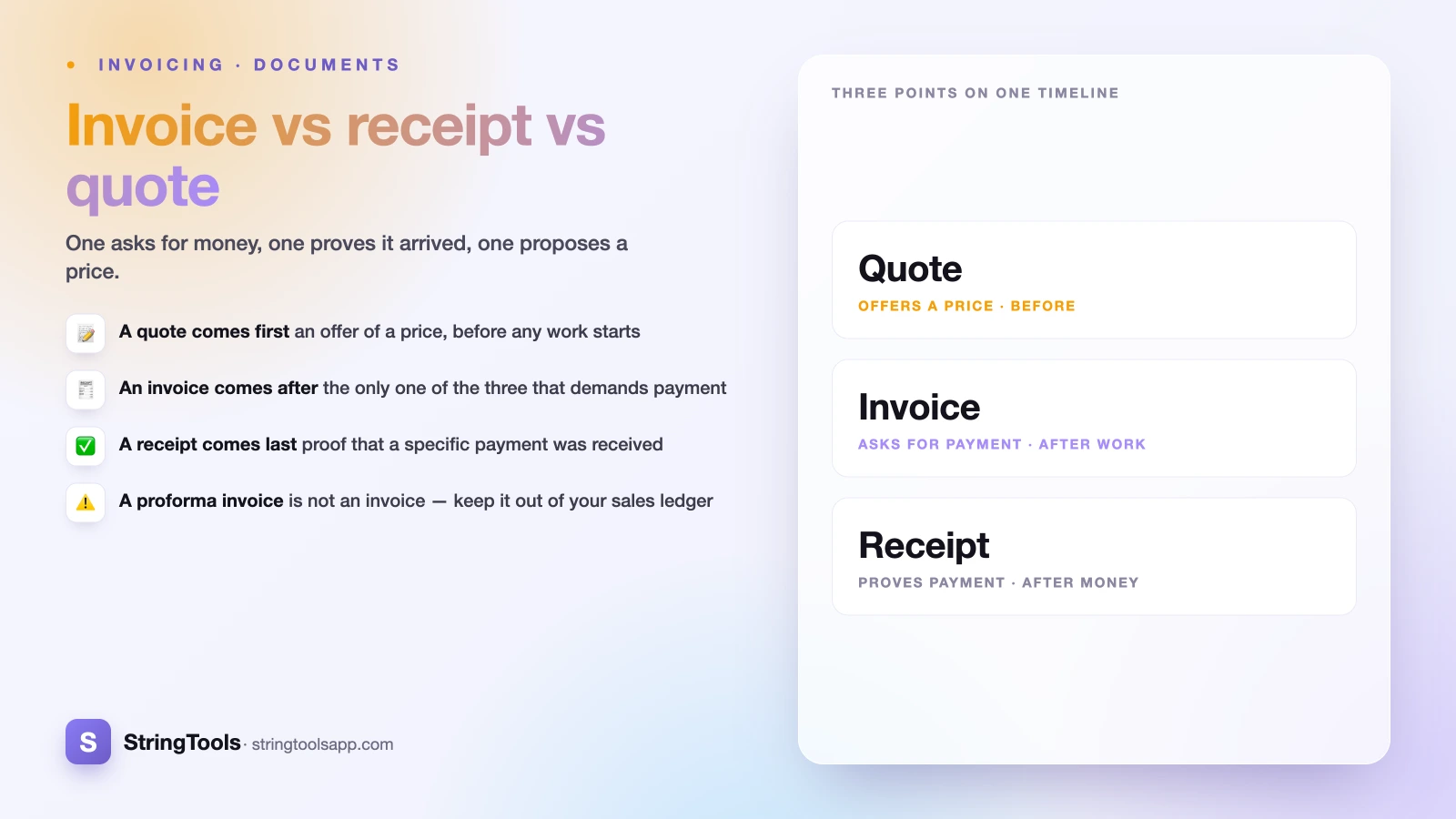
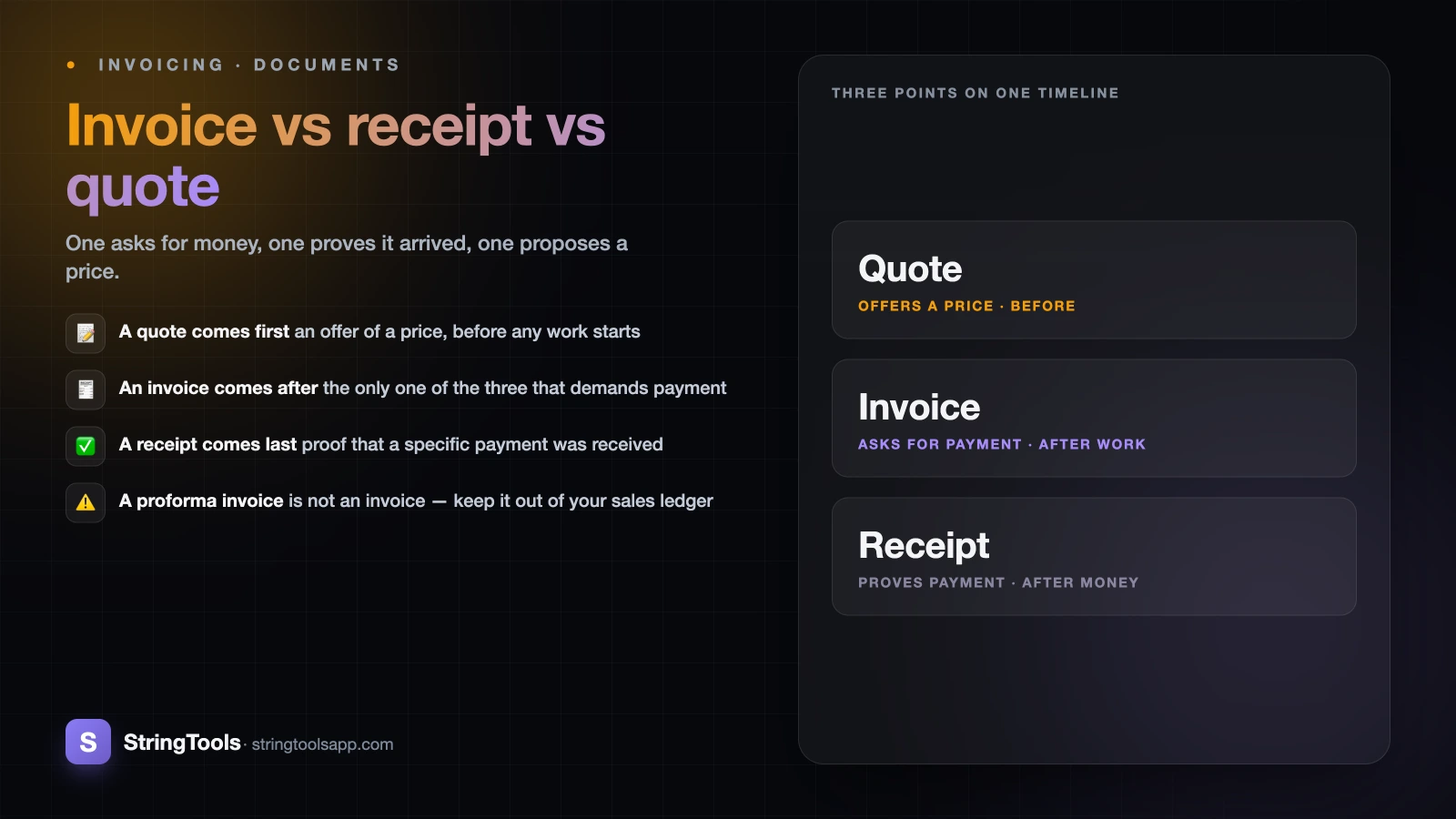
An invoice is a request for payment, issued by the seller once work is agreed or delivered. A receipt is proof that payment was made, issued after the money has changed hands. A quote is an offer of a price, given before any work starts. One asks, one confirms, one proposes.
Key Takeaways
- A quote comes first. An offer of a price, before work starts. Not a demand for payment.
- An invoice comes after. The seller's formal request to be paid, with a unique number, a date and payment terms.
- A receipt comes last. Evidence that a specific payment was received. It obliges no one.
- A "quote" and an "estimate" are not the same thing. A quote is generally treated as a fixed price offer; an estimate is an informed approximation. How much weight each carries depends on your jurisdiction.
- A proforma invoice is not an invoice, and does not belong in your sales ledger.
They sit at three points on the same timeline: before the work, after the work, and after the money. Once you see them that way, the documents that usually cause the confusion — proforma invoices, purchase orders, credit notes, estimates — slot into the same line.
Invoice vs Receipt vs Quote at a Glance
The last column settles most arguments: of the seven documents below, one is a demand to be paid.
| Document | What it is | Who issues it | When | Is it a demand for payment? |
|---|---|---|---|---|
| Quote | A firm offer to do the work for a stated price | Seller | Before work starts | No |
| Estimate | An informed approximation of the likely price | Seller | Before work starts | No |
| Purchase order (PO) | The buyer's formal order, carrying a PO number | Buyer | After the price is agreed, before delivery | No |
| Proforma invoice | A preview of the invoice to come, often used to request a deposit | Seller | Before goods ship or work begins | No — but it is often what triggers a prepayment |
| Invoice | A request for payment for goods or work delivered or agreed | Seller | On or after delivery, per the agreed terms | Yes |
| Receipt | Proof that a specific payment was received | Seller | After the payment clears | No — it closes the loop |
| Credit note | A document that cancels or reduces an earlier invoice | Seller | After an invoice is issued in error, or goods are returned | No — it reduces what is owed |
The rows are in the order a job runs in, and everything except the purchase order is issued by the seller.
The Invoice: A Request for Payment
An invoice is the document that says you owe me this, by this date, for this. It turns finished work into a debt with a deadline attached, creating an account receivable for you and an account payable for your customer whether or not either of you ever touches the money.
Because it is a financial record rather than correspondence, an invoice has a minimum content list: the word "Invoice", a unique sequential number, the issue date, both parties' names and addresses, a description of what was supplied, the amount due, and the payment terms. In VAT and GST countries a tax invoice adds mandatory fields — your tax registration number, the rate applied and the tax shown separately — because it is what the buyer uses to reclaim the tax. Requirements vary by country, so check what your own tax authority demands; the UK rules are in the GOV.UK guide to invoicing and taking payment from customers, and a field-by-field breakdown is in what to include on an invoice.
Two dates matter and people conflate them. The issue date is when the invoice was raised, and in many tax systems it drives which period the sale falls into. The due date is when the money is expected. "Net 30" means 30 days from the issue date; "due on receipt" means immediately. State terms, or there is no clear moment at which the invoice becomes late.
The number matters more than it looks. It must be unique and should be sequential, so a gap is visible. Never reuse one, and never delete an invoice to fix a mistake — that is what credit notes are for. The invoice generator lays out the fields and totals in the right order.
The Receipt: Proof That Money Changed Hands
A receipt is evidence, not a request. It records that a particular payment, of a particular amount, was received on a particular date by a particular method. It asks for nothing and obliges no one. A good receipt states the amount paid, the date, the payment method, what it was for, and — if it settles an invoice — the invoice number.
Receipts feel interchangeable with invoices because of the shop counter: when you buy a coffee, the request for payment and the proof of payment happen in the same second, so the till prints one slip that does both jobs. In trade, where delivery and payment are days apart, the documents separate too.
Three practical points follow:
- A paid invoice is not automatically a receipt, though one marked "PAID" with the payment date is usually accepted as such. If a customer asks, issue a separate document.
- Part payments get their own receipts. Pay half of a GBP 4,000 invoice and the receipt records the GBP 2,000 received; the invoice stands for the balance.
- A remittance advice is the mirror image, sent by the buyer to say which invoices a payment covers. A courtesy note, not proof of receipt.
Customers want receipts because their own records depend on them: expense claims, warranties, insurance, and substantiating a business deduction at tax time. Most tax authorities expect deductions to be backed by contemporaneous records, which is why "I paid cash and got nothing" is an expensive habit — the US position is summarised in the IRS's small business and self-employed guidance.
Quote vs Estimate: The Word That Can Bind You
This is where the money is lost. A quote is normally understood as a fixed price offer: this work, this price. The general principle in most common-law systems is that offer plus acceptance makes a contract, so once the customer accepts, the price is the price — you cannot raise it because the job took longer than you hoped. An estimate is an informed approximation based on what you knew at the time; the final bill can legitimately differ, though the customer is generally entitled to expect the difference to be reasonable and to hear about it before the extra cost is run up.
That is the general principle, not a universal rule. How much weight the label carries, and what a business must do before charging more than it quoted, differs by country and sometimes by state or province. GOV.UK and Citizens Advice cover the UK position; in Australia the ACCC publishes guidance on quotes and misleading pricing; in the US it is largely state consumer protection law, with several states requiring a written estimate before certain work, vehicle repair being the usual example; in Canada it sits with provincial consumer affairs offices. Check the authority that covers you, and take proper legal advice if a large sum turns on the wording. Nothing here is legal advice.
In a dispute, what matters is not only the word at the top of the page but what the two sides actually agreed — and calling a rough figure a "quote" can bind you to it.
The defensive habits cost nothing:
- Label the document deliberately — "Quotation" or "Estimate" at the top, and mean it.
- State a validity period. "Valid for 30 days" stops a customer accepting last spring's price.
- List what is excluded — materials, disposal, parking, out-of-hours work.
- Say how variations are priced. A line such as "additional work will be priced and approved in writing before it begins" prevents most arguments. Get the acceptance in writing, even if it is one line in an email.
The Three Documents People Confuse With These
Once the main three are clear, the rest of the family is easy.
Proforma invoice
A proforma invoice looks like an invoice and is not one. It is a preview: this is what I will charge, if you go ahead. Businesses use them to request a deposit, to give a customer something to raise a PO against, and for customs paperwork on international shipments.
The consequences are administrative. A proforma should not take a number from your invoice sequence or be posted to your sales ledger, and in VAT and GST countries it is generally not a valid tax invoice, so the buyer cannot reclaim tax on it — UK guidance is explicit that it should be marked as not a VAT invoice. When the customer pays or the goods ship, you raise the real invoice.
Purchase order
A purchase order runs the other way: the buyer issues it to the seller, formally ordering what was quoted. It carries a PO number, and in larger organisations that number is the key to getting paid — an invoice without it often bounces straight out of accounts payable. If your customer works with POs, get the number before you start and quote it on every invoice.
Credit note
A credit note reduces or cancels an invoice already issued: wrong amount, goods returned, a discount agreed after the fact, a job cancelled. It is effectively a negative invoice, with its own number and a reference to the invoice it corrects. It exists because you must not delete an issued invoice — sequential numbering only works if the sequence is intact, and auditors read gaps as missing sales.
A credit note is also not a refund: the note adjusts the debt, the refund moves the money. Sometimes both happen, and sometimes the credit simply sits against the next invoice.
Which Document You Need at Each Stage of a Job
Take a straightforward job — fitting a bathroom, or building a website — and walk the paper trail from first contact to closed file.
1. Enquiry. Nothing is issued yet, but write down what was asked for. The scope agreed here is what every later document rests on. 2. Pricing. Send a quote if you can price the work firmly, or an estimate if too much is unknown. Label it, date it, give it a validity period, list the exclusions. 3. Acceptance. The customer accepts in writing. A business customer may issue a purchase order. Record the PO number. 4. Deposit, if you take one. Issue a proforma invoice or a clearly marked deposit invoice, then a receipt when it lands. 5. The work. For goods, a delivery note travels with the shipment so the customer can check what arrived against what was ordered. It shows no prices. 6. Completion. Issue the invoice — final amount, less any deposit paid, with the PO number and your payment terms. 7. Payment. Issue a receipt, or return the invoice marked paid with the date. If you bill monthly, a statement lists what is outstanding across all invoices — a summary, not a new demand. 8. Something goes wrong. A return, an error, an agreed reduction: issue a credit note against the original invoice, and refund separately if money must go back.
The steps people skip are 2 and 7. Skip the quote and you argue about price after the work is done; skip the receipt and you get a customer who cannot remember paying you. If step 6 is the fiddly part, how to write an invoice walks through it line by line.
Keeping the Paper Trail Straight
The documents only work as a set, and a few habits keep the set intact. Build them in early.
Keep separate number series. Quotes as QUO-0001, invoices as INV-0001, credit notes as CRN-0001, proformas as PRO-0001. One series per document type, never reused, never rewound. Then when a customer references "number 42" you know which document they mean.
Never edit an issued invoice. Correct it with a credit note and reissue. This one habit separates books that survive an audit from books that do not.
Match three ways. Before paying a supplier invoice, check it against the purchase order and the delivery note: quantity, price and what arrived should agree. In reverse, check your own invoice against your quote before sending — an invoice exceeding an accepted quote without an approved variation is a reliable way to start a payment dispute.
Keep records as long as your tax authority requires. Retention periods differ by country and run in years, counted from the end of the relevant tax period rather than the invoice date, so check your own authority's current rule rather than a figure someone quoted you. File by customer, then document type, then number; digital copies are fine in most regimes provided they are complete, legible and unaltered.
None of this requires software, only a naming convention you follow. To lay the invoice out correctly without setting up an accounting package, the invoice generator produces a properly structured document you can send today.
Frequently Asked Questions
Is an invoice the same as a receipt?
No. An invoice is a request for payment, issued before the money arrives. A receipt is proof that payment was received, issued after. They can look almost identical, which is why the wording at the top matters. An invoice clearly stamped "PAID" with the payment date is usually accepted in place of a receipt, but issuing a separate receipt is cleaner and leaves no room for argument.
Can I use a quote as an invoice?
You should not. A quote is an offer made before the work; an invoice is a request for payment for work delivered or agreed. They serve different purposes and carry different information — an invoice needs a unique invoice number, an issue date, payment terms and, in VAT or GST countries, tax details a quote does not have. Send the quote first, then raise the invoice from it when the work is done.
Is a proforma invoice legally binding?
A proforma invoice is not a demand for payment and is generally not a valid tax invoice, so a buyer cannot normally use one to reclaim VAT or GST. It is a preview of the invoice that will follow, commonly used to request a deposit or for customs paperwork. Whether the underlying offer binds you depends on what you agreed with the customer, not on the proforma itself. Check your own tax authority's rules on what counts as a valid invoice.
Can a business charge more than the quoted price?
As a general principle, an accepted quote is a fixed price offer and the supplier cannot simply raise it — though the price can change if the customer agrees to extra work or the job turns out to be materially different from what was quoted. An estimate is an approximation, so the final figure can move. The exact rules, and what a business must tell you before charging more, differ by country and sometimes by state or province, so check the authority that covers you — GOV.UK in the UK, the ACCC in Australia, your state consumer protection office in the US, or your provincial consumer affairs office in Canada.
What is the difference between a credit note and a refund?
A credit note is paperwork: it cancels or reduces an invoice that has already been issued, and it carries its own number and a reference to the original invoice. A refund is money moving back to the customer. They often happen together, but not always — a credit can instead sit on the customer's account and be applied against their next invoice. Issue a credit note rather than deleting or editing the original invoice.
Do I have to give a receipt if the customer paid by bank transfer?
Requirements vary by country and by transaction type, so check your local rules. As a matter of practice, issue one anyway. The customer's bank statement shows money leaving their account but not what it was for, and they may need proof of purchase for an expense claim, a warranty or their own tax records. Sending the invoice back marked paid, with the date and the payment method, takes seconds and prevents a chase later.
Sources and references
invoicing and taking payment from customers (gov.uk) · small business and self-employed (irs.gov) · ACCC (accc.gov.au). Content was reviewed against these sources as of the last-updated date above; external figures and rules may change after publication.