
Fixed and Variable Costs, Defined by One Test
A fixed cost happens whether or not you make a sale — rent, salaries, insurance, software. A variable cost exists only because a particular unit was made or sold — materials, packaging, card fees, commission. The test is a single question: if that sale had not happened, would this cost still have landed on the bank statement.
Key Takeaways
- Sort by cause, not by size or by how the invoice arrives. A large annual bill can still be fixed; a tiny per-order fee is variable.
- Semi-variable costs, such as a phone bill with a standing charge plus usage, get split into their two parts rather than dumped into one bucket.
- Step-fixed costs are flat until a volume threshold and then jump. Model the step where you expect it instead of drawing a straight line forever.
- Misclassifying a variable cost as fixed still produces a break-even figure that looks right at your estimated volume, then drifts badly either side of it.
- The fixed-to-variable mix is a risk decision. Two cost structures can share the same break-even point and behave completely differently in a bad month.
This is the sorting job that sits underneath every break-even calculation, every price decision and every quote. Get it right once and the numbers downstream stop arguing with each other.
The break-even calculator takes itemised fixed costs and a single variable cost per unit, so the quality of its answer is entirely the quality of your sorting. How to calculate your break-even point covers what happens after the sort.
The Test, and How to Apply It Consistently
Ask the question in the past tense about one specific sale: if that order had not come in, would this cost still have happened? If yes, it is fixed. If no, it is variable.
Two rules keep the answer consistent.
Fix the period first
Fixed costs are only fixed within a period and a range of activity. Rent is fixed for a month; over five years it is a negotiable commitment. Pick a month, total everything for that month, and stay in that frame. Do not mix an annual insurance premium in with monthly rent without dividing it by twelve.
Ignore who the invoice comes from
Owners tend to sort by supplier — "the printer is a variable cost" — when the correct unit is the cost line. The same supplier can send you a fixed monthly retainer and a per-item charge. Split them.
Two traps recur. The first is treating labour as automatically variable. A salaried employee you pay whether or not orders arrive is a fixed cost, even though they spend their day producing units. Only piece rates, overtime driven by volume and genuinely on-demand contractors behave variably. The second is treating an unpredictable cost as variable because it moves around. Repairs vary month to month without varying with sales volume, which makes them a lumpy fixed cost, not a variable one.
Twenty Common Costs, Sorted
This is the list most small businesses actually argue about. The reason column matters more than the label.
| Cost | Type | Why |
|---|---|---|
| Rent or workshop lease | Fixed | Due in full on an empty month |
| Salaried staff | Fixed | Paid regardless of volume |
| Piece-rate or per-job contractors | Variable | Only engaged when there is work |
| Raw materials | Variable | Consumed by the unit |
| Packaging | Variable | One per order |
| Outbound postage and courier | Variable | Charged per shipment |
| Card processing fee | Variable | A percentage of each sale |
| Marketplace commission | Variable | Charged per sale |
| Business insurance | Fixed | Annual premium, volume-independent |
| Accountant or bookkeeper retainer | Fixed | A flat monthly fee |
| Software subscriptions on a flat plan | Fixed | Same charge at any volume |
| Software priced per transaction | Variable | Scales with orders |
| Utilities standing charge | Fixed | The connection fee half of the bill |
| Utilities usage | Variable | The metered half, where production drives it |
| Loan interest | Fixed | Set by the balance, not by sales |
| Equipment lease | Fixed | Contractual monthly payment |
| Depreciation on owned equipment | Fixed | Time-based, not usage-based |
| Sales commission | Variable | A share of each closed sale |
| Advertising on a fixed monthly budget | Fixed | A decision, not a consequence of a sale |
| Repairs and maintenance | Fixed and lumpy | Varies over time, not with volume |
Advertising is the entry people push back on. If you have committed to a fixed monthly spend, it is fixed — you chose it, and a slow week does not reduce it. Only advertising genuinely charged per conversion, such as an affiliate payout, belongs in the variable column.
Semi-Variable Costs: Split, Do Not Guess
A semi-variable cost has a standing part and a usage part. The classic is a utility bill, but the pattern also covers mobile plans with overage, a leased machine with a per-hour charge, and a warehouse contract with a base fee plus a pick fee.
The high-low method separates them with two months of data. Take your highest-activity month and your lowest:
| Month | Units produced | Total bill |
|---|---|---|
| Quiet month | 300 | 260 |
| Busy month | 500 | 340 |
The variable rate is the change in cost divided by the change in volume: (340 − 260) divided by (500 − 300) = 0.40 per unit. The fixed part is then whatever is left in either month: 260 − (0.40 times 300) = 140. Check it against the busy month: 140 + (0.40 times 500) = 340. It reconciles.
So that 260 bill is 140 of fixed cost plus 0.40 per unit of variable cost, and those two halves go into two different places in your model. Two months is the minimum and it is sensitive to an unusual month, so use the most normal high and low you have rather than the true extremes, and redo it when your process changes.
Step-Fixed Costs: Where the Line Jumps
Fixed costs are flat only within a range of activity. Cross a capacity threshold and they step up: a second oven, a bigger unit, another full-time pair of hands, the next software tier.
Take a maker with 4,800 of monthly fixed costs, a price of 24.00 and a variable cost of 9.00. Contribution is 15.00, so break-even is 4,800 divided by 15.00 = 320 units. Suppose capacity runs out at 600 units and the second oven adds 900 a month. Above that threshold the fixed base is 5,700, and break-even becomes 5,700 divided by 15.00 = 380 units.
| Volume band | Monthly fixed costs | Break-even units in that band |
|---|---|---|
| Up to 600 units | 4,800 | 320 |
| 601 units and above | 5,700 | 380 |
The practical reading is that the step costs you 60 units of extra sales before you are level again — and that growth is not smooth. The month you add capacity is usually a worse month than the one before it, which is normal and worth planning cash for rather than being surprised by. Model the step at the volume you expect to hit it, and check both sides of the threshold before committing.
What a Misclassified Cost Actually Costs You
Here is why the sorting matters more than it looks. Our maker pays a courier 2.00 per order but files it as a fixed cost, estimating 320 orders a month and entering 640 in the fixed column. The variable cost then looks like 7.00 rather than 9.00.
- Correct model: fixed 4,800, contribution 15.00, break-even 320 units.
- Misclassified model: fixed 5,440, contribution 17.00, break-even 320 units.
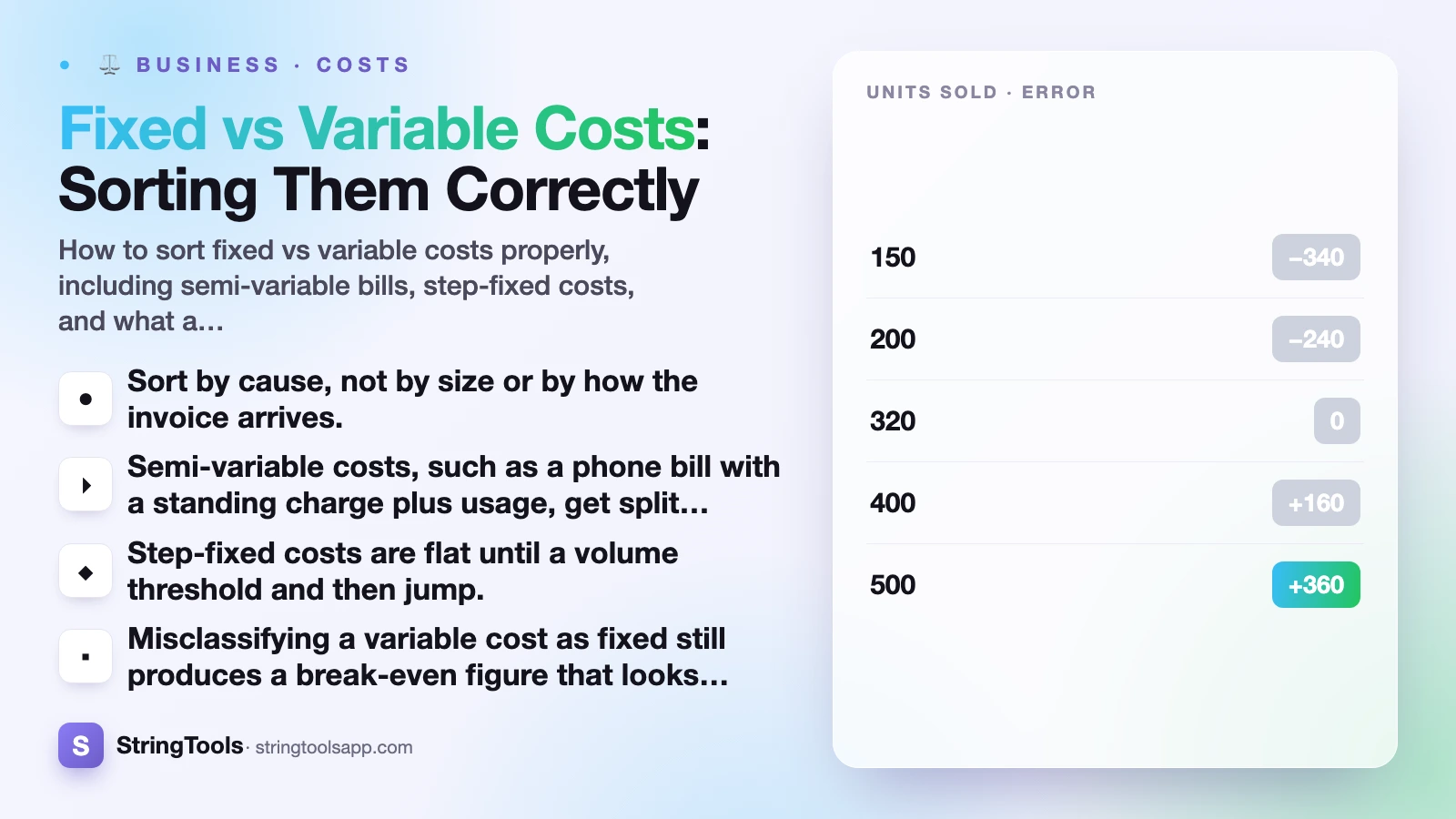
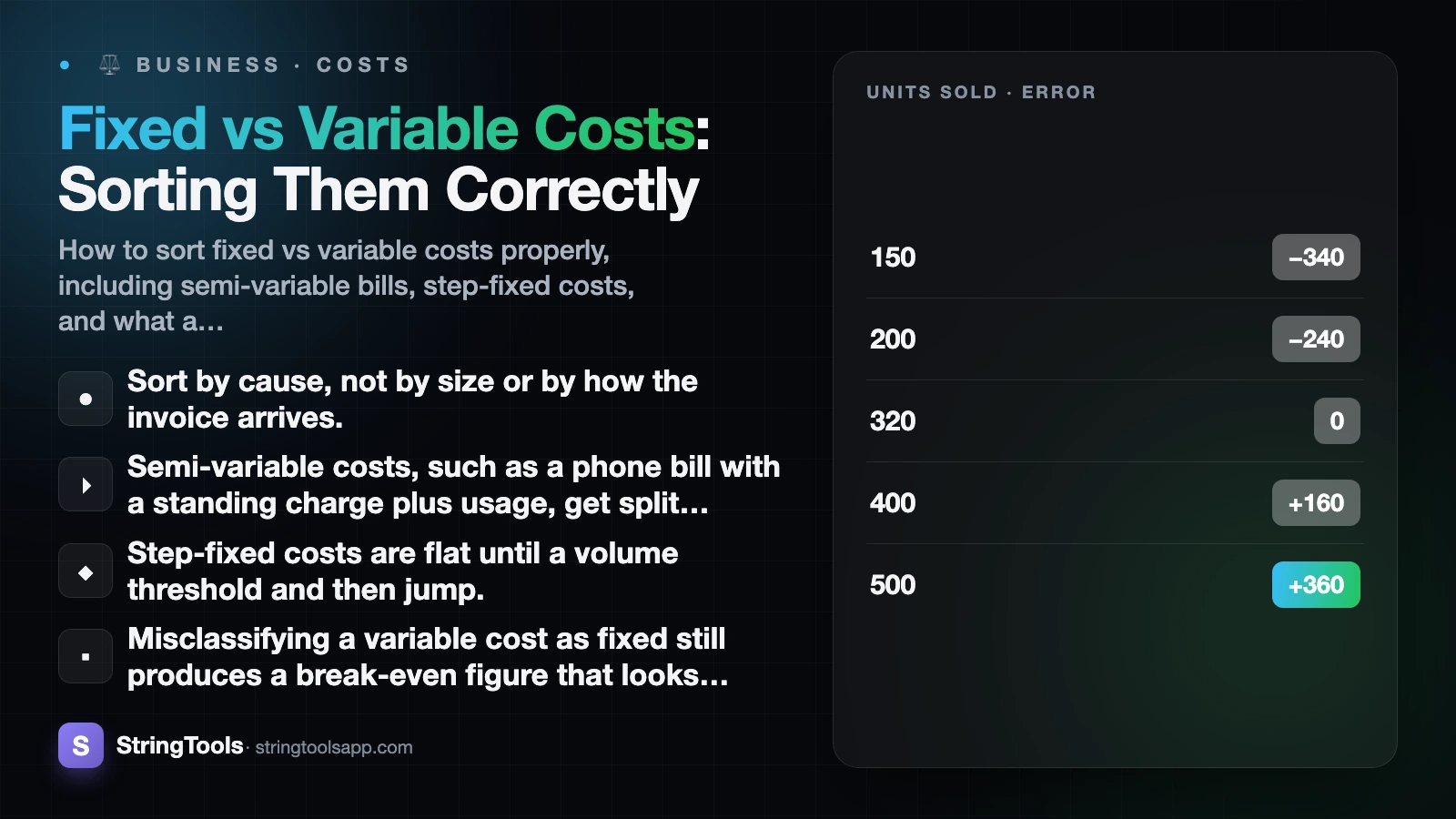
Both say 320, because the estimate was built at 320. The models only diverge once reality does:
| Units sold | Profit, correct model | Profit, misclassified model | Error |
|---|---|---|---|
| 150 | −2,550 | −2,890 | −340 |
| 200 | −1,800 | −2,040 | −240 |
| 320 | 0 | 0 | 0 |
| 400 | 1,200 | 1,360 | +160 |
| 500 | 2,700 | 3,060 | +360 |
| 600 | 4,200 | 4,760 | +560 |
A good month looks 560 better than it is, and a bad month looks 340 worse. The error is invisible at exactly the volume you assumed and grows in both directions. That is a bad property for a number you use to decide whether to take on a big low-margin order — the misclassified model tells you each extra unit contributes 17.00 when it really contributes 15.00, which is exactly the decision you cannot afford to get wrong. Contribution margin goes further into why that per-unit figure drives the decisions.
The Mix Is a Risk Decision, Not an Accounting One
Once you can sort costs, you can choose them. The same business can often be built with high fixed costs and a low unit cost, or low fixed costs and a high unit cost — in-house production versus outsourcing, employees versus contractors, owned equipment versus rented.
Compare two structures for the same product at a 24.00 price:
| Structure A: in-house | Structure B: outsourced | |
|---|---|---|
| Monthly fixed costs | 4,800 | 2,400 |
| Variable cost per unit | 9.00 | 16.50 |
| Contribution per unit | 15.00 | 7.50 |
| Break-even units | 320 | 320 |
| Profit at 200 units | −1,800 | −900 |
| Profit at 400 units | 1,200 | 600 |
| Profit at 640 units | 4,800 | 2,400 |
Identical break-even points, completely different risk profiles. Structure A doubles your money in a good month and hurts twice as much in a bad one. That sensitivity is called operating leverage, and it is a deliberate choice: high fixed costs suit a predictable order book, low fixed costs suit a volatile or seasonal one.
New businesses generally do better starting at the Structure B end and converting variable costs into fixed ones only when volume is proven. Outsourcing is more expensive per unit precisely because someone else is carrying the fixed cost and the risk. The Corporate Finance Institute's summary of fixed and variable costs sets the same distinction out in textbook terms.
Keeping the List Honest
A cost list rots. Subscriptions renew at a higher tier, suppliers reprice, and a trial you forgot about has been billing since spring. Three habits keep it usable.
- Rebuild the fixed list from the bank statement, not from memory. Read a full month of outgoings line by line. The costs people forget are almost always fixed ones, which means the break-even point they carry in their head is too low.
- Recheck the variable cost per unit whenever a supplier or a fee changes. Payment-processing terms, shipping bands and material prices move independently, and a 10% rise in a unit cost quietly moves your whole volume target.
- Keep one period. Convert annual costs to monthly by dividing by twelve, and keep the price and variable cost in the same currency and tax treatment.
For what belongs in the list at all, the tax authority in your own country defines allowable business expenses, and that definition is worth reading before you invent categories. The US Small Business Administration's startup costs guide is a solid prompt list, and GOV.UK's expenses guidance for the self-employed does the equivalent job in the UK.
One note on tax. Break-even models normally work with figures that exclude sales tax or VAT on both sides, because that money is collected on behalf of an authority rather than earned. Keep it out of price and out of variable cost, and be consistent.
This article is general business information, not accounting or tax advice. Cost classification affects reporting and filings, so check the treatment for your own business with a qualified accountant.
Frequently Asked Questions
Is labour a fixed or a variable cost?
It depends on how you pay for it. A salaried employee you pay whether or not orders arrive is a fixed cost, even if they spend the whole day producing units. Piece-rate work, volume-driven overtime, per-job contractors and commission are variable. A salesperson on a base salary plus commission is both: the base goes in fixed costs, the commission in the variable cost per unit.
How do I split a semi-variable cost like a utility bill?
Use the high-low method. Take your highest and lowest activity months, then divide the change in cost by the change in volume to get the variable rate. If a quiet month at 300 units cost 260 and a busy month at 500 units cost 340, the variable rate is 80 divided by 200 = 0.40 per unit, and the fixed part is 260 minus 0.40 times 300 = 140. Check it against the other month before using it.
What is a step-fixed cost?
A cost that stays flat within a range of output and then jumps when you cross a capacity threshold — a second machine, a bigger unit, another full-time hire. With 4,800 of fixed costs and a 15.00 contribution, break-even is 320 units; if passing 600 units requires 900 of extra capacity, fixed costs become 5,700 and break-even rises to 380. Model the step at the volume you expect to reach it.
Is advertising a fixed or a variable cost?
A committed monthly budget is fixed: the charge lands whether or not it produces sales, so it belongs with rent and insurance. Only spend that is genuinely triggered by a sale, such as an affiliate payout or a per-conversion fee, is variable. Treating a fixed ad budget as variable makes your contribution per unit look worse than it is and distorts pricing decisions.
Does it really matter if I put a cost in the wrong bucket?
Yes, and the damage is hidden. If you move a 2.00 per-unit courier charge into fixed costs using a 320-unit estimate, both models report a break-even of 320 units. But at 600 units the misclassified version overstates profit by 560, and at 150 units it understates it by 340. Worse, it tells you each extra unit contributes 17.00 when it really contributes 15.00, which is the number you use to price marginal work.
Is depreciation a fixed cost?
Usually yes. Straight-line depreciation on owned equipment is time-based, so it accrues at the same rate in a busy month and an empty one, which makes it fixed. The exception is usage-based depreciation, where the charge is calculated per machine-hour or per unit produced; in that case it behaves variably. Note that depreciation is an accounting charge rather than a cash payment, so it belongs in a profit model but not in a cash-flow one.
Sources and references
Corporate Finance Institute's summary of fixed and variable costs (corporatefinanceinstitute.com) · US Small Business Administration's startup costs guide (sba.gov) · GOV.UK's expenses guidance for the self-employed (gov.uk). Content was reviewed against these sources as of the last-updated date above; external figures and rules may change after publication.