
The Short Answer
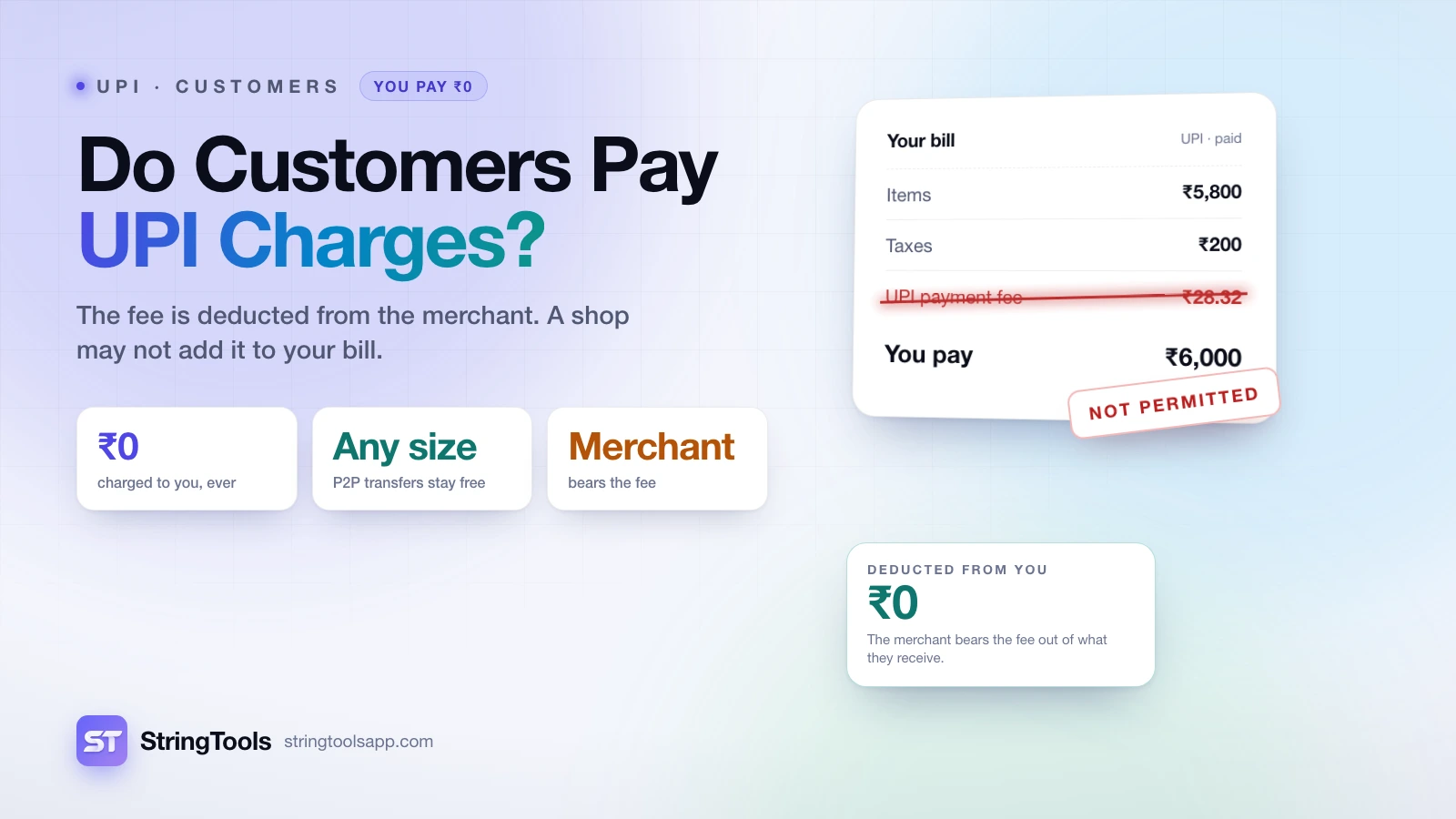
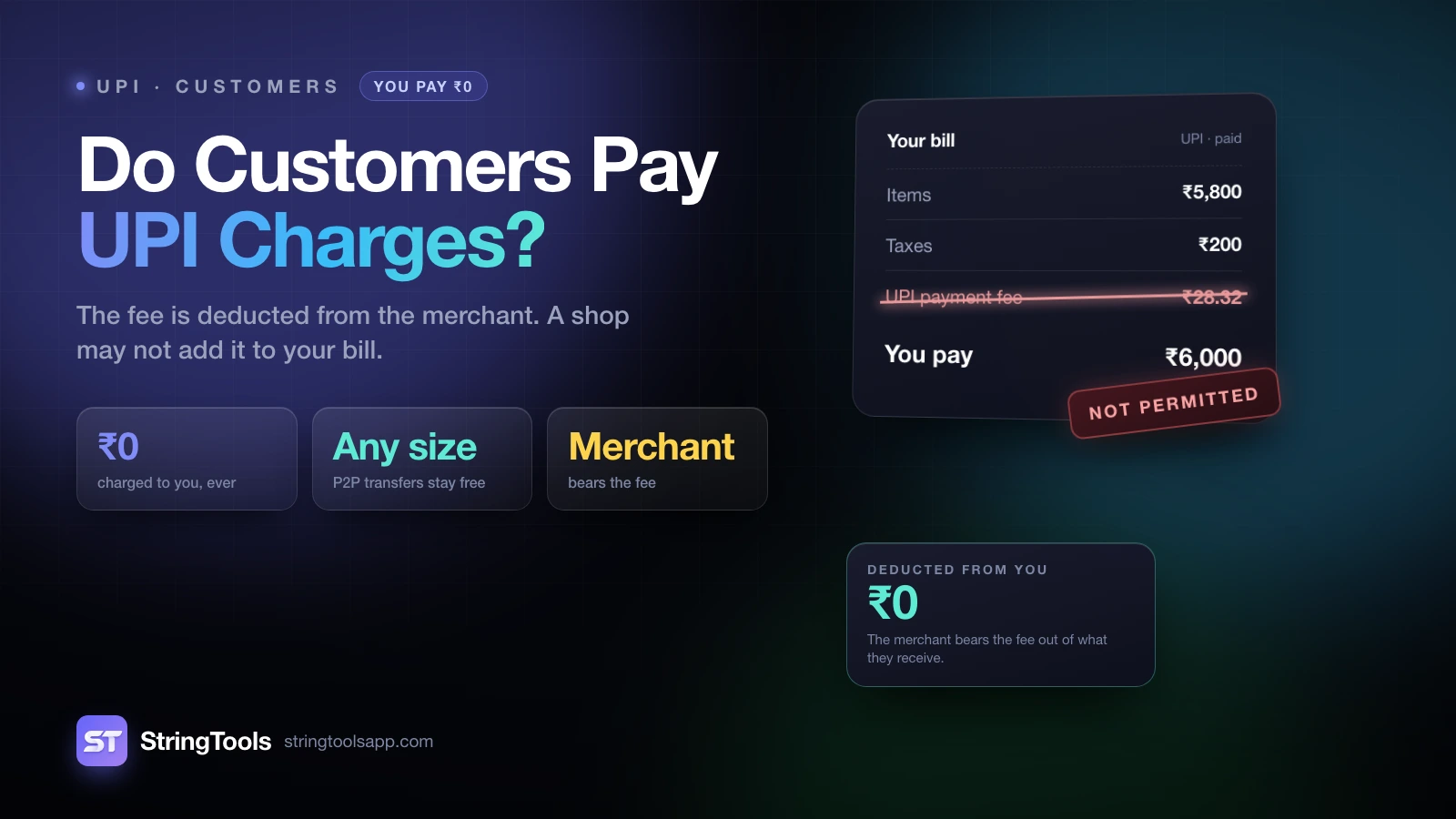
No. If you are the person paying, you are not charged anything, and a merchant is not permitted to add the fee to your bill as a surcharge. The Merchant Discount Rate introduced on 15 October 2026 is deducted from the business receiving the money. Your side of the transaction is exactly what it was.
Key Takeaways
- The fee is deducted from the merchant, never collected from the person paying.
- Merchants are not permitted to pass it on to customers as a surcharge or a separate line.
- Person-to-person transfers are outside the framework at any amount, so sending money to family, friends or a landlord is unaffected.
- Payments of Rs 2,000 or less carry no fee for anybody, merchant or customer.
- If a shop asks you to cover a UPI charge, that is not how the rule works.
- A shop raising its prices is a different thing, and is entirely within its rights.
Where the Confusion Came From
The announcement in September 2026 was widely reported as UPI becoming chargeable, and for a fortnight afterwards a lot of people believed that paying by phone was about to cost them money. The confusion has three roots, and each one is worth untangling.
The first is that UPI is used for two very different things that happen to look identical on your phone. Sending Rs 3,000 to a friend and paying Rs 3,000 to a shop are the same gesture from where you stand, but only one of them is a merchant transaction. The framework touches only the second.
The second is the GST headline. Coverage saying that 18% GST applies to UPI led many to picture 18% of their payment disappearing. The GST is charged on the fee, which is itself 0.4% of the payment. On a Rs 10,000 purchase the fee is Rs 40 and the GST on it is Rs 7.20 — both paid by the merchant, neither by you.
The third is that fees on other payment methods are sometimes passed on, so people reasonably assumed this one would be too. Convenience fees on ticketing sites and platform charges on some apps have made Indian consumers wary of anything described as a payment charge. The rule here is explicit that this particular cost stays with the merchant.
Underneath all three is a simple fact about how the story travelled. The announcement was made on 15 September 2026 and the detail sat in a government FAQ document, while the summary that reached most people was a headline about UPI no longer being free. Headlines have no room for the words qualifying, merchant, above Rs 2,000, or small-merchant exemption, and those four qualifications are most of the rule.
What You Actually Pay, by Situation
| What you are doing | Fee to you | Fee to the other side |
|---|---|---|
| Sending money to a friend or family member | Nothing | Nothing |
| Paying rent to an individual landlord | Nothing | Nothing |
| Buying something for Rs 450 at a shop | Nothing | Nothing |
| Buying something for Rs 6,000 at a shop | Nothing | Rs 28.32 |
| Paying a Rs 6,000 bill to a small QR vendor | Nothing | Nothing |
| Paying Rs 40,000 to a business | Nothing | Rs 188.80 |
Every row in the first column reads the same. That is the point of the table. The merchant's cost varies with the payment size and with their category, and yours does not vary at all because it does not exist. If you want to see what a given payment costs the business receiving it, the UPI MDR calculator will show you, though it is their number rather than yours.
If a Shop Tries to Charge You
It will happen, mostly out of genuine confusion rather than bad faith. A lot of small businesses have read the same misleading coverage everyone else has, and some will conclude that the fee is something they are meant to collect.
If you are asked to pay extra for using UPI, the position is straightforward: merchants are not permitted to pass the MDR to customers. That applies however the charge is described, whether it appears as a UPI fee, a digital payment charge, or a convenience fee added at the counter for choosing to pay by phone.
What a merchant may legitimately do is set their own prices. If a shop raises the price of an item and everyone pays the higher price regardless of how they pay, that is ordinary commercial pricing and has nothing to do with this rule. The distinction is between pricing a product, which is theirs to decide, and taxing a payment method, which is not. Absorbing the fee into prices takes a rise of roughly 0.474%, as our guide on price increase calculator works through.
A shop offering a discount for cash sits in a greyer area, and is a commercial decision rather than a clear rule. What is not grey is a line item added to your bill because you tapped a QR code.
In practice the kindest response, if it comes up at a shop you use regularly, is to mention what the rule actually says rather than to argue about the amount. Most owners asking for it have simply misunderstood what they read, and the sums involved are so small that nobody is getting rich from the confusion. A Rs 6,000 purchase costs the merchant Rs 28.32, and if they are GST-registered they recover Rs 4.32 of that as input credit.
What This Means for How You Pay
Practically, nothing about your habits needs to change. There is no reason to carry more cash, no reason to split your own payments into smaller pieces, and no reason to switch to cards. If anything, the logic runs the other way: UPI remains far cheaper for the merchant than the alternatives, so using it is quietly the friendliest thing you can do for a small business you like.
The comparison is not close. On a Rs 5,000 purchase, UPI costs the merchant Rs 23.60 including GST. A credit card at a typical 2% costs them around Rs 118, and a payment gateway charging 2% plus a fixed fee costs about Rs 121.54. Our payment method comparison goes through the full set.
If you are a customer who wants to be helpful rather than merely neutral, paying by UPI at a small shop is worth more to them than paying by card, and both are usually worth more than handing over notes that someone has to count, reconcile and deposit.
The one situation where your choice genuinely matters is a large purchase from a small business. Buying a Rs 40,000 appliance by credit card costs the shop about Rs 944, while the same purchase by UPI costs them Rs 188.80. That Rs 755 difference is real money to a small dealer, and it is entirely invisible to you at the counter. If you were going to pay either way, the rail you pick is a free gift to whichever side you prefer.
The One Change You Might Notice
Prices may drift up slightly at businesses that sell mostly above Rs 2,000, and that is a legitimate response rather than a workaround. The scale is small: a Rs 3,000 item needs to become Rs 3,014 for the merchant to end up where they were, and a Rs 5,000 item needs to become Rs 5,023.71.
You may also encounter a shop asking to take a larger payment in parts, so that each piece stays under Rs 2,000. This is not prohibited in the way a surcharge is, but it is a practice official guidance has discouraged, and it asks you to approve several payments where one would do. You are entitled to decline and pay in one go. Our piece on payment splitter explains where that sits.
Beyond those two possibilities, the change is invisible from the customer's side, which is very close to how it was designed.
There is one more thing you might notice over time, though it will be subtle. Businesses that sell almost entirely above Rs 2,000 — appliance dealers, opticians, furniture shops, clinics — now have a small reason to prefer payment methods that cost them less, and a slightly stronger reason to care which one you reach for. If a shop mentions that UPI helps them, that is not a sales line; on a Rs 40,000 sale the difference between UPI and a credit card is about Rs 755 of their margin.
Checking This for Yourself
If you would rather not take anyone's word for it, the Department of Financial Services published FAQs on MDR for select UPI (P2M) transactions setting out who bears the charge. SCC Online's explanation of the NPCI FAQs states the consumer position plainly, and HDFC Bank's summary for account holders covers the same ground in ordinary language.
It is worth knowing that the fee itself is not new as a concept. A Merchant Discount Rate has always existed on card payments in India, quietly paid by merchants out of the sale price, and nobody ever billed a customer for it separately. What is new is that UPI, which was free of it for years, now carries a small version of the same thing. The rule that the merchant bears it is the part that has stayed constant throughout.
Frequently Asked Questions
Will money be deducted from my account for using UPI?
No. The amount that leaves your account is the amount you chose to pay, exactly as before. The Merchant Discount Rate is deducted from the business on the other side of the transaction, out of what they receive. Your bank does not charge you for the payment, the app does not charge you, and the merchant is not permitted to add it to your bill. Nothing about the customer experience changes on 15 October 2026.
Is there a charge for sending money to friends and family?
No, and this is worth stating separately because it is where most of the worry has landed. Person-to-person transfers are outside the framework entirely, at any amount. Sending rent to a landlord who is an individual, splitting a restaurant bill with friends, sending money home, or moving money between your own accounts all remain free. The fee exists only on qualifying payments to businesses.
Can a shop add a UPI fee to my bill?
No. Merchants are not permitted to pass the Merchant Discount Rate on to customers as a surcharge, however it is labelled on the bill. If you are asked to pay extra specifically because you are using UPI, that is contrary to how the framework works, and you are within your rights to question it or to ask for it to be removed. Raising the price of goods for everybody is a different matter and is allowed.
Should I pay by cash instead to help small shops?
Usually not. Cash has real costs for a business that are easy to overlook: time spent counting and reconciling, trips to deposit it, the risk of shortfalls, and the loss of a clean record for accounting. On top of that, most small vendors fall under the small-merchant category and pay nothing on UPI anyway, and no merchant pays anything on a payment of Rs 2,000 or less. Paying by UPI is generally the more helpful choice.
Do I pay a fee if the shop is very small?
You never pay a fee regardless of the shop's size, but it is worth knowing that the shop probably does not either. Small merchants classified under P2PM, receiving up to Rs 1 lakh a month through a UPI QR code, are outside the fee at every payment size and do not need GST registration to qualify. Between that carve-out and the Rs 2,000 threshold, the great majority of small Indian businesses are untouched by this change.
Sources and references
FAQs on MDR for select UPI (P2M) transactions (financialservices.gov.in) · explanation of the NPCI FAQs (scconline.com) · HDFC Bank's summary for account holders (hdfc.bank.in). Content was reviewed against these sources as of the last-updated date above; external figures and rules may change after publication.