
Where the Cap Sits and Why
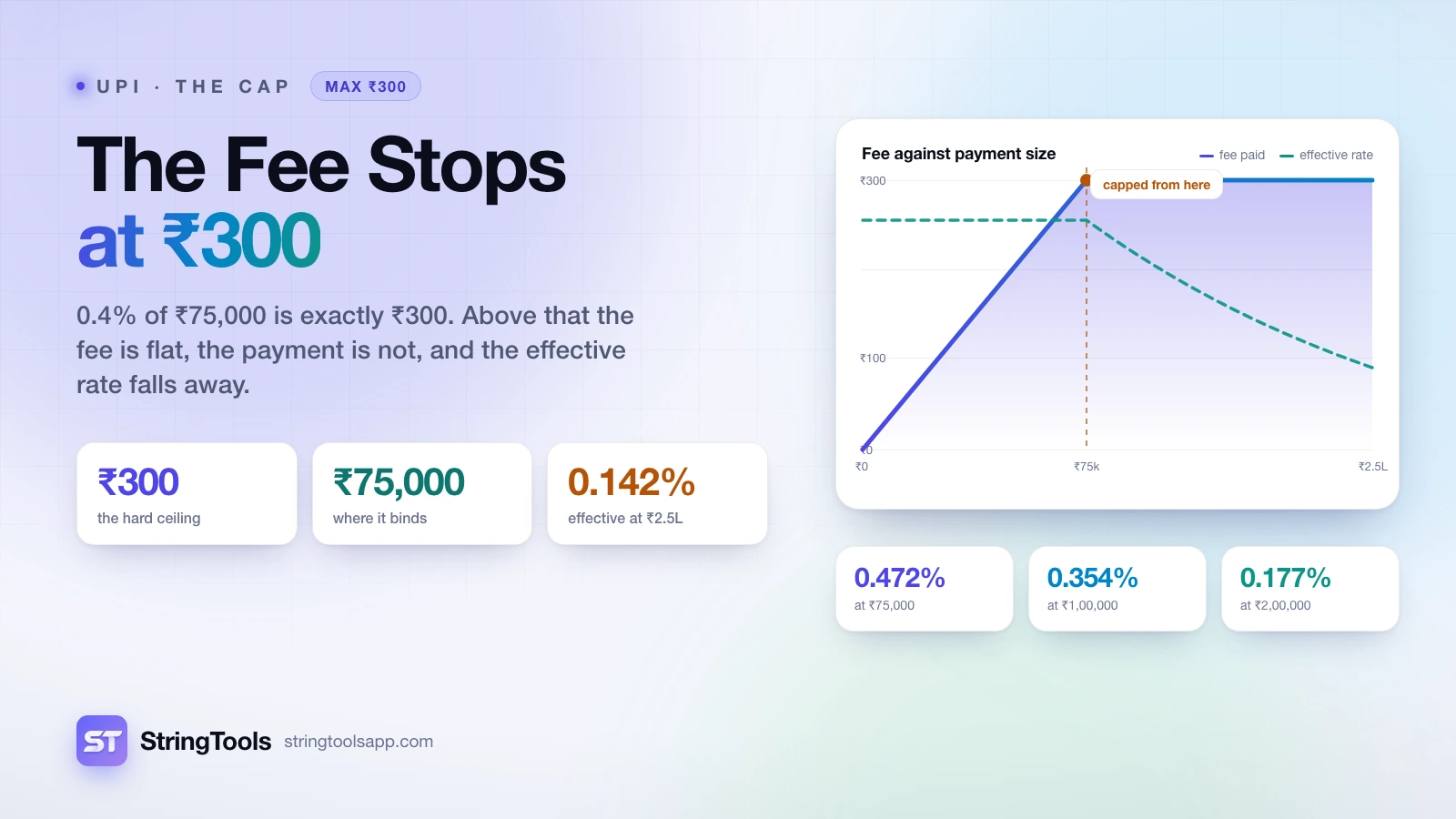
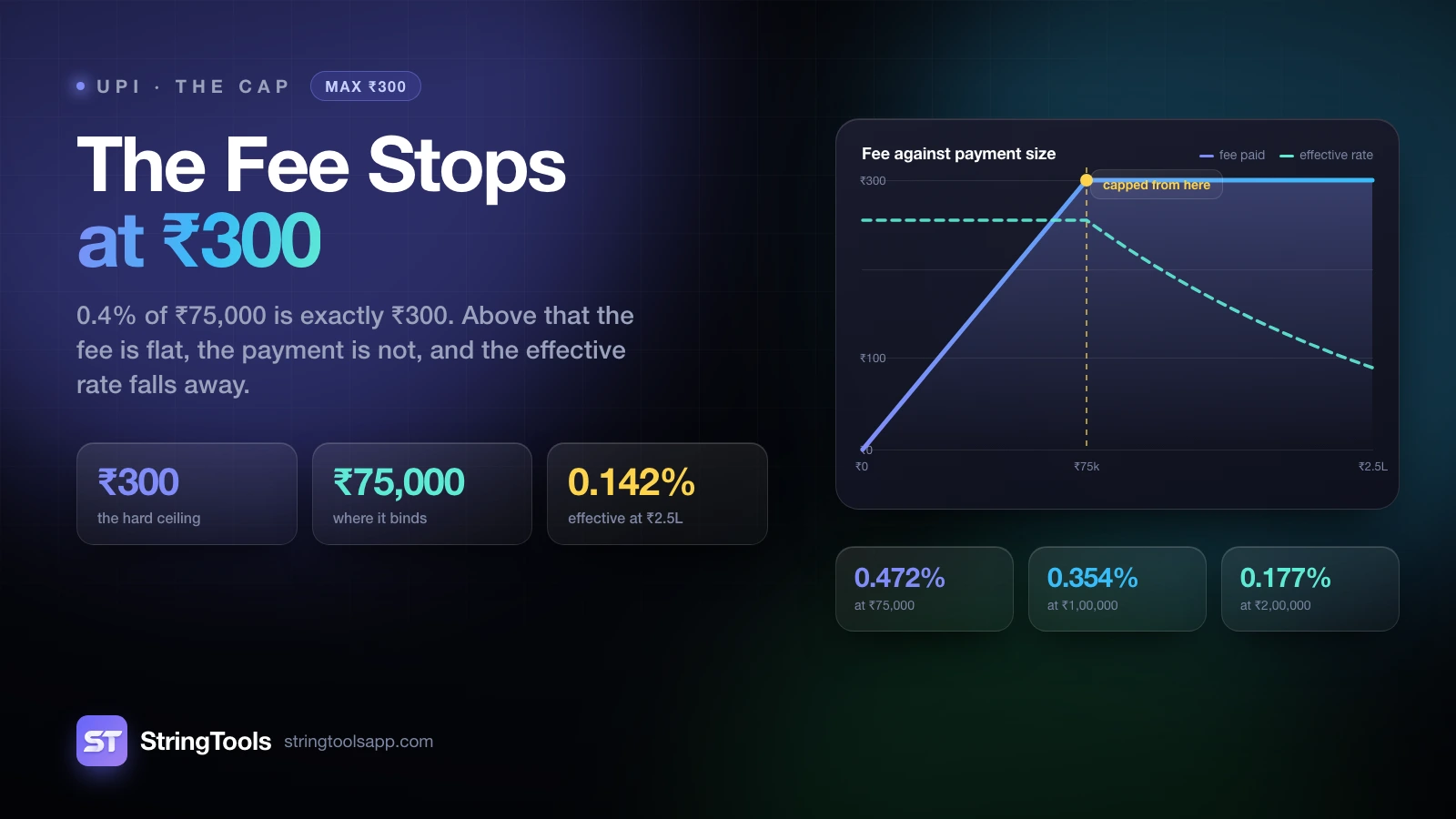
The Merchant Discount Rate on a UPI payment is capped at Rs 300, and the cap starts to bind at Rs 75,000. That is not a coincidence: 0.4% of Rs 75,000 is exactly Rs 300, so the percentage and the ceiling meet at that point. Above it the fee stops growing while the payment keeps going, so the effective rate falls away.
Key Takeaways
- The per-transaction fee is capped at Rs 300, plus Rs 54 of GST, so Rs 354 at most.
- The cap binds from Rs 75,000 upwards, where 0.4% equals exactly Rs 300.
- Above that point the effective rate falls: 0.354% at Rs 1 lakh, 0.177% at Rs 2 lakh.
- A Rs 10 lakh payment costs the same Rs 354 as a Rs 75,000 one.
- The cap is what makes UPI dramatically cheaper than cards on large sales.
- It also means splitting large payments makes no arithmetic sense at all.
The Falling Rate, in Numbers
| Payment | MDR | Deducted with GST | Effective rate |
|---|---|---|---|
| Rs 50,000 | Rs 200.00 | Rs 236.00 | 0.472% |
| Rs 75,000 | Rs 300.00 | Rs 354.00 | 0.472% |
| Rs 1,00,000 | Rs 300.00 | Rs 354.00 | 0.354% |
| Rs 2,00,000 | Rs 300.00 | Rs 354.00 | 0.177% |
| Rs 2,50,000 | Rs 300.00 | Rs 354.00 | 0.142% |
The first two rows are the last of the percentage regime. From the third row down the deduction is frozen and only the denominator moves, so the rate slides. By Rs 2.5 lakh the merchant is paying about one seventh of one percent.
This is the opposite of what most people assume when they hear a percentage fee. The instinct is that big payments are expensive, and under a pure percentage they would be. The cap inverts it: the larger the sale, the cheaper it is in proportional terms, and the gap against uncapped alternatives widens rather than narrows. Any amount can be checked in the UPI MDR calculator, which flags when the cap has taken effect.
What the Cap Does to the Card Comparison
Card pricing in India generally has no equivalent ceiling. A credit card at a typical 2% charges 2% whether the sale is Rs 5,000 or Rs 5 lakh. Put that next to a fee that stops at Rs 300 and the divergence becomes dramatic.
| Sale | UPI | Credit card at a typical 2% | Difference |
|---|---|---|---|
| Rs 5,000 | Rs 23.60 | Rs 118.00 | Rs 94.40 |
| Rs 25,000 | Rs 118.00 | Rs 590.00 | Rs 472.00 |
| Rs 75,000 | Rs 354.00 | Rs 1,770.00 | Rs 1,416.00 |
| Rs 2,00,000 | Rs 354.00 | Rs 4,720.00 | Rs 4,366.00 |
On the last row the card costs roughly thirteen times what UPI does. Card rates are typical commercial figures rather than regulated ones and vary by acquirer and card type, so your own contract governs — but the shape holds regardless of the exact percentage, because the shape comes from one fee being capped and the other not being.
For a jeweller, a furniture retailer, an appliance dealer or anyone taking payments in the lakhs, this is the single most important feature of the new framework. Our payment method comparison works through the rest of the methods.
Why Splitting Large Payments Is Pointless
The cap quietly destroys the case for breaking big payments into pieces, and it is worth seeing why in numbers.
Suppose you are collecting Rs 2,50,000 and you split it into payments of Rs 2,000 to stay under the threshold. That is 125 separate payments. The fee you avoid is Rs 354, of which Rs 54 was GST you would have reclaimed anyway if registered, so the real saving is Rs 300. Divided across 125 approvals, each one your customer has to authorise on their phone, that is Rs 2.40 per approval.
Compare the same exercise on a Rs 12,000 sale: six payments, a real saving of Rs 48, or Rs 8 an approval. Still small, but three times better per unit of customer friction. The saving from splitting peaks somewhere in the middle of the range and then collapses, precisely because the undivided fee was already capped.
So the rule of thumb is simple: above Rs 75,000, splitting achieves nothing worth having. Our guide to payment splitter has the full table, and the payment splitter shows the number of approvals alongside the saving so the trade is visible.
Who This Helps Most
The cap is a deliberate piece of design, and it favours a specific set of businesses. If your average sale is well above Rs 75,000, your effective cost of accepting UPI is a fraction of the headline rate, and it keeps falling as your ticket size rises.
That includes vehicle dealers, jewellers, electronics and appliance retailers, furniture and interiors businesses, medical procedures, education fees where the concessional treatment does not already apply, and business-to-business suppliers invoicing in lakhs. For all of them the change from zero MDR to capped MDR is modest, while the comparison against card acceptance has moved sharply in UPI's favour.
That pattern is unusual enough to state plainly, because it runs against the intuition most people bring to fees. A structure with a threshold at one end and a cap at the other is hardest on whoever sits between them, and a few thousand rupees a sale puts you squarely in that band. It is still under half a percent, but it is the full half a percent, on nearly everything you sell.
The businesses that feel this change most are not the ones taking huge payments. They are the ones clustered just above the threshold — selling at Rs 2,500 to Rs 10,000, where the full 0.472% applies to everything and no cap relief arrives. A dealer selling Rs 12,000 phones pays 0.472% on nearly all revenue. A dealer selling Rs 2 lakh machines pays 0.177%. The mid-market carries the highest proportional cost, which is worth knowing when you read claims that this change targets large business.
How the Cap Changes a Quotation
For businesses that quote before they invoice, the cap turns what looks like a percentage into something closer to a fixed line item, and that is worth reflecting in how you price large jobs.
Consider a contractor quoting Rs 3 lakh for a fit-out. Under a pure percentage the payment cost would scale with the job, so a bigger contract would carry a bigger fee and pricing it as a percentage would make sense. Under the cap it does not scale at all: the fee on that Rs 3 lakh is Rs 354, exactly the same as on a Rs 75,000 job. Building a percentage allowance into a large quotation therefore over-recovers, sometimes substantially.
The cleaner approach on high-value work is to treat the payment cost as a flat Rs 354 per invoice and, if the job is being paid in stages, to count one Rs 354 per stage that exceeds Rs 75,000. Staged payments are where this bites: a Rs 3 lakh job settled in four instalments of Rs 75,000 costs Rs 1,416 rather than Rs 354, because each instalment is capped separately. That is the one case where consolidating payments genuinely saves money, and it is the mirror image of splitting them.
Checking Your Own Position
Two figures are worth working out before 15 October. The first is your effective rate, which is your total expected fee divided by your total UPI turnover — the only number directly comparable to what other payment methods cost you. The UPI fee estimator computes it from a mix of payment sizes rather than a single average, which matters because the threshold and the cap both sit inside most businesses' range.
The second is the share of your turnover that sits above Rs 75,000 per transaction. If a large part of your revenue arrives in payments over that line, your headline exposure is much smaller than 0.4% and the cap is doing the work.
For the rules themselves, the Department of Financial Services published FAQs on MDR for select UPI (P2M) transactions, and SCC Online's walk-through of the NPCI FAQs covers the cap explicitly. Vajiram and Ravi's summary of the new merchant charges is a compact reference if you want the structure without the detail.
One last point is worth carrying away. The cap means the worst case for any single UPI payment is Rs 354, and you can say that flatly to anyone in your business who is nervous about large transactions. There is no scenario in which a customer paying you a very large sum costs you a very large fee. That certainty is unusual in payment pricing, and it is most of what the cap actually buys you.
It also changes how a high-value business should think about which rail to encourage. If you sell at Rs 1 lakh and a customer offers a credit card, the difference to you is roughly Rs 4,366 on that one sale. Nothing stops you making the QR code the obvious option at the counter, and at those amounts it is worth the small effort of doing so.
Frequently Asked Questions
What is the maximum MDR on a single UPI transaction?
Rs 300, plus Rs 54 of GST on that fee, so Rs 354 is the most that can be deducted from one payment. The cap applies from Rs 75,000 upwards, because 0.4% of Rs 75,000 is exactly Rs 300. Above that value the fee does not grow at all, so a Rs 10 lakh payment costs the merchant the same Rs 354 as a Rs 75,000 payment does.
Why does the effective rate fall on large payments?
Because the fee is frozen while the payment keeps growing. Up to Rs 75,000 the deduction is 0.472% of the payment including GST, and that proportion is constant. Above Rs 75,000 the deduction is a fixed Rs 354, so dividing it by a larger and larger payment gives a smaller and smaller percentage: 0.354% at Rs 1 lakh, 0.177% at Rs 2 lakh, 0.142% at Rs 2.5 lakh.
Does the cap make UPI cheaper than cards on big sales?
Substantially, and the gap widens as the sale grows. Card pricing in India generally has no equivalent ceiling, so a card at a typical 2% keeps charging 2% at any value. On a Rs 2 lakh sale that is around Rs 4,720 against Rs 354 on UPI, roughly thirteen times as much. Card rates are commercial figures that vary by acquirer and card type, but the shape holds because one fee is capped and the other is not.
Should I split large payments to avoid the fee?
Above Rs 75,000 there is no arithmetic case for it at all. The fee on the undivided payment was already capped at Rs 300, so splitting Rs 2,50,000 into 125 payments of Rs 2,000 saves Rs 300 in real terms, about Rs 2.40 for each approval you ask your customer to make. Structuring payments around a regulatory threshold is also a pattern acquirers monitor, which makes a poor trade worse.
Which businesses benefit most from the cap?
Anyone whose typical sale is well above Rs 75,000: vehicle dealers, jewellers, appliance and furniture retailers, medical procedures and business-to-business suppliers invoicing in lakhs. Their effective rate is a fraction of the headline. The businesses carrying the highest proportional cost are those selling between roughly Rs 2,500 and Rs 10,000, where the full rate applies to everything and no cap relief ever arrives.
Sources and references
FAQs on MDR for select UPI (P2M) transactions (financialservices.gov.in) · walk-through of the NPCI FAQs (scconline.com) · summary of the new merchant charges (vajiramandravi.com). Content was reviewed against these sources as of the last-updated date above; external figures and rules may change after publication.