
What Changed, in One Paragraph
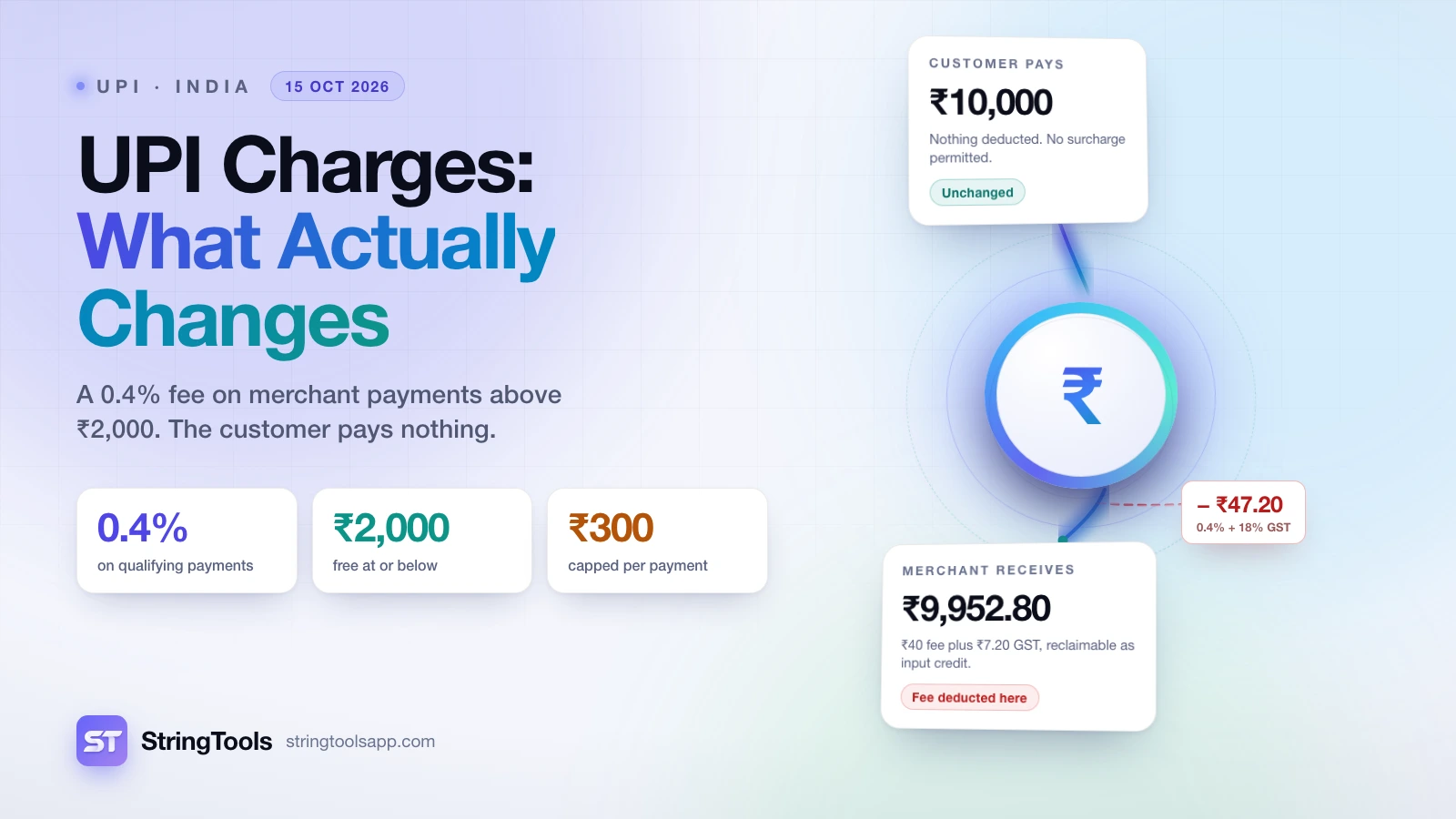
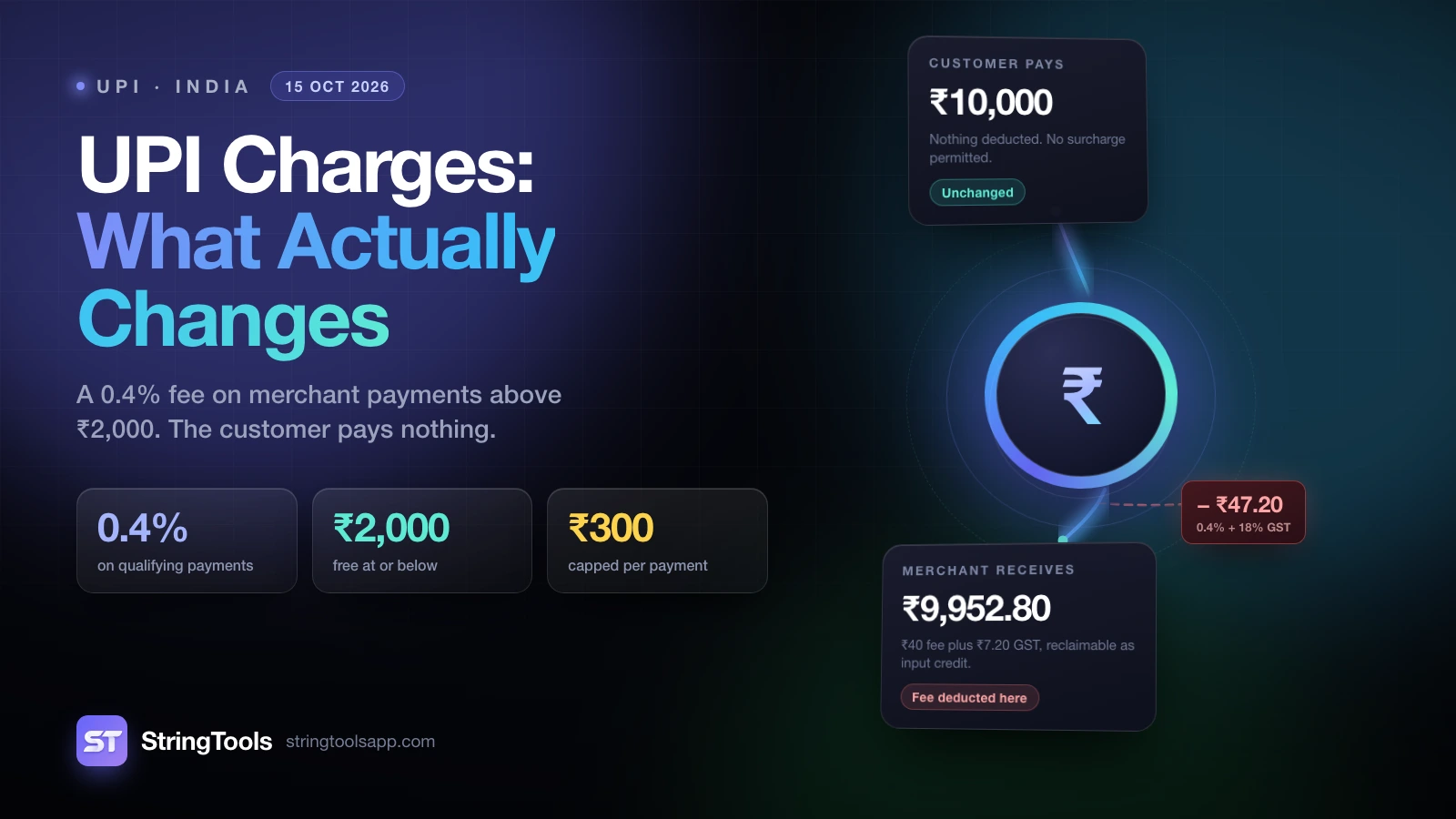
From 15 October 2026, a Merchant Discount Rate of 0.4% applies to qualifying UPI person-to-merchant payments above Rs 2,000. The merchant pays it, not the customer. It is capped at Rs 300 on a single transaction, small merchants receiving up to Rs 1 lakh a month by QR code pay nothing, and every payment of Rs 2,000 or less stays free for everyone. Person-to-person transfers are untouched at any amount.
Key Takeaways
- The rate is 0.4% on qualifying merchant payments above Rs 2,000, effective 15 October 2026.
- Merchants pay it, customers do not, and merchants may not add it to a bill as a surcharge.
- The fee is capped at Rs 300 per transaction, a ceiling that binds from Rs 75,000 upwards.
- 18% GST applies to the fee itself, and a GST-registered merchant reclaims it as input tax credit.
- Small merchants under P2PM, taking up to Rs 1 lakh a month by QR, continue at zero.
- Sending money to another person sits outside the framework entirely, at any value.
The Numbers, Payment by Payment
The quickest way to understand the change is to watch what it does to real amounts. The table below is the whole rule expressed as arithmetic, for a standard merchant.
| Payment | MDR | GST on the fee | Deducted | Merchant receives |
|---|---|---|---|---|
| Rs 500 | Rs 0 | Rs 0 | Rs 0 | Rs 500.00 |
| Rs 2,000 | Rs 0 | Rs 0 | Rs 0 | Rs 2,000.00 |
| Rs 2,500 | Rs 10.00 | Rs 1.80 | Rs 11.80 | Rs 2,488.20 |
| Rs 10,000 | Rs 40.00 | Rs 7.20 | Rs 47.20 | Rs 9,952.80 |
| Rs 75,000 | Rs 300.00 | Rs 54.00 | Rs 354.00 | Rs 74,646.00 |
| Rs 2,00,000 | Rs 300.00 | Rs 54.00 | Rs 354.00 | Rs 1,99,646.00 |
Two things stand out. The step from Rs 2,000 to Rs 2,500 is where the fee begins, and it begins on the whole payment rather than on the Rs 500 sitting above the line. And the last two rows are identical, because the cap has already bound by then. You can run any amount through the UPI MDR calculator to see the same breakdown for your own figures.
The pattern in the middle of the table is worth naming. Between Rs 2,000 and Rs 75,000 the effective rate is flat at 0.472% — that is the 0.4% plus its GST — and it does not vary with the size of the sale at all. Only at the two ends does anything interesting happen.
It is also worth sitting with how small these numbers are in absolute terms. A business taking a Rs 10,000 payment gives up Rs 47.20, and Rs 40 of that if it can reclaim the GST. That is roughly the cost of a cup of tea for each customer spending ten thousand rupees. Whether that matters depends entirely on the margin in the sale, which is why the same fee can be irrelevant to a jeweller and irritating to a mobile-phone dealer working on two percent.
Who Pays Nothing at All
Most Indian businesses will not pay this fee, and it is worth being specific about why rather than leaving people to assume the worst.
The small-merchant category, known as P2PM, covers vendors and tiny businesses accepting payments through a UPI QR code. While monthly receipts stay within Rs 1 lakh, the MDR is zero at every payment size. GST registration is not required to qualify, which matters because a great many of the vendors this category protects sit below the GST registration threshold anyway.
Separately, and independently, any payment of Rs 2,000 or less attracts nothing. This catches far more businesses than people expect. A tea stall taking 3,000 payments averaging Rs 120 collects Rs 3,60,000 in a month and owes nothing, because not one of those payments crosses the threshold. The same holds for a kirana store whose baskets are mostly under Rs 1,000. Neither of them needs small-merchant status to escape the fee; the threshold alone does it.
Certain sectors pay a flat Rs 5 per qualifying transaction instead of the percentage: railways, telecom, insurance, fuel and agricultural inputs. On a Rs 50,000 payment that is Rs 5.90 including GST rather than Rs 236. Capital markets receive a concessional 0.02% capped at Rs 300. Education is described as receiving concessional treatment, though no single published figure has been given, so institutions should confirm with their acquirer rather than budget on a guess.
The logic behind these carve-outs is not hard to read. The flat-fee sectors are ones where payments are large, frequent and low-margin, and a percentage would have been punishing: a fuel station taking Rs 3,000 at a time on wafer-thin margins would have felt 0.4% badly. Capital markets move enormous sums where even a small percentage becomes absurd. The small-merchant carve-out exists because the vendors it covers could not absorb a card-style fee at all, and because pushing them back to cash would undo a decade of work getting them onto digital rails.
Why This Is Not a Tax on Your Payments
A good deal of the alarm around this change comes from two words being run together: GST and UPI. The headline that 18% GST applies has been read by many people as 18% of their payment, which would be extraordinary. It is not that.
GST at 18% applies to the fee, not to the transaction. On a Rs 10,000 sale the fee is Rs 40 and the GST on that fee is Rs 7.20. The total leaving the merchant's account is Rs 47.20. Nothing whatsoever is charged on the Rs 10,000 itself.
There is a further step that most coverage skips. A GST-registered merchant can claim that Rs 7.20 back as input tax credit, which makes the real cost the bare Rs 40. A merchant who is not registered, or who supplies exempt goods and cannot claim full credit, genuinely bears the whole Rs 47.20. The gap between those two positions is 18% of the cost, decided entirely by registration status. Our guide to GST on UPI MDR and input tax credit works through both cases, and the GST calculation guide covers how input credit works more generally.
The Practical Effect on a Real Business
Headline rates tell you very little on their own. What matters is how your sales are distributed across payment sizes, because the fee has a threshold sitting in the middle of ordinary retail prices.
| Business | Monthly turnover | Fee a month | Effective rate |
|---|---|---|---|
| Tea stall, 3,000 payments averaging Rs 120 | Rs 3,60,000 | Rs 0 | 0% |
| Kirana store, mostly small baskets | Rs 3,87,000 | Rs 283.25 | 0.073% |
| Restaurant, mixed table sizes | Rs 12,38,000 | Rs 1,486.80 | 0.120% |
| Electronics dealer, high-ticket sales | Rs 20,58,000 | Rs 9,062.40 | 0.440% |
The restaurant and the electronics dealer are the pair worth studying. The dealer collects less than twice as much money and pays six times the fee, because almost none of its sales fall under the threshold while almost all of the restaurant's do. Turnover is the wrong number to start from; the shape of your sales is the right one, which is why the UPI fee estimator asks for bands of payment sizes rather than a single total.
These are illustrative business shapes chosen to show the range, not survey data, and they exclude anything your bank or aggregator charges you separately.
What You Should Not Do About It
Three responses come up immediately, and two of them are mistakes.
Adding a UPI surcharge at the till is not permitted. Merchants may not pass the MDR to customers, whatever the line on the bill is called. This is the clearest rule in the whole framework and the one least worth testing.
Splitting every sale into pieces under Rs 2,000 saves less than people assume and creates a pattern that acquirers monitor. On a Rs 4,550 sale, splitting saves Rs 18.20 once input tax credit is accounted for, in exchange for asking a customer to authorise three payments instead of one. There are legitimate reasons to split a payment, and our guide to payment splitter covers both sides honestly, but fee avoidance is a thin one.
Pricing for it is the legitimate lever. Absorbing a 0.4% fee takes a price rise of about 0.474%, slightly more than the fee because raising the price raises the fee with it. On a Rs 3,000 item that is Rs 14. Setting your own prices has always been your decision, and at that scale most customers will not notice.
There is a fourth response that deserves mentioning only to be dismissed: going back to cash. Weigh the fee against what handling notes actually costs you — the time counting and reconciling, the trips to deposit, the shrinkage, the sales lost when a customer has nothing on them, and the clean record that digital payments hand you for free. On a Rs 5,000 sale the fee is Rs 23.60, or Rs 20 after input credit. Very few businesses can process the same Rs 5,000 in cash for twenty rupees of effort.
Where to Check the Rules Yourself
This change has been covered unevenly and some of what has circulated is simply wrong. The Department of Financial Services published FAQs on MDR for select UPI (P2M) transactions on 15 September 2026, which is the document to read if you want the rules first-hand. SCC Online's walk-through of the NPCI FAQs is an easier read for anyone who wants the legal framing without the PDF, and HDFC Bank's summary of the new rules is written for account holders rather than lawyers.
For the wider question of why a fee was introduced at all after years of zero-MDR policy, Al Jazeera's report on the change and who benefits sets out the arguments on both sides.
If you are a merchant, the single most useful thing you can do before 15 October is find out from your bank or payment provider which category your account is in. P2PM and P2M are assigned by your provider from how the account was registered and how it is used, not chosen by you, and the difference between them is the difference between paying nothing and paying the standard rate. It is a question they can answer in a minute, and it beats guessing.
Frequently Asked Questions
Do I have to pay a fee when I send money on UPI?
No. If you are sending money to another person, nothing has changed and nothing is deducted. The fee applies only to qualifying payments made to businesses, and even then the business pays it rather than you. Merchants are not permitted to add it to your bill as a separate charge. If a shop tells you there is a UPI fee for you to pay, that is not how the rule works, and you would be right to question it.
Is UPI no longer free in India?
For consumers it is exactly as free as it was. For merchants, qualifying payments above Rs 2,000 now carry a 0.4% cost, which is still the cheapest electronic payment rail available to them by a wide margin. Small merchants inside the Rs 1 lakh monthly QR limit continue at zero, and payments of Rs 2,000 or less are free for every merchant. The change is considerably narrower than the headlines have suggested.
What is the maximum UPI charge on one transaction?
Rs 300, plus Rs 54 of GST on that fee, so Rs 354 leaves the merchant's account at most. The cap applies from Rs 75,000 upwards, which is not a coincidence: 0.4% of Rs 75,000 is exactly Rs 300, so the percentage and the ceiling meet at that value. Above it the fee stops growing while the payment does not, so the effective rate falls the larger the transaction gets.
When exactly does this start?
15 October 2026. The framework was announced on 15 September 2026, giving a month of notice. Payments made before that date are unaffected and there is nothing retrospective about it. If you are a merchant, that month is best spent confirming your category with your payment provider and working out what your own mix of payment sizes will actually cost, rather than assuming the headline rate applies to everything you sell.
Which businesses are exempt from UPI MDR?
Small merchants classified under P2PM who receive up to Rs 1 lakh a month through UPI QR codes pay nothing at any payment size, and GST registration is not required to qualify. Beyond that, every merchant pays nothing on payments of Rs 2,000 or less. Railways, telecom, insurance, fuel and agricultural inputs pay a flat Rs 5 rather than a percentage, and capital markets pay a concessional 0.02% capped at Rs 300.
Sources and references
FAQs on MDR for select UPI (P2M) transactions (financialservices.gov.in) · walk-through of the NPCI FAQs (scconline.com) · HDFC Bank's summary of the new rules (hdfc.bank.in) · report on the change and who benefits (aljazeera.com). Content was reviewed against these sources as of the last-updated date above; external figures and rules may change after publication.