
The Answer, and Why It Matters
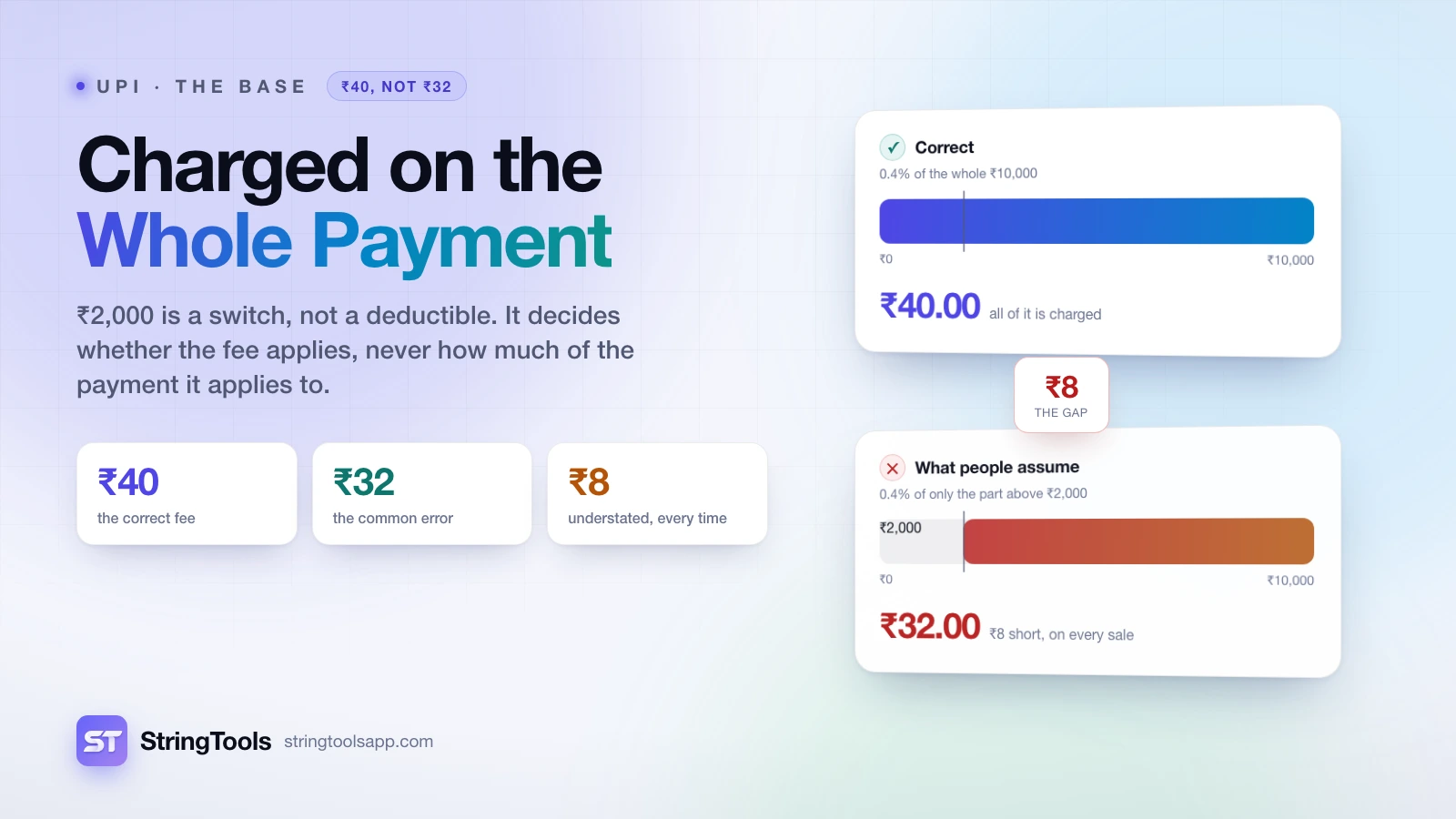
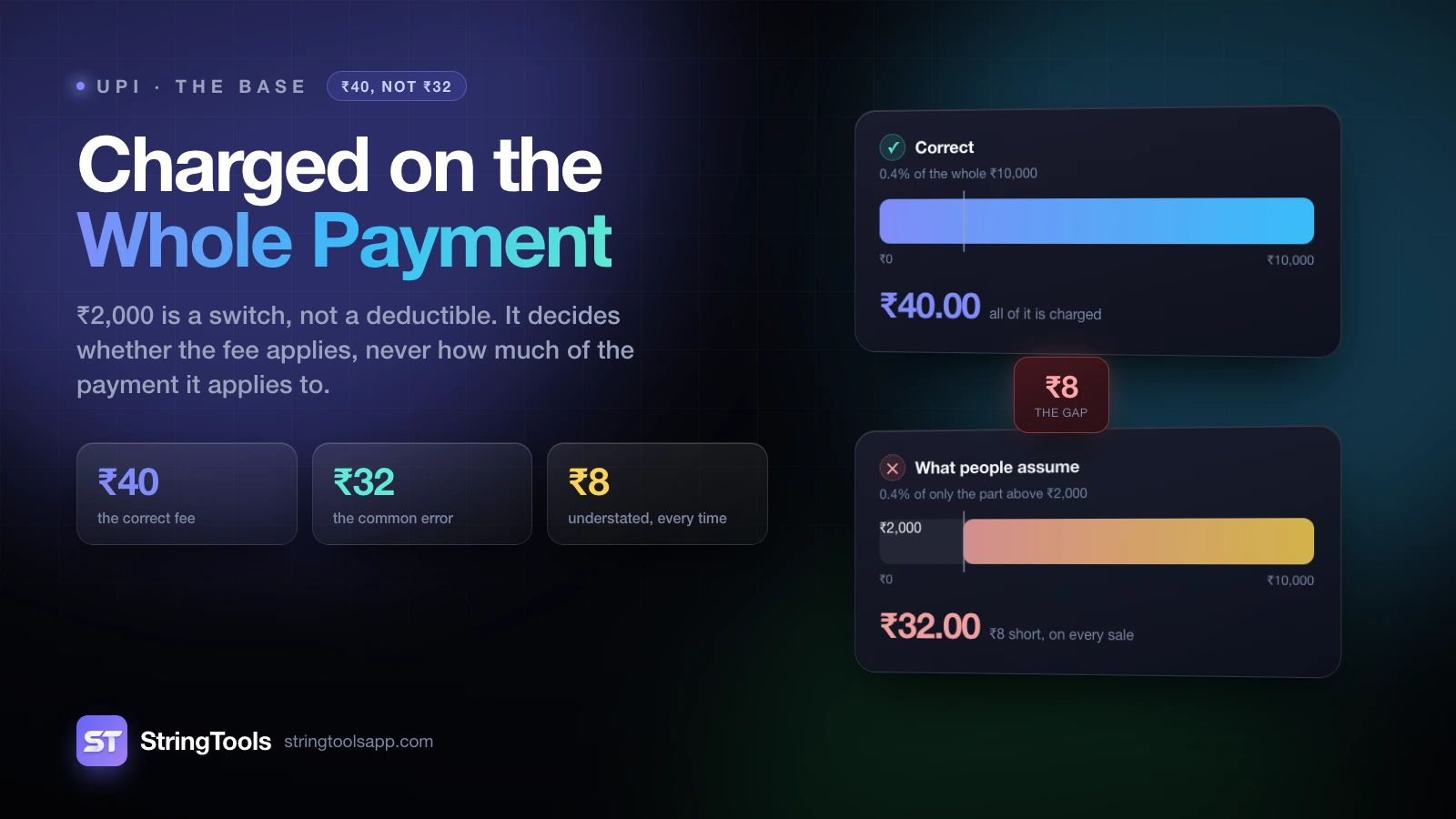
The 0.4% is charged on the whole payment. A Rs 10,000 sale attracts 0.4% of Rs 10,000, which is Rs 40 — not 0.4% of the Rs 8,000 sitting above the threshold, which would be Rs 32. The Rs 2,000 figure decides whether the fee applies at all. It never reduces the amount it applies to.
Key Takeaways
- The percentage is applied to the entire payment, not to the slice above Rs 2,000.
- Rs 2,000 is a switch, not a deductible: it turns the fee on, it does not shrink the base.
- On Rs 10,000 that is the difference between Rs 40 and Rs 32, a 25% understatement.
- The government's own worked example uses Rs 40 on Rs 10,000, which settles the reading.
- A payment of exactly Rs 2,000 is free; Rs 2,000.01 carries the full Rs 8 fee.
- This is a threshold, unlike income tax slabs, which is where the confusion comes from.
Why So Many People Get This Wrong
The mistake is a reasonable one, and it comes from somewhere specific: Indian taxpayers are trained on slabs. Income tax in India works by applying each rate only to the income falling within its band, so someone earning above a threshold pays the higher rate only on the excess. That mental model is correct for income tax and wrong here, as our explainer on effective versus marginal tax rates sets out for the tax case.
MDR is not a slab system. It is a threshold system, which behaves quite differently. Below the line, nothing. Above the line, the full percentage on the full amount. There is no graduated band, no marginal calculation, and no portion of the payment that escapes.
The practical consequence is a discontinuity at the threshold that a slab system would never produce. A payment of Rs 2,000 costs nothing. A payment of Rs 2,000.01 costs Rs 8 in MDR plus Rs 1.44 in GST. One paisa more in revenue costs Rs 9.44 in fees. That cliff is real, it is a genuine oddity of the design, and it is the single strongest argument for the splitting behaviour the framework discourages.
Most of the time the cliff does not matter, because very few sales land within a rupee of Rs 2,000. But it is worth knowing it exists, particularly if you sell something priced at Rs 1,999 or Rs 2,050.
The Two Readings, Side by Side
| Payment | Correct: 0.4% of the whole | Wrong: 0.4% of the excess | Understated by |
|---|---|---|---|
| Rs 2,500 | Rs 10.00 | Rs 2.00 | Rs 8.00 |
| Rs 4,550 | Rs 18.20 | Rs 10.20 | Rs 8.00 |
| Rs 10,000 | Rs 40.00 | Rs 32.00 | Rs 8.00 |
| Rs 25,000 | Rs 100.00 | Rs 92.00 | Rs 8.00 |
| Rs 50,000 | Rs 200.00 | Rs 192.00 | Rs 8.00 |
The last column is the interesting one, and it is the same on every row. The error is always exactly Rs 8, because Rs 8 is 0.4% of the Rs 2,000 that the wrong method excludes. That makes the mistake proportionally enormous on a small sale — 500% too low at Rs 2,500 — and almost irrelevant on a large one, where Rs 8 is lost in the noise.
So if you have been budgeting with the wrong method, the damage depends on your ticket size. A business selling mostly at Rs 2,500 to Rs 5,000 has been understating its fee bill by a wide margin. A business selling at Rs 50,000 has barely been wrong at all. The UPI MDR calculator uses the correct method throughout, and shows the rule it applied beneath each result.
How We Know This Is the Right Reading
Two independent confirmations point the same way.
The first is the worked example in the official material. The Department of Financial Services published FAQs on MDR for select UPI (P2M) transactions, and the widely reported illustration that accompanied the announcement uses a Rs 10,000 payment producing Rs 40 of MDR and Rs 7.20 of GST. Rs 40 is 0.4% of Rs 10,000. If the excess-only reading were correct, the example would say Rs 32. It does not.
The second is the language of the rule itself. The framework describes a 0.4% charge on specified transactions exceeding Rs 2,000. The word doing the work is exceeding, and it qualifies which transactions are covered, not which portion of them is charged. A slab-style rule would have to say something like on the amount in excess of, and it does not.
SCC Online's walk-through of the NPCI FAQs frames it the same way, and HDFC Bank's summary for account holders presents the calculation on the full transaction value. When the primary source, the legal commentary and the banks all read a rule identically, that is usually the end of the question.
Where the Percentage Stops Applying
There is one place where the whole-amount rule genuinely stops, and it is at the other end of the scale. The fee is capped at Rs 300 per transaction, and 0.4% of Rs 75,000 is exactly Rs 300, so the cap binds from Rs 75,000 upwards.
Above that point the fee is a flat Rs 300 regardless of size. A Rs 1 lakh payment and a Rs 10 lakh payment cost the merchant the same Rs 300, plus Rs 54 of GST in both cases. The effective rate therefore falls away: 0.472% at Rs 75,000, 0.354% at Rs 1 lakh, 0.177% at Rs 2 lakh. Our piece on the Rs 300 cap works through what that means for high-value businesses.
So the complete picture is three regions rather than two. Below Rs 2,000, nothing. Between Rs 2,000 and Rs 75,000, a flat 0.472% of everything including GST. Above Rs 75,000, a fixed Rs 354 that becomes a smaller and smaller share as the payment grows. Only the middle region behaves like a percentage at all.
What to Do With This
If you are estimating what UPI will cost your business, use the whole-payment method or you will plan with a number that is too low. The gap is not catastrophic on any single sale, but it compounds across a month. A business taking 200 payments of Rs 3,000 owes Rs 2,832 including GST, not the Rs 2,265 the excess-only method would suggest — a difference of Rs 567 a month, or Rs 6,804 a year.
The UPI fee estimator does this correctly across a mix of payment sizes, which matters more than getting a single transaction right. Most businesses do not have one ticket size; they have a distribution, and the threshold cuts through the middle of it.
It also matters if you are checking a settlement statement. If your provider's deduction looks higher than you expected, the excess-only assumption is the first thing to rule out before you raise a query. Work the sale out both ways, and if the correct method matches their figure, the statement is right and the expectation was wrong.
The same reasoning applies when you set prices to absorb the fee. A merchant who believes the charge is 0.4% of the excess will conclude that a Rs 2,500 item needs a rise of two rupees, when it actually needs about twelve. Getting the base wrong quietly under-recovers on every single sale, and the shortfall surfaces months later as a margin that is slightly thinner than it should be without any obvious cause. The price increase calculator works from the correct base.
A Note on Exactly Rs 2,000
Payments of exactly Rs 2,000 are free. The rule covers payments above Rs 2,000, and Rs 2,000 is not above Rs 2,000. A payment of Rs 2,000.01 is chargeable, and because the percentage applies to the whole amount, it carries Rs 8 of MDR plus Rs 1.44 of GST.
This produces the sharpest edge in the framework, and it is worth thinking about if your pricing happens to sit near it. An item priced at Rs 2,050 costs you Rs 9.68 to collect. The same item priced at Rs 1,999 costs you nothing. That is a difference of under ten rupees, so it should not drive your pricing on its own — but if you were already considering a price around that level, the threshold is a small thumb on the scale.
What it should not drive is splitting every sale to get under the line. The saving is a few rupees, and structuring payments around a regulatory threshold is a pattern acquirers watch for. Our guide on payment splitter covers where that line sits.
There is a softer version of the same idea that carries no risk at all. If you are setting a price from scratch and the natural figure lands at Rs 2,010, nothing stops you choosing Rs 1,995 instead. That is pricing, not structuring, and it is the same decision a shop makes when it prices at Rs 99 rather than Rs 103. The distinction is between choosing where to set a price in the first place and breaking a completed sale into pieces after the fact.
Frequently Asked Questions
Is the 0.4% charged on the full payment or only the amount above Rs 2,000?
On the full payment. A Rs 10,000 sale is charged 0.4% of Rs 10,000, which is Rs 40, not 0.4% of the Rs 8,000 above the threshold, which would be Rs 32. The Rs 2,000 figure is a switch that decides whether the fee applies at all, and it never reduces the base the percentage is applied to. The official worked example uses Rs 40 on Rs 10,000, which confirms the reading.
Why is this different from income tax slabs?
Because it is a threshold rather than a slab. Income tax applies each rate only to income falling within its band, so crossing a threshold affects only the excess. MDR has no bands: below Rs 2,000 there is no fee, and above it the full percentage applies to the full amount. Indian taxpayers are so used to the slab model that the threshold model feels wrong, which is why this is the most common misunderstanding of the rule.
How much is the error if I use the wrong method?
Exactly Rs 8 on every chargeable transaction, because Rs 8 is 0.4% of the Rs 2,000 that the incorrect method excludes. That makes it proportionally huge on small payments and trivial on large ones: at Rs 2,500 the wrong method gives Rs 2 instead of Rs 10, a fivefold understatement, while at Rs 50,000 it gives Rs 192 instead of Rs 200. The absolute error never changes, only its significance.
Does a payment of exactly Rs 2,000 attract a fee?
No. The rule covers payments above Rs 2,000, and exactly Rs 2,000 is not above Rs 2,000. A payment of Rs 2,000.01 is chargeable, and because the percentage applies to the whole amount it carries Rs 8 of MDR plus Rs 1.44 of GST. That single paisa therefore costs Rs 9.44, which is the sharpest discontinuity in the framework and a genuine oddity of threshold design.
Does the whole-amount rule apply at every payment size?
Not above Rs 75,000. The fee is capped at Rs 300 per transaction, and 0.4% of Rs 75,000 is exactly Rs 300, so the percentage and the cap meet there. Above that point the fee is a flat Rs 300 however large the payment, plus Rs 54 of GST. The effective rate consequently falls as the payment grows, reaching 0.177% at Rs 2 lakh and continuing downwards from there.
Sources and references
FAQs on MDR for select UPI (P2M) transactions (financialservices.gov.in) · walk-through of the NPCI FAQs (scconline.com) · HDFC Bank's summary for account holders (hdfc.bank.in). Content was reviewed against these sources as of the last-updated date above; external figures and rules may change after publication.