
Your Bracket Is the Rate on Your Last Dollar, Not on All of It
Your marginal tax rate is the rate applied to your next dollar of income. Your effective tax rate is your total tax divided by your total income. Because tax systems are progressive, only the slice of income inside a bracket is taxed at that bracket's rate — so your effective rate is always lower than your top bracket.
That single sentence dissolves most of the confusion people have about tax. When someone says "I'm in the 22% bracket," they almost never pay 22% of their income — they pay something closer to 13%. The 22% is the price of their last dollar, not the average price of all of them.
The distinction changes how you value a raise, what a deduction is worth to you, and whether a pension top-up is a good deal. All figures below are for the 2026 tax year (2026/27 in the UK, 2026-27 in Australia), current as of August 2026.
Key Takeaways
- Marginal rate = the rate on your next dollar. Effective rate = total tax ÷ total income. They are never the same number in a progressive system.
- Moving into a higher bracket only taxes the income above the new threshold at the higher rate. The dollars below it don't change.
- A raise essentially never leaves you with less take-home income from income tax alone. That myth is false everywhere brackets are marginal.
- The myth is true in specific places: benefit and credit cliffs, and allowance tapers, which can push real marginal rates to 60%, 100%, or higher.
- A deduction saves you your marginal rate. A credit saves you its face value. A $1,000 deduction is worth $220 at 22%; a $1,000 credit is worth $1,000.
A Real Slice-by-Slice Example: $95,000 in the United States
Take a single filer earning $95,000 in 2026. The 2026 standard deduction for single filers is $16,100, so taxable income is $78,900. That number is what gets sliced.
| Bracket | Income taxed in this band | Rate | Tax from this band |
|---|---|---|---|
| 10% band ($0 - $12,400) | $12,400 | 10% | $1,240.00 |
| 12% band ($12,400 - $50,400) | $38,000 | 12% | $4,560.00 |
| 22% band ($50,400 - $105,700) | $28,500 | 22% | $6,270.00 |
| Total federal income tax | $78,900 taxable | — | $12,070.00 |
Now run both rates:
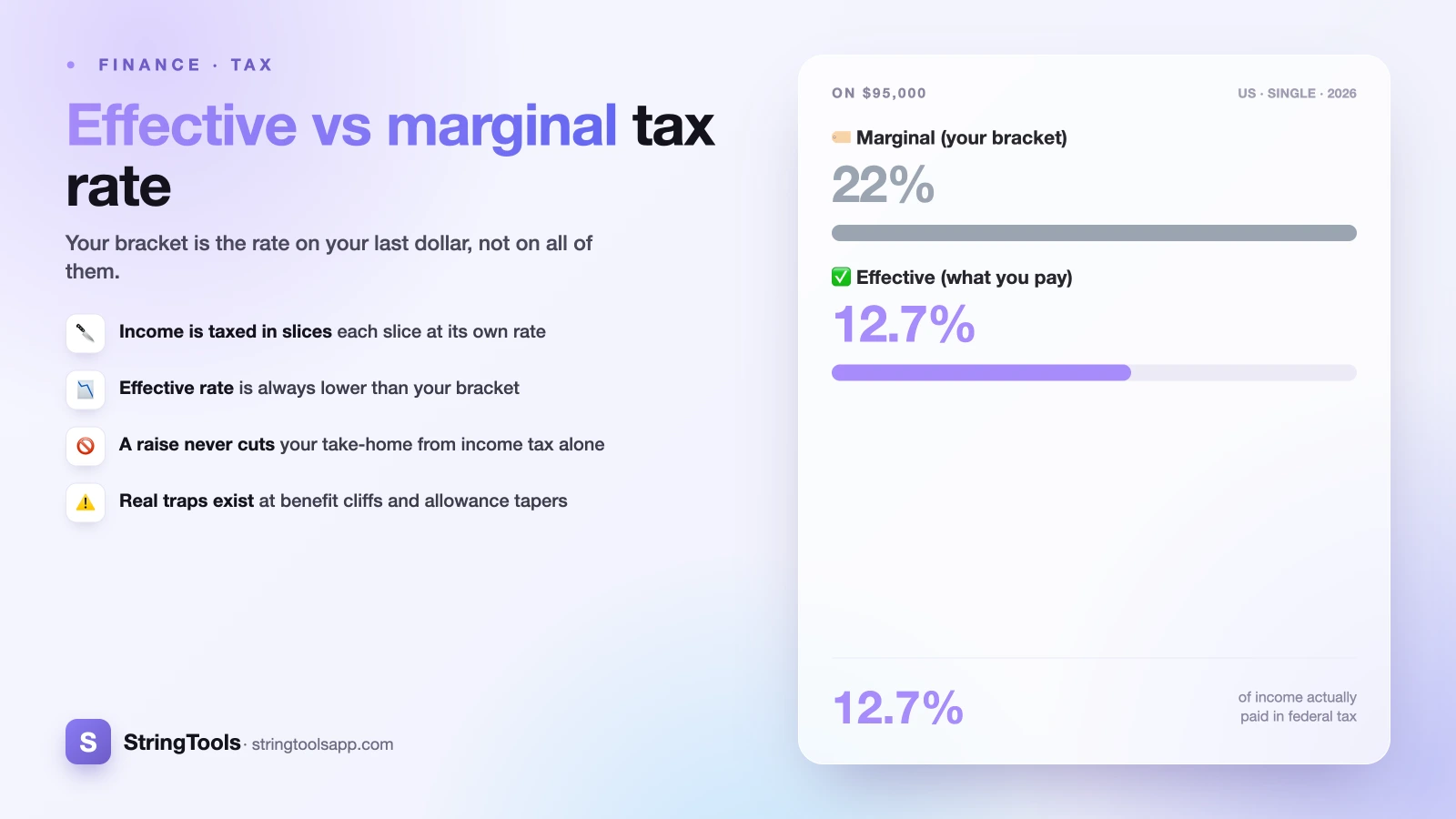
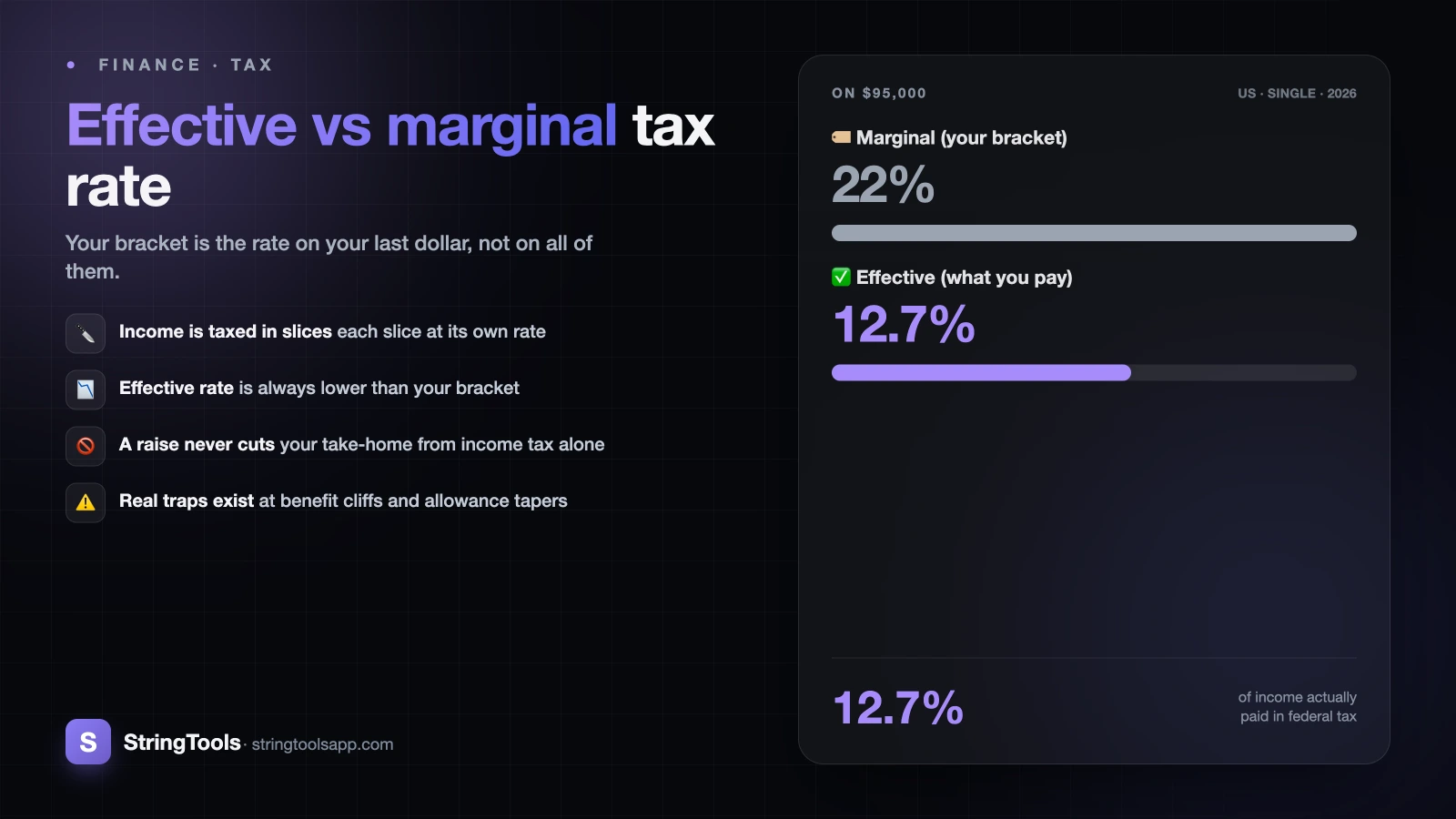
- Marginal rate: 22%. The last dollar earned sits in the 22% band.
- Effective rate on taxable income: 15.3% ($12,070 ÷ $78,900).
- Effective rate on gross salary: 12.7% ($12,070 ÷ $95,000).
Someone "in the 22% bracket" is handing over 12.7 cents on the dollar in federal income tax. The gap between 22% and 12.7% is the entire point of a progressive system, and it is the number most people get wrong.
One caveat: this is federal income tax only, excluding FICA payroll tax (7.65% on wages, up to the Social Security wage cap), state tax, and any credits. The 2026 figures come from the IRS inflation adjustments in Revenue Procedure 2025-32. To model your own numbers including payroll tax, use the salary calculator.
The Raise Myth, Killed With Arithmetic
Here is the most durable money myth in the English-speaking world: "I turned down the raise because it would push me into a higher bracket and I'd take home less."
For income tax, this is simply not how the machine works. Give our $95,000 filer a $5,000 raise. Taxable income goes from $78,900 to $83,900. All $5,000 of the new income lands inside the 22% band, which runs to $105,700.
- Extra federal income tax: $5,000 x 22% = $1,100
- Extra take-home from the raise: $3,900 before payroll and state tax
Nothing happened to the first $78,900. It is still taxed at 10%, then 12%, then 22%, exactly as before. Crossing a bracket threshold never re-prices the income underneath it.
The effective rate does creep up, from 12.7% to about 13.1% of gross, because a larger share of income now sits in the higher band. But a bigger effective rate on a bigger income still leaves you with more money. A raise only leaves you worse off when something other than the brackets falls off a ledge — which brings us to the part almost nobody explains. To see the before-and-after on your own payslip, how to calculate take-home pay walks through the deductions in order.
Where the Myth Is Actually True: Cliffs and Tapers
Tax brackets are smooth. Benefits, credits and allowances often are not. When a benefit is withdrawn as income rises — abruptly (a cliff) or gradually (a taper) — the withdrawal behaves exactly like extra tax, and shows up in no bracket table. That is where the "a raise cost me money" stories come from. They are real; they are just not caused by the brackets.
| Country | Where it bites | Real marginal rate there | What causes it |
|---|---|---|---|
| UK | £100,000 - £125,140 | 60% (62% with National Insurance) | Personal Allowance tapered £1 for every £2 of income |
| UK | £60,000 - £80,000 with children | ~52% with two children | High Income Child Benefit Charge claws back 1% per £200 |
| US | Household income just over 400% FPL (~$62,600 single, 2026) | Effectively infinite at the edge | ACA premium tax credit drops to $0 in one step |
| US | Medicaid and SNAP eligibility limits | Varies by state | Eligibility is a yes/no test, not a taper |
| India | ₹12,00,000 - ~₹12,70,588 taxable | 100% | §87A rebate lost; marginal relief caps tax at the excess |
| Australia | Crossing $105,000 single (2026-27) | ~$1,050 step | Medicare levy surcharge is 1% of total income |
| Australia | HELP/HECS repayments | Fixed since 1 July 2025 | Repayments are now marginal, not a % of total income |
The rest of this article takes the four biggest of these apart, because the details are where the money is.
The UK's 60% Band and the Child Benefit Trap
The UK has the cleanest example of a hidden marginal rate anywhere, and HMRC has never published it as a rate.
The standard Personal Allowance is £12,570 and the higher rate starts at £50,270. But once adjusted net income passes £100,000, the allowance shrinks by £1 for every £2 above that line, disappearing entirely at £125,140. Watch what one extra pound does in that band:
- The pound itself is taxed at the higher rate: 40p
- It also removes 50p of allowance, which is then taxed at 40%: 20p
- Total: 60p of tax on a single pound of income.
Add the 2% employee National Insurance above the upper earnings limit and the real figure is 62%. Across the whole £25,140 band you lose the full £12,570 allowance, costing an extra £5,028 on top of normal higher-rate tax. The bands are published on GOV.UK's Income Tax rates page.
The Child Benefit charge stacks on top
The High Income Child Benefit Charge applies when the higher earner's adjusted net income exceeds £60,000: you repay 1% of the Child Benefit received for every £200 above that, reaching 100% at £80,000.
Child Benefit for 2026/27 is £27.05 a week for the eldest child and £17.90 for each additional child. For a family with two children that is roughly £2,337 a year, clawed back across a £20,000 band — an extra 11.7 percentage points. Combined with 40% higher-rate tax, the real marginal rate between £60,000 and £80,000 is around 52%. With three children it is closer to 56%.
This is why UK pension contributions and salary sacrifice are so effective in these bands: they reduce adjusted net income, and every £1 sacrificed can be worth 52p to 62p.
The US Cliff That Came Back in 2026
This one changed recently, so the advice you find in older articles is wrong.
From 2021 through 2025, the American Rescue Plan and then the Inflation Reduction Act removed the ACA premium tax credit cliff. Above 400% of the federal poverty level you still got help; your premium was simply capped at 8.5% of income. Those enhanced credits expired on 31 December 2025.
For 2026 coverage, the original rule is back. Eligibility for the premium tax credit runs from 100% to 400% of the poverty level, and at 400.01% the credit is $0. For a single person in the 48 contiguous states, 400% of the 2025 poverty guideline works out to about $62,600.
The shape of that is brutal. Earn $62,500 and you may receive several thousand dollars of premium help. Earn $62,700 and you receive nothing — a $200 raise can cost thousands. This is the one genuine case where "the raise left me worse off" is literally true, and it is a credit cliff, not a bracket.
SNAP and Medicaid behave the same way, with limits set by household size and varying by state. Eligibility is a threshold test: you are either under it or you are not.
Near any of these lines, the practical move is to know your number before you accept extra hours or a bonus, and to check whether pre-tax contributions (401(k), HSA, traditional IRA) can pull your modified adjusted gross income back under it. That is a question for a tax professional, not a blog.
India's ₹12 Lakh Edge and Australia's Medicare Step
India: the §87A rebate edge, softened by marginal relief
Under India's new regime, the §87A rebate wipes out tax entirely for a resident individual with taxable income up to ₹12,00,000 — a rebate worth up to ₹60,000. One rupee above that and the rebate vanishes.
Run the slabs on ₹12,10,000 of taxable income: nil on the first ₹4L, 5% on the next ₹4L (₹20,000), 10% on the next ₹4L (₹40,000), and 15% on the final ₹10,000 (₹1,500). That is ₹61,500 of tax triggered by ₹10,000 of extra income — a marginal rate above 600%.
Which is why marginal relief exists. It caps your tax at the amount by which income exceeds ₹12,00,000, so the bill on ₹12,10,000 is ₹10,000 plus cess, not ₹61,500. The relief keeps working to roughly ₹12,70,588 of taxable income, where the normal calculation catches up. Inside that stretch your real marginal rate is effectively 100%. The official slabs come from the Income Tax Department, and the income tax calculator applies the rebate and marginal relief for both regimes.
Australia: one real cliff, one that got fixed
The Medicare levy surcharge is a genuine step. For 2026-27 it starts at $105,000 for singles and $210,000 for families (rising $1,500 per dependent child after the first), and it is charged at 1% to 1.5% of your whole income for surcharge purposes — not just the excess. Cross $105,000 by a dollar without private hospital cover and you owe roughly $1,050. The thresholds are published on the government's privatehealth.gov.au site.
HELP/HECS used to be worse. Until 30 June 2025, crossing a repayment threshold meant paying a percentage of your entire income, which produced true cliffs. From 2025-26 repayments are calculated marginally, only on income above the threshold — $69,528 for 2026-27. A rare case of a government deliberately sanding a cliff flat.
Deductions Save You Your Marginal Rate. Credits Save You Their Face Value.
Once you understand marginal rates, the difference between the two main kinds of tax break stops being jargon.
A deduction reduces the income you're taxed on. Its value therefore depends entirely on the rate that income would have been taxed at — your marginal rate.
A credit reduces your tax bill directly, dollar for dollar, regardless of your bracket.
| $1,000 tax break | Filer at 12% marginal | Filer at 22% marginal | Filer at 35% marginal |
|---|---|---|---|
| Deduction | Saves $120 | Saves $220 | Saves $350 |
| Credit (non-refundable) | Saves $1,000 | Saves $1,000 | Saves $1,000 |
Three consequences worth internalising:
- Credits favour lower earners, deductions favour higher earners. A $2,000 credit means far more at 12% than a $2,000 deduction does to almost anyone.
- Deductions are worth most exactly where marginal rates spike. A £1,000 UK pension contribution inside the £100,000-£125,140 band saves £600, not £400, because it restores allowance as well as cutting taxable income.
- A refundable credit can pay out below zero tax; a non-refundable one stops at zero. At low incomes that difference is huge.
Which is why "what's my tax rate?" is the wrong question before a financial decision. The right one is: what rate applies to the next pound I earn, or the next one I shelter?
How to Work Out Your Own Effective Rate in Two Minutes
You don't need software. You need last year's return.
1. Find total tax. On a US Form 1040 that's the "total tax" line — not the amount withheld, and not your refund. UK readers can use the figure on a P60 or Self Assessment calculation. 2. Pick your denominator and stick to it. Total tax ÷ gross income answers "how much of what I earn goes to tax." Total tax ÷ taxable income gives a higher number, better for comparing years. Both are legitimate; mixing them is not. 3. Divide, then multiply by 100. $12,070 ÷ $95,000 = 0.127 → 12.7%. 4. Find your marginal rate separately, then check whether you're near any of the cliffs above. That second check is the one people skip.
The two numbers do different jobs. Your effective rate tells you what tax actually costs, which is what belongs in a budget. Your marginal rate tells you what the next decision costs — an overtime shift, a bonus, a pension top-up. Use the salary calculator to see how a raise changes your net pay before you say yes, and if the extra money is real, how much of your paycheck to save is the reasonable next question.
Finally: thresholds and cliff edges are re-set most years, and several here moved within the last eighteen months. Everything reflects official guidance as of August 2026, but before making a decision that turns on a specific number, confirm it with your tax authority or a qualified professional. This is general information, not personal tax advice.
Frequently Asked Questions
Does getting a raise put me in a higher tax bracket?
It can move your top dollar into a higher bracket, but only the income above that threshold is taxed at the higher rate. Everything below it is taxed exactly as before. A single US filer going from $95,000 to $100,000 in 2026 pays 22% on the extra $5,000 — $1,100 more tax — and keeps $3,900. You are never worse off from income tax alone. The exceptions are benefit and credit cliffs, such as the ACA premium tax credit ending at 400% of the federal poverty level, where a small raise really can cost you money.
What is my effective tax rate?
Divide your total tax by your total income and multiply by 100. Using gross income as the denominator answers "what share of my earnings goes to tax"; using taxable income gives a higher figure that's better for year-on-year comparison. For a single US filer on $95,000 in 2026, federal income tax of $12,070 is 12.7% of gross or 15.3% of the $78,900 of taxable income — well under the 22% bracket they sit in. Add payroll and state tax for a full picture.
What is the difference between effective and marginal tax rate?
Your marginal rate is the rate charged on your next dollar of income — your top bracket. Your effective rate is the average rate across all your income, calculated as total tax divided by total income. In a progressive system the effective rate is always lower, because early slices of income are taxed at lower rates. Use the marginal rate to judge decisions (overtime, a bonus, a pension contribution) and the effective rate to judge what tax actually costs you.
Why is the UK marginal tax rate 60% between £100,000 and £125,140?
Above £100,000 of adjusted net income, the £12,570 Personal Allowance is withdrawn by £1 for every £2 of income. So an extra £1 is taxed at the 40% higher rate, and it also removes 50p of allowance which is then taxed at 40% — 60p of tax on £1. With 2% National Insurance the real rate is 62%. It applies to 2026/27 and is not published as a headline rate anywhere, which is why so many people never notice it.
Is a tax deduction or a tax credit better?
A credit is almost always worth more. A deduction reduces taxable income, so it saves you your marginal rate — $1,000 of deduction is worth $120 at 12% and $350 at 35%. A credit reduces the tax bill directly, so $1,000 of credit is worth $1,000 to everyone. Credits therefore favour lower earners, while deductions are worth most to high earners and to anyone sitting inside a taper band where the real marginal rate is inflated.
Can earning more money ever leave me with less take-home pay?
Not from income tax brackets, which are always marginal. It can happen at benefit and credit cliffs. For 2026 US coverage the ACA premium tax credit drops to zero above 400% of the federal poverty level — roughly $62,600 for a single person — with no phase-out, after the enhanced subsidies expired on 31 December 2025. Australia's Medicare levy surcharge charges about $1,050 the moment a single filer passes $105,000 in 2026-27. Medicaid and SNAP eligibility limits work the same yes/no way.
Sources and references
Revenue Procedure 2025-32 (irs.gov) · GOV.UK's Income Tax rates page (gov.uk) · Income Tax Department (incometax.gov.in) · privatehealth.gov.au (privatehealth.gov.au). Content was reviewed against these sources as of the last-updated date above; external figures and rules may change after publication.