
The short answer, and why it starts with take-home pay
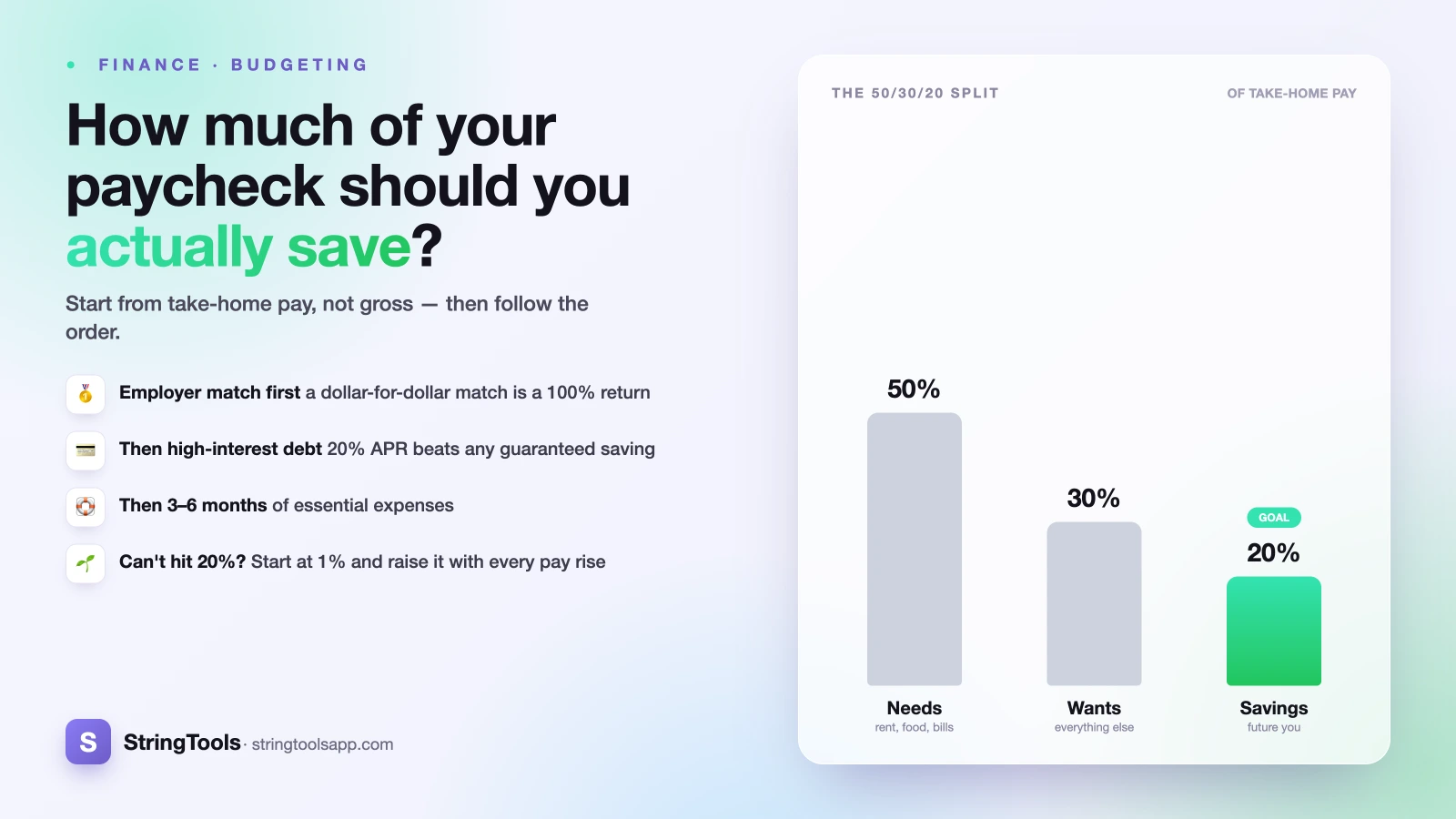
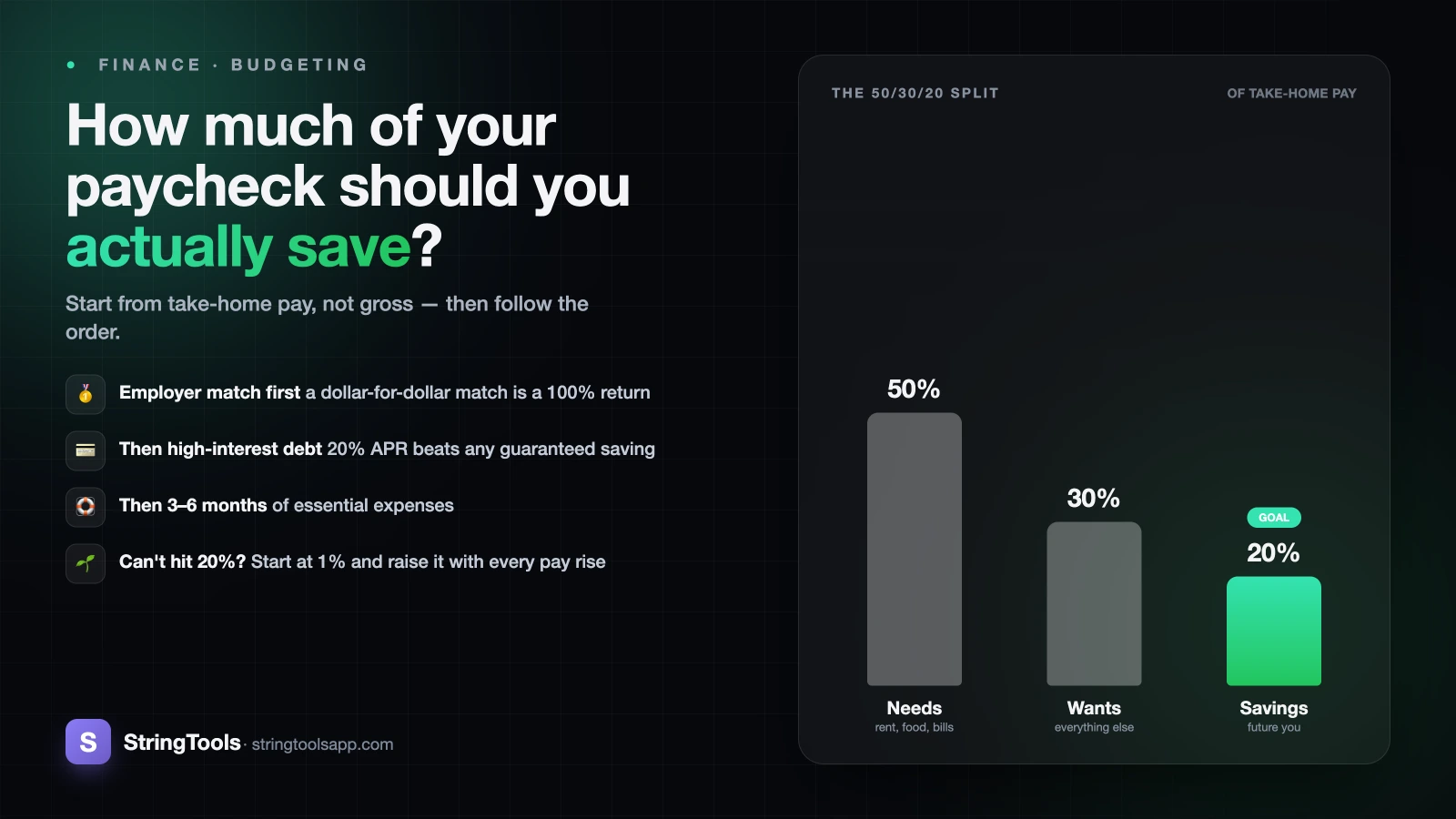
Aim to save 20% of your take-home pay if you can: roughly 15% toward retirement and 5% toward cash savings. If 20% is out of reach, save whatever you can automate today, even 1-5%, and raise it with every pay rise. The percentage matters far less than starting and never going backwards.
That is the honest version of the answer. The rest of this guide shows you what 20% actually looks like in dollars at different income levels, the exact point where the famous 50/30/20 rule stops working, and a priority order that beats any single percentage when money is tight.
Key Takeaways
- Budget from net (take-home) pay, not gross. Gross pay is a number you never actually receive.
- 50/30/20 is a starting shape, not a law. It assumes housing is affordable, which it often is not.
- A priority order beats a percentage: starter buffer, employer match, high-interest debt, full emergency fund, then long-term investing.
- Automate the transfer on payday. Saving what is left at the end of the month almost never works.
- Saving 1% now and adding a point with each raise beats waiting until you can afford 20%.
This article is general educational information, not personalised financial advice. For decisions that depend on your own tax position, debts, or family situation, speak to a licensed financial adviser.
Gross pay is a headline. Net pay is your actual budget
The single most common budgeting mistake is running the percentages on your salary instead of on what lands in your bank account. A $72,000 salary is not $6,000 a month of spendable money. After federal and state tax, Social Security and Medicare, health insurance premiums, and your own retirement contributions, take-home pay is commonly 25-35% lower than gross in the US, and similar gaps exist in the UK (income tax, National Insurance, student loan, pension) and Australia (PAYG withholding).
So the first practical step is boringly simple: find out what actually arrives. Pull up your last two payslips, or run the numbers through a salary calculator so you have one reliable monthly net figure to build on. If you want the mechanics of every deduction line by line, we walk through them in how to calculate take-home pay.
One useful side effect: if you contribute to a workplace pension or 401(k) through payroll, that money is already saved before it hits your net pay. It counts toward your savings rate even though you will never see it in your checking account. Do not double-count it, and do not forget it either.
What 50/30/20 looks like in real dollars
The 50/30/20 rule, popularised by Senator Elizabeth Warren, splits take-home pay into three buckets: 50% needs (housing, utilities, groceries, transport, insurance, minimum debt payments), 30% wants (eating out, subscriptions, travel, hobbies), and 20% savings and extra debt payoff.
Here is the split applied to four realistic monthly take-home figures:
| Monthly take-home | Needs (50%) | Wants (30%) | Save + debt payoff (20%) | Annual savings |
|---|---|---|---|---|
| $2,500 | $1,250 | $750 | $500 | $6,000 |
| $3,500 | $1,750 | $1,050 | $700 | $8,400 |
| $4,500 | $2,250 | $1,350 | $900 | $10,800 |
| $6,000 | $3,000 | $1,800 | $1,200 | $14,400 |
What the rule gets right is the order of magnitude. Most people who feel financially stuck are running something closer to 70/28/2, and simply seeing the three numbers side by side is often enough to reveal that the wants bucket has quietly absorbed a raise or two.
What it gets wrong is the assumption that 50% covers your needs at all.
Where 50/30/20 breaks: the rent problem
The old rule of thumb says housing should cost no more than 30% of income. It comes from US public housing policy dating back to the 1980s, when it replaced an earlier 25% standard, and it was designed as an affordability benchmark for programme eligibility, not as personal financial advice.
Run a single $1,800-a-month one-bedroom against different take-home figures and you can see the rule snap:
| Monthly take-home | $1,800 rent as % of net | Left inside the 50% needs bucket | Realistic? |
|---|---|---|---|
| $2,500 | 72% | -$550 (rent alone blows the bucket) | No |
| $3,500 | 51% | -$50 | No |
| $4,500 | 40% | $450 for everything else | Very tight |
| $6,000 | 30% | $1,200 for everything else | Workable |
At $2,500 take-home, rent alone eats 72% of the money. There is no arrangement of the remaining $700 that produces a 20% savings rate while also feeding you. Telling someone in that position to "just save 20%" is not advice, it is arithmetic denial.
Two honest responses. First, in high-cost cities, treat 30-40% of net on housing as the realistic band and accept a lower savings rate for now rather than pretending. Second, recognise that housing is the one line item where a single decision (a roommate, a move one transit stop further out, a lease renegotiation) can move more money than a year of skipped coffees. Everything else is rounding error by comparison.
If you are in the tight band, flip the ratio: instead of 50/30/20, try 60/25/15 or 65/25/10 and protect the savings line as a fixed, non-negotiable number, however small.
The priority order that beats any percentage
When money is limited, where your savings go matters more than the percentage. Not all savings dollars are worth the same. A dollar that captures an employer match is worth more than a dollar in a savings account, and a dollar that kills 24% credit card interest is worth more than a dollar in the stock market with an uncertain return.
Work down this list in order. Do not move to the next step until the current one is handled:
| # | Step | Why it comes first | Target |
|---|---|---|---|
| 1 | Starter cash buffer | Stops the next flat tyre becoming new credit card debt | $500-$1,000, or one month of essentials |
| 2 | Capture the full employer match | A dollar-for-dollar match is an immediate 100% return on that money before any investment growth | Whatever percentage unlocks the full match |
| 3 | Attack high-interest debt | Clearing a 22% APR balance is a guaranteed 22% return; nothing safe beats it | Every card and personal loan above roughly 8-10% |
| 4 | Build the full emergency fund | Turns job loss from a catastrophe into an inconvenience | 3-6 months of essential expenses |
| 5 | Long-term investing | Time in the market is the only lever you cannot buy back later | 15% of gross toward retirement is the common benchmark |
Step 2 deserves emphasis because people leave real money on the table. In the US, the 2026 employee 401(k) deferral limit is $24,500 (with an extra $8,000 catch-up from age 50), according to the IRS as of August 2026. In the UK, auto-enrolment requires a minimum 8% total contribution on qualifying earnings, of which the employer must pay at least 3%, for the 2026/27 tax year. In Australia, the Superannuation Guarantee is 12% of ordinary time earnings, the final legislated rate. Contributing enough to unlock every dollar of match your employer offers is usually the highest-return financial move available to an ordinary employee.
Step 3 is where the maths is most brutal and most freeing. Paying down a card at 22% is a risk-free, tax-free 22% return. No savings account, bond, or index fund guarantees that. The CFPB's consumer tools are a good, unbiased starting point if you are working out which debts to tackle first.
For step 4, size the target off your essential monthly spending, not your total spending, and read how to build an emergency fund for the practical version. Australians can sanity-check the whole plan against the government's own guidance at ASIC's Moneysmart budgeting hub.
Pay yourself first: automate it on payday
The behavioural finding here is unusually consistent: people who transfer money to savings on payday save far more than people who save whatever is left at the end of the month. The money you never see in your checking account is the money you do not spend.
The setup takes about fifteen minutes:
- Open a separate savings account, ideally at a different bank so transferring back takes a day and a decision.
- Set a standing transfer for the day after each payday, for a specific dollar amount.
- Start with an amount that feels almost too easy. A transfer you cancel in month three is worse than a smaller one you keep for five years.
- Give each account a job: "Emergency", "Car", "Christmas". Named accounts get raided less often.
If you are paid bi-weekly, you get 26 paychecks a year, which means two months every year contain a third paycheck. Budget your fixed bills against the 24 "normal" paychecks, and treat those two extra ones as pure savings. On a $1,600 bi-weekly net that is $3,200 a year of savings you never had to feel. Semi-monthly pay (24 cheques) does not produce this quirk, which is one of several practical differences covered in bi-weekly vs semi-monthly pay.
What to do when your income is irregular
Percentages assume a steady paycheck. Freelancers, contractors, hospitality staff on variable shifts, and anyone on commission need a different mechanism.
Budget on your floor, save the spikes. Look back at the last 12 months and find your lowest month. Build your fixed budget around that number. In any month you earn more than the floor, a fixed share of the surplus (say 50%) goes straight to savings before you adjust your lifestyle.
Run a buffer account. All income lands in one holding account. Once a month you pay yourself a fixed "salary" from it into your everyday account. Good months build the buffer; thin months draw it down; your spending stays flat. Aim to get one full month of pay ahead, then two.
Set aside tax first. If you are self-employed, tax is not savings. Move 25-30% of every payment into a separate tax account the day it arrives and mentally write it off. What is left is your real income, and the savings percentages apply to that.
Target a bigger emergency fund. Irregular income usually means 6-9 months of expenses rather than 3-6, because the downside months and the job-loss months are the same months.
Start at 1%, then raise it with every pay rise
If you take one thing from this guide, take this: the savings rate you can sustain today beats the savings rate you are waiting to afford.
Saving 20% is genuinely impossible for a lot of people right now, and there is nothing virtuous about pretending otherwise. But 1% is almost never impossible. On $3,500 take-home that is $35 a month. What it buys you is the habit and the plumbing, and both are already built when your income improves.
Then use the one trick that does the heavy lifting: every time you get a raise, send at least half of it to savings before you ever see it. Your standard of living still rises, just more slowly than your income. Do that through three or four raises and you arrive at a 15-20% savings rate without a single month of feeling deprived.
The long-run effect is larger than most people expect. Adding 1% of a $4,500 monthly take-home is $45 a month. Contributed for 30 years and growing at an assumed 6% average annual return (an illustrative assumption, not a promise, since real returns vary and can be negative), that single extra percentage point compounds to roughly $45,000. You can test that with our compound interest calculator or the SEC's own compound interest calculator at Investor.gov.
Start where you are. Get your real net figure from a salary calculator, pick a percentage you can genuinely hold for a year, automate it for the day after payday, and raise it the next time your pay does. That sequence, repeated, is what actually builds savings, and it works at every income level.
This guide is general educational information and does not take your personal circumstances into account. It is not financial, tax, or investment advice. Please consult a licensed financial adviser before making decisions about debt, retirement contributions, or investments.
Frequently Asked Questions
How much of my paycheck should I save each month?
A common benchmark is 20% of your take-home pay, split roughly 15% toward retirement and 5% toward cash savings. If that is unrealistic right now, save a smaller fixed percentage you can automate and sustain, and increase it by one or two points every time your pay rises. Consistency beats the size of the first number.
Is the 50/30/20 rule based on gross or net income?
Net income, meaning your take-home pay after tax and payroll deductions. Applying it to gross pay will overstate every bucket and set you up to overspend. If you contribute to a workplace pension or 401(k) through payroll, that contribution already counts toward the 20% savings bucket even though it never reaches your bank account.
What percentage of my paycheck should go to rent?
The traditional guideline is no more than 30% of income on housing, but that benchmark came from US housing policy, not personal finance research, and it is unrealistic in many high-cost cities. A practical band is 30-40% of take-home pay. Above 40%, expect a lower savings rate and treat housing itself, rather than small daily spending, as the main thing to change.
Should I pay off debt or save first?
Do both, in order. Build a small starter buffer of about $500-$1,000 first so an unexpected bill does not create new debt, then contribute enough to capture your full employer retirement match, then attack debt above roughly 8-10% interest aggressively. Clearing a 22% credit card is a guaranteed 22% return, which no ordinary savings or investment product can promise.
How much should I have saved by age 30?
A widely quoted rule of thumb is around one times your annual salary saved by 30, rising to roughly three times by 40. Treat these as rough direction markers rather than pass-or-fail tests, since they ignore student debt, caring costs, and late career starts. A more useful test at 30 is whether you have 3-6 months of expenses in cash and are capturing your full employer match.
Is saving 20% of my income realistic on a low salary?
Often no, and it is worth saying plainly. When housing takes 50% or more of take-home pay, a 20% savings rate is arithmetically out of reach, and the honest answer is to protect a small, fixed savings amount rather than abandon saving entirely. Start at 1-5%, keep the automation running, and put the bulk of each future pay rise into savings so the rate climbs as your income does.
Sources and references
CFPB's consumer tools (consumerfinance.gov) · ASIC's Moneysmart budgeting hub (moneysmart.gov.au) · compound interest calculator at Investor.gov (investor.gov). Content was reviewed against these sources as of the last-updated date above; external figures and rules may change after publication.