
Gross Pay vs Net Pay: The Short Answer
To calculate your take-home pay, start with your gross salary, subtract pre-tax deductions like retirement contributions and health premiums, then subtract income tax and social insurance contributions such as Social Security and Medicare in the US or National Insurance in the UK. What remains is your net pay.
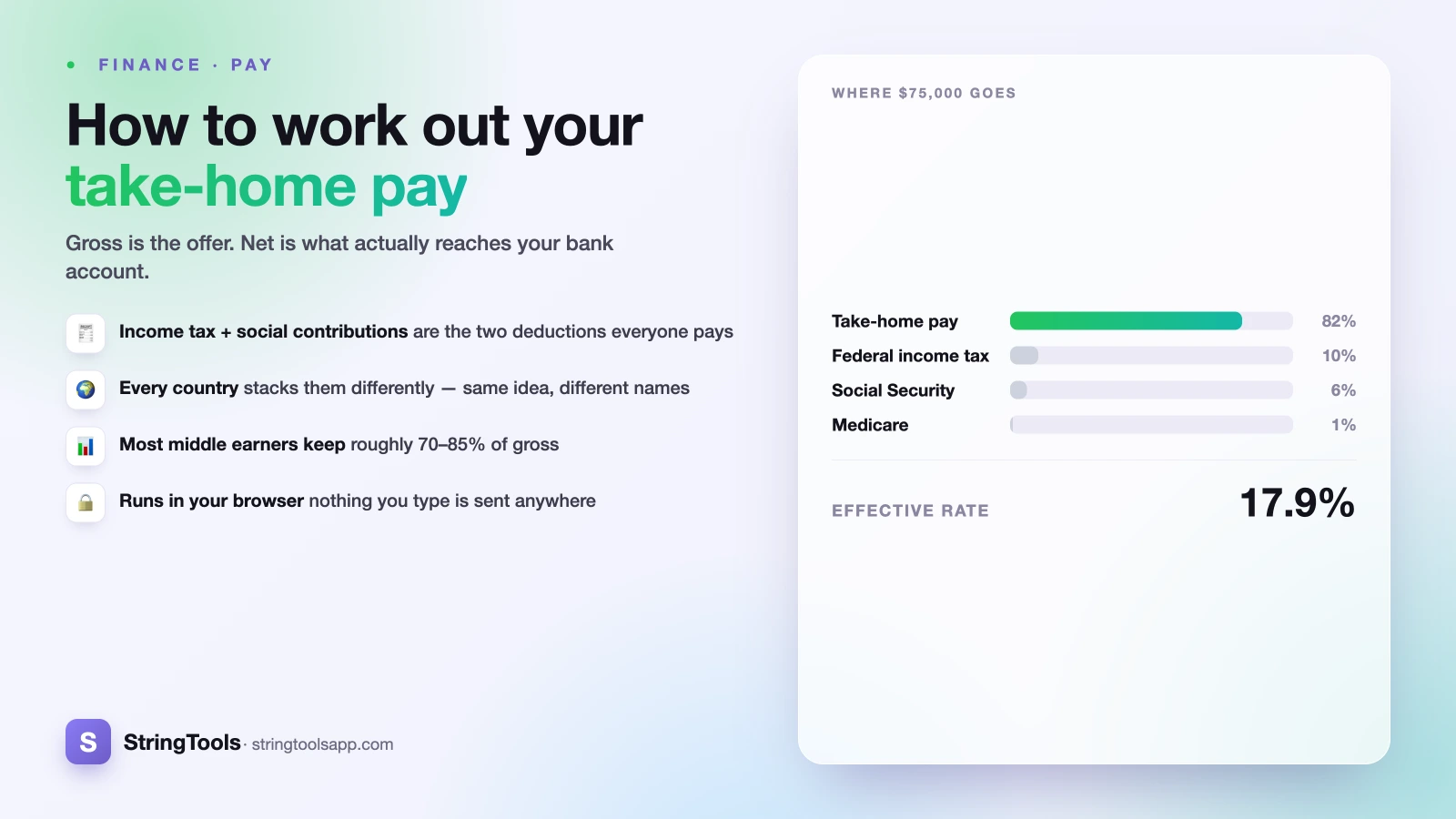
That gap is bigger than most people expect. A $75,000 offer in the United States lands closer to $61,600 before any state tax. A GBP 45,000 salary in England pays out about GBP 35,900. Nobody quotes you those numbers at the interview, so the first payslip is where the surprise arrives.
The good news is that the arithmetic is completely knowable. Every deduction on your payslip follows a published rule, and once you can name the five or six lines that come out, you can work out your own number in a couple of minutes with a salary calculator or a sheet of paper.
Key Takeaways
- Gross pay is the headline number in your offer letter. Net pay is what reaches your bank account after tax and deductions.
- Most people lose somewhere between 18% and 32% of gross to income tax plus social insurance, depending on country, income level and where they live.
- Pre-tax deductions come out before tax is calculated, so a dollar into a 401(k) or a workplace pension costs you less than a dollar of take-home.
- Your marginal rate is not your effective rate. A US worker in the 22% bracket on $75,000 pays an effective federal income tax rate of about 10.2%.
- Figures in this guide are as of August 2026 and cover the 2026 US tax year, 2026-27 in the UK and Australia, 2026 in Canada and FY 2026-27 in India. This is general information, not tax advice.
The Deduction Stack: What Actually Comes Out of Your Pay
Payslips look chaotic, but almost every line falls into one of four buckets, and they are applied in a specific order. Get the order right and the maths falls into place.
1. Pre-tax deductions. These come off your gross before income tax is worked out, which makes them the most efficient money on your payslip: a traditional 401(k) in the US, a workplace pension in the UK, RRSP contributions in Canada, Employee Provident Fund in India. US health premiums paid through a Section 125 plan sit here too, and usually shrink your Social Security and Medicare base as well.
2. Income tax. Charged on what is left, using progressive bands. Only the slice of income inside each band is taxed at that band's rate — the single most misunderstood part of the system.
3. Social insurance and levies. These are separate from income tax and usually charged on gross pay with their own rules and caps: Social Security and Medicare in the US, National Insurance in the UK, CPP and EI in Canada, the Medicare levy in Australia.
4. Post-tax deductions. Roth contributions, union dues, UK student loan repayments, garnishments. These cut your take-home dollar-for-dollar with no tax benefit.
Your employer also pays contributions on top of your salary that never appear as a deduction — the employer half of Social Security, employer National Insurance, 12% superannuation in Australia. Real compensation, but not part of the gross you are taxed on.
Worked Example: $75,000 Single Filer in the US (2026)
Let us run a clean case: $75,000 salary, single filer, no dependants, taking the standard deduction, no 401(k) contribution, and no state income tax. For tax year 2026 the standard deduction for a single filer is $16,100, per the IRS inflation adjustments for 2026.
Taxable income is $75,000 minus $16,100, or $58,900. The 2026 single-filer brackets apply in slices:
- 10% on the first $12,400 = $1,240
- 12% on income from $12,400 to $50,400 ($38,000) = $4,560
- 22% on income from $50,400 to $58,900 ($8,500) = $1,870
That is $7,670 in federal income tax. Now add payroll taxes, which are charged on the full $75,000 with no standard deduction: Social Security at 6.2% and Medicare at 1.45%.
| Line | Amount | Notes |
|---|---|---|
| Gross salary | $75,000.00 | The offer-letter number |
| Standard deduction | -$16,100.00 | Leaves $58,900 taxable |
| Federal income tax | -$7,670.00 | Across the 10%, 12% and 22% brackets |
| Social Security (6.2%) | -$4,650.00 | On gross, capped at $184,500 of wages |
| Medicare (1.45%) | -$1,087.50 | No cap; +0.9% surcharge above $200,000 |
| Total federal deductions | -$13,407.50 | |
| Net take-home pay | $61,592.50 | About $5,132.71 a month |
Two numbers to sit with. Your marginal rate is 22% — the rate on your next dollar earned. Your effective federal income tax rate is 10.2% ($7,670 divided by $75,000). Counting payroll taxes as well, the all-in federal bite is 17.9%.
State tax is the big missing piece. In Texas, Florida or Washington your number stands. In California or New York, expect several thousand dollars more to come out. Run your own state and filing status through the salary calculator rather than assuming this example transfers.
Why Your Marginal Rate Is Not Your Effective Rate
The most common take-home miscalculation is multiplying gross salary by your top bracket. Our $75,000 earner is "in the 22% bracket", but 22% of $75,000 would be $16,500 — more than double the $7,670 they actually owe in income tax.
This matters for real decisions. A raise is taxed at your marginal rate, so a $5,000 raise for our earner faces 22% federal plus 7.65% payroll, leaving roughly $3,518. But crossing into a higher bracket never reduces your total take-home, because only the income above the threshold is taxed at the new rate. The idea that a raise can leave you worse off is a myth in every country covered here.
The same split shows up everywhere: a UK worker on GBP 60,000 is a "40% taxpayer" paying an effective income tax rate closer to 22%. If this distinction is driving a decision — negotiating a raise, weighing overtime, comparing offers — our breakdown of effective vs marginal tax rate goes deeper.
Worked Example: GBP 45,000 in the UK (2026-27)
The UK stack is simpler than the US one: one income tax calculation, one National Insurance calculation, and no state or provincial layer. Take a GBP 45,000 salary in England for the 2026-27 tax year, which runs 6 April 2026 to 5 April 2027.
The personal allowance is GBP 12,570 and the basic rate is 20% up to GBP 50,270, per GOV.UK income tax rates. Employee National Insurance is 8% on earnings between GBP 12,570 and GBP 50,270, then 2% above that.
| Line | Amount |
|---|---|
| Gross salary | GBP 45,000.00 |
| Personal allowance (tax-free) | GBP 12,570.00 |
| Income tax at 20% on GBP 32,430 | -GBP 6,486.00 |
| National Insurance at 8% on GBP 32,430 | -GBP 2,594.40 |
| Total deductions | -GBP 9,080.40 |
| Net take-home pay | GBP 35,919.60 (about GBP 2,993.30 a month) |
The effective rate here is 20.2% — higher than the US example, because National Insurance starts biting at a lower income and there is no standard deduction stacking on top of a large 0% band.
Two lines this deliberately leaves out. Auto-enrolment pension contributions are a minimum of 5% of qualifying earnings for most employees, roughly another GBP 1,620 off take-home — though that one builds your own pot. And student loan repayments are charged above a plan-specific threshold, catching a large share of UK graduates.
How the Deduction Stack Differs by Country
If you are comparing offers across borders, or you moved and your payslip stopped making sense, this is the map. All figures are as of August 2026.
| Country (tax year) | Income tax on the first taxed slice | Social insurance from your pay | Tax-free base |
|---|---|---|---|
| US (2026) | 10%, rising through seven brackets to 37% | Social Security 6.2% up to $184,500 of wages, Medicare 1.45% uncapped | $16,100 standard deduction (single); $32,200 married filing jointly |
| UK (2026-27) | 20% basic rate, 40% above GBP 50,270 | National Insurance 8%, dropping to 2% above GBP 50,270 | GBP 12,570 personal allowance |
| Canada (2026) | 14% federal, plus a separate provincial layer | CPP 5.95% plus EI 1.63% of insurable earnings | $16,452 basic personal amount |
| Australia (2026-27) | 15% above the threshold, then 30% above $45,000 | Medicare levy 2% of taxable income | $18,200 tax-free threshold |
| India (FY 2026-27, new regime) | 5% above INR 4 lakh | EPF 12% of basic salary (employee share) | INR 4 lakh basic exemption plus INR 75,000 standard deduction |
Three quirks worth flagging. Australian superannuation is employer-paid on top of salary at 12%, not deducted from gross like a 401(k) — a $100,000 package with super quoted separately is genuinely $112,000. Canada layers provincial tax on federal, so identical Ontario and Alberta salaries take home different amounts. And India runs two parallel regimes, where the winner depends entirely on your deductions — exactly what our income tax calculator compares.
Two More Worked Numbers: Australia and India
Australia: $100,000 salary, 2026-27
The tax-free threshold covers the first $18,200. The second bracket dropped from 16% to 15% on 1 July 2026, and the 30% bracket runs from $45,001 to $135,000.
- Tax on $18,201 to $45,000 at 15% = $4,020
- Tax on $45,001 to $100,000 at 30% = $16,500
- Medicare levy at 2% of $100,000 = $2,000
Total: $22,520, leaving $77,480 take-home, an effective rate of 22.5%. Your employer separately pays $12,000 into super, which you cannot spend now but do own.
India: INR 15,00,000 salary, FY 2026-27, new regime
Start by subtracting the INR 75,000 standard deduction, leaving INR 14,25,000 taxable. The new-regime slabs published by the Income Tax Department then apply in slices: nil to INR 4 lakh, 5% to INR 8 lakh, 10% to INR 12 lakh, 15% to INR 16 lakh.
- 5% on INR 4,00,000 = INR 20,000
- 10% on INR 4,00,000 = INR 40,000
- 15% on INR 2,25,000 = INR 33,750
- Subtotal INR 93,750, plus 4% health and education cess of INR 3,750
Total tax INR 97,500, leaving roughly INR 14,02,500 before EPF and professional tax — an effective rate of just 6.5%. The Section 87A rebate wipes out tax entirely for taxable income up to INR 12 lakh, so a salaried worker on up to INR 12.75 lakh gross can pay nothing at all. Above that the rebate stops applying, as it does here.
The Deductions That Quietly Shrink Your Take-Home
Once tax is settled, a handful of other lines decide whether your payslip matches your estimate. These are the ones that catch people out.
- Health insurance premiums. Often the largest non-tax deduction in the US, with family coverage running several hundred dollars a month. Usually pre-tax, which softens it.
- Retirement contributions. A 5% 401(k) on $75,000 is $3,750 of gross — but only about $2,925 of take-home at a 22% marginal rate, because the rest is tax you would have paid anyway.
- HSAs and FSAs. Pre-tax, and a payroll-funded US HSA also escapes Social Security and Medicare.
- Post-tax items. Roth contributions, union dues and garnishments come off after tax, so each cuts take-home by its full face value.
Pay frequency reshapes your cash flow even when the annual total is identical: every two weeks means 26 cheques and two "extra-cheque" months, while twice a month means 24 larger, perfectly predictable ones. If you budget to the week, the difference between bi-weekly vs semi-monthly pay is worth knowing.
Working Out Your Own Number
Here is the process, start to finish.
1. Write down your true gross. Base salary plus expected bonus and any guaranteed allowances. If you are paid hourly, convert first — our guide to hourly to salary conversion covers the annualising step and the paid-time-off adjustment most people forget. 2. Subtract pre-tax deductions. Retirement contributions, pre-tax health premiums, HSA or FSA. 3. Apply the income tax bands in slices, not as a flat rate on the whole amount. 4. Add social insurance separately, on gross rather than on taxable income, and respect the caps. 5. Subtract post-tax deductions, then divide by your number of pay periods.
A calculator does all five steps without arithmetic slips, and it is the sensible way to test scenarios: what a 6% raise is really worth, whether another 2% into retirement is affordable, how two offers in different states compare.
One closing caveat, and it matters. This produces a close estimate, never a payslip-exact figure — your employer's withholding depends on the form you filed, your tax code, mid-year changes and local taxes no general model can see. Treat it as a planning number. This article is general information, not tax advice; for anything consequential, check with a qualified tax professional or your national tax authority.
Frequently Asked Questions
How much of my paycheck goes to taxes?
For most salaried workers in the US, UK, Canada and Australia, the combined bite of income tax plus social insurance lands between 18% and 32% of gross pay. A US single filer on $75,000 loses about 17.9% to federal income tax plus Social Security and Medicare in 2026, before any state income tax. UK and Australian workers on comparable salaries typically sit around 20% to 23%. Your exact share depends on income level, filing status and where you live.
What is the difference between gross pay and net pay?
Gross pay is your total earnings before anything is deducted — the number in your offer letter or contract. Net pay, also called take-home pay, is what actually reaches your bank account after pre-tax deductions, income tax, social insurance contributions and any post-tax deductions have been subtracted. Gross is what you negotiate; net is what you can spend.
How much is $75,000 a year after taxes?
For a single filer in the US taking the standard deduction in tax year 2026, $75,000 gross leaves about $61,592 after federal income tax of $7,670, Social Security of $4,650 and Medicare of $1,087.50 — roughly $5,133 a month. That figure assumes no state income tax and no 401(k) contribution. In a state like California or New York, expect several thousand dollars less.
Does a pay raise ever put me in a higher bracket and leave me worse off?
No. Tax brackets are marginal, meaning only the portion of income above each threshold is taxed at the higher rate. If you cross into the 22% bracket, only the dollars above that threshold are taxed at 22% — everything below keeps its lower rate. A raise always increases your take-home pay. The one genuine exception is means-tested benefits or credits that phase out at a threshold, which is a separate mechanism from income tax.
Should I use gross or net income when applying for a mortgage?
Lenders in the US, UK, Canada and Australia generally assess affordability on gross annual income, then apply their own debt-to-income or affordability ratios. But you should budget the repayment against your net pay, because that is the money actually available each month. A mortgage that looks comfortable at 28% of gross can feel very different at 38% of net.
How do I calculate take-home pay if I am paid hourly?
Convert to an annual gross figure first: multiply your hourly rate by hours worked per week, then by the number of weeks you are actually paid for. A $30 per hour job at 40 hours a week over 52 weeks is $62,400 gross. Then run that annual figure through the same deduction stack — pre-tax deductions, income tax bands, social insurance — as a salaried worker. Unpaid time off reduces the annual figure and needs to be subtracted before you start.
Sources and references
IRS inflation adjustments for 2026 (irs.gov) · GOV.UK income tax rates (gov.uk) · Income Tax Department (incometax.gov.in). Content was reviewed against these sources as of the last-updated date above; external figures and rules may change after publication.