
Hourly to Salary: The One-Line Answer
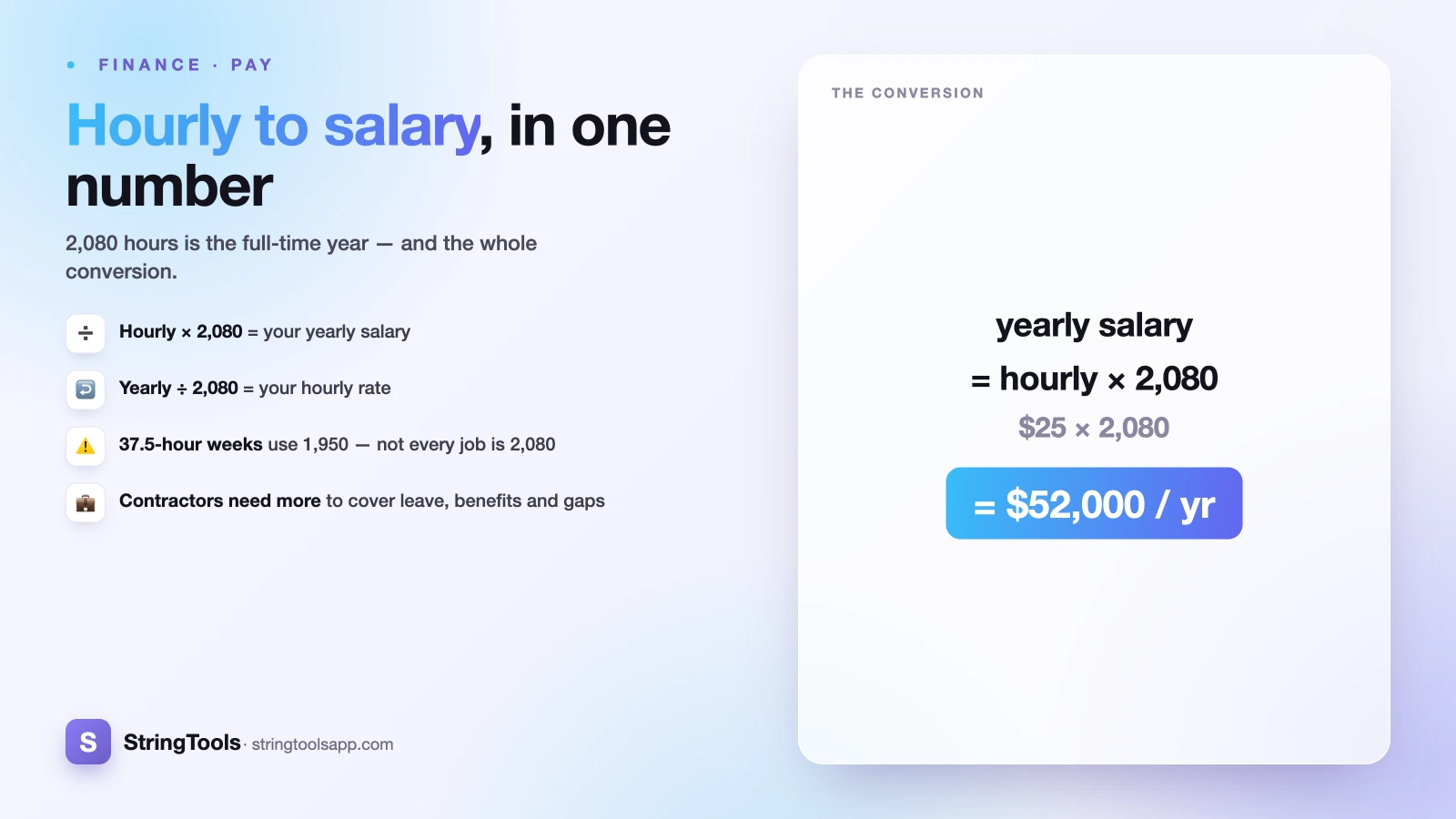
To convert an hourly wage to an annual salary, multiply the hourly rate by 2,080 — the number of hours in a 40-hour week worked for 52 weeks. So $25 an hour is $52,000 a year. To go the other way, divide the salary by 2,080: $60,000 a year is $28.85 an hour.
That is the whole calculation. The hard part isn't the arithmetic — it's knowing when 2,080 is the wrong number, and why an hourly rate and a salary that look identical on paper can be worth thousands of dollars apart once paid leave, holidays and benefits are counted.
Key Takeaways
- Hourly to yearly: rate x 2,080. Yearly to hourly: salary / 2,080.
- Mental shortcut: double the hourly rate and add three zeros. $25/hr -> roughly $50,000. It runs about 4% low, because a real year is 2,080 hours, not 2,000.
- 2,080 assumes a 40-hour week, 52 paid weeks and no unpaid time off. Change any of those and the divisor changes with it.
- All figures in this guide are gross — before income tax, national insurance, payroll deductions or pension contributions. Your take-home will be meaningfully lower.
- The real comparison isn't rate vs rate. A salaried job with 25 paid days off is worth roughly 10% more per hour worked than an hourly job at the same headline number.
Where 2,080 Comes From — and the Number the US Government Actually Uses
The convention is simple: 40 hours per week x 52 weeks = 2,080 hours. Every payroll system, recruiter and salary benchmark you'll meet uses it, which is exactly why you should too when comparing offers. Using the same divisor as the person on the other side of the table keeps the conversation clean.
But 2,080 is a rounding, not a fact. A calendar year rarely contains exactly 52 weeks of workdays — 2026 has 261, and leap years can push it to 262. The US Office of Personnel Management ran the numbers over a full 28-year calendar cycle and settled on a divisor of 2,087 hours, the true average once you account for years with 260, 261 and 262 workdays (OPM's 2,087-hour fact sheet). Federal employees' hourly rates are computed that way.
The practical difference is small. A $60,000 salary is $28.85/hr at 2,080 and $28.75/hr at 2,087 — about ten cents. Use 2,080 for everyday comparisons and don't lose sleep over it. Just don't be surprised if a government or enterprise payslip is a few cents off your own maths.
The Full Hourly to Salary Conversion Chart
Here is the chart most people are actually searching for. Weekly assumes 40 hours; yearly is rate x 2,080; monthly is the annual figure divided by 12 (not four weeks — see the note below).
These are gross figures, before any tax or deductions. The numbers read exactly the same in dollars or pounds — the arithmetic doesn't care about the currency symbol.
| Hourly rate | Per week (40 hrs) | Per month | Per year |
|---|---|---|---|
| $12 | $480 | $2,080.00 | $24,960 |
| $15 | $600 | $2,600.00 | $31,200 |
| $18 | $720 | $3,120.00 | $37,440 |
| $20 | $800 | $3,466.67 | $41,600 |
| $22 | $880 | $3,813.33 | $45,760 |
| $25 | $1,000 | $4,333.33 | $52,000 |
| $30 | $1,200 | $5,200.00 | $62,400 |
| $35 | $1,400 | $6,066.67 | $72,800 |
| $40 | $1,600 | $6,933.33 | $83,200 |
| $45 | $1,800 | $7,800.00 | $93,600 |
| $50 | $2,000 | $8,666.67 | $104,000 |
| $60 | $2,400 | $10,400.00 | $124,800 |
| $75 | $3,000 | $13,000.00 | $156,000 |
| $100 | $4,000 | $17,333.33 | $208,000 |
The monthly column trips people up. A month is not four weeks. Four weeks x 12 is only 48 weeks — you'd lose a month of pay a year. Always take the annual figure and divide by 12. If you're paid every two weeks rather than monthly, the mismatch between those two rhythms is worth understanding: see bi-weekly vs semi-monthly pay.
For context on the bottom of that chart: the US federal minimum wage is still $7.25 an hour as of August 2026, unchanged since 2009 (US Department of Labor) — about $15,080 a year at 2,080 hours, though most states set a higher floor. The UK's National Living Wage for workers aged 21 and over is £12.71 an hour from April 2026.
To run your own number in seconds, including a different weekly-hours figure, use our free salary calculator.
Salary to Hourly: The Reverse Chart
Divide the annual salary by 2,080. That's it.
| Annual salary | Hourly equivalent | Per week |
|---|---|---|
| $30,000 | $14.42 | $576.92 |
| $40,000 | $19.23 | $769.23 |
| $50,000 | $24.04 | $961.54 |
| $60,000 | $28.85 | $1,153.85 |
| $70,000 | $33.65 | $1,346.15 |
| $80,000 | $38.46 | $1,538.46 |
| $100,000 | $48.08 | $1,923.08 |
The number that catches most people out is the one at the top of the search results: $60,000 a year is $28.85 an hour, not $30. The gap exists because the mental shortcut divides by 2,000, and the year has 2,080 hours in it. Over a year, that 4% is $2,400 — real money.
There's a second, sharper catch for salaried workers. The divisor is 2,080 only if you actually work 40 hours. If your $60,000 job quietly expects 50-hour weeks, you're working 2,600 hours and earning $23.08 an hour — less than the $25/hr job you turned down.
When 2,080 Is Simply Wrong
The 2,080-hour rule assumes a full-time 40-hour week, 52 paid weeks, and no unpaid gaps. Plenty of real jobs break at least one of those assumptions.
- The 37.5-hour week. Standard in a great many UK, Irish and Canadian office roles, where an unpaid 30-minute lunch is deducted from a 40-hour day. That's 1,950 hours a year, not 2,080.
- The 35-hour week. Common in UK public sector, finance and some US union roles: 1,820 hours.
- Australia's 38-hour week. Full-time under the National Employment Standards is 38 ordinary hours: 1,976 hours.
- Part-time and job shares. 20 hours a week is 1,040 hours; 30 hours is 1,560.
- Unpaid weeks. Seasonal work, school-term contracts, agency work and freelancing rarely deliver 52 paid weeks. Four unpaid weeks drops you to 1,920 hours.
- Overtime and shift work. If a meaningful slice of your income is time-and-a-half, night differentials or weekend premiums, no single divisor describes your year. Convert your actual gross pay from last year's final payslip instead.
Here's what a $25 hourly rate becomes on each schedule. Same rate, wildly different year.
| Schedule | Hours per year | $25/hr becomes |
|---|---|---|
| 40 hrs x 52 wks (US/Canada standard) | 2,080 | $52,000 |
| 38 hrs x 52 wks (Australia full-time) | 1,976 | $49,400 |
| 37.5 hrs x 52 wks (common UK/Canada office) | 1,950 | $48,750 |
| 40 hrs x 48 paid wks (4 unpaid weeks) | 1,920 | $48,000 |
| 35 hrs x 52 wks | 1,820 | $45,500 |
| 30 hrs x 52 wks (0.75 FTE) | 1,560 | $39,000 |
| 20 hrs x 52 wks (part-time) | 1,040 | $26,000 |
The spread between the top and bottom full-time rows is $6,500 a year — on an identical hourly rate. Before you accept any conversion, find out how many hours the contract actually specifies.
The Real Trap: 'Equal' Pay Isn't Equal
This is the section that matters most, and the one the big calculator sites skip.
Suppose you're weighing a $25/hour role against a $52,000 salary. The chart says they're identical. They usually aren't.
The salaried job comes with paid time off. Say it offers 15 vacation days plus 10 public holidays — 25 days, or 200 hours. That salaried worker earns $52,000 for 1,880 hours of actual work, an effective rate of $27.66 an hour.
The hourly worker who takes those same 25 days off gets paid for 1,880 hours at $25 and earns $47,000. The two offers are $5,000 apart. To genuinely match a $52,000 salary with 25 paid days off, an hourly worker needs about $27.66/hr — roughly a 10% premium.
And paid leave is only the first line. Also count:
- Paid sick leave. For an hourly worker, a week of flu is a week of no pay.
- Employer pension or retirement contributions. In the UK, auto-enrolment requires a minimum 3% employer contribution. In Australia, the Superannuation Guarantee is 12% of ordinary earnings as of August 2026. In the US, a 4-6% 401(k) match is common. On a $52,000 salary, a 5% match is $2,600 you never see on the payslip.
- Health insurance, where the employer premium share can exceed $7,000 a year in the US.
- Guaranteed hours. An hourly job that quietly drops you from 40 to 32 hours in a slow quarter has cut your annual pay by 20% with no conversation.
- Statutory floors. Entitlements vary a lot by country — UK workers, for example, get a statutory minimum of 5.6 weeks' paid holiday, which is 28 days for a five-day week (GOV.UK holiday entitlement).
None of this shows up in a rate-to-rate comparison, and all of it shows up in your bank account. Once you've settled on gross, the next question is what actually lands: work through how to calculate take-home pay.
What a Contractor Has to Charge to Match a Salary
Freelancers and contractors get this wrong constantly. They see $60,000 / 2,080 = $28.85 and quote $35 an hour, feeling like they've priced in a premium. They've actually taken a large pay cut.
Two things break at once. First, billable hours are not working hours. Nobody bills 2,080 hours. Strip out holidays, sick days, admin, invoicing, sales calls and the gaps between contracts, and 1,400-1,600 billable hours is a realistic full year. Second, you now pay the costs an employer used to absorb — including the employer half of payroll taxes. In the US, the self-employment tax rate is 15.3% (12.4% Social Security plus 2.9% Medicare) as of August 2026, roughly double the 7.65% an employee sees withheld.
Here's what replacing a $60,000 salaried job actually costs. Swap in your own figures — this is an illustration, not a quote.
| Line item | Amount |
|---|---|
| Salary you're replacing | $60,000 |
| Employer payroll taxes you now cover (~7.65%) | $4,590 |
| Health insurance the employer used to pay | $7,000 |
| Lost retirement match (4%) | $2,400 |
| Business costs: software, kit, accountant, insurance | $3,000 |
| Revenue you need | $76,990 |
| Divided by 1,500 billable hours | $51.33 / hour |
That's 1.78x the naive $28.85 conversion. Hence the rule of thumb most experienced contractors land on:
> Take the salaried hourly equivalent and multiply by 1.5 as an absolute floor, 1.75-2.0 to genuinely match the package. The simplest version: halve the target salary, divide by 1,000, and double it. $60,000 -> $30 -> quote $50-60/hour.
If your rate is below 1.5x, you are subsidising your client's payroll department out of your own pension.
Comparing Two Offers in Five Minutes
A short checklist that beats any calculator on its own:
1. Convert both offers to gross annual using the hours the contract actually specifies — not 2,080 by default. Our salary calculator handles non-standard weeks. 2. Subtract unpaid time. For the hourly offer, multiply the rate by the hours you'll genuinely be paid for, after the holidays and sick days you realistically take. 3. Add employer contributions to the salaried offer: pension or super, insurance, bonus at its typical payout, not its maximum. 4. Convert to an effective hourly rate — annual value divided by hours actually worked. This is the only apples-to-apples number. 5. Then, and only then, look at take-home, because tax treatment can differ between employment types. 6. Stress-test the downside. What happens to each offer in a bad quarter? Salaried pay is fixed; hourly pay is not.
Two offers that look identical in the chart routinely land 10-20% apart after step 3. Run the numbers before you answer the email — and once the money starts arriving, decide where it goes with what to do with each paycheck.
Everything above is general information to help you compare offers, not tax, legal or financial advice. Rates and statutory entitlements change, and your own situation is specific to you — check current figures with the relevant government body or a qualified professional before making a decision.
Frequently Asked Questions
How much is $20 an hour per year?
$20 an hour is $41,600 a year gross, based on a 40-hour week for 52 weeks (2,080 hours). That works out to $800 a week and about $3,466.67 a month before tax. On a 37.5-hour week it drops to $39,000, and on a 35-hour week to $36,400.
How much is $25 an hour a year?
$25 an hour is $52,000 a year gross at 2,080 hours — $1,000 a week, or roughly $4,333.33 a month before deductions. If the job has no paid holiday and you take 25 days off, you'd actually receive around $47,000, which is why paid leave matters so much in a comparison.
$60,000 a year is how much an hour?
$60,000 a year is $28.85 an hour ($60,000 divided by 2,080 hours). It is not $30 — that's the 2,000-hour mental shortcut, which understates the year by about 4%. On a 37.5-hour week the same salary is $30.77 an hour, and on a 35-hour week it's $32.97.
How much is $18 an hour a month?
$18 an hour is about $3,120 a month gross. Take the annual figure ($18 x 2,080 = $37,440) and divide by 12. Don't multiply the weekly pay by four — that only covers 48 weeks and undercounts your year by a full month's pay.
Is a $30/hour contract better than a $60,000 salary?
As a straight employee-to-employee comparison, yes: $30/hr is $62,400 versus $60,000. As a self-employed contract, almost certainly not. After self-employment taxes, no paid leave, no employer insurance or retirement contribution, and unbilled hours between contracts, matching a $60,000 salaried package typically needs $50-60 an hour.
Why do some employers use 2,087 or 1,950 hours instead of 2,080?
2,087 is the true 28-year average number of workdays in a US calendar year and is the divisor the US federal government uses for hourly rates. 1,950 reflects a 37.5-hour week — standard in many UK and Canadian office roles where an unpaid lunch break is deducted. Always convert using the hours your own contract states.
Sources and references
OPM's 2,087-hour fact sheet (opm.gov) · US Department of Labor (dol.gov) · GOV.UK holiday entitlement (gov.uk). Content was reviewed against these sources as of the last-updated date above; external figures and rules may change after publication.