
The 30-Second Answer
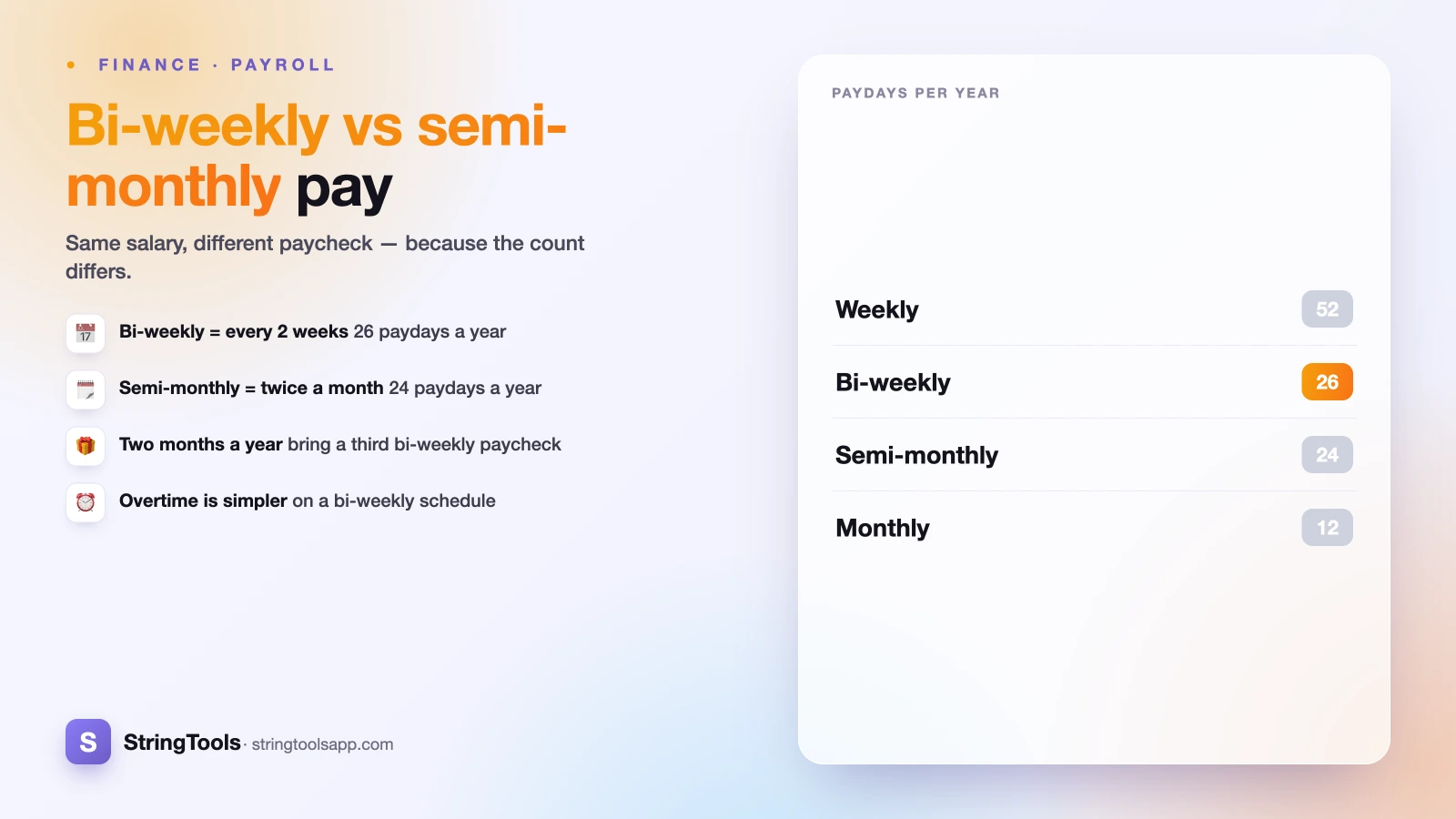
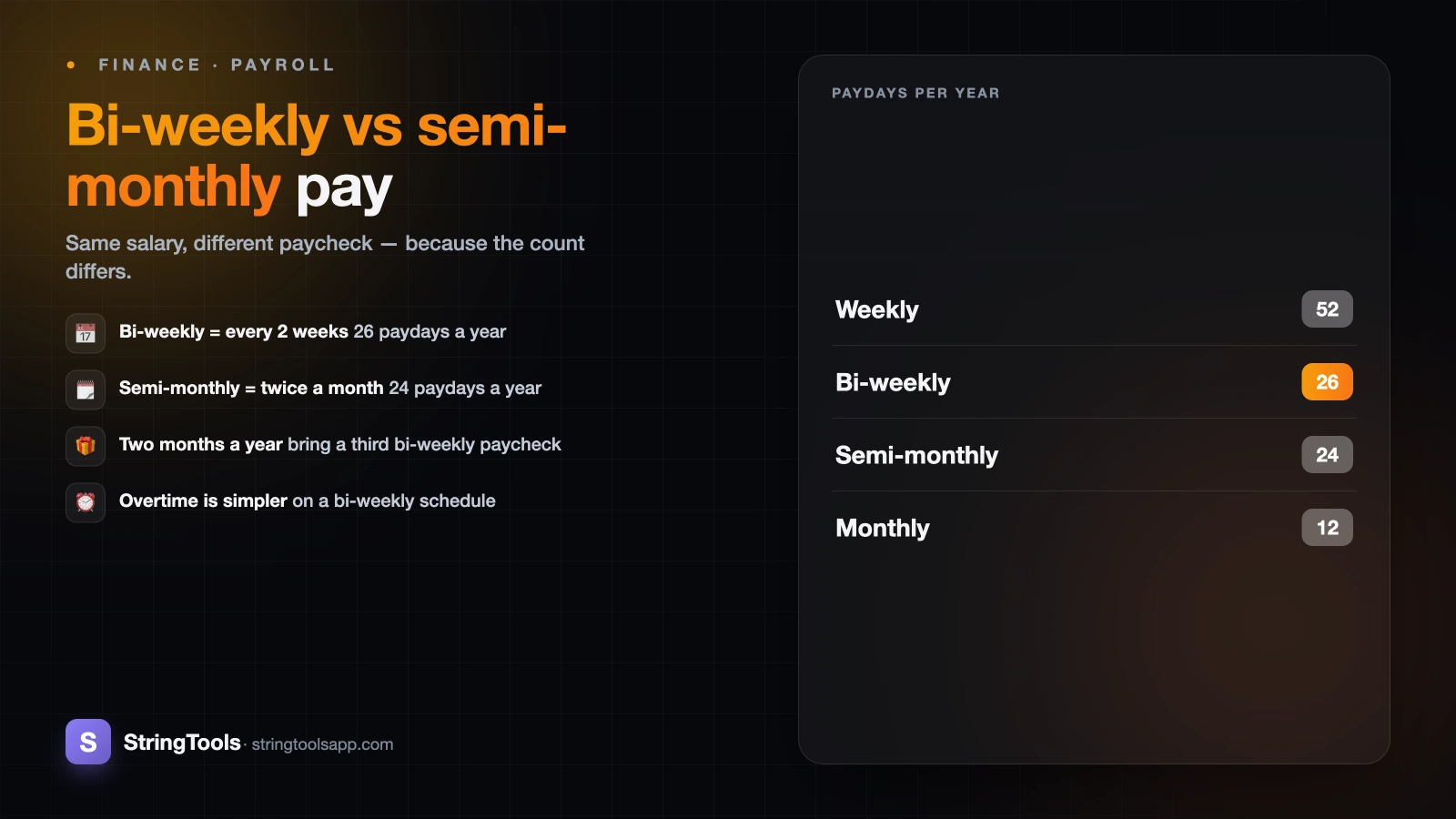
Bi-weekly pay means you're paid every two weeks — always on the same weekday, 26 times a year. Semi-monthly pay means you're paid twice a month, usually on the 15th and the last day, 24 times a year. Same annual salary, different math: bi-weekly checks are smaller but you get two extra ones.
That difference of two paychecks is the whole story. On a $75,000 salary, bi-weekly gives you $2,884.62 per check and semi-monthly gives you $3,125.00. Neither one pays you more over the year. But they feel completely different month to month, and they budget very differently.
Key Takeaways
- Bi-weekly = 26 paychecks. Semi-monthly = 24 paychecks. Both add up to the same annual salary.
- Bi-weekly always lands on the same weekday (say, every other Friday). Semi-monthly lands on the same dates, so the weekday drifts.
- Twice a year, a bi-weekly schedule produces a three-paycheck month. Semi-monthly never does.
- Semi-monthly lines up cleanly with monthly bills. Bi-weekly does not, which is why two months a year feel unusually flush.
- For hourly staff with overtime, bi-weekly is far simpler, because it maps to whole 7-day workweeks.
If you want to see the per-check number for your own salary on any of these schedules, run it through our salary calculator — it does the division and the rounding for you.
Definitions, Without the Payroll Jargon
The two words sound almost identical, which is exactly why people mix them up. Here is the distinction that matters:
Bi-weekly is anchored to the calendar week. You get paid every 14 days. If your payday is Friday, it is always Friday. Because 52 weeks divided by 2 is 26, you get 26 paychecks in a normal year.
Semi-monthly is anchored to the calendar month. You get paid twice each month — most commonly the 15th and the last day, though the 1st and 16th is also popular. Twelve months times two is 24 paychecks, every single year, without exception.
Two other schedules are worth knowing. Weekly is 52 paychecks, every 7 days — common in construction, restaurants, and staffing agencies. Monthly is 12 paychecks, rare for hourly work in the US but standard for salaried employees in the UK and Australia, and common for executives and some public-sector roles in North America.
According to the U.S. Bureau of Labor Statistics, bi-weekly is the most common pay period length among US private businesses, with larger employers especially likely to use it.
The Same Salary, Four Different Paychecks
This is the table people actually come looking for. Same annual gross salary, four schedules, four very different-looking numbers.
| Schedule | Paychecks/year | Gross per check on $50,000 | Gross per check on $75,000 |
|---|---|---|---|
| Weekly | 52 | $961.54 | $1,442.31 |
| Bi-weekly | 26 | $1,923.08 | $2,884.62 |
| Semi-monthly | 24 | $2,083.33 | $3,125.00 |
| Monthly | 12 | $4,166.67 | $6,250.00 |
Look at the two middle rows. On $75,000, the semi-monthly check is $240.38 bigger. That looks like a raise, and it absolutely is not — the bi-weekly worker collects that difference back as two extra paychecks later in the year.
The same idea from the other direction: in a typical month, a bi-weekly employee on $75,000 receives two checks totalling $5,769.24, while their semi-monthly colleague receives $6,250.00. The bi-weekly employee is "behind" by about $480 most months — then catches all of it up, twice.
None of these figures are what actually hits your bank account. Taxes, retirement contributions, and insurance premiums come off first; our guide to how to calculate take-home pay covers what happens between gross and net.
The Three-Paycheck Month, and How to Find Yours
Twelve months, 26 paychecks. The arithmetic forces two months a year to contain three paydays instead of two. That is the famous three-paycheck month, and it is one of the most useful things a bi-weekly earner can plan around.
How to find yours in about a minute: take your first payday of the year, write it on a calendar, then keep adding 14 days until you hit December. Any month that ends up with three marks is a three-paycheck month. They fall roughly six months apart.
A concrete example. If your first 2026 payday was Friday, January 2, adding 14 days at a time puts three paydays in January (2nd, 16th, 30th) and three in July (3rd, 17th, 31st). Start one week later, on Friday, January 9, and your three-paycheck months become May and October instead. It depends entirely on your employer's anchor date — which is why most "3 paycheck months in 2026" articles are wrong for most readers.
The 27-paycheck year
Every decade or so the calendar shifts enough that a bi-weekly schedule squeezes in a 27th payday. A schedule anchored on Friday, January 1, 2027, for instance, produces 27 paydays — with three-paycheck months in January, July, and December. Employers handle this differently: some simply pay the extra check, others adjust the per-period amount so the annual total stays put. Ask HR which approach yours takes.
What to do with the extra check. Your regular bills are already covered by the two "normal" checks that month, so the third is effectively unallocated. The highest-value uses are usually an emergency fund, a high-interest balance, or front-loading an annual expense like insurance — how much of your paycheck to save goes deeper on the ratios.
Why Your Paycheck Date Keeps Moving (or Doesn't)
This trips people up more than the amounts do.
Bi-weekly is weekday-stable, date-unstable. Payday is always a Friday (or always a Thursday). You never have to check. But the date wanders — the 3rd one month, the 17th the next — so it drifts against your rent, mortgage, and credit card due dates.
Semi-monthly is date-stable, weekday-unstable. The 15th and the last day, every month. But the 15th might be a Tuesday this month and a Sunday next. When a payday lands on a weekend or bank holiday, most employers pay on the preceding business day — which is why your deposit sometimes shows up on the 13th.
There's a subtler quirk too: semi-monthly periods aren't equal in length. The first half of a 31-day month covers 15 days, the second half 16, and you're paid the same for both. Over a year it evens out, but for hourly staff the hours per period fluctuate while the calendar math stays fixed. Bi-weekly periods are always exactly 14 days — no short months, no February weirdness.
How Monthly Bills Collide With Each Schedule
Your rent is monthly. Your health insurance premium is usually quoted monthly. Your streaming subscriptions are monthly. Your paycheck may not be.
Semi-monthly wins on simplicity. Two checks, every month, same total. Half your rent from each and you're done. Health premiums are typically split evenly across the 24 periods, so every deduction line looks the same all year.
Bi-weekly needs a small adjustment. Ten months bring two checks; two months bring three. If you budget as though every month has three, you'll come up short ten times. The fix is to budget on two checks and treat the third as a bonus — never the other way round.
Deduction handling differs too. Many employers on bi-weekly payroll take health premiums out of only the first two checks of each month, leaving the third free of that deduction and making it feel even bigger. Others spread the annual premium across all 26 periods. Compare a stub from a three-paycheck month against a normal one and you'll see which system you're on.
This is also where 401(k) matching can quietly bite: if your match is capped per pay period rather than annually, the number of periods affects how much match you can capture. Worth asking HR rather than guessing.
Overtime: The Real Reason Employers Pick Bi-Weekly
For salaried staff, the choice is mostly about administrative taste. For hourly staff with overtime, it's a genuine operational problem.
Under the Fair Labor Standards Act, overtime is calculated on a fixed and regularly recurring 7-day workweek — not per day, and not per calendar month. The U.S. Department of Labor's FLSA overview sets out the framework.
A bi-weekly period is exactly two workweeks. The boundaries line up perfectly: payroll totals week one, totals week two, applies overtime to each, done.
A semi-monthly period averages about 15.2 days, so its boundaries slice through the middle of workweeks. A week starting on the 13th ends on the 19th, spanning two pay periods. Payroll has to split those hours, work out overtime for the whole week, then allocate it across two checks. Plenty of employers manage it, but it's a recurring source of errors and disputes.
| Factor | Bi-weekly | Semi-monthly |
|---|---|---|
| Overtime calculation | Clean — 2 whole workweeks | Messy — workweeks split across periods |
| Payroll runs per year | 26 | 24 |
| Per-check amount | Varies for hourly, fixed for salary | Fixed for salary |
| Matches monthly bills | No — drifts | Yes — aligns |
| Payday predictability | Same weekday, shifting date | Same date, shifting weekday |
| Best suited to | Hourly staff, overtime-heavy teams | Salaried staff, professional services |
That trade-off explains the pattern you see in the wild: warehouses, hospitals, and retail chains tend to run bi-weekly, while law firms, agencies, and corporate offices with mostly exempt employees often run semi-monthly. If you're comparing an hourly offer against a salaried one, hourly to salary conversion covers how to put both on the same footing.
Who Decides — and Can You Ask to Change It?
Pay frequency in the US is set by state law, not federal law. As of August 2026, the FLSA does not mandate any particular pay frequency; it requires that employees be paid on a regular, predictable payday for the period in which they worked. The state rules are what actually set the floor, and they vary a lot — the Department of Labor maintains a state payday requirements table listing them.
The variation is real. Some states set no statutory frequency at all; others require semi-monthly as a minimum; New York requires weekly pay for workers who qualify as manual workers; several states permit monthly pay only for employees meeting the executive, administrative, or professional exemption. These rules change, so check the DOL table or your state labor department rather than a summary.
Can you ask to be switched individually? In practice, almost never. Pay frequency is a payroll-system-wide setting, and running two schedules at once roughly doubles the work. Company-wide changes do happen, usually during a payroll migration — and employees moving from semi-monthly to bi-weekly often see a one-off transition check while the calendars realign.
What you can control is how you budget around it. Know your number per check, know which months carry a third payday, and set your automatic transfers to match. Run your salary through the salary calculator for your exact per-period figure on any of the four schedules, then budget on the schedule you actually have — not the one that would be more convenient.
This article is general information about how pay schedules work, not legal, payroll, or tax advice. For questions about your own pay, talk to your employer's payroll team or your state labor department.
Frequently Asked Questions
Is bi-weekly pay better than semi-monthly pay?
Neither pays you more — both total the same annual salary. Bi-weekly is better if you like the two "extra" paychecks a year and you're hourly with overtime, because the periods line up with workweeks. Semi-monthly is better if you want steady, predictable checks that match your monthly rent and bills without any adjustment.
How many paychecks are there in a year?
Weekly is 52, bi-weekly is 26, semi-monthly is 24, and monthly is 12. Semi-monthly and monthly are fixed every year. Bi-weekly is usually 26, but roughly once a decade the calendar produces a 27th payday, depending on which date your employer's schedule is anchored to.
Which months have 3 paychecks?
It depends entirely on your employer's first payday of the year — there's no universal answer. Mark your first payday on a calendar and add 14 days repeatedly; the two months with three marks are yours. They land about six months apart. For example, a schedule starting Friday, January 2, 2026 gives three paychecks in January and July.
Why is my paycheck different this month?
The most common causes are a three-paycheck month on a bi-weekly schedule, a deduction that only comes out of the first two checks of the month, a change in overtime hours, or a benefits or tax-withholding change taking effect. Compare two stubs line by line — the deduction section usually reveals it immediately.
Does bi-weekly pay mean I earn more per year than semi-monthly?
No. A salaried employee earning $75,000 receives $2,884.62 across 26 bi-weekly checks or $3,125.00 across 24 semi-monthly checks. Both total $75,000. The bi-weekly checks are smaller precisely because there are two more of them.
Can my employer change my pay frequency?
Generally yes, as long as the new schedule still meets your state's minimum pay-frequency requirement and you get advance notice — pay frequency is governed by state law, not federal law. Employers most often change it during a payroll system migration. Check your state's rules on the Department of Labor's state payday requirements table.
Sources and references
U.S. Bureau of Labor Statistics (bls.gov) · U.S. Department of Labor's FLSA overview (dol.gov) · state payday requirements table (dol.gov). Content was reviewed against these sources as of the last-updated date above; external figures and rules may change after publication.