
What the 18% Is Actually Charged On
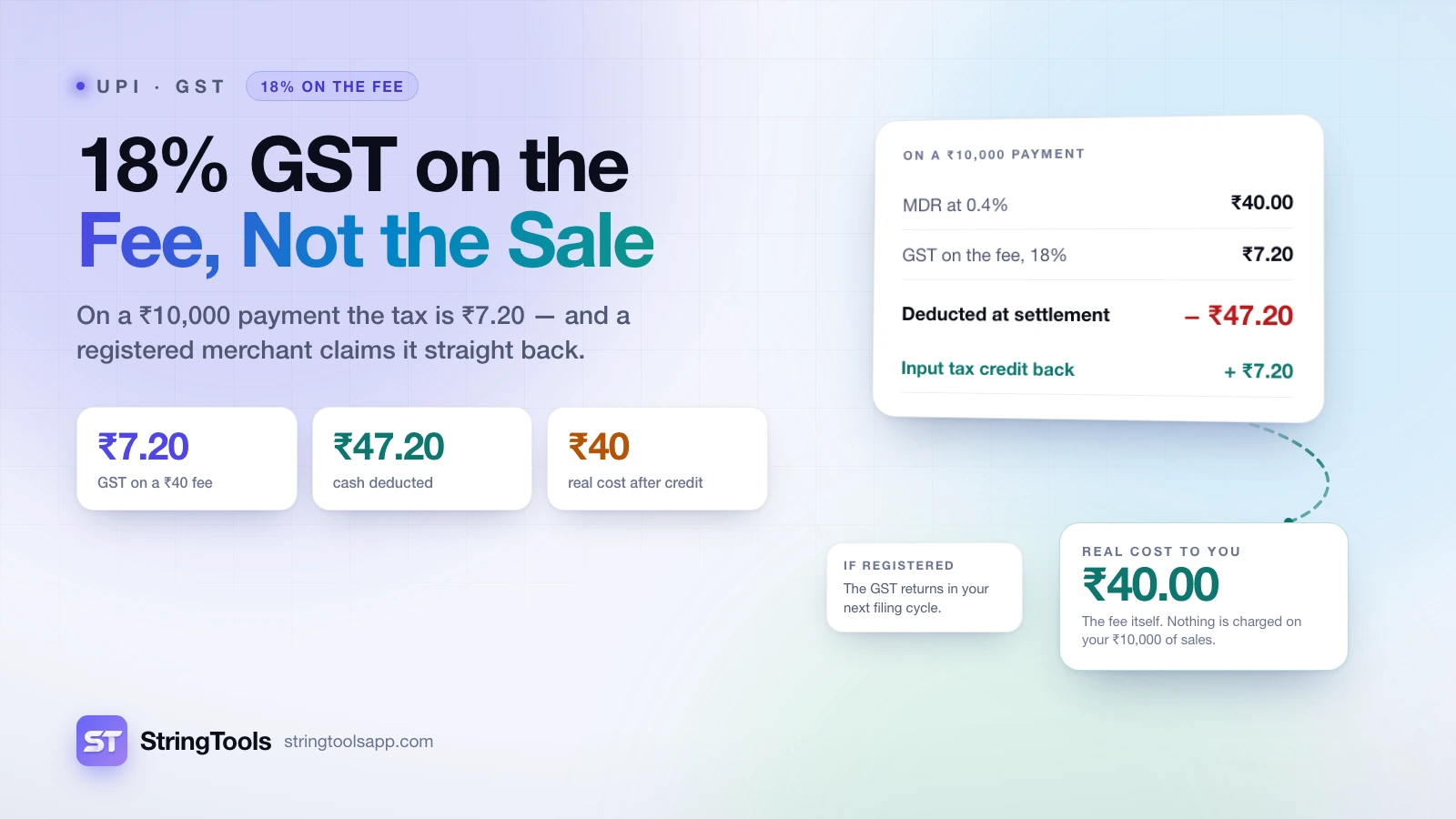
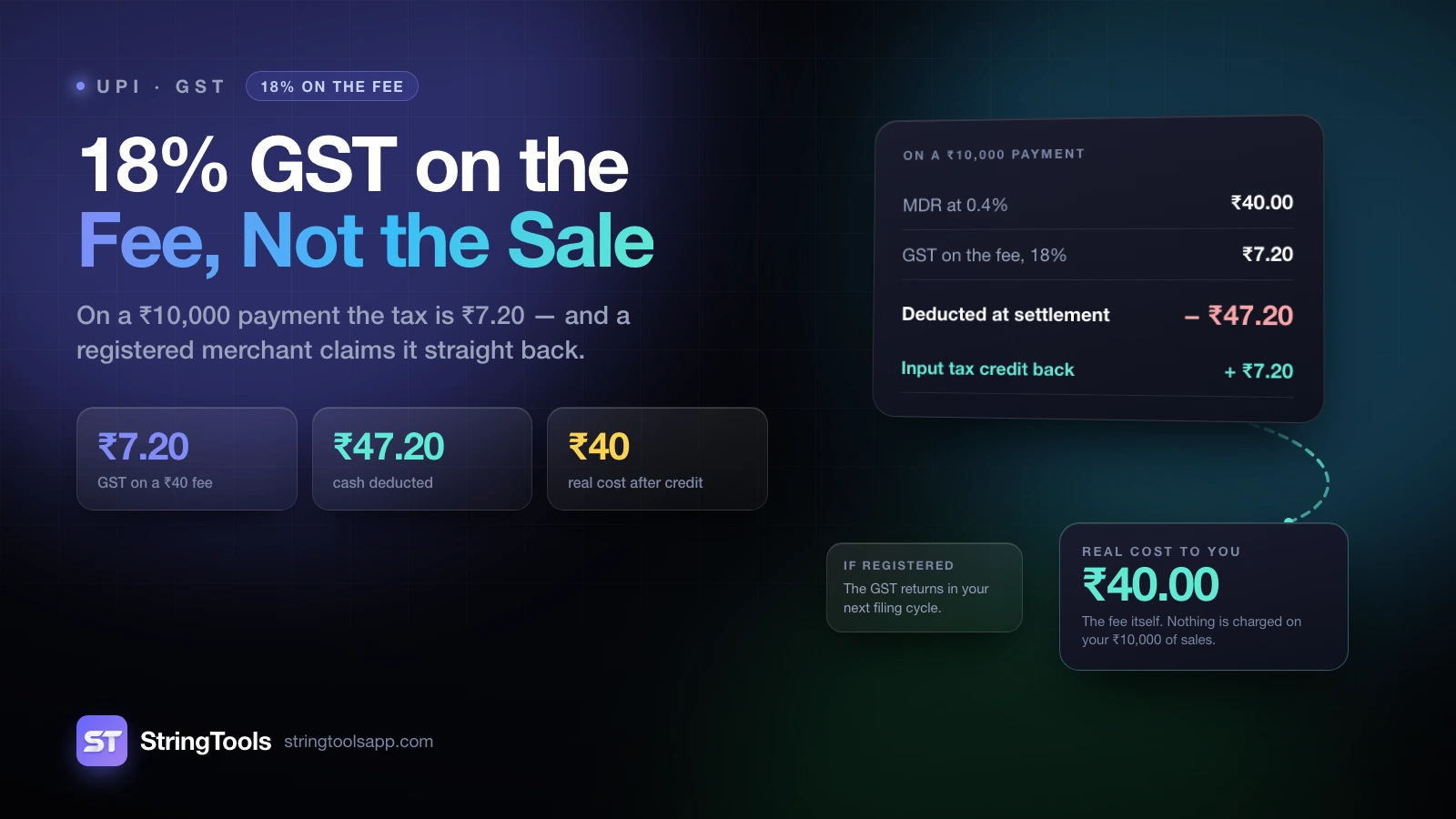
GST at 18% applies to the Merchant Discount Rate, not to the payment. On a Rs 10,000 sale the fee is Rs 40 and the GST on that fee is Rs 7.20, so Rs 47.20 leaves the merchant's account in total. Nothing is charged on the Rs 10,000 itself. A GST-registered merchant can then reclaim the Rs 7.20 as input tax credit, which makes the real cost Rs 40.
Key Takeaways
- The 18% is levied on the fee, never on the transaction value.
- On Rs 10,000: fee Rs 40, GST Rs 7.20, total deducted Rs 47.20.
- A GST-registered merchant reclaims the GST as input tax credit, so the true cost is Rs 40.
- An unregistered merchant, or one dealing in exempt supplies, genuinely bears all Rs 47.20.
- That makes the same sale 18% more expensive for an unregistered business.
- The headline "18% GST on UPI" has caused more confusion than any other part of this change.
The Headline That Frightened Everyone
When the framework was announced, a great many people read "18% GST on UPI" and pictured 18% of their payments disappearing. On a Rs 10,000 purchase that would be Rs 1,800, which would indeed be alarming. It is a misreading, but an understandable one, because the sentence is ambiguous unless you already know what MDR is.
Here is the chain, in order. A customer pays Rs 10,000 to a merchant. The payment system charges the merchant a Merchant Discount Rate of 0.4%, which is Rs 40. That Rs 40 is a service the merchant has been supplied, and services attract GST. The GST on Rs 40 at 18% is Rs 7.20. So the merchant receives Rs 10,000 minus Rs 47.20.
The customer pays Rs 10,000 and is charged nothing. Our piece on whether customers pay UPI charges covers that side in full.
What makes this worth labouring is the scale of the difference between the two readings. The correct figure is Rs 7.20. The feared figure was Rs 1,800. Those are not in the same universe, and a lot of small businesses spent a fortnight planning for the wrong one.
The Part Almost Nobody Mentions
Input tax credit is the step that turns this from a cost into a cash-flow item, and it has been badly under-reported. If you are GST-registered, the GST you pay on business inputs can be set against the GST you collect on your sales. The GST on your MDR is exactly that kind of input.
So a registered merchant paying Rs 7.20 of GST on a Rs 40 fee gets that Rs 7.20 back through their return. The cash leaves the account on the day of the transaction and comes back in the credit cycle. The genuine cost of accepting that Rs 10,000 payment is Rs 40, not Rs 47.20.
Free Press Journal's report that UPI MDR attracts 18% GST with input tax credit available on eligible transactions is one of the few pieces to spell this out. It matters because the difference is material at volume: a business paying Rs 4,000 of MDR a month is paying Rs 720 of GST on top, and whether that Rs 720 comes back is worth Rs 8,640 a year.
The UPI MDR calculator shows both figures on every result for this reason — the cash deducted and the real cost after credit — rather than picking one and hoping you understand which.
Registered Versus Unregistered, in Numbers
| Payment | MDR | GST on fee | Registered merchant pays | Unregistered merchant pays |
|---|---|---|---|---|
| Rs 2,500 | Rs 10.00 | Rs 1.80 | Rs 10.00 | Rs 11.80 |
| Rs 5,000 | Rs 20.00 | Rs 3.60 | Rs 20.00 | Rs 23.60 |
| Rs 10,000 | Rs 40.00 | Rs 7.20 | Rs 40.00 | Rs 47.20 |
| Rs 25,000 | Rs 100.00 | Rs 18.00 | Rs 100.00 | Rs 118.00 |
| Rs 75,000 and above | Rs 300.00 | Rs 54.00 | Rs 300.00 | Rs 354.00 |
The last two columns differ by exactly 18% on every row, which is the whole story in one sentence: being unregistered makes accepting digital payments 18% more expensive.
For most businesses this is academic, because anyone with enough turnover to be paying meaningful MDR is usually registered anyway. Where it bites is the middle ground — a business below the registration threshold that nonetheless sells high-value items, or one supplying exempt goods and services that cannot claim full credit. Those merchants bear the whole amount and should budget accordingly.
How to Record It
Treat the MDR like any other input service. The fee and its GST will appear on the statement your acquirer or payment aggregator issues, and that document is what supports the credit. You are not inventing an entry; you are claiming against a tax invoice for a service you were supplied.
Two practical points come up often. First, the deduction usually happens at settlement rather than at the point of sale, so your books need to reconcile gross sales against net settlements with the fee sitting in between. If you record only the net figure, your revenue will be understated and the input credit will be invisible. Our guide to UPI fee estimator covers the bookkeeping shape in more detail.
Second, if you supply a mix of taxable and exempt goods, the credit may be restricted proportionally rather than available in full. That is a general feature of input tax credit rather than anything specific to UPI, but it is the case where the simple story above stops being simple. The official GST portal is the right starting point, and this is a genuine question for your accountant rather than for a website.
When the Money Leaves and When It Comes Back
The timing is the part that catches businesses out in their first quarter, because the two halves of the transaction happen weeks apart.
The fee and its GST are deducted at settlement, usually within a day or two of the sale. The input tax credit arrives when you file, which may be a month or more later. So a business paying Rs 4,000 of MDR a month is out of pocket by Rs 720 of GST for most of that month, every month, on a rolling basis. It comes back, but it is not instantaneous.
For most businesses this is immaterial. For one running tight on working capital it is worth knowing about, because it behaves like a small permanent float rather than a one-off. The cash impact is roughly one month's GST on your MDR, held continuously.
The other timing point concerns reconciliation. If your sales ledger records gross amounts and your bank shows net settlements, the difference is the fee, and it needs a home in your accounts rather than being quietly absorbed as a smaller revenue figure. Recording the net is the most common bookkeeping error here: it understates both revenue and costs, and it makes the input credit invisible at exactly the moment you want to claim it.
Why the Rate Is 18% and Not Something Else
There is nothing UPI-specific about the 18%. It is the standard GST rate applying to financial and payment services in India, and it has applied to card MDR for years in exactly the same way. Card-accepting merchants have been paying GST on their MDR, and reclaiming it where eligible, throughout.
That is the useful context for anyone feeling singled out. This is not a new tax invented for UPI; it is the ordinary tax treatment of a payment service, now applying to a payment service that previously carried no fee for the GST to attach to. When the fee was zero, 18% of zero was zero.
It also means the comparison between payment rails is unaffected by GST. Every rail's fee carries the same 18%, so it scales all of them equally and leaves the ranking untouched. If you are comparing UPI against cards, compare the fees themselves and treat the GST as a timing difference — which is what our payment method comparison does. For background on how GST slabs work more generally, the GST calculation guide is the fuller treatment.
The One-Line Summary Worth Remembering
If you are GST-registered, your cost of accepting a UPI payment above Rs 2,000 is 0.4% of the payment, and the 18% you see deducted comes back to you. If you are not registered, your cost is 0.472%, and it does not.
That single sentence resolves most of the questions people have about this change. It also explains why two merchants can describe the same fee differently and both be right — one is quoting the cash that left their account, the other is quoting what it ultimately cost them.
For the avoidance of doubt, none of this is a reason to register for GST that you would not otherwise have. Registration brings filing obligations, compliance work and a good deal else besides, and recovering a few hundred rupees of MDR GST is nowhere near enough to justify it on its own. A business paying Rs 2,000 of MDR in a month carries Rs 360 of GST on top, and against staff, rent, stock or electricity that is not a figure that should occupy much management attention. The reason to understand it properly is not that it is large, but that planning with the wrong number quietly distorts every pricing decision that follows. Our UPI fee estimator works through a month of real transactions rather than a single sale, which is the level at which any of this starts to mean something. The FAQs published by the Department of Financial Services are the primary reference for the fee itself, and the credit question belongs with your accountant.
Frequently Asked Questions
Is 18% GST charged on my UPI payments?
No. The 18% is charged on the merchant's fee, not on the payment. On a Rs 10,000 sale the fee is Rs 40 and the GST on that fee is Rs 7.20. If you are the customer, nothing at all is charged to you. If you are the merchant, Rs 47.20 is deducted in total, and Rs 7.20 of that comes back as input tax credit if you are GST-registered. The payment value is never taxed.
Can I claim input tax credit on UPI MDR?
If you are GST-registered and the fee relates to your taxable business supplies, yes. The GST on the MDR is an input tax like any other, supported by the statement your acquirer or aggregator issues. Businesses supplying exempt goods or services may find the credit restricted proportionally rather than available in full, which is a general feature of input tax credit rather than anything specific to UPI. Confirm your own position with your accountant.
How much more does this cost an unregistered business?
Exactly 18% more. A registered merchant's real cost on a Rs 10,000 payment is Rs 40, because the Rs 7.20 of GST is reclaimed. An unregistered merchant bears the whole Rs 47.20. The gap is the same proportion at every payment size. For most businesses this is academic, since anyone paying meaningful MDR is usually registered, but it matters for smaller businesses selling high-value items.
Why is GST charged on a fee at all?
Because the MDR is payment for a service supplied to the merchant, and services attract GST in the ordinary way. There is nothing UPI-specific about it: card MDR has carried the same 18% for years, with merchants reclaiming it where eligible. When UPI carried no fee, there was nothing for GST to attach to. The rate is the standard one for financial and payment services rather than a special levy.
Does GST change which payment method is cheapest for a merchant?
No. The same 18% applies to the fee on every rail, so it scales all of them equally and leaves the ranking untouched. UPI at 0.4% remains far cheaper than a card at a typical 2%, with or without GST in the comparison. What GST does affect is cash flow, since the money leaves at settlement and returns in the credit cycle, and it affects unregistered merchants permanently because they cannot reclaim it.
Sources and references
report that UPI MDR attracts 18% GST with input tax credit available on eligible transactions (financialservices.gov.in) · GST portal (gst.gov.in). Content was reviewed against these sources as of the last-updated date above; external figures and rules may change after publication.