
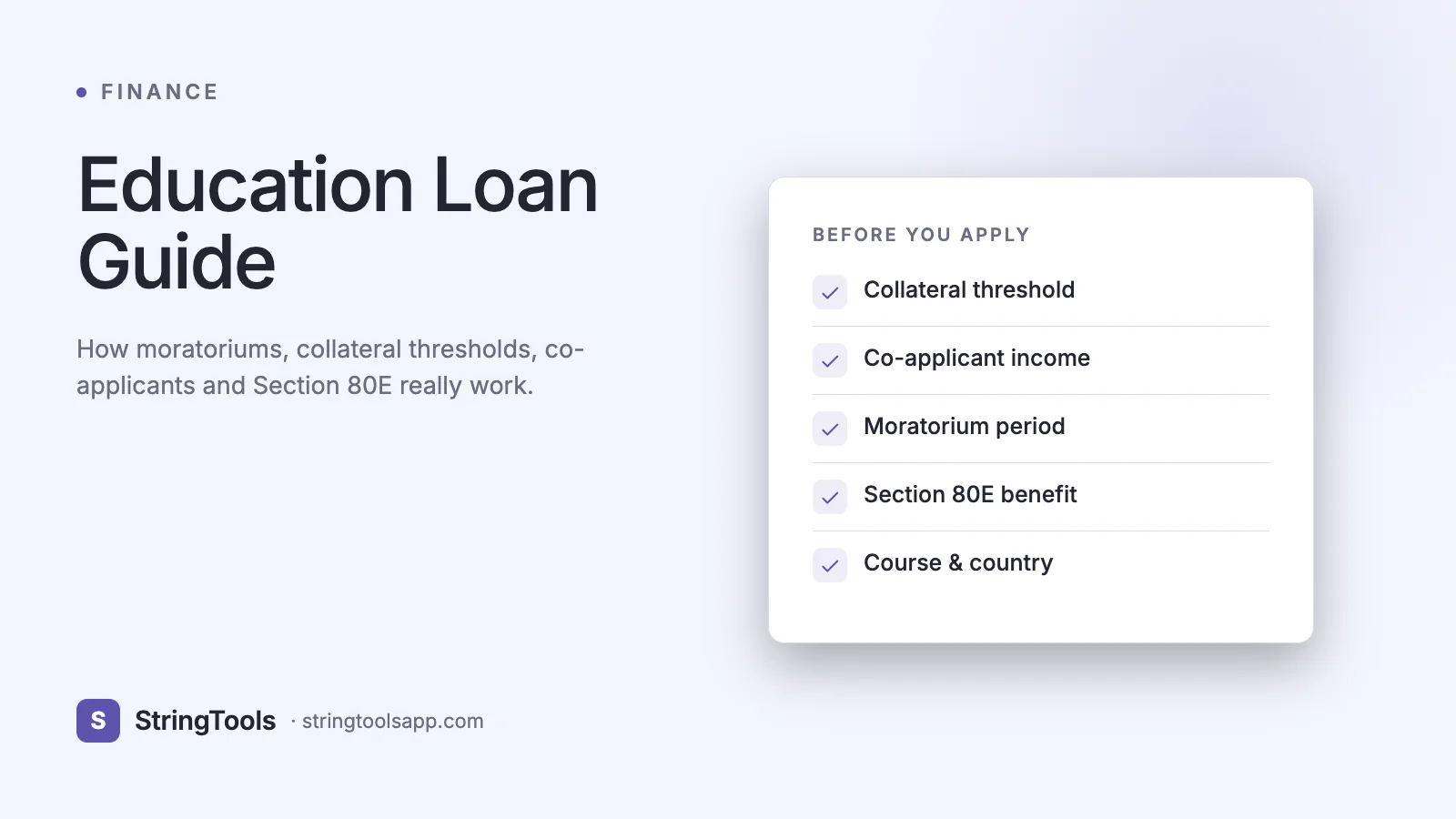
Why Education Loans Play by Different Rules
Key Takeaways
- An education loan's moratorium pauses your EMIs but not your interest — on a ₹20 lakh loan at 10.5%, letting interest capitalise pushes your starting balance to about ₹25.25 lakh before repayment even begins.
- Collateral-free does not mean co-signer-free: nearly every Indian education loan needs a fully liable co-applicant, even loans up to ₹4–7.5 lakh that carry no security.
- Your college matters more than your credit score — a premier institution can unlock unsecured loans well into the tens of lakhs, plus a lower rate.
- Section 80E lets you deduct education-loan interest with no upper limit, but only interest (never principal), for up to eight years, and generally only under the old tax regime.
- Margin money means you fund part of the cost yourself — commonly around 5% for studies in India and around 15% for studies abroad.
- Because pricing is list-based and policy-based, two identical students can get very different offers, so always compare more than one lender.
Education loans play by different rules because they are underwritten against a future salary, not a present one: the borrower typically has no income or credit history, repayment starts years after disbursement, and interest quietly accrues throughout the study period. Those differences drive who must co-sign, when collateral is required, and what the loan truly costs.
You have an admission letter in one hand and a fee schedule in the other, and the gap between them is several lakh rupees — or several tens of thousands of dollars if the university is abroad. This is the moment most families first encounter an education loan, and it is also the moment most mistakes are made, because people assume an education loan works like a personal loan or a car loan. It does not.
An education loan is the only mainstream loan where repayment is designed to start years after the money is disbursed, where the primary borrower usually has no income and no credit history, and where the lender is effectively underwriting a future salary rather than a present one. That changes everything: who has to sign, when collateral is demanded, how interest quietly accumulates while you study, and even how the tax benefit works.
This guide walks through the pieces that actually decide whether you get approved and what the loan truly costs: the moratorium period, collateral thresholds, the co-applicant requirement, Section 80E in India, margin money for abroad studies, and a fully worked numeric example showing what the study-period grace really costs. By the end you should be able to read a sanction letter and know exactly what you are agreeing to.
The Moratorium Period, Explained Properly
An education loan moratorium is a repayment holiday covering your course duration plus a grace window of six months to a year, during which no EMIs are due. Interest still accrues on each disbursed tranche from day one, so the balance you eventually repay is larger than the amount you originally borrowed.
The moratorium — sometimes called the repayment holiday or grace period — is the defining feature of an education loan. In the typical Indian structure, EMIs do not begin while the course is running. Repayment usually starts after course completion plus a grace window, commonly six months to a year, or from the time you land a job if that happens earlier. A two-year master's degree with a six-month grace window means roughly two and a half years can pass between the first disbursement and your first EMI.
Here is the part many borrowers miss: the moratorium pauses repayment, not interest. From the day each tranche is disbursed, interest starts accruing on it. Most lenders charge simple interest during the study period and then add the accumulated amount to your principal when EMIs begin — a process called capitalisation. Some lenders offer a small interest-rate concession if you (or your parents) service the interest during the moratorium instead of letting it pile up, which is worth asking about explicitly.
The practical consequence is that the loan you repay is larger than the loan you took. If you borrow twenty lakh and let interest accrue for two and a half years, you could begin repayment owing twenty-five lakh or more, depending on the rate. Once capitalised, that larger balance itself earns interest for the full tenure — the same compounding mechanic a compound interest calculator makes visible — which is why the moratorium decision deserves real arithmetic, not a shrug. We will do that arithmetic in a moment.
Collateral Thresholds and the Co-Applicant Requirement
In India, education loans up to about ₹4–7.5 lakh are commonly sanctioned without collateral, while loans above ₹7.5 lakh typically need tangible security such as property or fixed deposits — exact cutoffs vary by lender. Separately, virtually every education loan, secured or not, requires a fully liable co-applicant, usually a parent or guardian.
Whether you need collateral depends mostly on how much you are borrowing and where you got admitted, and the cutoffs genuinely vary by lender and scheme — there is no single universal number, so treat any figure you read online as a starting point for negotiation, not a rule.
The broad pattern in India looks like this. Smaller loans — often up to somewhere in the region of four to seven and a half lakh rupees at public-sector banks — are commonly sanctioned without any collateral, sometimes supported by government credit-guarantee schemes. Mid-sized loans may require a third-party guarantee or partial security. Larger loans, especially for expensive overseas programmes, typically require tangible collateral: residential property, fixed deposits, or similar assets, usually pledged by the parents.
| Loan amount band | Collateral required | Co-applicant |
|---|---|---|
| Up to ₹4 lakh | None | Required |
| ₹4–7.5 lakh | Usually none, sometimes a third-party guarantee | Required |
| Above ₹7.5 lakh | Tangible collateral (property or fixed deposits) | Required |
There is a major exception. For students admitted to institutions the lender classifies as premier — think IITs, IIMs, top NITs, and well-ranked foreign universities — many banks and NBFCs extend unsecured loans well into the tens of lakhs. Each lender maintains its own institution list with its own unsecured ceiling and pricing, which is exactly why two students with identical profiles can get wildly different offers from different lenders.
Separately from collateral, virtually every Indian education loan requires a co-applicant — usually a parent or guardian, sometimes a spouse or sibling. This is not a formality. The co-applicant is jointly and fully liable for the debt, the loan appears on their credit report, and their income and credit score materially affect approval and pricing. A collateral-free loan is not a co-signer-free loan; the two requirements are independent, and confusing them is one of the most common misunderstandings in this market. Unlike a home loan, where a mortgage calculator can map the whole repayment picture from day one because the asset and income already exist, an education loan's security package is assembled from whatever the family can offer today against income that does not exist yet.
What Lenders Actually Evaluate: Your College Matters More Than Your Credit Score
Because the student usually has no income, lenders underwrite education loans on a different axis: the employability of the education itself. The single biggest driver of your approval odds, your unsecured limit, and your interest rate is the institution and course you got into. A seat in a programme with a strong placement record is, from the lender's perspective, a near-guarantee of future repayment capacity; an unranked institution or a course with weak job outcomes shifts the entire burden onto collateral and the co-applicant's finances.
Beyond the institution, lenders typically look at the course type and duration, since professional and technical degrees with clear career paths score better than open-ended ones; your academic record, because consistent past performance predicts course completion; the co-applicant's income stability and credit score, which carry the application while you study; the country of study for overseas loans, since visa regimes and post-study work rights differ; and the total cost versus the amount requested, because lenders like to see the family contributing a share.
Understanding this hierarchy helps you present your application well. Lead with the admission letter and placement statistics, not with the collateral. If your institution appears on a lender's premier list, say so and ask what unsecured limit and rate concession that unlocks — the difference can be substantial.
A Worked Example: What the Moratorium Really Costs
On a ₹20 lakh education loan at 10.5% with a 2.5-year moratorium and a 10-year repayment tenure, capitalising the study-period interest raises the starting balance to ₹25,25,000, lifts the EMI from about ₹26,987 to about ₹34,071, and costs roughly ₹3.25 lakh more overall than paying the ₹5.25 lakh interest as you study.
Numbers make this concrete. Suppose you borrow ₹20,00,000 for a two-year master's programme at an interest rate of 10.5% per year, repayable over 10 years (120 months) once EMIs begin, with a two-and-a-half-year moratorium (course plus six months' grace). These figures are illustrative — actual rates vary by lender, institution list, and collateral — but the mechanics are exact.
Scenario one: interest is serviced during the moratorium. Simple interest on ₹20,00,000 at 10.5% for 2.5 years is ₹20,00,000 × 0.105 × 2.5 = ₹5,25,000, paid as you go. When repayment starts, the principal is still ₹20,00,000. Using the standard amortization formula, the monthly rate is 10.5 ÷ 12 ÷ 100 = 0.00875, and the EMI works out to about ₹26,987. Over 120 months you repay roughly ₹32.38 lakh, of which about ₹12.38 lakh is interest — plus the ₹5.25 lakh paid during study, for a total interest outgo of about ₹17.63 lakh.
Scenario two: interest is capitalised. The same ₹5,25,000 of accrued interest is instead added to the loan, so repayment begins on ₹25,25,000. The EMI on that balance over the same 120 months is about ₹34,071 — roughly ₹7,084 more every single month. Total repayment is about ₹40.89 lakh, and the total interest cost is about ₹20.89 lakh.
The comparison: capitalising costs you about ₹8.5 lakh in extra EMI payments over the tenure, versus ₹5.25 lakh paid during the study period — a net additional cost of roughly ₹3.25 lakh for the convenience of deferring. If the family can service even part of the interest during the course, it usually pays off. One nuance in your favour: lenders disburse in tranches each semester, so interest accrues only on amounts actually released, which makes the real accrual somewhat gentler than this simplified single-disbursement example. Run your own numbers in an EMI calculator with your actual rate and tranche schedule before deciding.
India Specifics: Section 80E, Margin Money — and How the US System Differs
In India, Section 80E lets you deduct education-loan interest with no upper limit — interest only, for up to eight years, and generally only under the old tax regime — while margin money requires you to fund about 5% of costs for studies in India and about 15% abroad. The US instead runs a two-track federal-versus-private system.
Section 80E of the Income Tax Act is the education loan's headline tax benefit, and it is unusually generous in one specific way: there is no upper limit on the amount of interest you can deduct. If you pay ₹2.4 lakh of education-loan interest in a year, the entire amount reduces your taxable income. The fine print matters, though. The deduction covers interest only, never principal. It is available for up to eight years starting from the year you begin paying interest, or until the interest is fully repaid, whichever comes first — a reason some borrowers deliberately avoid stretching repayment far beyond that window. The loan must come from a bank, a notified financial institution, or an approved charitable institution, and it must fund higher education for yourself, your spouse, your children, or a student you are legal guardian to. Crucially, Section 80E is a deduction under the old tax regime; if you file under the new regime, you generally cannot claim it, so factor your regime choice into the loan's true after-tax cost.
Margin money is the other India-specific concept, especially for abroad studies. Lenders rarely fund 100% of the cost: you are expected to contribute a percentage yourself, commonly around 5% for studies in India and around 15% for studies abroad above a small loan size, though the exact split varies by lender and scheme. Scholarships and assistantships can usually be counted toward your margin, which is worth confirming in writing because it can meaningfully shrink the cash your family must produce upfront.
For contrast, the United States runs a two-track system. Federal student loans — applied for through FAFSA — carry fixed rates set by law, require no credit check or cosigner for most undergraduate borrowing, and come with protections private lenders rarely match: income-driven repayment plans, deferment options, and potential forgiveness programmes. Private student loans, by contrast, are credit-underwritten, usually need a cosigner for young borrowers, and offer fewer safety nets. The standard advice for US students is to exhaust federal eligibility before touching private loans — a useful reminder that everywhere in the world, the structure of a student loan matters as much as its headline rate.
Common Mistakes and Myths That Cost Borrowers Money
The costliest education-loan mistakes are treating the moratorium as free money, assuming collateral-free means co-signer-free, drawing the full sanctioned amount early, expecting Section 80E to cover the whole EMI, comparing lenders on headline rate alone, overlooking the job-trigger clause, and applying to only one bank. Each one is avoidable.
Treating the moratorium as free money. It is the single most expensive misconception. Interest accrues from disbursement day one, and as the worked example showed, letting it capitalise can add lakhs to your total cost. At minimum, know the number you will owe when EMIs begin.
Assuming collateral-free means co-signer-free. Unsecured education loans still require a co-applicant who is fully liable. Your parent's credit report will carry this loan for its entire life, and a missed EMI damages their score as much as yours.
Borrowing the full sanctioned amount reflexively. Sanction and disbursement are different things. Since disbursement happens in tranches and interest accrues only on released amounts, drawing money earlier than the university actually bills you means paying interest for nothing.
Believing Section 80E covers the whole EMI. It covers interest only, only under the old tax regime, and only for a limited number of years after repayment begins. Budgeting as if the entire EMI is tax-deductible leads to unpleasant surprises.
Comparing lenders on headline rate alone. Processing fees, margin requirements, whether interest is simple or compounded during the moratorium, prepayment terms, and whether your institution sits on the lender's premier list can swing the true cost far more than half a percent of interest. A loan calculator that shows total interest over the full tenure is a fairer comparison tool than any rate table.
Forgetting the job-trigger clause. At many lenders, repayment starts from course completion plus the grace window or from when you get a job, whichever is earlier. If you land a role during your final semester, your EMI clock may start sooner than you planned — read this clause before signing.
Applying to a single bank. Education loan pricing is list-based and policy-based, so the spread between the best and worst offer for the same student is often the widest of any retail loan category. Not shopping around is leaving money on the table.
Finding the Right Education Loan Without Running Bank to Bank
The fastest way to find the right education loan is to make lenders compete: get quotes from several RBI-regulated banks and NBFCs — or a reputable, regulated comparison marketplace — and compare their offers side by side rather than applying to each one individually.
Everything above points to one practical conclusion: because unsecured ceilings, institution lists, moratorium interest treatment, and margin requirements differ so much between lenders, the single highest-value hour in this process is the one you spend making lenders compete. A student with a strong admission can often move from a collateral-demanding offer at one bank to a fully unsecured, cheaper loan at another — but only if both offers are on the table.
That is exactly why the comparison hour pays off. Gather offers from several banks and NBFCs regulated by the Reserve Bank of India — covering your course, institution, amount, and country — and compare them side by side instead of repeating the same paperwork at every branch. When the offers arrive, put each one through an EMI calculator to verify the quoted instalment, and use a loan calculator to compare total interest across different tenures and moratorium treatments before you commit — a sanction letter should never contain a number you have not independently checked.
An education loan, structured well, is one of the few debts that reliably pays for itself: it buys earning power, carries a genuinely useful tax break in India, and gives you breathing room to study before you repay. Take the time to understand the moratorium, negotiate the collateral question with more than one lender, and do the arithmetic — your future salary will thank you.
This article is general education, not financial advice; eligibility criteria, interest rates, collateral thresholds, and tax rules vary by lender and change over time, so confirm current terms with your lender and a qualified advisor.
Frequently Asked Questions
Can I get an education loan without collateral?
Yes, within limits. Smaller loans — often up to somewhere around ₹4–7.5 lakh at public-sector banks — are commonly unsecured, sometimes backed by government credit-guarantee schemes. For students admitted to institutions on a lender's premier list (IITs, IIMs, top-ranked foreign universities and similar), many banks and NBFCs extend unsecured loans well into the tens of lakhs. Thresholds vary significantly by lender and scheme, so compare multiple offers. Note that even a collateral-free loan still requires a co-applicant, usually a parent, who is fully liable for the debt.
What is the moratorium period on an education loan?
It is the repayment holiday covering your course duration plus a grace window — typically six months to a year after course completion, or until you get a job, whichever comes first. EMIs do not run during this period, but interest does accrue from each disbursement. Most lenders charge simple interest during the moratorium and add it to your principal when repayment starts, so you begin EMIs owing more than you borrowed unless you service the interest during your studies.
Is there a limit on the Section 80E tax deduction for education loan interest?
No — Section 80E has no upper limit on the interest amount you can deduct, which makes it unusual among Indian tax deductions. But it applies to interest only (never principal), is available for a maximum of eight years starting from the year you begin paying interest, requires the loan to be from a bank or approved institution, and is generally available only under the old tax regime. If you file under the new regime, you typically cannot claim it.
Do education loans require a co-applicant?
In India, almost always. Lenders require a parent, guardian, spouse, or sibling as co-applicant because the student usually has no income or credit history. The co-applicant is jointly and fully liable, the loan appears on their credit report, and their income and credit score directly affect approval and the interest rate. This requirement applies even when the loan is collateral-free — the co-applicant and collateral are separate, independent requirements.
Should I pay interest during the moratorium period or let it accumulate?
Pay it if you can. On a ₹20 lakh loan at 10.5% with a 2.5-year moratorium, letting interest capitalise raises your repayment principal to about ₹25.25 lakh and your EMI from roughly ₹26,987 to about ₹34,071 over a 10-year tenure — around ₹8.5 lakh extra in EMIs versus ₹5.25 lakh paid during study, a net additional cost of about ₹3.25 lakh. Some lenders also offer a small rate concession for servicing interest during the course, which improves the maths further.
What do banks check for education loan eligibility?
The biggest factor is the employability of your education: the institution's reputation and placement record, and the course type. Lenders maintain internal lists of premier institutions that unlock higher unsecured limits and better rates. They also assess your academic record, the co-applicant's income and credit score, the country of study for overseas loans, and your margin contribution (commonly around 5% for India, around 15% for abroad, varying by lender). Your own credit score matters less than in other loans because the co-applicant's profile carries the application.
Sources and references
Section 80E of the Income Tax Act (incometax.gov.in) · FAFSA (studentaid.gov) · Reserve Bank of India (rbi.org.in). Content was reviewed against these sources as of the last-updated date above; external figures and rules may change after publication.