
The fastest loan you can get is sitting in your locker
Key Takeaways
- Gold loans disburse fast — often within an hour — because your pledged ornaments, not your income or credit score, are the security.
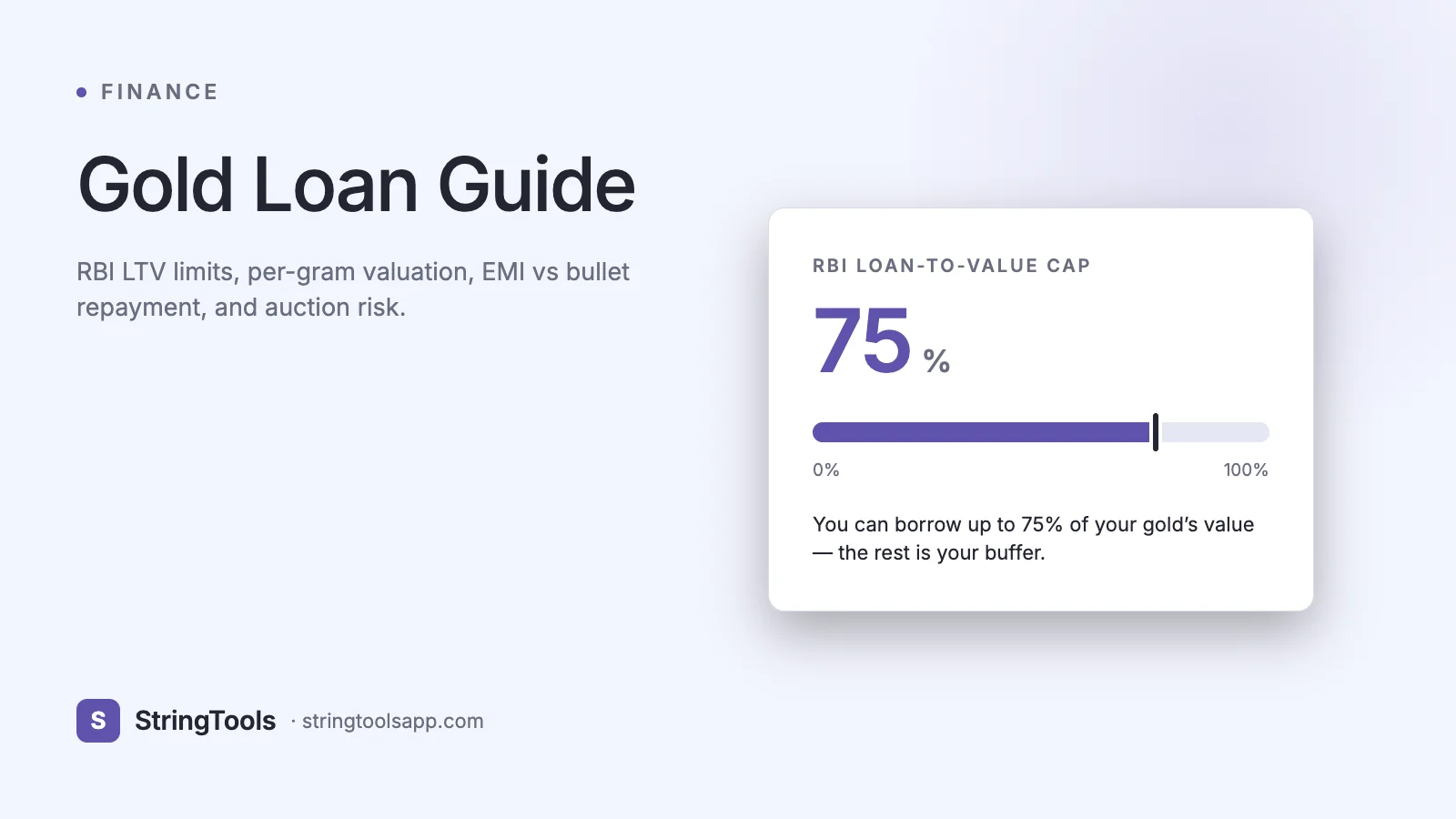
- The RBI caps gold loans at 75 percent loan-to-value, with 2025 tiered rules allowing up to around 85 percent on small-ticket loans.
- Only gold content counts: stones, making charges, and non-gold weight are excluded, so the loan value sits well below the jeweller's shop price.
- On the same illustrative 2,00,000 rupee, 12-month loan at 12 percent, EMI repayment costs about 13,240 in interest versus about 24,000 for bullet repayment.
- Gold loan rates (roughly 9 to 18 percent per annum) are almost always cheaper than personal loans and dramatically cheaper than credit card debt.
- Borrow below the LTV cap and pledge only with RBI-regulated banks or NBFCs — the real risk is the auction of your family's jewellery on default.
A gold loan is a secured loan where you pledge gold jewellery with a bank or NBFC and borrow up to the RBI's loan-to-value cap — 75 percent of the gold's assessed value — often disbursed within an hour, with no income proof, because the vaulted gold itself is the lender's security.
When you need money urgently — a medical bill, a business payment that cannot wait, a college fee deadline — most loans move too slowly. A personal loan needs income proof, a credit check, and often two to five working days. A loan against property can take weeks. But if your family owns gold jewellery, you are probably sitting on the fastest, cheapest secured credit available to ordinary households: the gold loan.
A gold loan is simple at its core. You pledge gold ornaments with a bank or a non-banking financial company (NBFC), the lender assesses the purity and weight, and you walk out — often within an hour — with a loan worth a large fraction of the gold's market value. Your gold sits in the lender's vault as security, and you get it back the day you repay.
This is not a niche product. India holds one of the largest stocks of privately owned gold in the world, and gold loans are a mainstream part of household finance across India and South Asia. Dedicated gold-loan NBFCs run thousands of branches, and every major bank offers the product. In the US, UK, Canada, and Australia, the closest equivalents are pawnbroker loans and other asset-backed lending, which work on similar logic but are usually far more expensive relative to bank credit — one reason the gold loan model is studied globally as an unusually efficient form of collateralised lending.
This guide explains exactly how gold loans work, how much you can borrow per gram, what the RBI's loan-to-value rules mean for you, how the two main repayment structures compare in rupee terms, and the genuine risks — including the one scenario every borrower should understand before pledging: what happens if you cannot repay.
How a gold loan actually works, step by step
A gold loan works in six quick steps: you bring gold ornaments to a bank or NBFC, the lender tests their purity and net weight, applies a per-gram rate, caps the loan at the RBI loan-to-value limit, verifies your KYC, and disburses cash — often within an hour. You reclaim the same ornaments on repayment.
The process is refreshingly short compared with any other secured loan, but each step matters.
Step one: you bring gold ornaments to a branch. Most lenders accept jewellery of 18 karats and above, with 22-karat ornaments being the standard. Bank-minted gold coins are often accepted up to a small weight limit, while bars and bullion are generally not accepted from retail customers under Indian regulations.
Step two: the lender tests purity and weighs the gold. Appraisal is done in front of you using touchstone, acid, or electronic (XRF) testing. Only the gold content counts — stones, pearls, wax filling, and non-gold attachments are excluded from the weight. A heavy ornament with large stones can therefore be valued at far less than its shop receipt suggests.
Step three: the lender applies its per-gram rate. Lenders publish a rate per gram of 22-karat gold, updated frequently and anchored to recent market prices rather than today's spot price alone — regulators require valuation to be based on an average of recent reference prices so that a one-day spike does not inflate loan amounts.
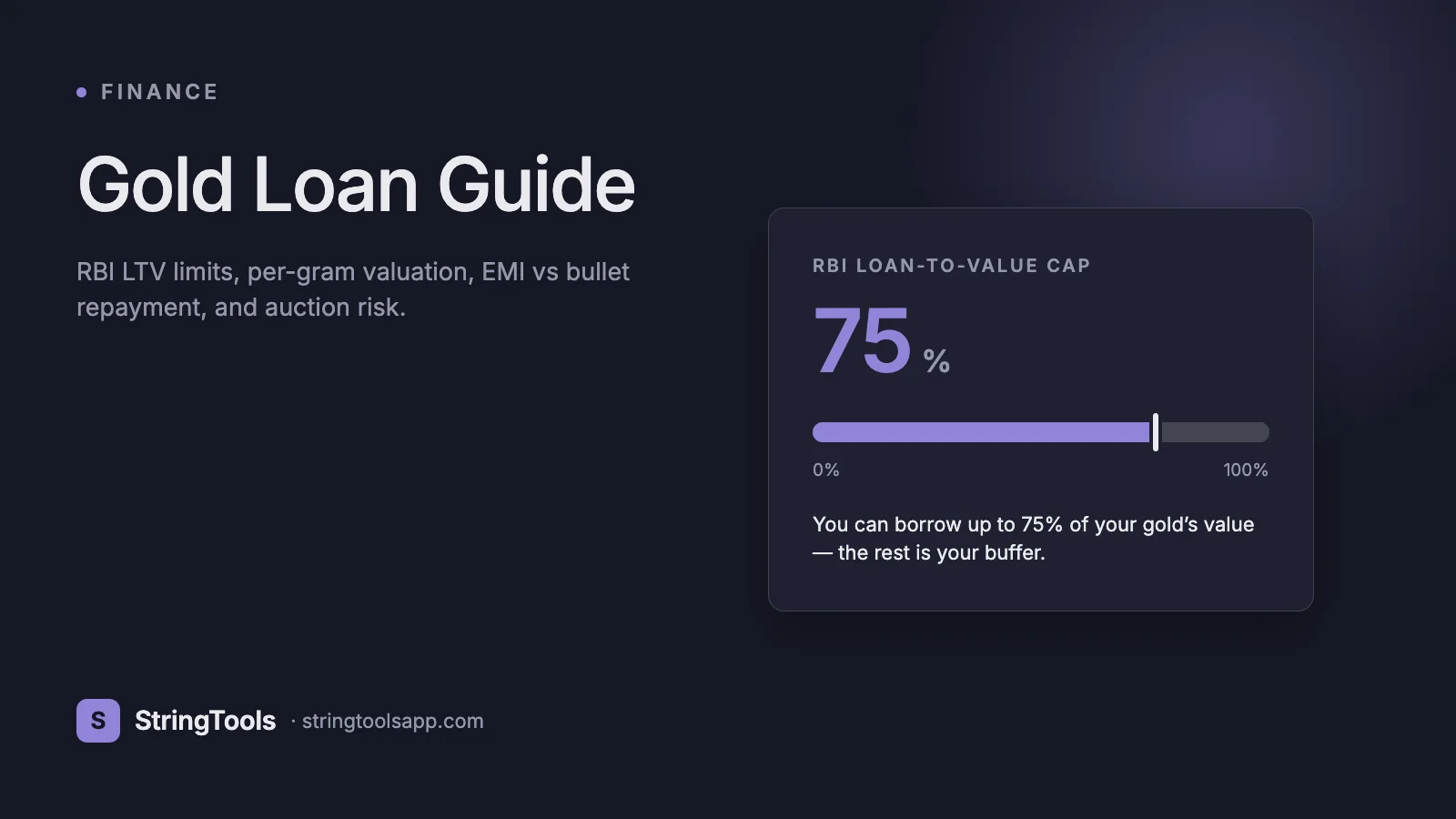
Step four: the loan-to-value (LTV) cap is applied. In India, the RBI has long capped gold loans at 75 percent of the gold's assessed value, and its 2025 lending directions introduced tiered caps that permit somewhat higher LTV on small-ticket loans. Whatever the current tier, you will never legally get 100 percent of your gold's value as a loan.
Step five: minimal paperwork, then disbursal. You need identity and address proof (KYC). There is usually no income proof and only a light credit check, because the lender's security is the vaulted gold, not your salary. Disbursal to your bank account or by instrument commonly happens the same day, frequently within the hour.
Step six: repayment and release. When you repay principal plus interest, the lender must return your pledged ornaments — the same items, sealed and identified, not equivalent gold. Recent RBI directions also push lenders to return pledged gold promptly after closure and to compensate borrowers for unjustified delays.
How much can you borrow per gram, and what the RBI LTV cap means
You can borrow up to 75 percent of your gold's assessed value under the RBI's loan-to-value cap, with the 2025 tiered rules permitting up to around 85 percent on small-ticket loans. Lenders translate this into a published per-gram rate for 22-karat gold based on recent average market prices, and only the gold content in your ornaments counts.
The phrase people search — gold loan per gram — reflects how lenders quote the product. Each lender publishes a maximum lending rate per gram of 22-karat gold. That number moves with the gold price, so any figure you see in an article (including this one) is illustrative, not a promise.
Here is the arithmetic every lender runs. Suppose you pledge 50 grams of 22-karat jewellery and the lender's assessed value works out to 6,400 rupees per gram — an illustrative figure. Your gold's assessed value is 50 multiplied by 6,400, which is 3,20,000 rupees. At a 75 percent LTV cap, the maximum loan is 2,40,000 rupees. If you only need 2,00,000, borrow 2,00,000 — you are never obliged to take the maximum, and as we will see in the risk section, borrowing below the cap gives you a safety buffer.
Two regulatory points are worth knowing. First, the 75 percent LTV ceiling has been the RBI's standard rule for gold loans for years, and it exists to protect both sides: if gold prices fall, the lender still has cushion, and you are less likely to face a demand for extra payment. The RBI's 2025 directions on lending against gold collateral moved to a tiered structure that allows higher LTV (up to around 85 percent) on smaller loans while keeping 75 percent for larger ones — so always check the current rules or ask the lender to show you the applicable cap in writing.
Second, LTV is monitored through the life of the loan, not just at disbursal. On bullet-repayment loans especially, accrued interest counts toward the outstanding amount, which is why lenders cap the initial disbursal below the ceiling — they need headroom for interest to accrue without breaching the regulatory limit.
Purity drives everything. 24-karat is pure gold, but ornaments are almost never 24K. A 22-karat ornament is roughly 91.6 percent gold, and an 18-karat one is 75 percent gold, so 10 grams of 18K jewellery contains meaningfully less lendable gold than 10 grams of 22K. Hallmarked jewellery speeds up appraisal and reduces disputes, but lenders will still test everything independently.
Interest rates and the two repayment structures
Gold loan interest rates in India typically range from roughly 9 to 18 percent per annum at the time of writing, and can run higher for very small tickets at some NBFCs. Banks generally sit at the lower end of the range; gold-loan NBFCs charge more but offer faster service, longer branch hours, and more flexible schemes — the trade-offs are the same ones covered in our guide to bank vs NBFC borrowing. These are typical ranges that vary by lender, scheme, loan size, and time — treat any specific number as something to verify on the day you borrow. Either way, gold loans are almost always cheaper than personal loans and dramatically cheaper than credit card debt, because the lender's risk is low.
Just as important as the rate is the repayment structure, and this is where borrowers most often misjudge the true cost. There are three common structures.
EMI repayment. You repay principal and interest in equal monthly instalments, exactly like a personal loan or car loan. Because principal falls every month, the total interest paid is the lowest of the three structures. Best if you have steady monthly income.
Bullet repayment. You pay nothing (or interest only, periodically) during the term and settle everything at the end — typically 6 or 12 months. This is hugely popular with farmers, traders, and anyone whose income arrives in lumps. The catch: interest accrues on the full principal for the entire term, and with some schemes unpaid interest itself attracts interest, compounding the cost. A compound interest calculator will show you how quickly unserviced interest snowballs if a bullet loan is rolled over instead of being closed.
Overdraft against gold. Some banks give you a credit line secured by gold; you draw what you need and pay interest only on the drawn amount. Efficient for business working capital, but usually with a slightly higher rate or fees.
Also ask about processing fees (often a flat amount or a small percentage), appraisal charges, and — critically — prepayment penalties. Many gold loans have zero or minimal foreclosure charges, which makes them excellent for genuinely short-term needs, but confirm it in the sanction letter rather than assuming.
A worked example: the same 2,00,000 rupee loan, three ways
On the same 2,00,000 rupee, 12-month loan at an illustrative 12 percent, EMI repayment costs about 13,240 rupees in total interest, bullet repayment about 24,000, and a comparable personal loan at 16 percent about 17,754 — making the gold loan EMI the cheapest of the three structures.
Numbers make the trade-offs concrete. Take the loan from our earlier example: 2,00,000 rupees against 50 grams of 22K gold, for 12 months. Assume an illustrative 12 percent per annum gold loan rate. Here is what each structure actually costs, using the standard amortization formula (EMI equals P times r times (1+r) to the power n, divided by ((1+r) to the power n minus 1), where r is the monthly rate).
Option one: EMI repayment at 12 percent. Monthly rate r is 0.01. The EMI works out to about 17,770 rupees per month. Over 12 months you pay roughly 2,13,240 rupees in total, so total interest is about 13,240 rupees. You can verify this yourself in seconds with an EMI calculator — and you should run your own lender's exact rate and tenure rather than trusting a branch official's verbal estimate.
Option two: bullet repayment at 12 percent simple interest. You pay nothing for 12 months, then repay 2,00,000 plus 24,000 rupees interest — 2,24,000 in one shot. Same rate, same tenure, but total interest is around 24,000 versus 13,240 on the EMI plan, because the full principal stays outstanding all year. The bullet structure costs you roughly 10,760 rupees more for the convenience of paying nothing monthly. That can be a perfectly rational trade for a farmer awaiting harvest income — but you should make it knowingly.
Option three: the personal loan alternative. Suppose a personal loan for the same 2,00,000 rupees is offered at 16 percent for 12 months (personal loan rates typically run several points above gold loan rates because they are unsecured). The EMI comes to about 18,146 rupees, and total interest is roughly 17,754 rupees — around 4,500 rupees more than the gold loan EMI option, plus typically higher processing fees and a hard credit check.
Side by side, the same 2,00,000 rupees over 12 months looks like this:
| Repayment structure | Illustrative rate | Monthly outflow | Total interest (12 months) |
|---|---|---|---|
| Gold loan EMI | 12% p.a. | ~17,770 | ~13,240 |
| Gold loan bullet | 12% p.a. | nothing until maturity | ~24,000 |
| Personal loan EMI | 16% p.a. | ~18,146 | ~17,754 |
The pattern generalises: for the same amount and tenure, gold loan EMI is cheapest, gold loan bullet trades higher total interest for zero monthly outflow, and the unsecured personal loan is the most expensive of the three. A general purpose loan calculator lets you rerun this comparison with whatever rates you are actually quoted.
Gold loan vs personal loan: which should you choose?
Choose a gold loan for short-term needs of roughly 12 to 18 months where you are confident of repayment — it is faster, cheaper, and needs no income proof. Choose a personal loan for larger amounts, tenures of 3 to 5 years, or uncertain repayment, because a default then damages your credit but cannot cost you the family jewellery.
This is the decision most borrowers actually face, so here is an honest comparison rather than a sales pitch for either.
Speed. Gold loan wins decisively. Same-day, often same-hour disbursal, versus one to five days for most personal loans (instant pre-approved personal loans exist, but only for existing customers the bank has already underwritten).
Eligibility. Gold loan wins for anyone with thin or damaged credit. There is no income proof requirement and approval does not hinge on your credit score — self-employed people, homemakers, farmers, and new-to-credit borrowers can all qualify. A personal loan effectively requires documented income and a decent score; if you are unsure where you stand, our note on credit score requirements explains the bands lenders look for.
Cost. Gold loan usually wins, typically by several percentage points, as the worked example showed. Secured credit is cheaper than unsecured credit almost everywhere in the world.
Amount and tenure. Personal loan wins for large, long needs. Gold loans are capped by the value of gold you own and are designed as short-tenure products (commonly 6 to 24 months, sometimes 36). Personal loans routinely run to 5 years and larger amounts if your income supports it. For multi-year needs, an EMI you can compare across lenders matters more than disbursal speed.
Risk to you. Personal loan wins, and this deserves emphasis. Default on a personal loan and you face collection pressure and severe credit score damage. Default on a gold loan and you face all of that plus the auction of your family's jewellery. The asset at stake is often irreplaceable in sentimental terms even when the financial loss is contained.
The practical rule of thumb: for a short-term need (under roughly 12 to 18 months) where you are confident of repayment, the gold loan is usually the better instrument — faster and cheaper. For longer tenures, larger amounts, or any situation where repayment is genuinely uncertain, prefer the personal loan and keep the gold out of it. And for home purchase or renovation, neither is the right tool — a home loan is far cheaper, which a mortgage calculator will confirm the moment you compare rates.
The real risks, and the mistakes that cause them
The main gold loan risks are auction of your pledged jewellery on default, margin pressure if gold prices fall while you have borrowed near the LTV cap, losing all regulatory protections with unregulated lenders, the bullet-loan rollover trap, and credit score damage from missed payments — each traceable to a specific, avoidable mistake.
Gold loans are safe when used correctly, but the failure modes are specific and worth knowing cold.
Auction on default. This is the big one. If you neither repay nor renew by the due date, the lender can auction your pledged gold after issuing the notices required by RBI rules. Regulated lenders must follow a defined process — notice to the borrower, public auction, and refund of any surplus above your dues back to you. You do not lose everything beyond what you owe, but you do lose the ornaments themselves, permanently. Lenders do not want to auction (it is costly and regulated); they will usually offer renewal or part-payment options first — but only if you engage before the account goes delinquent.
Gold price swings and margin pressure. Your loan was sized against a gold price on day one. If gold prices fall significantly during the tenure, the outstanding amount can breach the permitted LTV, and the lender can ask you to either pay down part of the loan or pledge additional gold. This bites hardest when you borrowed the absolute maximum per gram. The defence is simple: borrow below the cap so a routine 10 to 15 percent price dip cannot trigger a call.
Unregulated lenders. Pledge only with RBI-regulated entities — banks and registered NBFCs. Local pawnbrokers and informal moneylenders may quote attractive per-gram figures, but you lose every protection that matters: standardised auction procedure, surplus refund, grievance redressal via the RBI Ombudsman, and insured, audited vault storage. The few hundred rupees saved is not worth an ornament that vanishes.
The rollover trap. Bullet loans can be renewed by paying accrued interest. Done once, fine. Done repeatedly, you are paying interest year after year while the principal never shrinks — some borrowers effectively rent their own gold for years. If you have renewed twice, switch to an EMI scheme or sell something else and close the loan.
Assuming no credit consequences. Gold loans involve minimal credit checks at approval, but lenders report the account to credit bureaus. A default damages your credit score just like any other loan, on top of losing the gold.
Ignoring the net weight. Borrowers anchor on what an ornament cost at the jeweller — which included making charges, stones, and GST — and feel cheated by the loan value. The lender lends against gold content only. Check the appraised net weight in your pledge document before signing, not after.
Getting the best offer, and verifying it before you sign
Rates, per-gram values, processing fees, and scheme structures vary widely between banks and NBFCs — on the same day, for the same gold, quotes can differ by several percentage points, which on a 2,00,000 rupee loan is thousands of rupees a year. The single highest-return step in the whole process is to compare loan offers from multiple regulated lenders before you pledge, rather than walking into the nearest branch and accepting whatever is on the board.
Doing that comparison manually means visiting or calling half a dozen branches. The shortcut is to compare without walking into six branches: get quotes from several regulated lenders — or a reputable, regulated comparison marketplace — and let them compete for your file, which often produces sharper quotes than walk-in rates. This works for gold loans, personal loans, and other retail credit.
Whichever route you take, verify every offer with arithmetic before signing. Put the quoted rate, tenure, and amount into an EMI calculator or loan calculator and confirm the instalment and total interest match the sanction letter to the rupee. For a bullet scheme, ask the branch to state the exact maturity amount in writing and check whether unpaid interest compounds. Ask for the per-gram rate applied, the net gold weight recorded, the LTV percentage, processing and appraisal fees, foreclosure charges, and the auction notice process — a regulated lender will answer all of these without hesitation, and hesitation itself is a signal.
Used for a genuine short-term need, borrowed below the LTV cap, from a regulated lender, on a structure matched to your cash flow, a gold loan is one of the most efficient credit products a household can access. Used casually — maximum LTV, rolled over indefinitely, from an unregulated shop — it is how families lose heirlooms. The difference is entirely in the fifteen minutes of comparison and verification you do before pledging.
This article is general education, not financial advice; rates, LTV rules, and scheme terms change over time and vary by lender, so confirm current terms with the lender and check prevailing RBI regulations before borrowing.
Frequently Asked Questions
What is the current gold loan interest rate in India?
Gold loan rates typically range from about 9 to 18 percent per annum, with banks usually at the lower end and gold-loan NBFCs higher in exchange for speed and flexible schemes. Very small-ticket loans can cost more. Rates change with the market and vary by lender, loan size, and scheme, so always compare written quotes from two or three regulated lenders on the day you borrow rather than relying on any published figure.
How much gold loan can I get per gram?
It depends on the day's gold price, the purity of your ornaments, and the RBI's LTV cap. Lenders publish a per-gram rate for 22-karat gold based on recent average market prices, then lend up to the regulatory loan-to-value limit — historically 75 percent of assessed value, with RBI's 2025 directions permitting somewhat higher LTV on small-ticket loans. Only the gold content counts: stones, wastage, and making charges are excluded, so the loan value is always well below the jewellery's shop price.
Does a gold loan affect my credit score?
Taking one barely does — approval involves minimal credit checking because the gold secures the loan. But the account is reported to credit bureaus, so timely repayment can modestly help your score, while missed payments or a default will damage it just like any other loan, in addition to putting your pledged gold at risk of auction.
What happens if I can't repay my gold loan?
The lender will first offer renewal or part-payment options. If the loan stays unpaid, an RBI-regulated lender must send you formal notices and can then auction the pledged gold through a defined public process. Your dues are recovered from the sale proceeds and any surplus must be refunded to you — but the ornaments themselves are gone permanently. If you foresee trouble, contact the lender before the due date; renewing or converting to EMIs is almost always better than letting it slide to auction.
Is a gold loan better than a personal loan?
For short-term needs of roughly 6 to 18 months, usually yes: a gold loan is faster (often same-day), cheaper (typically several percentage points lower), and doesn't require income proof or a strong credit score. A personal loan is better for larger amounts, longer tenures of 3 to 5 years, or when repayment is uncertain — because defaulting on a personal loan damages your credit, while defaulting on a gold loan also costs you the family jewellery.
Can I get a gold loan on 18-karat gold or gold coins?
Most lenders accept jewellery of 18 karats and above, though 22-karat ornaments fetch the best per-gram value since they contain more gold (18K is 75 percent gold versus roughly 91.6 percent for 22K). Bank-minted gold coins are generally accepted up to a small weight limit per borrower, while gold bars and bullion are typically not eligible for retail gold loans under Indian rules. Policies differ, so confirm with the specific lender.
Sources and references
collateralised lending (investopedia.com) · RBI (rbi.org.in). Content was reviewed against these sources as of the last-updated date above; external figures and rules may change after publication.