
The short answer
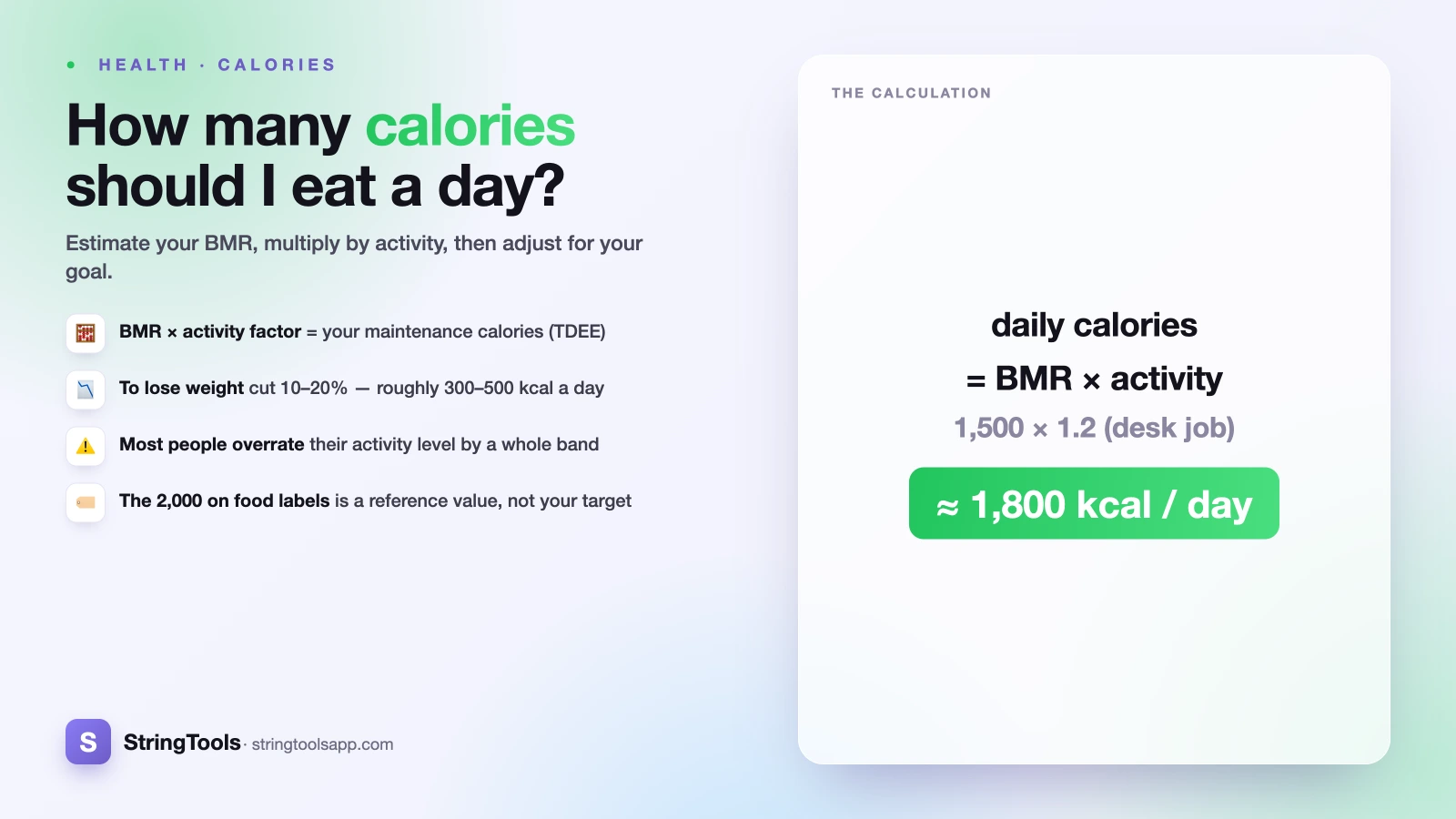
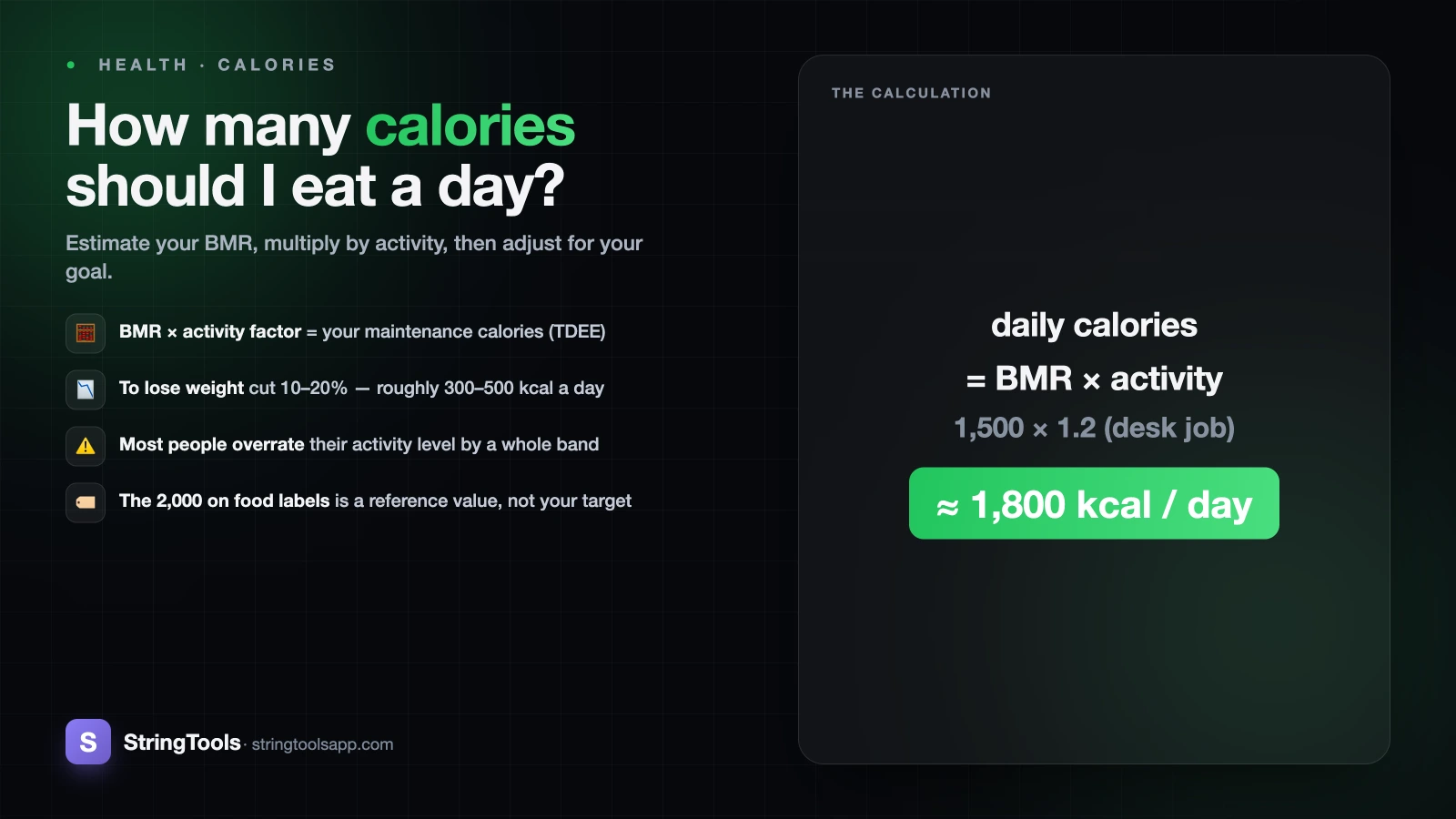
Most adults need somewhere between 1,600 and 3,000 calories a day. Your own figure depends on three things: your basal metabolic rate, how much you move, and whether you want to lose, maintain or gain weight. Estimate it by calculating your BMR, multiplying by an activity factor, then adjusting for your goal.
Key Takeaways
- There is no single correct calorie number. A 25-year-old builder and a 60-year-old office worker can differ by more than 1,000 calories a day and both be eating exactly right.
- The standard method is BMR (Mifflin-St Jeor) x activity factor = TDEE, then add or subtract for your goal.
- Every calculator, including this site's calorie calculator, gives an estimate. Real needs vary by roughly 10% either side of the prediction, and further at the extremes of body size.
- For weight loss, a deficit of about 10-20% below maintenance is the usual recommendation. Bigger is not better.
- The 2,000 calories printed on food labels is a labelling reference value, not a personal target.
- If you are pregnant or breastfeeding, under 18, have a medical condition, or have any history of disordered eating, work with a doctor or registered dietitian rather than a calculator.
Why there is no single right number
Your body spends energy in three broad ways, and only one of them is under much conscious control.
The largest share is your basal metabolic rate - the energy it costs to stay alive at complete rest. Breathing, circulating blood, holding body temperature, repairing tissue and running your brain account for most daily energy use in a sedentary adult. It is not a small background cost; it is the main event.
Next is the thermic effect of food, the energy used digesting what you eat, usually treated as roughly a tenth of intake. Last is physical activity, which splits into deliberate exercise and everything else: walking, standing, fidgeting, carrying shopping, stairs. That second category varies enormously between people who look identical on paper, which is much of why two friends of the same height and weight can eat quite differently and stay the same size.
Because BMR scales with body mass, height, age and sex, and activity varies by lifestyle, the only sensible approach is to estimate your own number rather than borrow someone else's.
Step 1: Work out your BMR with Mifflin-St Jeor
The Mifflin-St Jeor equation is the standard prediction equation used by dietitians and by most reputable calculators. It takes weight in kilograms, height in centimetres and age in years:
- Men: BMR = (10 x weight in kg) + (6.25 x height in cm) - (5 x age) + 5
- Women: BMR = (10 x weight in kg) + (6.25 x height in cm) - (5 x age) - 161
The two versions differ by a flat 166 calories, which is the equation's rough allowance for average differences in lean body mass between sexes. It is a population average, not a statement about any individual.
If you think in pounds and inches, convert first. Both conversions are exact by definition: 1 pound = 0.45359237 kg, and 1 inch = 2.54 cm. So 170 lb is 77.1 kg, and 5 ft 9 in is 69 inches, which is 175.3 cm.
Two things are worth knowing about the output. It is a prediction from a regression model built on measured data, so it lands close for most people but not all - being unusually muscular, unusually lean, very short, very tall or very heavy pushes you towards the edges of the model where the error grows. And it estimates resting expenditure only, so on its own it is not the number to eat. Feeding yourself only your BMR would mean eating as if you spent every hour asleep.
If you want the mechanics in more detail, BMR vs TDEE explained covers what each figure measures and why the distinction matters.
Step 2: Multiply by an activity factor to get TDEE
Total daily energy expenditure (TDEE) is your BMR multiplied by an activity factor. These multipliers have been in standard use for decades and are deliberately coarse:
| Activity level | What it looks like in practice | Multiplier |
|---|---|---|
| Sedentary | Desk job, little or no deliberate exercise | 1.2 |
| Lightly active | Light exercise or sport 1-3 days a week | 1.375 |
| Moderately active | Moderate exercise 3-5 days a week | 1.55 |
| Very active | Hard exercise 6-7 days a week, or a physical job | 1.725 |
| Extra active | Physical job plus daily training, or two sessions a day | 1.9 |
The most common mistake is picking a level too high. Three gym sessions a week alongside a desk job is "lightly to moderately active", not "very active". An hour of training does not undo nine hours of sitting, and people who train hard often move less for the rest of the day without noticing. When you are between two levels, take the lower one - you can always adjust upwards once you have real data.
The gap matters. For a BMR of 1,500, choosing 1.2 gives 1,800 calories and choosing 1.725 gives 2,588. That is an 800-calorie decision made by ticking a box.
What is TDEE and how to calculate it goes deeper on choosing the right multiplier.
Step 3: Adjust for your goal
TDEE is your maintenance figure: eat that, and your weight should hold roughly steady over time. From there:
- To maintain: eat at your TDEE.
- To lose weight: subtract about 10-20% of your TDEE, which for most adults works out at roughly 300-500 calories a day.
- To gain weight or build muscle: add about 10-15%, roughly 250-400 calories a day, alongside resistance training.
A rough and much-quoted rule says a kilogram of body fat holds around 7,700 calories (about 3,500 per pound), so a 500-calorie daily deficit predicts about half a kilo a week. Treat that as a starting estimate, not a promise. It consistently overpredicts loss over months, because as you get lighter your BMR falls, you tend to move less, and appetite pushes back. Real progress is usually slower than the arithmetic suggests, and that is normal rather than a sign of failure.
Where the floor is
Larger deficits are tempting and rarely worth it. Very low intakes make it hard to hit protein, fibre, vitamin and mineral targets, tend to cost you lean tissue alongside fat, and are hard to sustain.
As a general guide, do not eat below roughly 1,200 calories a day if you are a woman or 1,500 if you are a man without medical supervision. If your calculated target lands below that floor, the answer is not to eat less - it is to add movement, aim for a slower rate of loss, or get individual advice.
Calorie deficit for weight loss covers how to set and hold a deficit you can actually keep.
Two worked examples
Sarah: 34, female, 165 cm, 68 kg, desk job, gym three times a week
BMR = (10 x 68) + (6.25 x 165) - (5 x 34) - 161 = 680 + 1,031 - 170 - 161 = about 1,380 calories
She sits for work and trains three times a week, so lightly active (1.375) is the honest choice rather than moderately active.
TDEE = 1,380 x 1.375 = about 1,900 calories to maintain.
She wants to lose weight steadily. A 20% deficit is roughly 380 calories, giving a target of about 1,520 calories a day. That is comfortably above the 1,200 floor, and at a rough 400-calorie deficit it points to something in the region of 0.3-0.4 kg a week - slow enough to keep, fast enough to see on a chart after a month.
James: 45, male, 180 cm, 88 kg, warehouse job plus two gym sessions
BMR = (10 x 88) + (6.25 x 180) - (5 x 45) + 5 = 880 + 1,125 - 225 + 5 = about 1,785 calories
He is on his feet all day and trains twice a week, which puts him at very active (1.725).
TDEE = 1,785 x 1.725 = about 3,080 calories to maintain.
He wants to lose weight slowly without affecting his work, so a modest 15% cut, about 460 calories, gives a target of roughly 2,600 calories a day.
Notice the size of the gap. Sarah and James are both healthy adults following the same method, and their maintenance figures differ by about 1,180 calories. That is the whole argument against generic advice in one line.
Rough daily calorie needs by age, sex and activity
If you want a sanity check rather than a calculation, the table below gives the ballpark ranges used in national dietary guidance. These are estimates for healthy adults of average height and weight, rounded to the nearest 100. They are not personal targets, and an individual can sit well outside them for entirely ordinary reasons.
| Group | Sedentary | Moderately active | Active |
|---|---|---|---|
| Women 19-30 | 1,800-2,000 | 2,000-2,200 | 2,400 |
| Women 31-50 | 1,800 | 2,000 | 2,200 |
| Women 51-70 | 1,600 | 1,800 | 2,000-2,200 |
| Women 71+ | 1,600 | 1,800 | 2,000 |
| Men 19-30 | 2,400-2,600 | 2,600-2,800 | 3,000 |
| Men 31-50 | 2,200-2,400 | 2,400-2,600 | 2,800-3,000 |
| Men 51-70 | 2,000-2,200 | 2,200-2,400 | 2,600-2,800 |
| Men 71+ | 2,000 | 2,200 | 2,400-2,600 |
Two patterns are worth reading off it. Needs drift downwards with age - roughly 100 calories per decade after 30 in these figures - mostly because lean mass declines and people tend to move less. And activity is worth about 400-600 calories a day at any age, which is the same order of magnitude as the entire age effect across fifty years.
Pregnancy and breastfeeding both raise requirements, by amounts that change through the stages, so those are cases for individual advice rather than a table, as is anyone under 18 whose needs are tied to growth. The Dietary Guidelines for Americans publish the fuller version of this kind of table, and the NHS Live Well pages cover the UK equivalents.
Why the 2,000 calories on food labels is not your target
Nearly every packet in the shop refers to 2,000 calories somewhere. In the United States, the % Daily Value column on the Nutrition Facts label is calculated against a 2,000-calorie reference diet, a convention set by the FDA. In the UK and EU, front-of-pack figures usually work from 2,000 kcal for an average woman, with 2,500 often quoted for an average man.
That number exists so labels can be compared with each other. It was chosen as a round figure near the middle of adult requirements, not derived from your body. Treating it as a personal goal goes wrong at both ends: too much for many older or smaller sedentary adults, well short for most active men, teenagers and manual workers.
Use it as a ratio rather than a target. If a ready meal says 30% of your daily energy and your own maintenance figure is 2,600 rather than 2,000, it is closer to 23% of your day. The same caution applies to BMI, which is a population screening tool that says nothing about muscle versus fat - if you use a BMI calculator, read the result the way you read the 2,000 on a label.
What to do when the numbers do not match reality
The calculation gives you a starting point. Your body gives you the correction. Treat the estimate as a hypothesis and test it for two to three weeks.
Look at the weekly average, not the day. Body weight swings by a kilo or more from water alone - salt, carbohydrate intake, hydration, hard training and the menstrual cycle all move it. Weighing at the same time each morning and comparing this week's average with last week's filters out almost all of that noise.
Adjust in small steps. If the scale has not moved in three weeks, change intake by 100-200 calories a day, or add a daily walk, then wait another two to three weeks. Large swings make it impossible to tell what worked.
Expect the target to move. As you lose weight your BMR falls, because there is less of you to run. A figure that produced steady progress at the start may be maintenance six months later. Recalculating every 4-5 kg is reasonable.
Watch what a calorie figure cannot see. Persistent fatigue, poor sleep, hair loss, feeling cold all the time, stalling training performance, disrupted or absent periods, or preoccupation with food are signals to eat more and talk to a professional - not to cut harder.
Know when the calculator is the wrong tool. If you are pregnant or breastfeeding, under 18, managing diabetes, thyroid disease, kidney disease or any condition affecting metabolism or appetite, taking medication that affects weight, or have any history of an eating disorder, a general-purpose estimate is not appropriate for you. Speak to a doctor or a registered dietitian, who can account for what an equation cannot. MedlinePlus is a reasonable starting point for background reading meanwhile.
If you would rather not do the arithmetic by hand, the calorie calculator runs the same Mifflin-St Jeor equation, applies the activity factor you pick, adjusts for your goal and suggests a macronutrient split. The answer is still an estimate - the two to three weeks of real-world feedback are what turn it into your number.
Frequently Asked Questions
How many calories should I eat a day to lose weight?
Work out your maintenance figure (TDEE) first, then subtract about 10-20%, which is usually 300-500 calories a day. For someone maintaining at 2,200 that means eating around 1,760-1,980. Avoid going below roughly 1,200 calories a day as a woman or 1,500 as a man without medical supervision - if your calculated target lands under that, aim for a slower rate of loss or add activity instead of cutting further.
Is 1,200 calories a day too low?
For many adults, yes. 1,200 is widely treated as a floor for women rather than a sensible default, and it sits below the resting energy needs of plenty of people before any movement is counted. At that level it becomes difficult to get enough protein, fibre, iron, calcium and B vitamins from food. If your target calculation comes out below 1,200, that is a sign to change the plan rather than the plate. Anyone considering a very low intake should be doing it under medical supervision.
Why does my calorie calculator disagree with my fitness watch?
They estimate different things in different ways. A calculator applies a fixed activity multiplier to a predicted BMR; a watch estimates energy burned from heart rate, movement and its own model of you. Wearables are generally better at ranking your days against each other than at giving an absolute number, and they often overestimate calories burned during exercise. Use one source consistently and correct it against your actual weight trend rather than trying to reconcile the two.
Should I eat back the calories I burn from exercise?
It depends which method you used. Activity-multiplier calculators, including the approach in this guide, already build typical exercise into the TDEE figure, so eating back exercise calories on top would double-count them. If instead you calculated from BMR with a sedentary multiplier and log each workout separately, adding some of those calories back is consistent. Pick one method and stick with it.
Do calorie needs really change with age?
Yes, though more gradually than people expect. Requirements drift down by roughly 100 calories per decade after about 30 in standard guidance tables, driven mainly by loss of lean muscle mass and a general reduction in daily movement rather than by any sudden metabolic switch. Resistance training and staying active offset a meaningful part of it, which is why an active 60-year-old can need more than a sedentary 30-year-old.
How accurate is the Mifflin-St Jeor equation?
It is the most reliable of the commonly used prediction equations for healthy adults, but it is still a prediction from population data. Expect it to land within about 10% of your true resting metabolic rate, which on a 1,600-calorie BMR is a band of roughly 160 calories. Accuracy falls further at the extremes - very muscular, very lean, very short, very tall or very heavy people are all less well described by the model. This is why the real target is found by testing the estimate against your weight trend over a few weeks.
Sources and references
Dietary Guidelines for Americans (dietaryguidelines.gov) · NHS Live Well (nhs.uk) · FDA (fda.gov) · MedlinePlus (medlineplus.gov). Content was reviewed against these sources as of the last-updated date above; external figures and rules may change after publication.