
What TDEE actually means
Total Daily Energy Expenditure (TDEE) is the number of calories your body burns in 24 hours, including everything from keeping your heart beating to walking, fidgeting, digesting food and training. It is usually estimated by working out your basal metabolic rate and multiplying it by an activity factor.
Key Takeaways
- TDEE has four parts: basal metabolic rate (BMR), the thermic effect of food (TEF), non-exercise activity (NEAT) and exercise activity (EAT).
- BMR is the biggest slice at roughly 60-70%, so body size drives your calorie needs more than your gym schedule does.
- The standard method is BMR from the Mifflin-St Jeor equation, multiplied by an activity factor between 1.2 and 1.9.
- The activity multiplier is the weakest link: one step up the scale can add 200-300 calories a day, and most people place themselves too high.
- Every calculator produces an estimate. Treat it as a starting hypothesis and correct it against four weeks of bodyweight data.
- If you are pregnant or breastfeeding, under 18, have a medical condition, or have a history of disordered eating, speak to a doctor or registered dietitian.
The phrase sounds clinical, but the idea is simple: TDEE is your maintenance level. Eat that many calories and your weight holds steady on average; below it you lose weight, above it you gain. Almost every nutrition plan is built on this one number.
It is not a fixed property of your body. It is a moving average that shifts with your weight, your job, your sleep and the season. You can run the numbers with a calorie calculator in thirty seconds, but what comes out is a hypothesis about your average day, not a measurement of it.
The four components, and roughly what each contributes
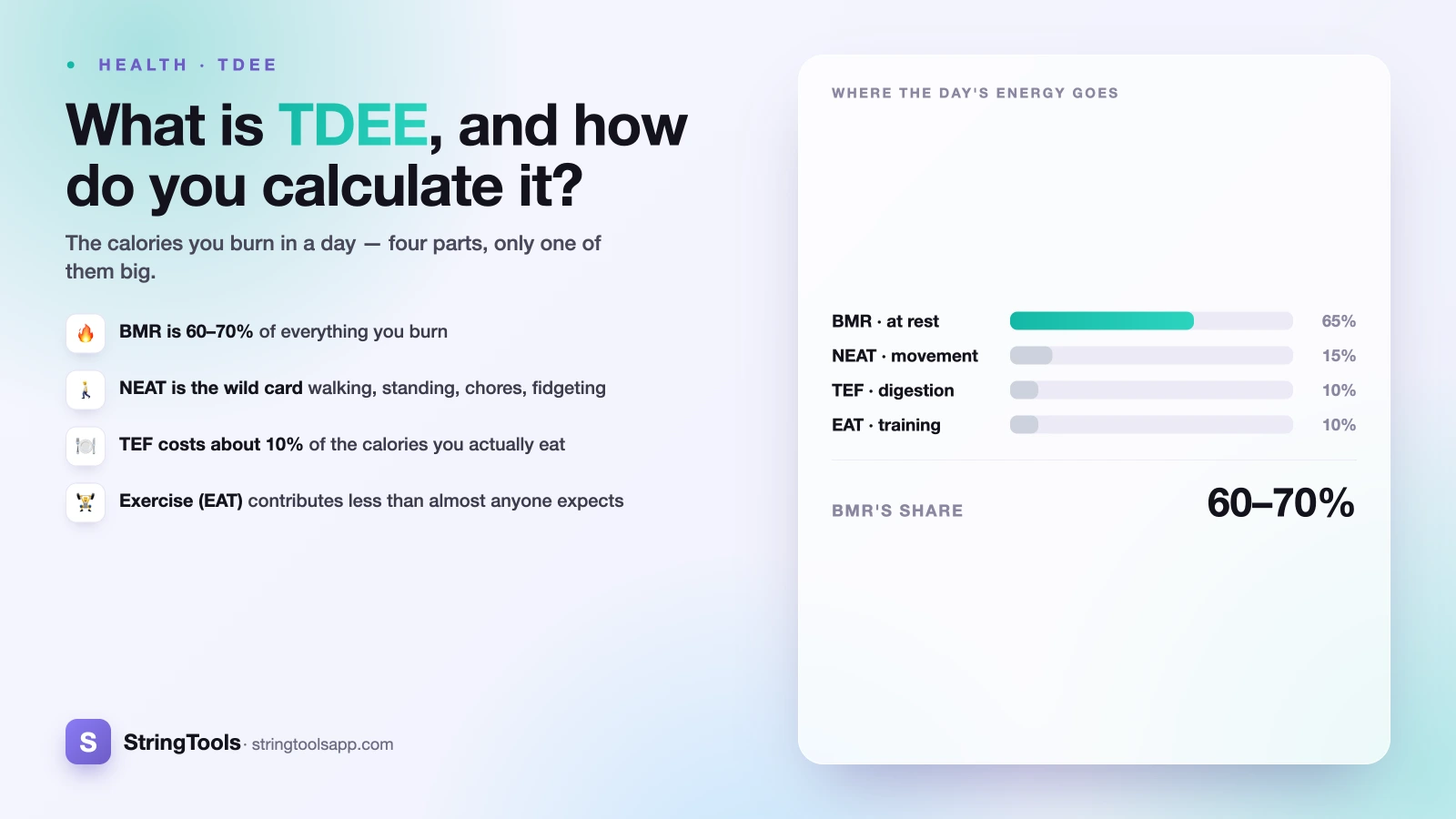
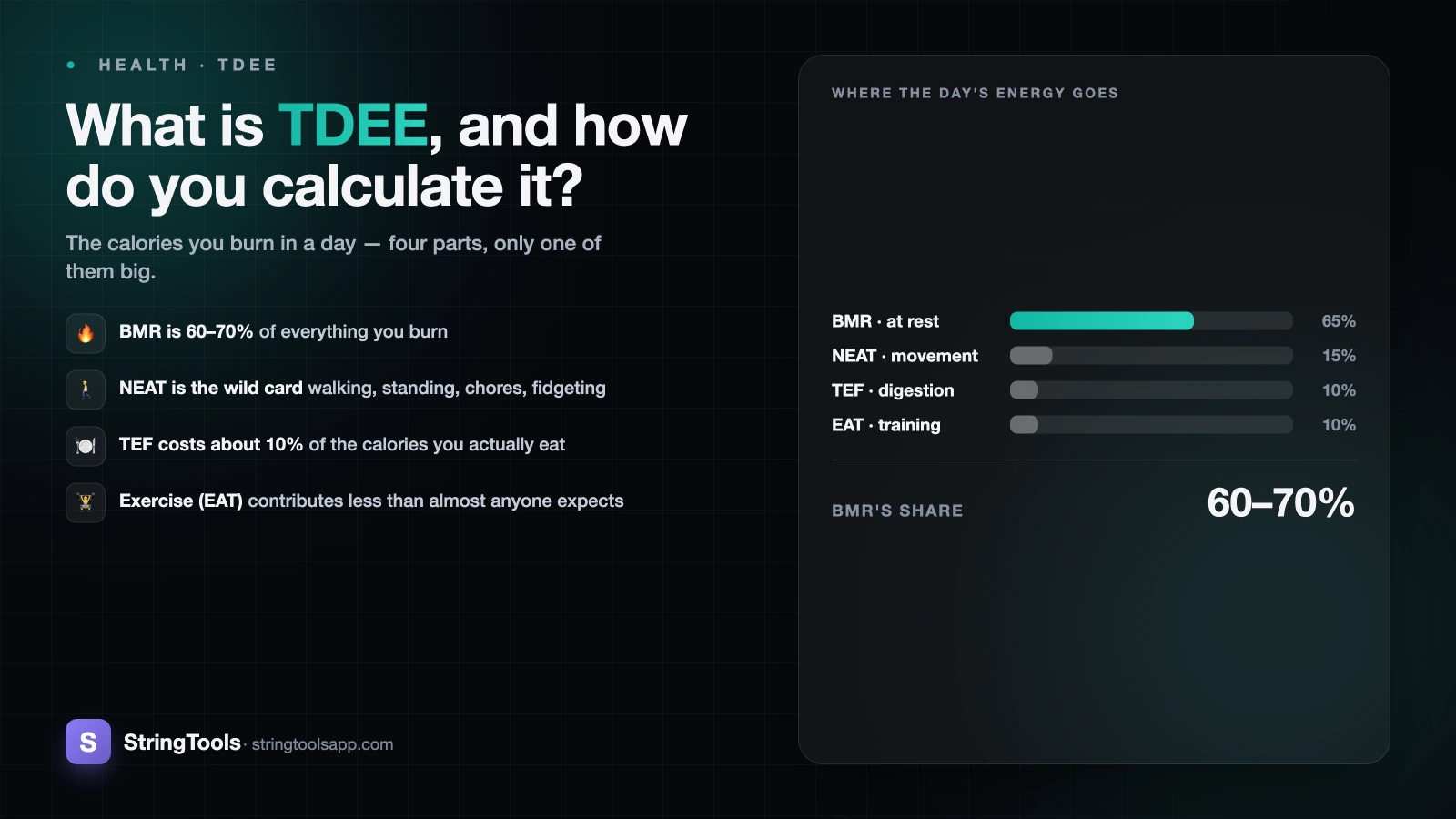
Energy expenditure is conventionally split into four buckets. The split is useful because each behaves differently and you have very different amounts of control over each.
| Component | What it covers | Typical share of TDEE |
|---|---|---|
| BMR (basal metabolic rate) | Keeping you alive at complete rest: breathing, circulation, brain function, cell repair, organ maintenance | 60-70% |
| TEF (thermic effect of food) | The energy spent digesting, absorbing and storing what you eat | About 10% of calories eaten |
| NEAT (non-exercise activity thermogenesis) | Walking, standing, chores, commuting, fidgeting, everything active that is not deliberate exercise | Roughly 15% when sedentary, considerably more in active jobs |
| EAT (exercise activity thermogenesis) | Deliberate training: gym sessions, running, cycling, sport | 0-15% for most people, higher for athletes |
Shares are approximate and overlap at the edges, so treat them as proportions rather than exact accounting.
BMR: the immovable majority
Basal metabolic rate is what your body spends doing nothing. It is dominated by organ tissue: the brain, liver, heart and kidneys are metabolically expensive despite weighing little. This is why a taller, heavier person has a higher BMR, why it falls slowly with age as lean mass declines, and why the idea that you can dramatically "speed up your metabolism" oversells the case.
TEF: small and predictable
Digestion costs energy, and macronutrients differ: protein is the most expensive to process, carbohydrate sits in the middle, fat is cheapest. Across a mixed diet TEF works out at roughly 10% of the calories you eat, and it scales with intake, so it shrinks when you diet. Most calculators fold it into the activity multiplier.
NEAT: the wild card
NEAT is everything active that is not exercise, and it has the widest spread between individuals. Two people of similar size with similar gym habits can differ substantially, and the gap between a desk-bound day and a day on your feet runs to several hundred calories. It also quietly falls when you diet, which is one reason weight loss slows more than the arithmetic predicts.
EAT: smaller than people think
Deliberate exercise is the component people fixate on and the one that usually contributes least. A brisk 45-minute walk or a moderate gym session typically burns in the low hundreds of calories. Exercise is excellent for health, strength, mood and appetite regulation, but as a calorie lever it is weaker than a modest change to what you eat.
Step one: calculate your BMR
The standard equation for BMR is Mifflin-St Jeor, published in 1990. Most current calculators use it because it has held up better than the older Harris-Benedict equation against measured metabolic rate in modern populations. It takes weight in kilograms, height in centimetres and age in years:
- Men:
BMR = (10 x weight kg) + (6.25 x height cm) - (5 x age) + 5 - Women:
BMR = (10 x weight kg) + (6.25 x height cm) - (5 x age) - 161
Two worked examples
A 32-year-old woman, 165 cm, 68 kg:
- 10 x 68 = 680
- 6.25 x 165 = 1,031
- 5 x 32 = 160
- 680 + 1,031 - 160 - 161 = 1,390 kcal/day
A 40-year-old man, 180 cm, 85 kg:
- 10 x 85 = 850
- 6.25 x 180 = 1,125
- 5 x 40 = 200
- 850 + 1,125 - 200 + 5 = 1,780 kcal/day
Those are BMR figures, not daily needs. Nobody spends 24 hours motionless, so neither person should eat at that level. BMR is only the base you multiply.
One limitation: Mifflin-St Jeor uses total bodyweight, so it cannot tell muscle from fat. Two people at 85 kg can have different resting rates if one carries far more lean mass. If you know your body fat percentage with confidence, the Katch-McArdle equation works from lean mass instead. The gap between the resting number and the daily number is the whole subject of BMR vs TDEE explained.
Step two: the activity multiplier table
Multiply BMR by an activity factor and you get TDEE. The five factors below are the ones almost every calculator uses. Their standard labels are vague, so the third column describes what each level tends to look like across a real week; the step counts are a rough gloss to make the levels concrete, not part of the original definitions.
| Multiplier | Label | What that week actually looks like | TDEE if BMR = 1,500 |
|---|---|---|---|
| 1.2 | Sedentary | Desk job, drive or short commute, no structured exercise. Under roughly 5,000 steps on a typical day. | 1,800 |
| 1.375 | Lightly active | Light exercise one to three days a week, or a job that keeps you on your feet part of the day. Roughly 5,000-7,500 steps. | 2,060 |
| 1.55 | Moderately active | Moderate exercise three to five days a week, or steady walking as part of the job. Roughly 7,500-10,000 steps. | 2,325 |
| 1.725 | Very active | Hard exercise six or seven days a week, or a physically demanding job plus regular training. | 2,590 |
| 1.9 | Extra active | Manual labour all day, or twice-daily training on top of an active job. Genuinely rare. | 2,850 |
Two rules for using this table honestly. The multiplier covers your whole week including rest days, not your best day. And if you pick a level that already includes training, do not add workout calories on top: that double-counts, and it is one of the most common ways people eat several hundred calories more than they think.
For the 32-year-old woman above at 1.375, TDEE comes out at about 1,910 kcal/day. For the 40-year-old man at 1.55, about 2,760 kcal/day.
Why the multiplier is where your estimate goes wrong
The BMR half is fairly robust: predictive equations compared against measured metabolic rate typically land within about 10% for most healthy adults. The activity half is not, because it asks you to grade your own behaviour on a five-point scale with no reference points.
Look at what a single step costs. With a BMR of 1,500, moving from 1.375 to 1.55 adds about 265 calories a day, roughly 1,850 a week. Nothing else in the calculation carries that much error in one click.
The bias also runs in one direction. Research using doubly labelled water, the gold standard for measuring real-world energy expenditure, has repeatedly found self-reported intake under-reported by a wide margin, commonly on the order of 20-30%. Overestimated activity and under-reported intake stack, and the result is a plan that looks like a deficit on paper and behaves like maintenance in real life.
There are three specific traps worth naming:
- The four-workouts-a-week trap. Four gym sessions feels like "very active". If the other 164 hours of the week are spent sitting, sedentary or lightly active is closer to the truth.
- The intention gap. People choose the multiplier that matches the week they meant to have. Grade yourself on the last month, not on the plan.
- The wearable mismatch. Trackers are reasonable at counting steps and unreliable at estimating energy expenditure; independent testing has generally found calorie estimates to be the weakest thing wearables do.
The practical fix is to choose the lower of the two levels you are torn between. Under-estimating TDEE is the safer error: you lose slightly faster than planned, notice quickly, and correct it. Over-estimating produces months of no change and no obvious explanation.
How to correct your estimate with real data
A calculator gives you a starting point. Your own body gives the actual answer, and it takes about a month to collect.
1. Take the calculator number and eat at it. Hold steady for two to four weeks, weighing food where you reasonably can. Consistency matters more than precision. 2. Weigh yourself daily, but only read the weekly average. Day-to-day weight moves with water, salt, carbohydrate stores, digestion and hormonal cycles, and those swings dwarf any real change in fat. 3. Compare week one's average with week four's average. If your weight is flat, the number you have been eating is your real TDEE. If it drifted down, your true TDEE is higher than what you ate. If it drifted up, it is lower. 4. Adjust by 100-150 calories at a time, then hold two to three weeks before judging again. Larger jumps make it impossible to tell what caused what.
You will see the guideline that a pound of body fat is worth about 3,500 calories, so a 500-calorie daily deficit should cost a pound a week. It is a useful rough anchor and a poor long-term predictor: as you lose weight your BMR falls, NEAT drifts down, and the same activities cost less energy. Real loss curves flatten; the arithmetic does not.
For turning a maintenance number into a sensible daily target, how many calories should I eat a day covers the deficit side in detail.
Using your TDEE safely
TDEE is a planning tool, not a medical assessment, and a few boundaries matter more than the precision of the number.
A deficit of roughly 10-20% below your TDEE is the usual recommendation for fat loss. It is slower than aggressive cutting, far easier to sustain, protects lean mass better, and leaves room for enough protein, fibre and micronutrients.
As a floor, adults should generally not eat below about 1,200 calories a day for women or about 1,500 for men without medical supervision. Below that it is genuinely difficult to meet nutrient requirements, and very low calorie diets are a clinical intervention that belongs under professional care.
Speak to a doctor or registered dietitian rather than relying on a calculator if you are pregnant or breastfeeding, under 18, have diabetes, thyroid or kidney disease or any condition affecting metabolism or appetite, take medication that affects weight, or have any history of disordered eating. In that last case daily weighing and calorie tracking can themselves be harmful, and a clinician should guide whether to use them at all.
The National Institute of Diabetes and Digestive and Kidney Diseases publishes research-based body weight planning tools that model metabolic adaptation over time, and both the Centers for Disease Control and Prevention and the NHS publish free guidance on healthy weight and activity.
Finally: no food needs moral clearance. Calories are a unit of energy, not a measure of virtue, and a framework that makes you feel worse about eating is not working, however accurate its arithmetic.
Keeping the number current as things change
The most common mistake after calculating TDEE once is treating it as permanent. Here is what actually shifts it, and when to recalculate.
Your weight changes. Each kilogram adds about 10 calories to BMR under Mifflin-St Jeor, and more once the multiplier is applied. Recalculate after every 5 kg of change in either direction.
Your job or routine changes. Moving from a warehouse to a desk, or losing a walking commute, can shift your multiplier a full step. That is usually a larger change than anything you do in the gym.
The season changes. Most people's NEAT falls in winter without them noticing: fewer walks, more time indoors, darker evenings. If your weight creeps up in the same months every year, that is the likely cause rather than a metabolic problem.
You have been dieting for a while. Extended restriction reduces expenditure by more than the weight loss alone accounts for, partly through reduced NEAT. If progress has stalled for weeks at an intake that should still be a deficit, a spell of eating at maintenance is often more productive than cutting further.
Re-run the numbers every couple of months, or whenever one of the above happens, then let a fortnight of weekly averages confirm or correct the estimate. A calculator gets you into the right neighbourhood; only your own weekly averages find the address.
Frequently Asked Questions
Is TDEE the same as maintenance calories?
Yes, in practice they describe the same thing. TDEE is the total energy your body uses in a day, so eating that many calories keeps your weight roughly stable over time. "Maintenance calories" is the everyday phrase for it. The only nuance is that TDEE is a moving average rather than a fixed figure, so your maintenance level today may not be your maintenance level after 10 kg of weight change or a job change.
How accurate are TDEE calculators?
They give estimates, not measurements. The BMR half is the more reliable part: predictive equations such as Mifflin-St Jeor typically land within about 10% of measured resting metabolic rate for most healthy adults. The activity multiplier is much less reliable, because it depends entirely on how honestly you grade your own week. Assume your first number could be out by a few hundred calories in either direction, and correct it against two to four weeks of weekly average bodyweight.
Should I add my exercise calories on top of my TDEE?
No, not if you selected an activity multiplier that already accounts for your training. That is the single most common double-count in calorie planning, and it can easily add several hundred phantom calories a day. Either pick a multiplier that covers your whole week including workouts and add nothing, or pick the sedentary factor of 1.2 and add each session's estimated burn separately. Do one or the other, never both.
Why does my smartwatch show a different TDEE?
Wearables estimate energy expenditure from heart rate, movement and your entered profile, and independent testing has generally found calorie estimation to be their least accurate function even on devices that count steps and measure heart rate well. Treat the daily figure as a trend indicator rather than a number to eat against. If your watch and a calculator disagree, resolve it with bodyweight data over a few weeks rather than picking the more flattering answer.
Why did my calorie needs drop after I lost weight?
Three things happen together. There is less of you to maintain, so BMR falls by roughly 10 calories per kilogram lost under Mifflin-St Jeor. Moving a lighter body costs less energy, so the same walk burns less. And non-exercise movement tends to decline during a sustained deficit. The combined effect is that a deficit which worked at the start becomes maintenance later, which is why a plateau usually calls for recalculating rather than simply eating less.
What deficit should I use once I know my TDEE?
A deficit of about 10-20% below your TDEE is the usual guidance for fat loss, which is a slower path than most crash approaches but far more sustainable and easier on lean mass. Do not go below roughly 1,200 calories a day for women or 1,500 for men without medical supervision. If you are pregnant or breastfeeding, under 18, managing a medical condition, or have any history of disordered eating, set targets with a doctor or registered dietitian instead of a calculator.
Sources and references
National Institute of Diabetes and Digestive and Kidney Diseases (niddk.nih.gov) · Centers for Disease Control and Prevention (cdc.gov) · NHS (nhs.uk). Content was reviewed against these sources as of the last-updated date above; external figures and rules may change after publication.