

What a Calorie Deficit Is, and How Big Yours Should Be
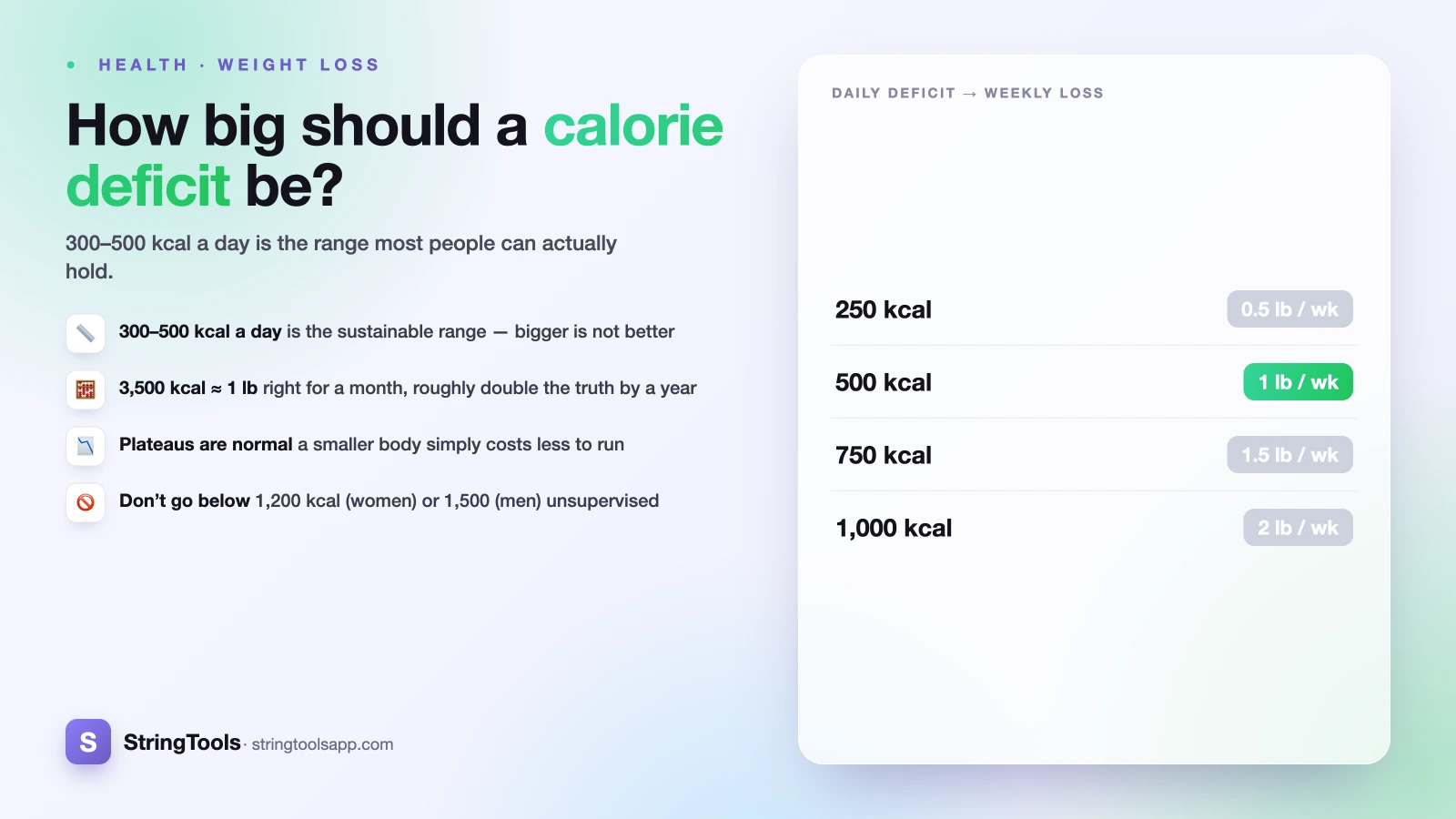
A calorie deficit means eating less energy than your body uses in a day. For most people a deficit of 300 to 500 kcal per day is the sustainable range, producing roughly 0.25 to 0.45 kg (0.5 to 1 lb) of weight loss per week at first. Larger deficits rarely hold.
That last sentence is where most weight-loss advice goes quiet. The arithmetic is simple and every article explains it. The harder question is how big a gap you can hold for months rather than days.
Energy use is estimated in two steps. Your basal metabolic rate (BMR) — the energy you spend at complete rest — comes from the Mifflin-St Jeor equation, using weight, height, age and sex; multiply it by an activity factor and you have total daily energy expenditure (TDEE). A deficit is eating below TDEE. A calorie calculator runs both steps, and how many calories should I eat a day covers the equation in detail.
Every figure produced this way is an estimate. Two people of identical height, weight, age and sex can differ in real energy needs by several hundred calories a day. A deficit is also not right for everyone: if you are pregnant or breastfeeding, under 18, managing a medical condition, or taking medication that affects appetite, start with a doctor or a registered dietitian rather than a calculator.
Key Takeaways
- A calorie deficit is eating below your total daily energy expenditure. The rest is detail about size and duration.
- The classic rule says 3,500 kcal equals about 0.45 kg (1 lb), so a 500 kcal daily deficit should give 1 lb a week.
- It is a linear approximation that overestimates long-run loss, because energy needs fall as body mass falls.
- 300-500 kcal a day is the range most people maintain. Bigger deficits buy faster early loss and worse adherence.
- Plateaus are normal, driven more by a shrinking body and drifting intake than a "broken" metabolism.
- Do not go below roughly 1,200 kcal a day for women or 1,500 for men without medical supervision.
Where the 500-Calorie-a-Day Rule Came From
The rule you have almost certainly met is this: a pound of body fat stores about 3,500 kcal, so cutting 500 kcal a day creates a 3,500 kcal weekly gap and costs you a pound a week.
The arithmetic is clean. 500 x 7 = 3,500. Halve it and you get half a pound a week; double it and you get two. It fits on a napkin, which is much of why it has survived since it was first proposed in the late 1950s.
It is not baseless. Adipose tissue really does hold roughly 3,500 kcal per pound, or about 7,700 kcal per kilogram, and over the first few weeks the rule tracks reality closely enough to be useful.
The problem is extending it. The rule treats your body as a fixed-size furnace: eat 500 fewer calories, lose the same tissue every week, forever. Run that forward and a 500 kcal daily deficit predicts 23.6 kg (52 lb) of loss in twelve months and more than 70 kg over three years. Nobody loses 70 kg by skipping a snack. The rule breaks because your body is not a fixed-size furnace.
Why the 3,500-Calorie Rule Overestimates Long-Run Loss
Two separate things pull reality away from the linear rule, and only one is about your metabolism.
Your energy needs fall as your body mass falls. A smaller body costs less to run: less tissue to maintain at rest, and every step cheaper because you are carrying less weight. A deficit that was 500 kcal in January might be 350 kcal by April after 10 kg of loss, without you changing anything you eat. The gap closes on its own, and loss decelerates towards a new equilibrium.
Adherence declines as the deficit grows. This is the larger effect in practice and the one least often admitted. Intake creeps upward over months — larger portions, untracked additions, more off-plan days — usually without anyone noticing. The bigger the deficit, the faster that drift sets in, because hunger, fatigue and social friction all scale with how restrictive the plan is.
Researchers now model weight change dynamically rather than linearly. A widely used rule of thumb from that work: a sustained change of about 10 kcal per day leads to roughly 0.45 kg (1 lb) of eventual weight change, about half of it within a year and nearly all within three. On that basis a 500 kcal deficit held indefinitely points to roughly 23 kg of eventual loss — but only half of that in the first twelve months, against the 23.6 kg the linear rule claims for year one alone.
The translation is short. The linear rule is roughly right for the first month and roughly double the truth by twelve months. Use it to set a starting point, not to forecast a year.
Deficit Size vs Expected Weekly Loss: A Reference Table
This table gives the linear prediction, the twelve-month figure it implies, and an honest note on whether the deficit survives contact with real life. The twelve-month column is there deliberately: it is what the 3,500-calorie rule claims, and setting it beside real results is the fastest way to see the rule's limits.
| Daily deficit | Weekly loss (3,500 rule) | 12-month loss if it held | Practical sustainability |
|---|---|---|---|
| 250 kcal | 0.23 kg (0.5 lb) | 11.8 kg (26 lb) | Easiest to hold, often without formal tracking. Slow enough that a bad week barely matters. |
| 500 kcal | 0.45 kg (1 lb) | 23.6 kg (52 lb) | The standard starting point. Noticeable but liveable. Expect real 12-month loss around half the figure shown. |
| 750 kcal | 0.68 kg (1.5 lb) | 35.5 kg (78 lb) | Workable for a defined block of weeks, more so at higher starting weights. Hunger and fatigue become the limit. |
| 1,000 kcal | 0.91 kg (2 lb) | 47.3 kg (104 lb) | Upper end of mainstream guidance. Often collides with the intake floors below, especially for smaller or older adults. |
| 1,500+ kcal | 1.36 kg (3 lb) | Not applicable | Not advisable outside a medically supervised programme. Protein and micronutrient needs are very hard to meet. |
Read those columns as a ceiling, not a forecast. Early loss also runs ahead of the table for a reason unrelated to fat: cutting carbohydrate depletes glycogen, and glycogen carries water with it. Several pounds in week one is normal, largely water, and does not continue.
Adaptive Thermogenesis, and Why Plateaus Happen
Adaptive thermogenesis is the part of the decline in energy expenditure that is larger than the loss of body mass alone would explain. Beyond the saving from carrying less weight, the body appears to become somewhat more economical during and after restriction — lower resting expenditure than predicted for the new body size, and often less spontaneous movement.
Its size is genuinely debated: studies report anywhere from a negligible effect to a few hundred calories a day, with wide variation between individuals and study designs. Anyone quoting a precise universal figure is overstating the evidence. The direction is not disputed — after weight loss, energy needs sit at or slightly below what your new body size predicts.
That is one input into a plateau; the other, usually bigger, is intake drift. Together they produce the typical trajectory: quick loss for four to six weeks, a steadier stretch, then a slowdown around month four to six as the shrinking deficit and the creeping intake meet in the middle. In most trials the average curve flattens well inside the first year.
A plateau is not a malfunction. It is the expected end state of a fixed calorie target applied to a body that is no longer the same size. It means the deficit has closed, not that your metabolism is broken.
Choosing a Deficit You Can Actually Keep
Rather than pick a round number, scale the deficit to your body. Two approaches work well and tend to agree.
- Percentage of TDEE. A deficit of 15-20% of maintenance suits most people. At a 2,400 kcal TDEE that is 360-480 kcal a day; at 1,800 kcal it is 270-360. It gives smaller people smaller deficits, which a flat 500 kcal rule gets wrong.
- Percentage of body weight per week. Aiming for 0.5-1% per week is a common guideline: at 90 kg that is 0.45-0.9 kg a week, at 60 kg it is 0.3-0.6 kg. The lower half of the range is the more comfortable place to live.
Three things make a deficit easier to hold, none of which involve labelling foods:
- Protein and fibre. Both blunt hunger for the calories they cost, and a sensible protein target helps preserve lean mass while dieting. How to count macros covers setting those targets.
- Movement you would do anyway. Activity raises TDEE, letting you eat more for the same deficit. Walking is unglamorous and unusually effective here.
- Planned flexibility. A deficit with room in it for a restaurant meal survives longer than one that treats every deviation as failure.
There are no good foods or bad foods in this. Foods differ in how filling and how nutrient-dense they are per calorie, which is a practical matter, not a moral one.
The Floors: Where a Deficit Stops Being Sensible
A calculator will happily return a target too low to eat well on; it has no way of knowing that. Hold these limits fixed regardless of what any number says.
- Do not go below roughly 1,200 kcal a day for women, or 1,500 for men, without medical supervision. Below those levels it is genuinely difficult to meet protein, vitamin and mineral needs from food, and very-low-calorie diets belong in supervised clinical programmes.
- If a percentage-based deficit takes you under that floor, reduce the deficit rather than the food. Take the slower rate, or raise your energy expenditure so the same deficit sits at a higher intake.
- Slower is not worse. Moderate and aggressive rates produce comparable long-run results, because faster early loss is repeatedly offset by earlier drop-out.
One more thing, said without any judgement attached. Calorie tracking suits some people and not others. If counting has ever tipped into something that felt compulsive or distressing, or if you have a history of disordered eating, please speak to a GP or a registered dietitian before starting a deficit rather than working from an online calculator. That is a common and entirely reasonable conversation, and support is available. Guidance on weight and health is published by the NHS and the Mayo Clinic.
What to Do When the Scale Stops Moving
Before adjusting anything, check the plateau is real. Daily body weight moves by a kilogram or more on water, sodium, glycogen and digestive contents alone. A genuine plateau is a flat weekly average over three to four weeks, not a disappointing Tuesday.
If it is real, work through these in order:
- Recalculate your TDEE at your current weight. After 8-10 kg of loss your maintenance calories have moved, so the target you set at the start is now a smaller deficit than you think. Re-running a calorie calculator often explains the whole thing.
- Re-audit intake for a week. Not as a test of discipline, as measurement. Cooking oils, drinks, spreads, sauces and untracked bites are where hundreds of calories a day routinely hide.
- Add expenditure before subtracting food. More activity restores the deficit without pushing you towards the intake floor.
- Consider a planned break. Returning to maintenance for two to four weeks does not undo your progress, and for many people it makes the next block far easier to start. Weight ticks up slightly on glycogen and water; that is not fat regain.
- Then, if needed, cut a further 100-200 kcal and reassess after three weeks.
What is not worth doing is treating a plateau as evidence of a personal failing. It is the predictable consequence of applying a fixed number to a body that has changed size.
Putting a Number on Your Own Deficit
Here is the whole process, in the order it actually works:
1. Estimate TDEE. Mifflin-St Jeor for BMR, then an activity multiplier. Treat the result as a starting hypothesis with a margin of a few hundred calories either way. 2. Take 15-20% off. Not a flat 500. Round to something you will remember. 3. Check it against the floors. If the target falls below about 1,200 kcal (women) or 1,500 kcal (men), raise it and accept the slower rate. 4. Hold it for three to four weeks and track the weekly average. Ignore day-to-day noise entirely. 5. Adjust from what happened, not from the equation. If your average is falling around 0.5% of body weight per week, the estimate was good. If nothing has moved after a genuine month, trim 100-200 kcal or add activity, then repeat.
Step 5 matters most and is the one most people skip. The equation is a starting guess; your own four-week trend is data about your body, and it beats any calculator on the internet, including the one on this site.
For anything beyond general information — a medical condition, a medication, pregnancy, an eating disorder history, or a target set by a clinician — ask a doctor or a registered dietitian rather than a formula. Broader background is published by the National Institute of Diabetes and Digestive and Kidney Diseases.
Frequently Asked Questions
How big should a calorie deficit be to lose weight?
For most people, 300-500 kcal per day, or 15-20% below your total daily energy expenditure. That produces roughly 0.25-0.45 kg (0.5-1 lb) of loss per week in the early weeks. Scaling to a percentage is better than a flat 500 kcal, because a 500 kcal deficit is modest for someone with a 3,000 kcal maintenance and severe for someone at 1,700.
Is a 1,000 calorie deficit per day too much?
It sits at the upper edge of mainstream guidance rather than beyond it, but it only makes sense if the resulting intake still clears the minimum floors — roughly 1,200 kcal a day for women and 1,500 for men — and that rules it out for many smaller or older adults. It is also markedly harder to sustain: faster early loss is regularly cancelled out by earlier drop-out, so twelve-month results are often no better than a moderate deficit. If you are considering it, do so with a doctor or a dietitian.
Why have I stopped losing weight in a calorie deficit?
Usually two things at once. Your energy needs fell as you lost weight, so the deficit you set is now smaller than it was, and reported intake has drifted upward without anyone noticing. Adaptive thermogenesis adds a further, smaller reduction in expenditure. First confirm the plateau is real by looking at a flat weekly average across three to four weeks, then recalculate your maintenance calories at your current weight.
How long does it take to lose 10 kg in a calorie deficit?
At a 500 kcal daily deficit, the linear 3,500-calorie rule predicts about 22 weeks. In practice, plan for longer — perhaps 26 to 35 weeks — because your energy needs fall as you lose weight and few people hold a deficit perfectly for six months. Losing 10 kg over roughly eight months is a much more realistic target than the four months the arithmetic suggests.
Can you be in a calorie deficit without counting calories?
Yes. Counting is a measurement method, not the mechanism. Changes such as smaller portions, fewer calorie-containing drinks, more protein and fibre, and more daily movement can create a 300-500 kcal deficit without any tracking at all. Counting is useful for the first few weeks to calibrate what portions actually contain, and many people then stop. If tracking feels compulsive or distressing, it is fine and often better to stop, and worth raising with a professional.
What is the lowest number of calories I should eat?
As a general floor for self-directed weight loss, about 1,200 kcal a day for women and 1,500 for men. Below that it becomes very hard to meet protein, vitamin and mineral needs from food, and very-low-calorie diets belong in supervised clinical programmes. If your calculated deficit lands under the floor, reduce the size of the deficit rather than the food, and accept the slower rate of loss.
Sources and references
NHS (nhs.uk) · Mayo Clinic (mayoclinic.org) · National Institute of Diabetes and Digestive and Kidney Diseases (niddk.nih.gov). Content was reviewed against these sources as of the last-updated date above; external figures and rules may change after publication.