
What counting macros actually means
Counting macros means tracking the grams of protein, carbohydrate and fat you eat each day against a target, instead of tracking calories alone. Because each macronutrient carries a known energy value — protein and carbohydrate 4 kcal per gram, fat 9 — the grams and the calories are two views of the same food.
Key Takeaways
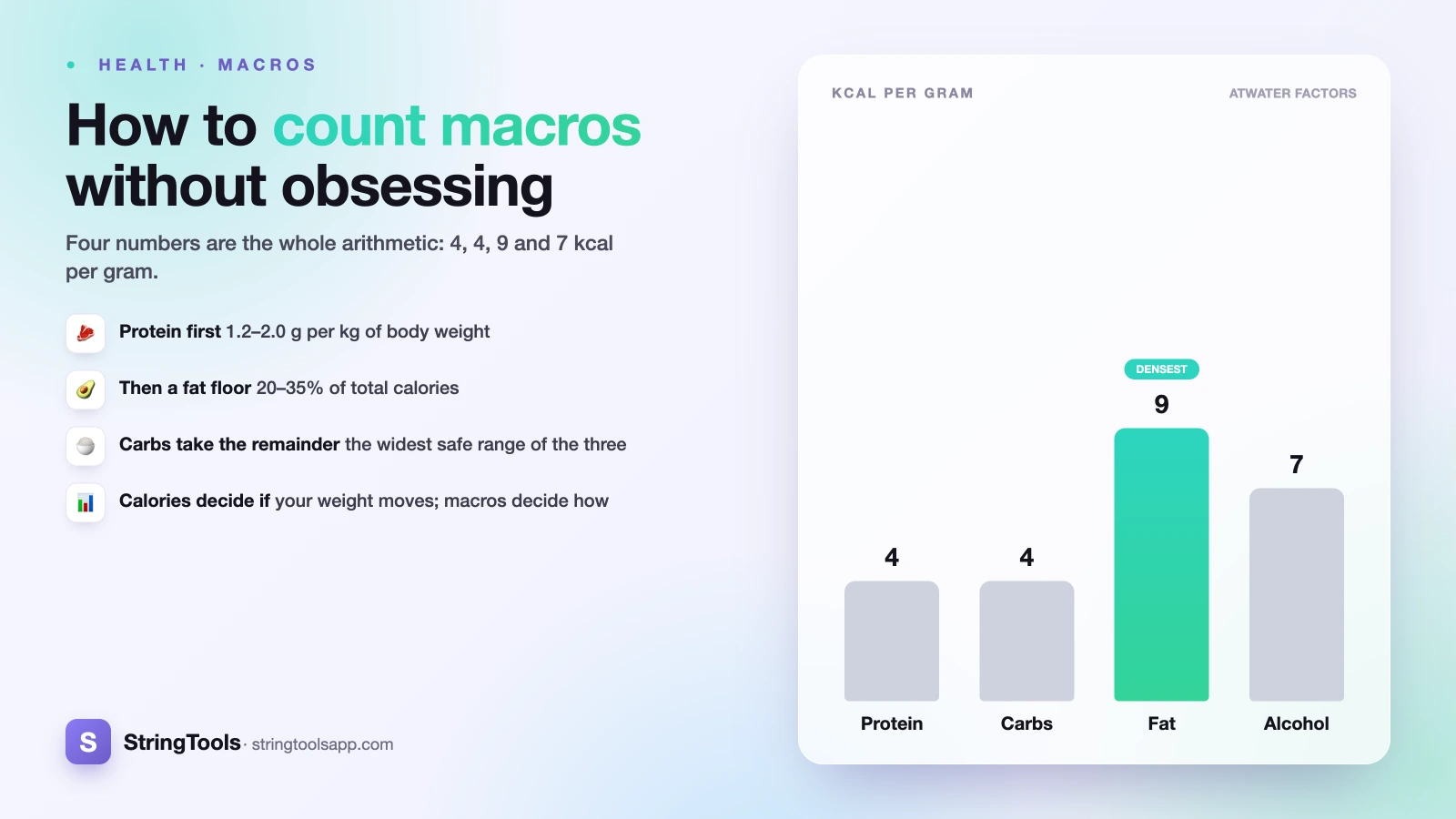
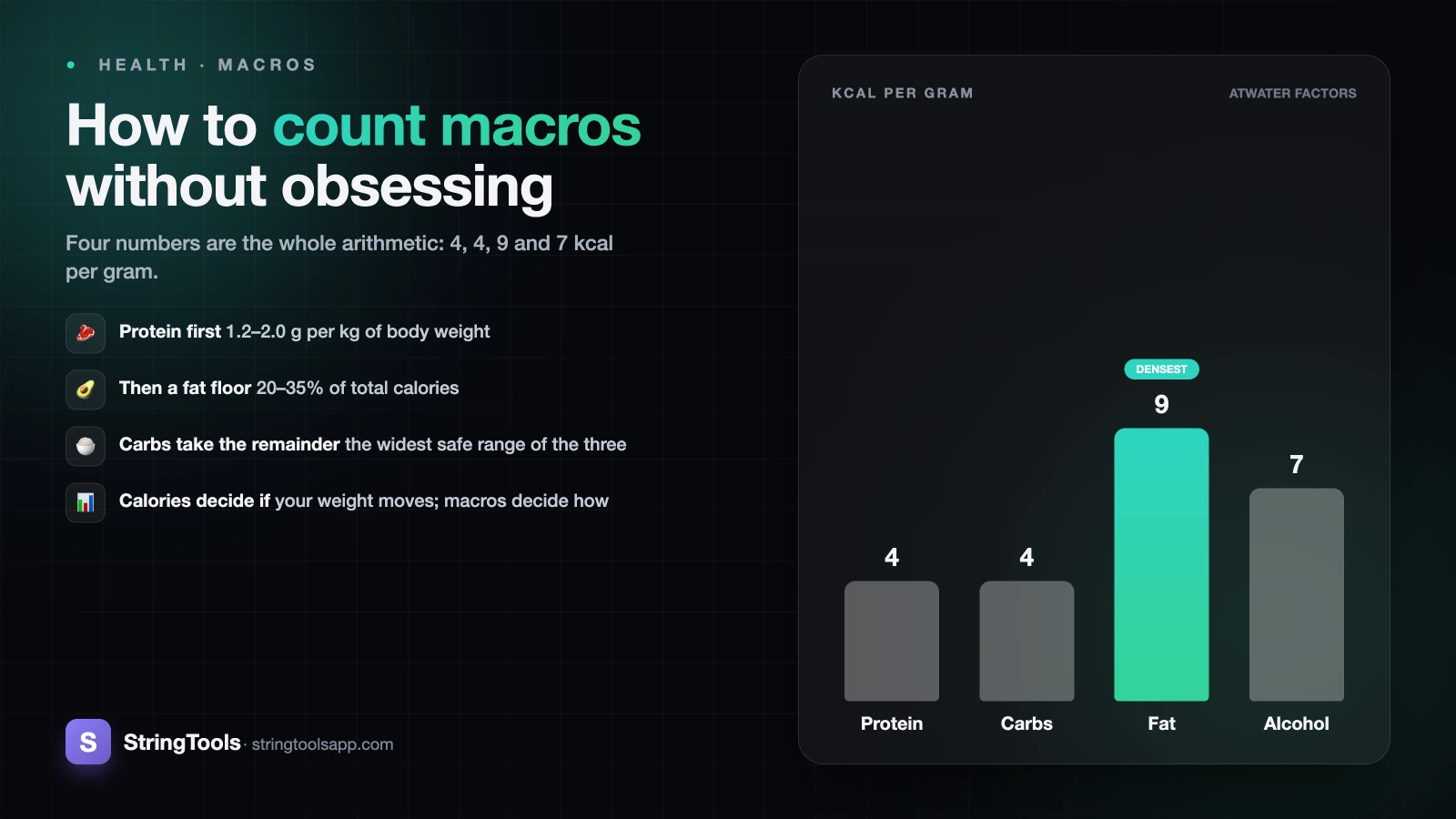
- Protein and carbohydrate supply 4 kcal per gram, fat 9, alcohol 7. Those four numbers are the whole arithmetic of macro counting.
- Calories decide whether your weight moves; macros mostly decide how — how much muscle you keep, how full you feel, how training goes.
- Set the calorie target first, then protein, then a fat floor, then let carbohydrate fill what is left.
- Consistency beats precision. A roughly accurate log kept for six weeks tells you far more than a perfect log kept for four days.
- Macro tracking suits some people and genuinely does not suit others. If counting makes you anxious, or you have a history of disordered eating, this is not a neutral tool — speak to a doctor or dietitian before starting.
Counting macros is refusing to let the calorie total hide which macronutrient it came from. Two 2,000 kcal days can look identical on a calorie tracker and behave completely differently: one leaves you full, trains well and holds onto muscle; the other leaves you hungry by three in the afternoon. It is not magic and it does not override energy balance — just more resolution on the same picture.
The three macronutrients and what each one costs
The values below are the Atwater factors — averages rather than physical constants, but every nutrition label and food database is built on them, so they are the numbers to plan with.
| Nutrient | Energy per gram | Energy per 100 g |
|---|---|---|
| Protein | 4 kcal | 400 kcal |
| Carbohydrate | 4 kcal | 400 kcal |
| Fat | 9 kcal | 900 kcal |
| Alcohol | 7 kcal | 700 kcal |
| Fibre | about 2 kcal | about 200 kcal |
Protein
Protein supplies the amino acids your body uses to repair and build tissue. It does two jobs for anyone changing their weight: it is the most filling macronutrient per calorie for most people, and it protects lean mass in a deficit. It also has the highest thermic effect — roughly 20 to 30 per cent of protein calories are spent digesting it, against a few per cent for fat.
Carbohydrate
Carbohydrate breaks down to glucose, the fuel your brain and hard training sessions prefer. Spare glucose is stored as glycogen along with water, which is why a big carbohydrate day can put a kilo on the scale overnight without any fat being gained.
Fibre is carbohydrate you largely do not digest, and labels treat it differently by region: in the United States it sits inside "Total Carbohydrate", while UK and EU labels exclude it and declare it separately.
Fat
Fat carries the fat-soluble vitamins A, D, E and K, supplies essential fatty acids your body cannot make, and underpins hormone production. At 9 kcal per gram it is the densest of the three, so fat targets move in much smaller increments. Cutting fat very low to free up calories rarely feels good for long.
Alcohol
Alcohol sits at 7 kcal per gram, closer to fat than to carbohydrate, and is the one energy source with no nutritional requirement attached. Trackers usually fold a drink into your carbohydrate or fat allowance, which is an approximation rather than a truth. Count the calories and accept that they displace food. Lower-risk drinking limits are a separate question; the NHS publishes UK guidance.
Turning a calorie target into gram targets
Macros are downstream of calories, so the calorie number comes first. Most calculators, including the one here, use the Mifflin-St Jeor equation to estimate resting metabolic rate, then apply an activity factor. The calorie calculator hands back a macro split alongside the calorie figure, so you can skip the arithmetic below — but it is worth understanding once.
Treat it as an estimate with real error bars: two people of identical height, weight, age and sex can differ by a few hundred calories a day. It is a starting point you correct against two or three weeks of real data, as how many calories should I eat a day sets out.
Step 1: set protein
Protein is the anchor because it has the clearest floor. The US recommended dietary allowance for adults is 0.8 g per kilogram of body weight — enough to prevent deficiency, not what is optimal for someone training or losing weight. Active adults and people in a deficit commonly aim for 1.2 to 2.0 g per kilogram, the higher end when the deficit is larger or training is heavy.
Step 2: set a fat floor
The Acceptable Macronutrient Distribution Ranges in US dietary guidance put fat at 20 to 35 per cent of total calories, carbohydrate at 45 to 65 per cent and protein at 10 to 35 per cent. A fat percentage inside that band — 25 or 30 per cent is a sensible default — keeps hormone production and vitamin absorption comfortable. See dietaryguidelines.gov.
Step 3: let carbohydrate take the remainder
Whatever is left becomes carbohydrate. That is deliberate: it has the widest safe range and is the macro most worth flexing around training and appetite.
A worked example
A 70 kg adult with a 2,000 kcal target:
- Protein at 1.6 g/kg = 112 g, which is 112 x 4 = 448 kcal
- Fat at 30 per cent of 2,000 = 600 kcal, which is 600 / 9 = 67 g
- Carbohydrate takes the rest: 2,000 - 448 - 600 = 952 kcal, which is 952 / 4 = 238 g
That is roughly 22 per cent protein, 30 per cent fat and 48 per cent carbohydrate — inside every recommended range, and arrived at from grams rather than from a percentage read off the internet.
Common macro splits and who they suit
Percentages are how splits get talked about; grams are how they get eaten. The table shows five common splits and the grams they produce at a 2,000 kcal target. Scale proportionally for a different target.
| Split | Protein / Carb / Fat | Protein | Carbs | Fat | Suits |
|---|---|---|---|---|---|
| Standard balanced | 20 / 50 / 30 | 100 g | 250 g | 67 g | General health, no specific goal |
| Higher-protein balanced | 30 / 40 / 30 | 150 g | 200 g | 67 g | Fat loss while lifting weights |
| High-protein | 40 / 35 / 25 | 200 g | 175 g | 56 g | Larger deficits, strength athletes |
| Lower-carb | 30 / 25 / 45 | 150 g | 125 g | 100 g | People who feel fuller on fat |
| Higher-carb / endurance | 20 / 55 / 25 | 100 g | 275 g | 56 g | Runners, cyclists, high training volume |
Two caveats. The high-protein row at 40 per cent and the lower-carb row at 25 per cent carbohydrate both sit outside the distribution ranges quoted earlier; healthy adults eat that way without trouble, but with kidney, liver, cardiac or metabolic conditions it is a conversation for a doctor rather than a decision to take from a blog table.
And the differences between these splits are smaller in practice than the internet suggests. With calories right and protein adequate, the carbohydrate-to-fat ratio is largely preference. Pick the row describing food you will enjoy for months; adherence beats optimisation, the same point calorie deficit for weight loss makes from the calorie side.
The mechanics: weighing, labels and databases
This is the part nobody writes about honestly, and it is where most people quietly give up in week two.
Weigh in grams
Cups, spoons and eyeballing are fine for vegetables and hopeless for anything calorie-dense. Oil, peanut butter, cheese, nuts and granola are where errors compound fastest — a heaped tablespoon of oil rather than a level one is 60 or 70 kcal you did not log. Bowl on the scale, tare, add the food, log it.
Pick raw or cooked, then stay consistent
Cooking changes weight without changing calories: meat loses water and gets lighter, rice and pasta absorb it and get heavier. Entries for "chicken breast, raw" and "chicken breast, cooked" are both correct and completely different per 100 g. Weigh raw where practical; otherwise use cooked entries every time.
Read the label properly
Two traps. Serving size: the calories on the front are per serving, and the packet may hold two and a half of them. And basis: UK and EU labels lead with per 100 g, US labels with per serving. Log from the per-100 g column and multiply by the weight you ate. Label figures are rounded too, which is a reason not to chase the last five calories.
Prefer verified database entries
Apps mix official data with entries typed in by users, and the user-submitted ones are frequently wrong. For whole foods, USDA FoodData Central underlies much of the world's nutrition data and is free to search directly.
Handle recipes by the batch
Weigh each ingredient in, log the recipe once, then weigh the finished dish and divide. If a curry comes to 1,600 g and you eat 400 g, you ate a quarter.
Why consistency beats precision
Every step above carries error. Labels round, databases average across cuts and growing conditions, you do not absorb 100 per cent of what you swallow, and a scale is accurate only to a gram or two. A careful log is realistically accurate to within something like 5 to 10 per cent, not to the calorie. What matters is that the error is consistent — log the same way daily and the changes in your numbers are real even if the absolute values are slightly off. Three habits follow:
- Judge by weekly averages. Day-to-day scale weight moves with water, glycogen, salt and digestion. A seven-day average moves with fat.
- Log the imperfect days. A rough estimate of a restaurant meal beats a blank, and blank days are where people lose the thread and stop.
- Hit protein and calories first. If you reliably control only two numbers, make them those; carbohydrate and fat can drift by tens of grams without much consequence.
Who this suits, and who it does not
Macro tracking works well for people who like data, who have a specific body-composition or performance goal, and who find a number gives structure to a decision they were making blind. Used for a few months it teaches you what portions actually look like, and that knowledge outlasts the logging. It suits other people badly, and that deserves saying just as plainly.
Weighing and logging every meal can turn eating into an accounting exercise. For some people that tips into something harmful: checking a database before agreeing to a meal, refusing food you cannot log, distress when a day goes over, or a slow narrowing of what you will eat down to a handful of countable foods. Those are not signs of discipline but signs the tool is doing damage, and the response is to stop tracking and talk to someone, not to try harder.
If you have a history of disordered eating, or numbers around food make you anxious, macro counting is not a neutral tool and this guide is not for you. That is a description, not a judgement, and it is common. Speak to a doctor or registered dietitian first; the NHS has information and referral routes for eating disorders, as do equivalent services elsewhere. The same applies if you are pregnant or breastfeeding, under 18, or managing a condition such as diabetes, thyroid disorders, or kidney or liver disease.
On floors: do not take a calorie target below roughly 1,200 kcal a day for women or 1,500 for men without medical supervision. Below that, meeting micronutrient needs becomes difficult and no macro split fixes it.
If tracking is not for you, the useful ideas survive without the arithmetic: a palm of protein at every meal, half the plate vegetables, and more of whatever leaves you full three hours later.
A realistic first two weeks
Most people fail at macro counting by changing what they eat and starting to log on the same day. Separate the two.
Days 1 to 7: log, change nothing. Eat as you normally would and record it. The point is a baseline, not compliance — one honest ordinary week teaches you more than four virtuous ones.
Build a shortlist as you go. Almost everyone eats the same 20 to 30 foods on rotation. Once each of yours has been logged accurately once, most days are a matter of tapping recent entries — the change that takes tracking from a chore to a two-minute habit. Pre-logging helps too: enter tomorrow's food tonight, then eat the plan.
Days 8 to 14: apply the targets. Land within about 5 g of your protein target and 100 kcal of your calorie target, and let carbohydrate and fat trade off freely. Weigh yourself under the same conditions each morning and average the week.
At two weeks, compare weekly averages. If the trend is not going where you want, adjust calories by 100 to 200 kcal rather than changing the split, and give that another fortnight before judging it. Chasing daily numbers is how people make four changes in a week and learn nothing from any.
Then plan the exit. Tracking is a calibration exercise with an end date, not a permanent condition. After a few months most people can estimate a plate reasonably well without the app. Some log a week a quarter to recalibrate; others put the scale away for good. Both count as the method having worked.
This article is general information, not medical or dietary advice. Calculators and food databases produce estimates, individual variation is wide, and anyone with a medical condition or a history of disordered eating should speak to a doctor or registered dietitian before changing what they eat.
Frequently Asked Questions
Do I have to hit my macros exactly every day?
No. Given label rounding, database variance and differences in absorption, a carefully kept log is realistically accurate to within about 5 to 10 per cent anyway. Landing within roughly 5 g of your protein target and 10 to 15 g on carbohydrate and fat is close enough for the numbers to be useful. What matters far more is that you log the same way every day, so that changes in the data reflect real changes rather than changes in how carefully you measured.
What happens if I hit my calories but miss my macros?
Your weight will still respond to the calorie total, because energy balance is what drives weight change. What suffers is everything else: chronically low protein while in a deficit means more of the weight you lose comes from lean tissue, and very low fat or very low carbohydrate tends to show up as poor training sessions, hunger or low mood. Calories decide the direction. Macros decide the quality of the result.
Is counting macros better than just counting calories?
It gives more information for slightly more effort. If your goal is simply to lose or gain weight and you already eat a reasonable amount of protein, calories alone will get you there. Macros earn their keep when body composition matters — keeping muscle in a deficit, gaining it in a surplus — or when you are trying to work out why you are hungry all afternoon. A reasonable middle ground is to track calories and protein only, and ignore the carbohydrate and fat split entirely.
Does fibre count towards my carbohydrate target?
It depends on where the label was printed. In the United States, fibre is included within Total Carbohydrate on the Nutrition Facts panel. In the UK and EU, the carbohydrate figure already excludes fibre, which is declared on its own line. Fibre itself supplies roughly 2 kcal per gram rather than the 4 kcal of digestible carbohydrate. If a US and a UK entry for the same food disagree, this is usually why.
How much protein do I actually need per day?
The US recommended dietary allowance for adults is 0.8 g per kilogram of body weight, which is set to prevent deficiency rather than to be optimal. People who train and people eating in a calorie deficit commonly use 1.2 to 2.0 g per kilogram, with the higher end for larger deficits or heavy resistance training. For a 70 kg adult that is a range of about 84 g to 140 g a day. Anyone with kidney disease should get an individual target from their doctor rather than using a general range.
Can I count macros without weighing my food?
Yes, less precisely. Hand portions are the usual method: a palm of protein, a cupped hand of carbohydrate, a thumb of fat, a fist of vegetables per meal. That gets most people into the right region without a scale in the kitchen. Expect the estimate to drift most on calorie-dense foods such as oils, nut butters and cheese, where a small visual error is a large calorie one. Many people weigh those few items and eyeball everything else.
Sources and references
NHS (nhs.uk) · dietaryguidelines.gov (dietaryguidelines.gov) · USDA FoodData Central (fdc.nal.usda.gov). Content was reviewed against these sources as of the last-updated date above; external figures and rules may change after publication.